

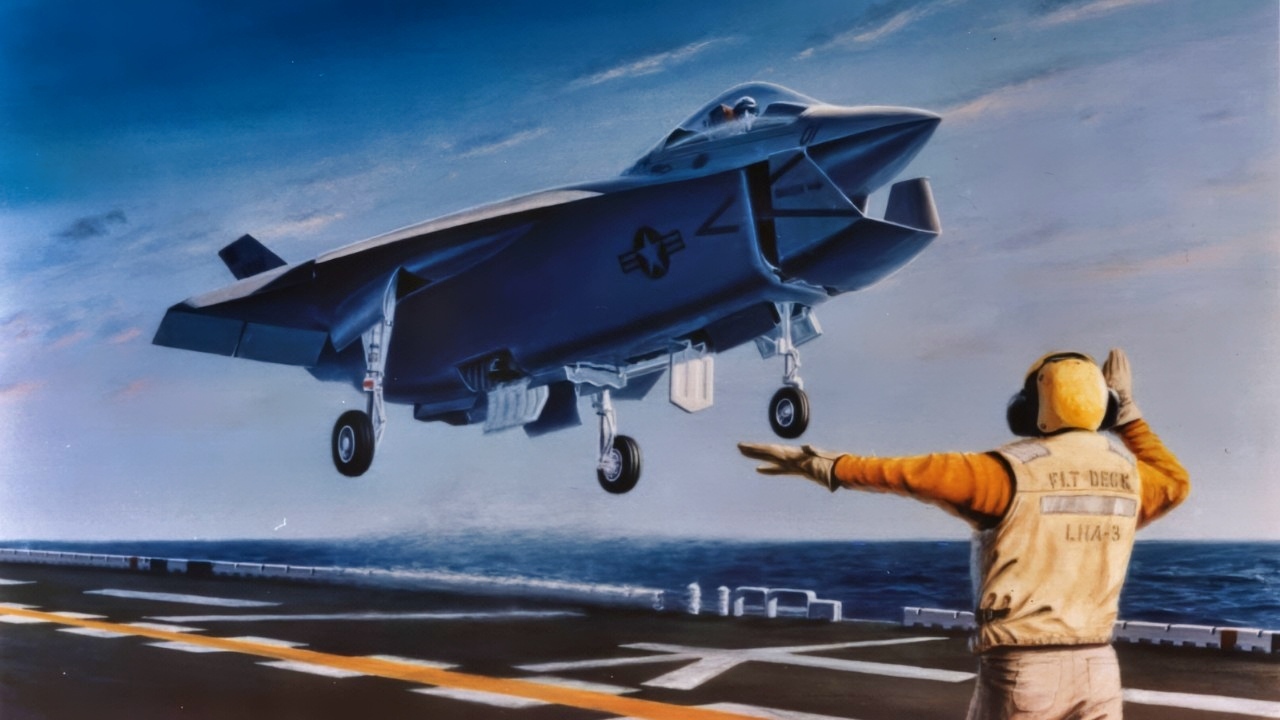
Key Points and Summary – Boeing’s X-32, the Joint Strike Fighter competitor to Lockheed Martin’s X-35, is often dismissed as a meme.
-Up close—and on the merits—it was a bold, sustainment-minded design: a roomy airframe, direct-lift STOVL, and a production-intent wing/tail the prototypes never got to fly.
-The program favored immediate demonstration over post-award growth risk; Lockheed’s combined STOVL profile and sleeker aero won the day.
-Yet a mature X-32 family could plausibly have delivered the same strategic ends: internal weapons, low-observable discipline, and a “missile-truck” ethos ideal for manned-unmanned teaming.
-The lesson isn’t about looks; it’s about how we judge prototypes vs. the airplanes they’d become.
Give the Boeing X-32 Stealth Fighter Its Due: The “Other JSF” Could Have Worked
I spent hours walking around Boeing’s X-32 at the National Museum of the U.S. Air Force, taking photos from every angle, letting the lines of the airplane soak in. (Most of the photos and video in this piece come from that visit.) Up close, the jet doesn’t read like the internet’s punchline. It reads like a bold engineering bet: a giant single-piece inlet that promised airflow with margin, a fat delta wing meant to trade raw elegance for lift and internal volume, and a fuselage that screams “maintenance access” and “growth space.”
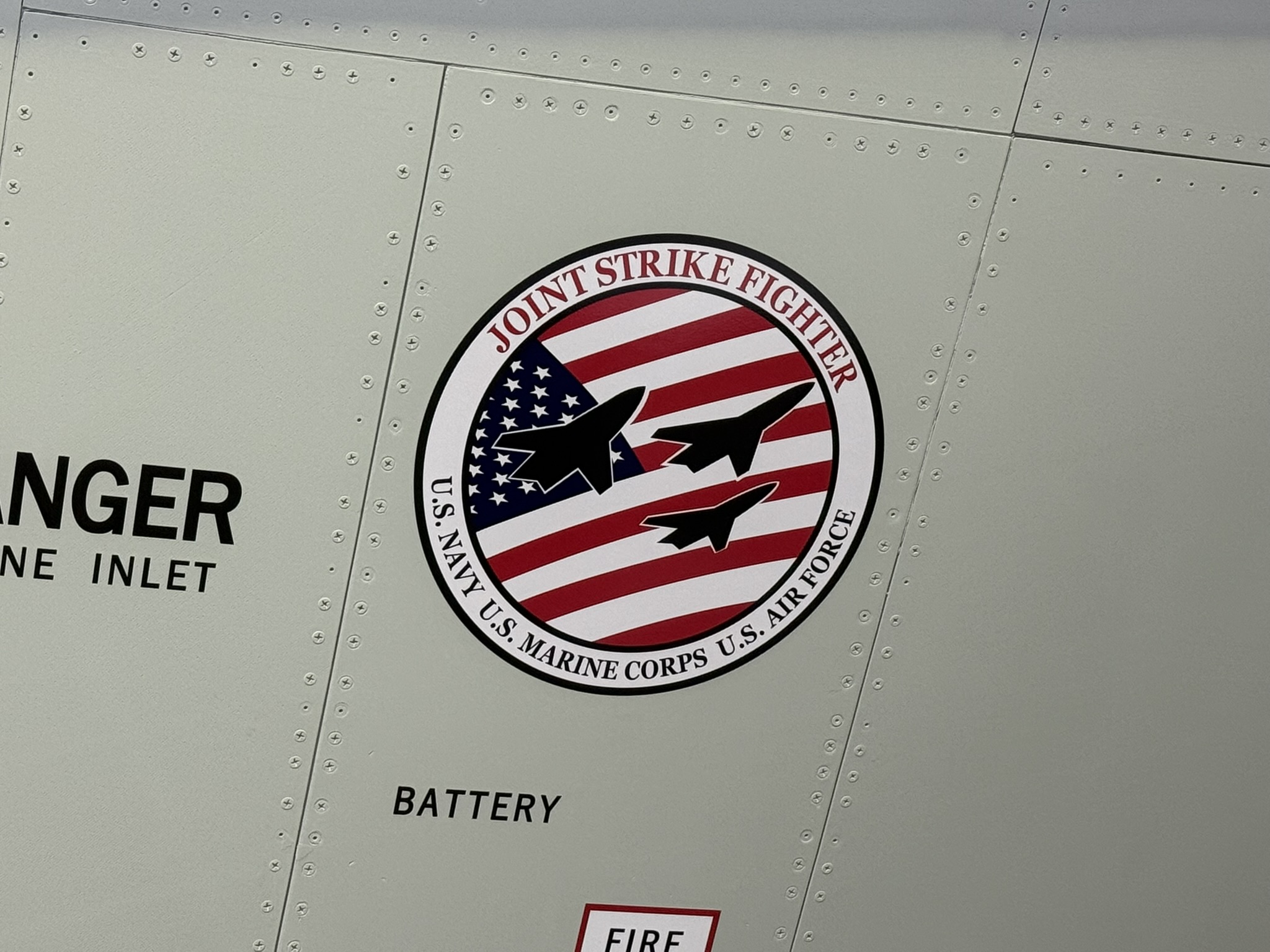
Boeing X-32 National Security Journal Photo. Taken on 7/19/2025.
The usual gag—“it lost because it was ugly”—melts away when you stand next to it. At least for me, and I am sure many will disagree. That’s fair.
But I won’t back down from this idea: The X-32 didn’t lose a beauty contest. It lost a knife fight inside a complex acquisition process, during a moment when “risk” and “demonstrated today” beat “promise and re-design tomorrow.”
That doesn’t mean the airplane couldn’t have grown into a very capable workhorse. It could have—and I’d argue it never got a truly fair shake.
What the Pentagon Actually Asked For
The Joint Strike Fighter competition was a moonshot for affordability and commonality. One family of aircraft had to cover three demanding roles: a conventional takeoff/landing fighter for the Air Force, a carrier variant for the Navy, and a short-takeoff/vertical-landing (STOVL) jet for the Marines and the UK. The winner had to be stealthy enough, carry a useful internal weapons load, plug seamlessly into the joint digital kill chain, and—crucially—be produced and sustained at a price the services could afford in big numbers.
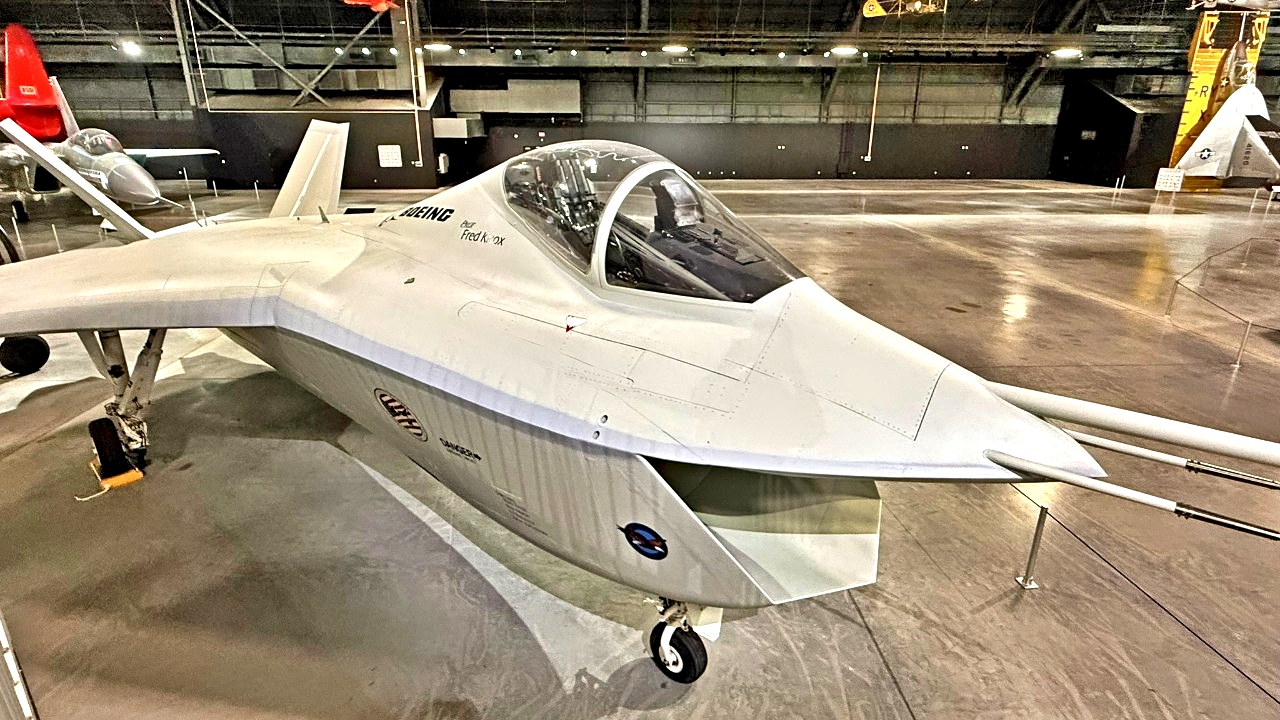
Boeing X-32 Fighter Original Image by National Security Journal. Taken on 7/20/2025.
Boeing and Lockheed Martin took different paths to the same hill. Lockheed wrapped its design around a shaft-driven lift fan for the STOVL variant and a more svelte platform for the other versions. Boeing bet on direct lift—vectoring the main engine’s thrust downward for hover and transition—paired with a big delta wing and a cavernous belly.
Both teams aimed at the same performance targets, the same weapons carriage, and the same “fusion jet” ambition. But the prototypes that flew in 2000–2001 were not the final production shapes; they were stepping stones meant to retire risk.
Meet the Boeing X-32…
If you only know the X-32 from photos of the demonstrators, you’re missing the second act Boeing briefed to the government.
The flying prototypes wore a blunt delta with no horizontal tail and that famous chin intake. The production-intent design, however, pivoted to a cranked-arrow wing with a conventional tail to improve low-speed handling and carrier approach qualities, refined inlets, and a reshaped fuselage to bake in stealth treatments and maintenance access learned during prototype build.
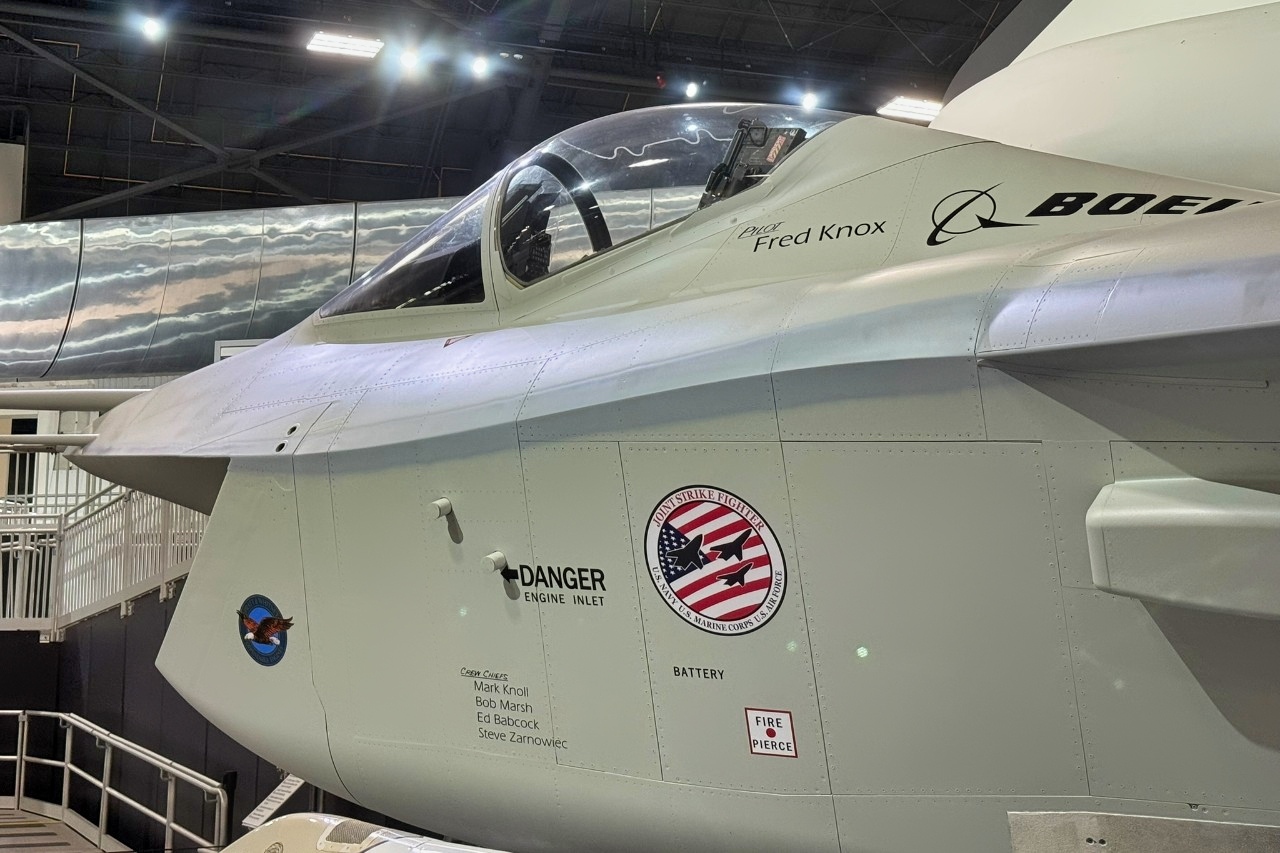
Boeing X-32 Fighter from USAF National Security Journal Original Photo. Taken July 20, 2025.
The plan was to retain what worked (the generous volume and the straightforward systems philosophy) and replace what flight test proved suboptimal.
Here’s the rub: the competition schedule didn’t allow Boeing to showcase that redesign in the air.
Evaluators had to judge what they could fly and measure right then. That left the X-32 carrying two handicaps—aerodynamic compromises the team intended to fix later, and perception risk that the airplane you’d actually buy hadn’t flown.
The STOVL Fork in the Road
At the heart of the competition sat a brutal but straightforward design choice: how to hover.
Lockheed’s lift-fan trades complexity and moving parts for cooler, more downwash-efficient vertical performance. Boeing’s direct-lift trades mechanical complexity for simplicity: one engine, vectored thrust, fewer bespoke components.
Each path brought risks. Lift-fan means gearboxes, clutching, shafts, and a big hole in the fuselage you carry in non-STOVL variants as structural and weight overhead. Direct-lift means hot-gas ingestion and thermal management in hover, tighter margin on hot/high days, and more burden on control laws and nozzle management.
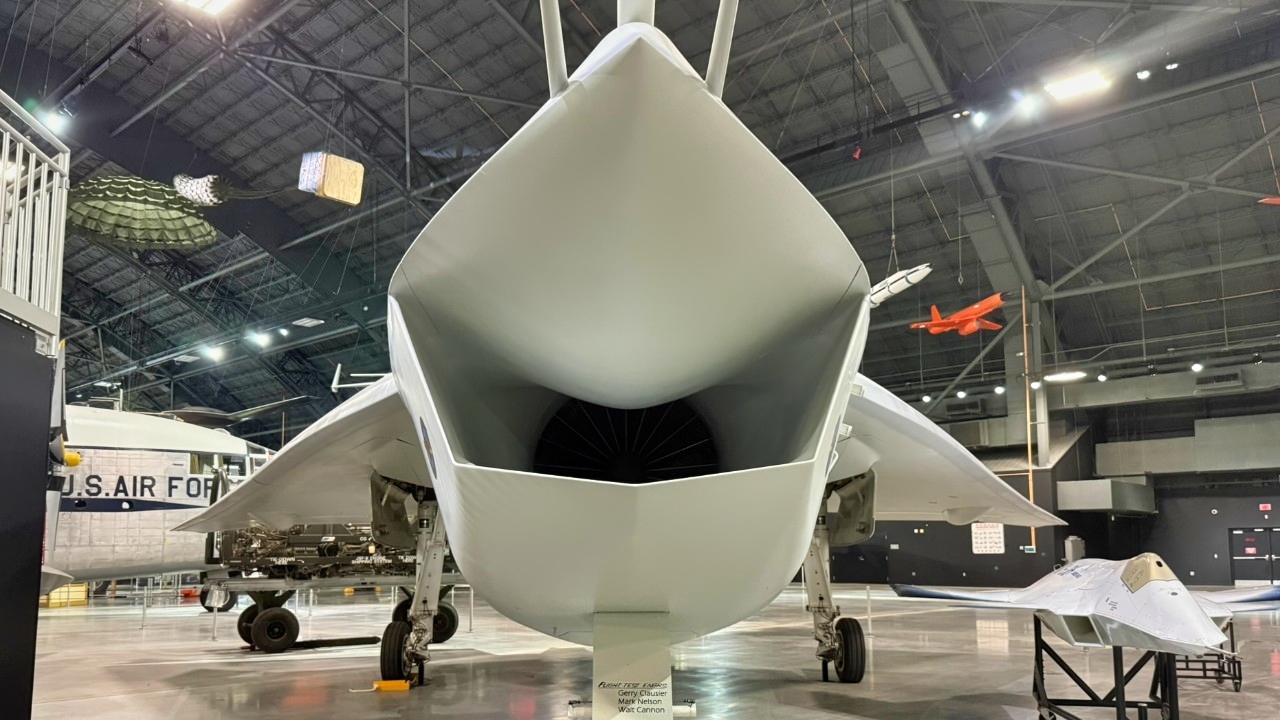
Head On Boeing X-32 Fighter. Image Credit: National Security Journal.
Boeing’s demonstrator hovered, transitioned, and landed. Lockheed executed the famous “short takeoff → supersonic dash → vertical landing” profile in one jet on one flight; Boeing split those proofs across two prototypes.
That became a narrative advantage for Lockheed. But let’s be honest about what the requirement really measured: repeatable margins and growth room in the STOVL envelope. Direct-lift demanded more avionics and thermal ingenuity over time.
Could Boeing have solved those with production hardware, control-law evolution, and materials? Reasonable engineers will disagree. I believe the answer is yes—especially given how much software and heat-management magic every fifth-gen jet now relies on.
The Boeing X-32: “It Lost Because It Was Ugly”
The X-32’s looks became a meme, but aesthetic taste doesn’t kill programs—risk does.
And the real risk ledger cut both ways.
Boeing’s blunt delta and giant inlet felt inelegant, but they bought airflow margin, internal volume, and access. The design telegraphed a maintainer-friendly ethos: big panels, fewer hard-to-reach compartments, simpler vertical-lift hardware in the STOVL case. Lockheed’s sleeker jet bought aerodynamic grace and low-observable shaping that tested beautifully in the window the government cared about most: now.
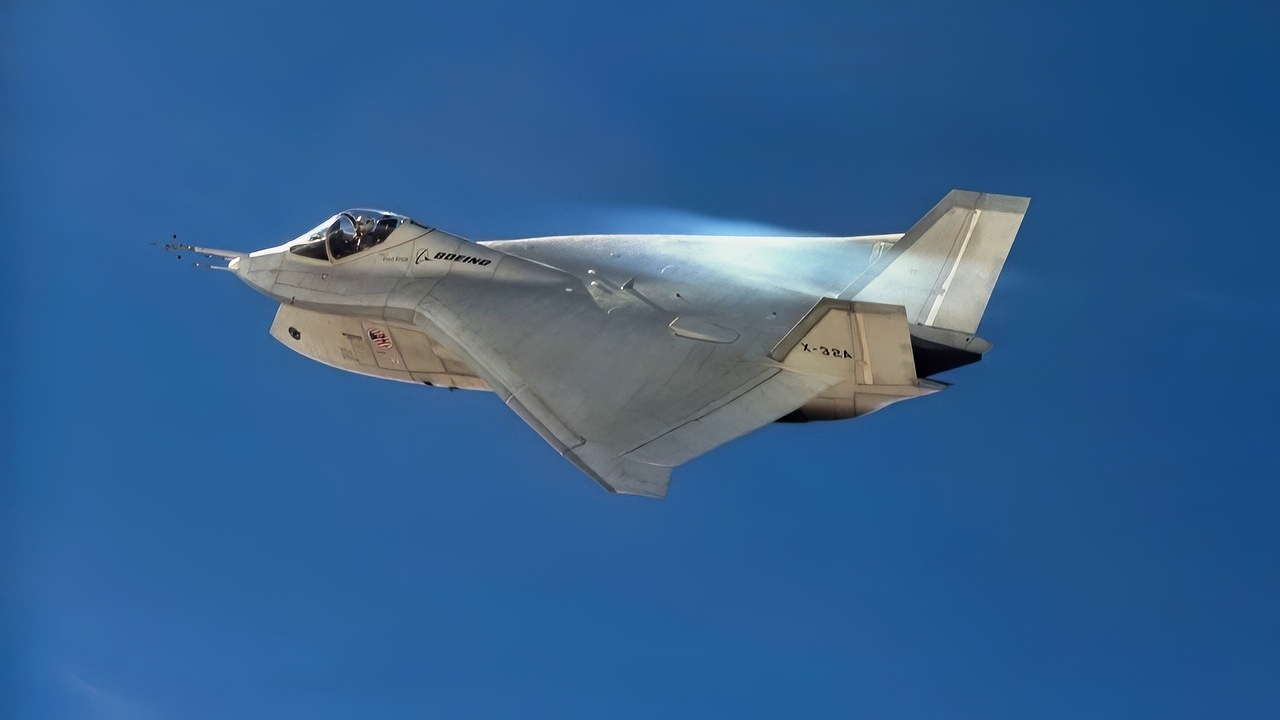
Boeing X-32 Flying High. Image Provided by U.S. Air Force Museum.
Had the tables turned—had Boeing flown the refined wing/tail production shape and logged the combined STOVL profile in one airframe—the “ugly” jokes would never have made it out of the hangar. The prototype’s appearance simply made it easy for critics to bundle “looks” with “risk,” when the substantive questions were about growth, sustainment, and how much re-engineering the services could stomach after contract award.
Stealth: Not a Yes…
Another misconception: that the X-32 was somehow a “non-stealth” path.
Both teams designed to a low-observable budget. The X-32’s chin intake fed an S-duct meant to hide compressor faces, and the production-intent planform carved away edges and seams that matter for signature.
Would its frontal aspect and broadband stealth have matched those of the eventual winning jet? Perhaps not in every regime, especially given the STOVL direct-lift compromises related to nozzle geometry.
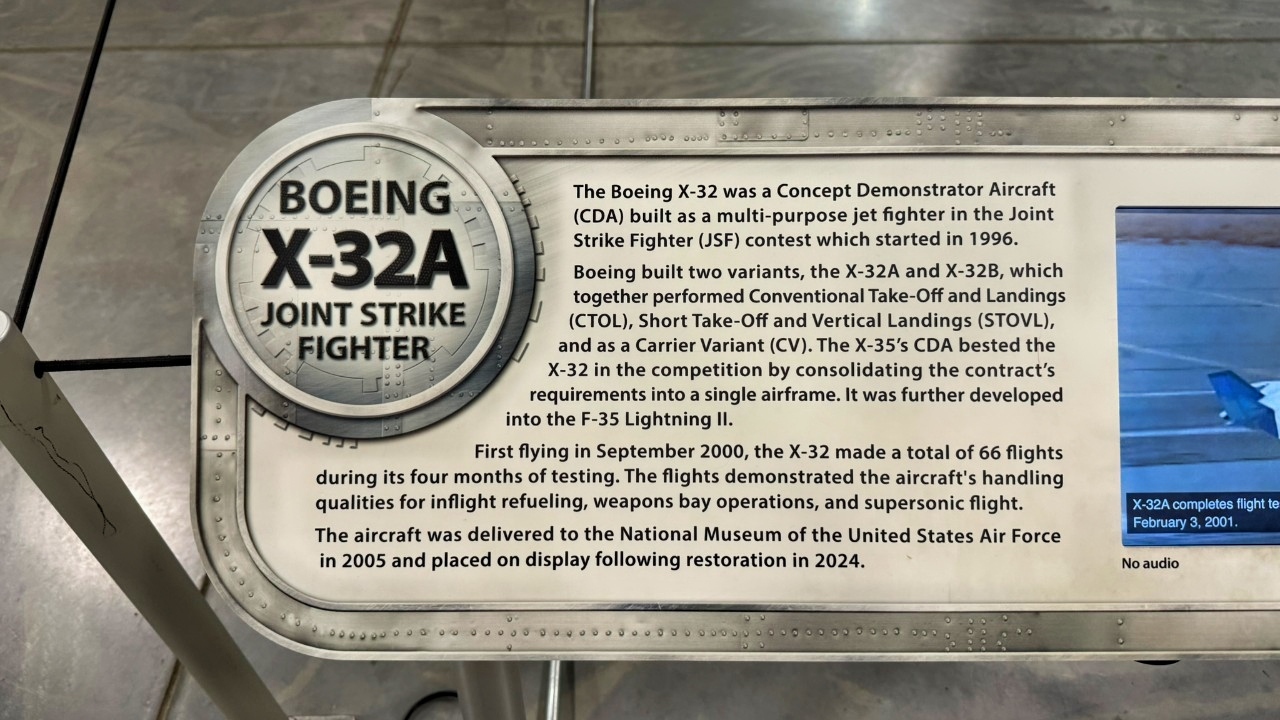
Boeing X-32 Fighter at USAF Museum July 2025. Image Credit: National Security Journal.
But “stealth enough” is a system question as much as a pure shaping question: coatings, edge treatments, inlet screens, radar blockers, IR management, and tactics make or break outcomes. Boeing’s concept aimed for signature discipline plus aggressive electronic warfare and deception—exactly the toolkit modern air arms use to keep 4.5-gen fighters lethal in 5th-gen fights.
The point isn’t to pretend the X-32 would be an F-22 in the RF spectrum. It’s to recognize that production X-32s would not have worn the demo jet’s blunt finish or antenna clutter. They would have arrived with the full stealth playbook the government paid both teams to develop.
Weapons, Bays, and the “Truck” Argument
The JSF baseline initially required internal carriage of a proper set, including air-to-air missiles and two 1,000-lb-class bombs, with growth to heavier or smarter stores and later external pylons for permissive missions.
Boeing’s deep belly and broad fuselage offered volume—room for bays, systems, and fuel. That is a feature, not a flaw, when you plan to spiral in new sensors and weapons for thirty years. The X-32 concept looked like a fighter, but it thought like a magazine: give me space, give me cooling and power, and I’ll carry what the joint force needs next decade, not just today.
We’ve learned since that the “missile caddy” role—lugging a lot of weapons while stealthier teammates do the early sensing—has real value. The X-32 was built in that spirit from day one.
The Carrier Piece on the X-32 Everyone Misses
Carrier aviation wasn’t an afterthought. Boeing’s proposed production wing and tail were optimized to tame the approach angle-of-attack, provide better low-speed authority, and meet the Navy’s demanding bring-back and fatigue life requirements.

Boeing X-32 Fighter at USAF Museum July 2025. Image Credit: National Security Journal.
The delta demonstrator wasn’t the boat jet; the redesigned airplane was. Could Boeing have shaken out the last carrier quirks on schedule? We’ll never know. But the structural volume in the X-32’s forward fuselage and wing center section promised what sailors care about more than sculpted beauty: access, inspectability, and repair room.
The Sustainment ‘What If’ Matters
Every modern fighter is a software machine wearing wings. The day-to-day bill is less about gas and more about parts churn, coatings, access, and how fast you can push updates. Here, the X-32’s philosophy—fewer bespoke STOVL parts, wide doors, generous avionics bays—might have paid dividends. A direct-lift STOVL path eliminates the lift-fan, clutch, and associated transmission complexity, along with the structural compromises that come with it. You pay elsewhere (for heat management and hover margins), but at least the hardware list is shorter.
Would the Boeing path have delivered meaningfully lower sustainment cost per flight hour? That’s a counterfactual. But I’ve stared into the X-32’s cavernous service panels, into the way the airplane invites human hands and test gear, and I don’t think it’s crazy to believe the logistics curve could have bent differently.
The Narrative That Stuck—and Why It Shouldn’t
When a program delivers a picture-perfect demo sequence and the competitor splits milestones across two airframes, the narrative writes itself. “Lockheed executed; Boeing promised.” Add in a mid-course aerodynamic redesign Boeing couldn’t fly before down-select, and the perception gap widened. None of that equates to incapable. It equates to less convincing in the time allotted.
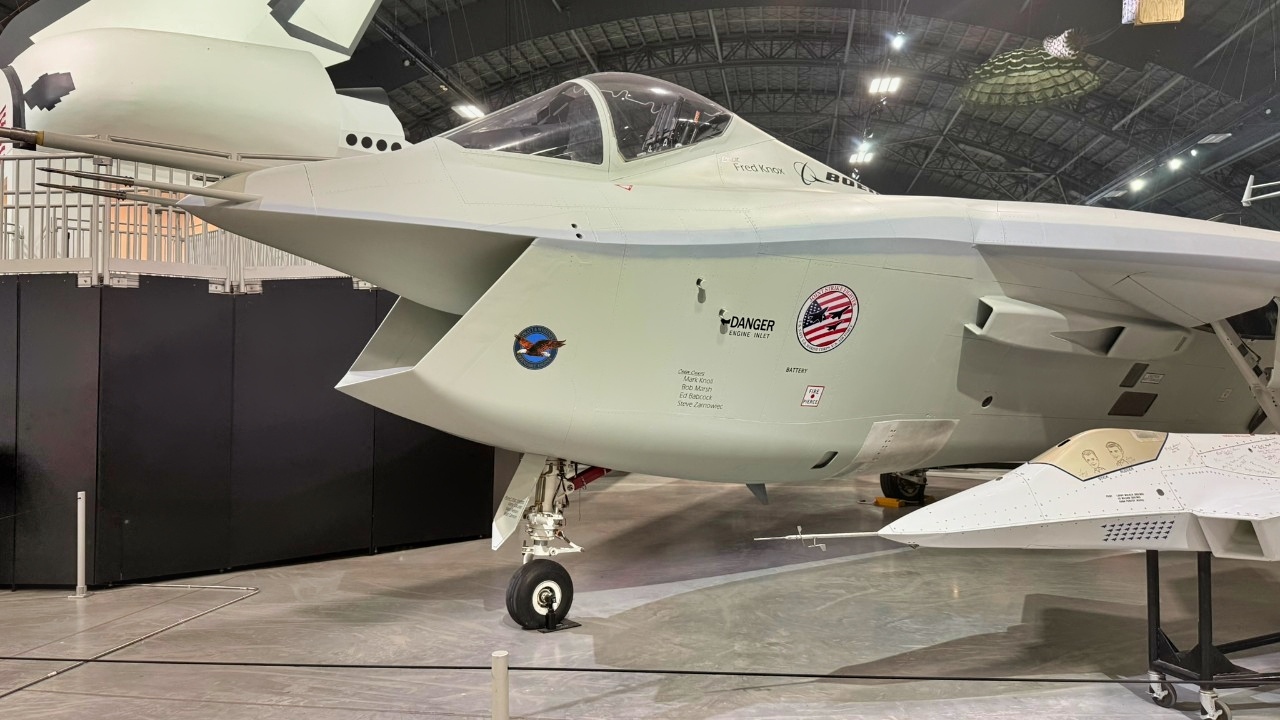
Side view of X-32 Boeing Stealth Fighter. Image Credit: National Security Journal.
The irony is that both teams were bidding to deliver airplanes that would change substantially as they moved through system development and demonstration. If the Department had prioritized post-award growth risk and sustainment pragmatism over prototype grace, the outcome might have flipped. And the fleet we live with today might look and cost different.
“Could it Have Replaced the F-35?” Isn’t the Right Question
The F-35 is here, it’s real, and in many missions it’s doing the job well. In fact, I consider it the best fighter on Earth today. Period.
The key question is whether a mature X-32 fleet could have achieved the same strategic objectives, even if the tactics differed.
I think so. Picture a joint force where the X-32’s STOVL variant trades some hover margin for simpler hardware and easier shipboard support, where the conventional and carrier variants carry more fuel and weapons internally thanks to that deep belly, and where software-first spiral upgrades keep the sensors and jammers current. The stealth delta might tilt in favor of the other team in some bands and geometries; the weapons and sortie quantity might tilt back. Campaigns are about balance sheets, not snapshots.
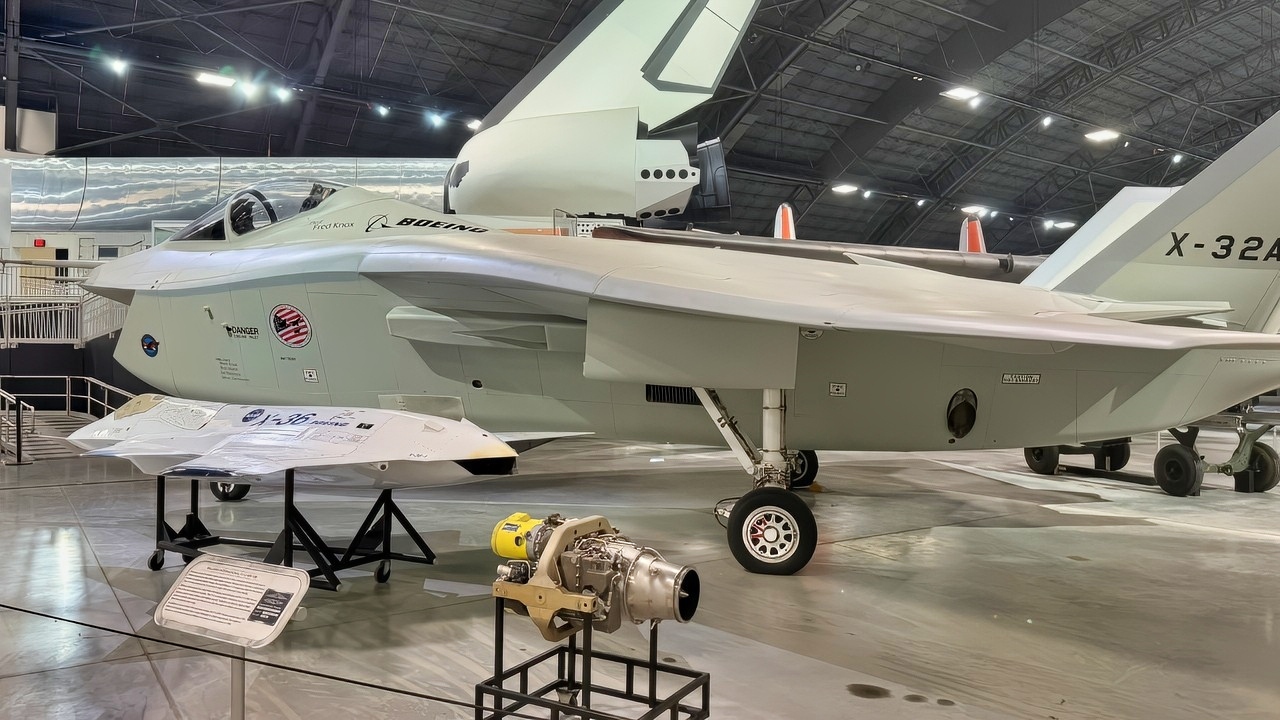
Boeing X-32 Full View. Image Credit: National Security Journal.
The “Ugly” Jet That Aged Well—at Least In Concept
Walk around the airframe again and imagine the production fairings, the re-contoured cockpit framing, the sawtooth edges along panel lines, the RAM coatings that arrived after the prototypes. Imagine the production inlet lips with tuned cowl edges, the revised wing and tail, the cleaned-up underside. Suddenly the “frog” becomes a purposeful tool—still not a beauty queen, but neither is a wrench. And in the business of nightly air plans, a reliable wrench you can fix anywhere is worth more than a sculpture.
What a Block 30-Something X-32 Might Have Looked Like
Fast-forward ten or fifteen years into service. You’d expect a radar well into its second or third AESA generation, a mature electro-optical targeting system, a wide-area aperture for missile warning, and a multi-ship fusion picture that lets one section of jets “ghost ride” their emissions while the other section paints the scene.
Weapons would evolve the same way they are now: long-range air-to-air, smarter anti-ship, more survivable standoff for land attack. The truck gets sharper teeth; the magazine gets deeper. Add manned-unmanned teaming, and the X-32 becomes a natural quarterback for loyal wingmen: send the drones forward, keep the humans at the edge of the storm, shoot when the picture is clean.
Could any of that have happened? Absolutely. The program’s success would have hinged on the same things that define the winner today: industrial cadence, software velocity, and ruthless sustainment discipline.
What Fairness Would Have Looked Like
A fair shake would have given Boeing time—and funding—to fly the production-intent aero and close the story loop on carrier approach handling. It would have down-weighted the theater of a single “all-in-one” STOVL demo and up-weighted the harder-to-fake questions: How many lines will your maintainers touch every turnaround? How many unique parts does the STOVL variant add? How fast can you clear a radar change across the fleet? It would also have asked the philosophical question that haunts every program now: Do you want more moving parts in hardware or more clever parts in software? Boeing picked the latter. We never got to see that choice mature.
Why This Matters Now
We’re entering an era where capacity—how many tails, how many sorties, how many shots—matters as much as exquisite capability. The X-32’s design DNA leans naturally toward capacity: volume, access, and a willingness to look a bit chunky if it means you can carry more and fix faster. As we stand up collaborative combat aircraft and try to buy back standoff magazines, I can’t help but think that an X-32-shaped fleet might have given planners a different, possibly cheaper, set of options.
None of this is an argument to unwind history. It’s a reminder to widen the aperture when we judge prototypes and, more importantly, to remember that prototype looks and production realities often part ways.
Boeing’s X-32 was a revolutionary design hiding in plain sight, and it deserved to be judged on the airplane it would have been—not the memes its prototypes inspired.
The Boeing X-32 Fighter Relook
The X-32 did the hard things it had to do in flight test, just not always in the most telegenic way. It carried a credible vision for a common family, a sustainment-friendly attitude, and a direct-lift philosophy that traded hardware for software—a swap the entire aerospace world has been making ever since.
It did not lose because it was ugly. It lost to timing, to perception of risk, and to a competitor that executed the set piece more cleanly during the narrow window that counted.
Could the X-32 have grown into a strong asset for the U.S. military—possibly even the fighter that replaced legacy fleets across the services?
Yes. In another roll of the dice, you could imagine a camouflaged X-32 taxiing at an overseas base today, its belly full of standoff weapons, its software updated last week, its crew chief smiling because the access panel actually opens without a prayer.
That’s not a fantasy. It’s one more plausible branch in the decision tree we took two decades ago—and a useful lesson for the next time we’re tempted to judge an airplane by a snapshot instead of its future.
And I think anyone who heads out to Dayton to see the plane themselves in the flesh might, just might, agree. And a neat bonus: the YF-23 Black Widow II sits 100 feet away. Now, that is some cool stuff for sure.

X-32 and YF-23 Together at the U.S. Air Force Museum. Image: National Security Journal.
About the Author: Harry J. Kazianis
Harry J. Kazianis (@Grecianformula) is Editor-In-Chief and President of National Security Journal. He was the former Senior Director of National Security Affairs at the Center for the National Interest (CFTNI), a foreign policy think tank founded by Richard Nixon based in Washington, DC. Harry has over a decade of experience in think tanks and national security publishing. His ideas have been published in the NY Times, The Washington Post, The Wall Street Journal, CNN, and many other outlets worldwide. He has held positions at CSIS, the Heritage Foundation, the University of Nottingham, and several other institutions related to national security research and studies. He is the former Executive Editor of the National Interest and the Diplomat. He holds a Master’s degree focusing on international affairs from Harvard University.
More Military
The F/A-18 Super Hornet Fighter Has Reached the End of the Line
The Ferrari F-35 Could Be a Sky Monster
F-22 Super: The ‘New’ Stealth Fighter Is Coming


John
September 9, 2025 at 5:10 pm
Boeing essentially brought an airframe to the competition, then upon realizing it didn’t work as intended, told DOD that the aircraft they brought wasn’t the REAL aircraft they’d build. The “real” aircraft had a substantially different design, a different wing and tail assembly, different weight and balance, engine, intake and cooling system, this rendering all the test data the flyoff was acquiring irrelevant. These attempts at revising what happened and how Boeing’s mismanagement made it impossible to win in order to pretend it was betterabsolute joke. superior path than what the X-35 offered is an absolute joke. This article is borderline clickbait.