

Summary and Key Points: National security expert Steve Balestrieri evaluates the M2/M3 Bradley Fighting Vehicle (BFV), documenting its trajectory from the 1960s MICV program to its 2026 deployment in Ukraine.
-Equipped with a 25mm Bushmaster chain gun and BGM-71 TOW missiles, the Bradley famously neutralized more Iraqi T-72 armor during Operation Desert Storm than the M1 Abrams.

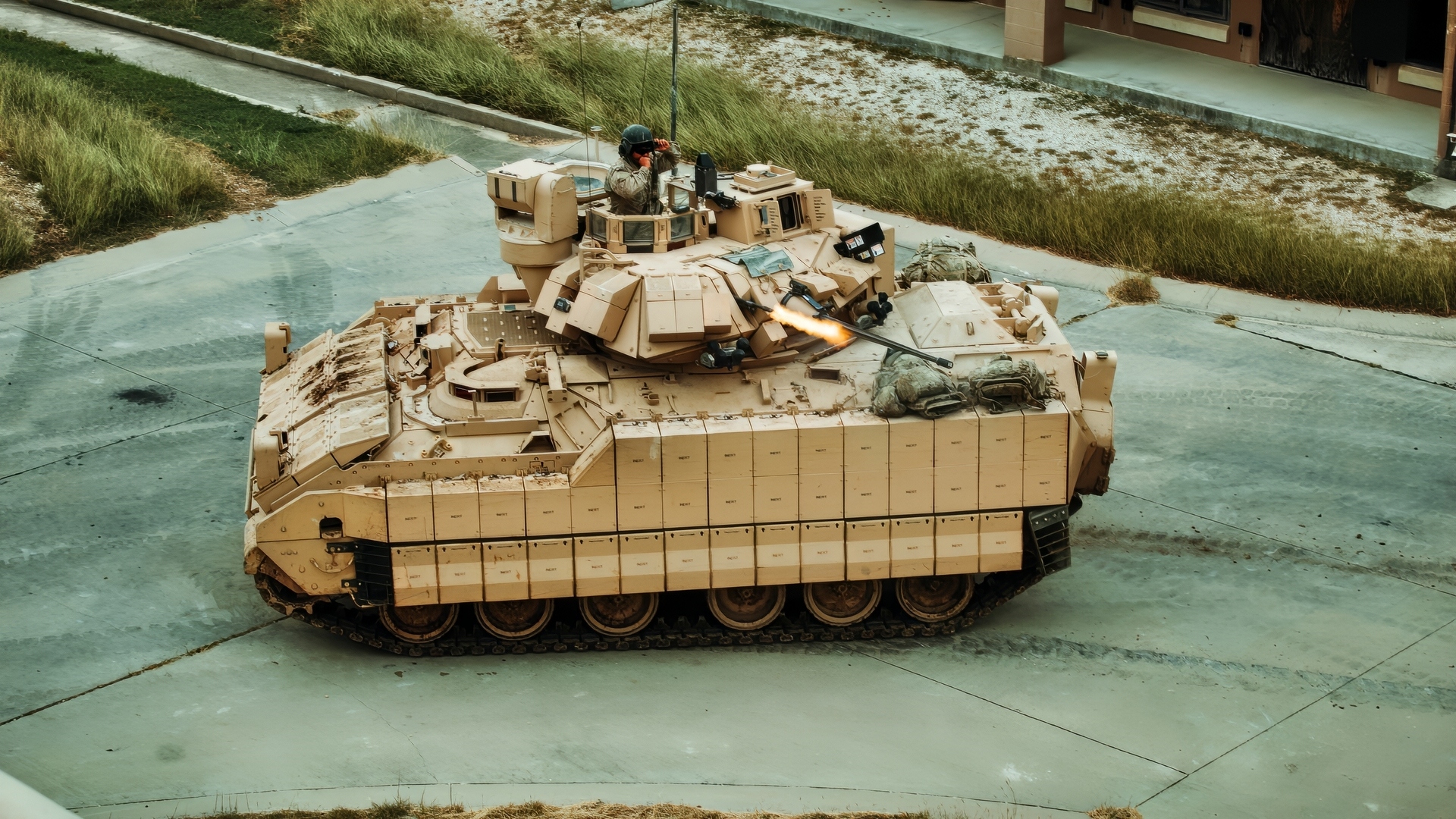
Troopers with 3rd Armored Brigade Combat Team, 1st Cavalry Division firing the 25mm canon on a Bradley fighting vehicle in order to zero the vehicles weapons systems at a range in Poland. Ranges such as these familiarize troopers with the vehicles systems in order to ensure combat readiness.

FORT MOORE , Ga. Maneuver Center of Excellence hosts the 2024 Armor Week media day on Harmony Church Mar. 14, 2024. The event featured live-fire demonstrations with the M1 Abrams Main Battle Tank, and an opportunity to get up close and hands-on with M1 Abrams and M2 Bradley Fighting Vehicle. Armor Week, April 29 to May 3, and the 2024 Sullivan Cup competition requires mastery of individual tasks, technical and tactical competence, and the ability to demonstrate an array of maneuver, sustainment, and gunnery skills. The competition focuses primarily on the performance of the Soldiers functioning as a crew. (U.S. Army photo by Patrick A. Albright)
-Balestrieri explores technical iterations from the aluminum-hulled originals to the M2A4E1 featuring the Iron Fist Active Protection System (APS).
-As the Army integrates the XM30, the Bradley remains indispensable for combined arms maneuver and troop survivability against asymmetric and drone-based threats.
From MICV to M2A4E1: The 45-Year Evolution of the U.S. Army’s Premier Infantry Fighting Vehicle
The Bradley Fighting Vehicle, introduced in 1981, is a key U.S. armored platform with a strong combat record in the Gulf War, Iraq War, and the ongoing Russo-Ukrainian War.
It is highly regarded for its 25mm chain gun and TOW missile firepower, and was responsible for destroying more enemy armor than M1 Abrams tanks during Desert Storm.
The Bradley Infantry Fighting Vehicle (IFV) has had a long, distinguished career. It has a tremendous track record as the world’s premier IFV.
On the battlefields in Ukraine, Ukrainian infantry soldiers love the Bradley for its firepower, survivability, and cross-country movement. Like the M1 Abrams series of tanks, the venerable M2 Bradley has endured 40+ years of service thanks to upgrades that have improved the vehicle.
The Bradley IFV Has Had A Long Career:
The M2/M3 Bradley Fighting Vehicle (BFV) is an American tracked armored fighting vehicle developed by FMC Corporation and now manufactured by BAE Systems Land & Armaments. It is named for U.S. General of the Army Omar Bradley of World War II fame.
The M2 Bradley has seen combat in conflicts such as the Gulf War, the Iraq War, and the Russo-Ukrainian War. During the Gulf War, it proved effective against Iraqi armor but suffered significant friendly-fire losses, leading to post-war survivability upgrades.
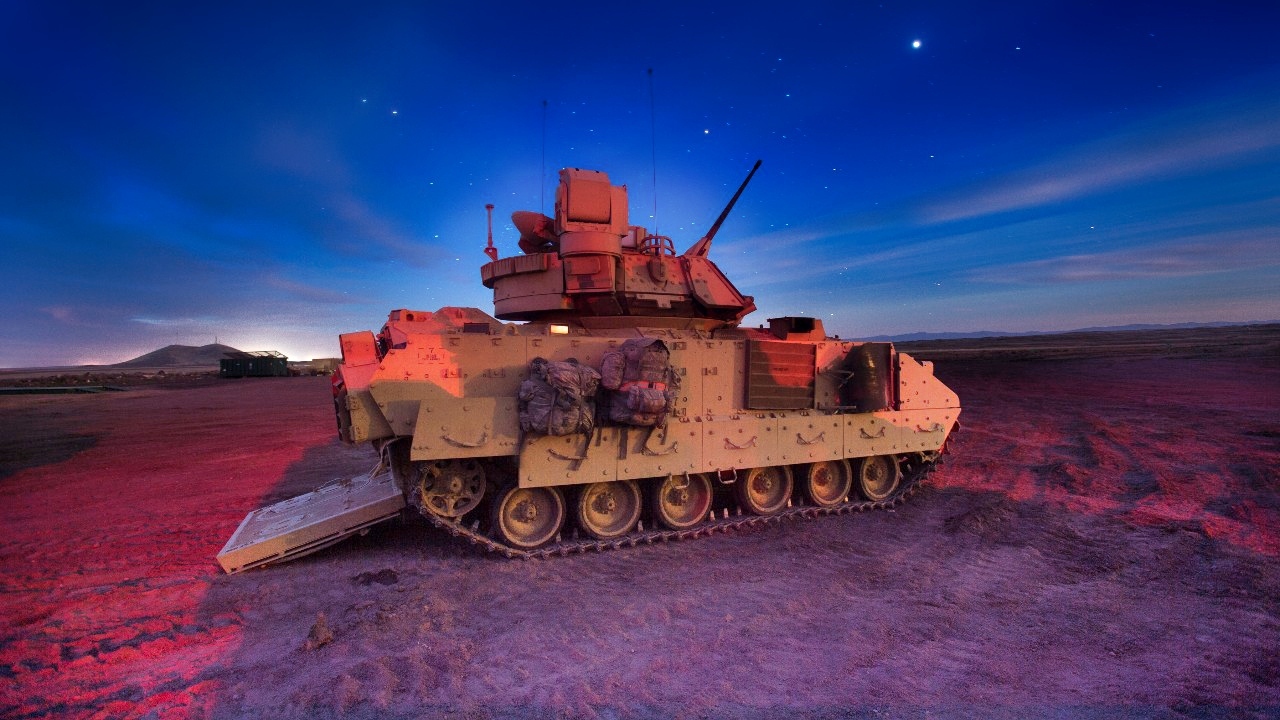
Engineers with the 116th Brigade Engineer Battalion conduct M2A3 Bradley fighting vehicle gunnery qualification on March 27, 2018, Orchard Combat Training Center, south of Boise, Idaho. Combat engineers with the 116th BEB trained through gunnery table XII, evaluating their ability to execute collective platoon-level tasks in a tactical live-fire environment; including integrating dismounted soldiers with their assigned BFV. (U.S. Army National Guard photo by 1LT Robert Barney)
Later, during the Iraq War, the Bradley was more vulnerable to asymmetric threats like improvised explosive devices (IEDs) and rocket-propelled grenades (RPGs) in an urban environment.
The M2/M3 Bradley Design:
The Bradley is designed to transport infantry or cavalry scouts with armor protection, while providing covering fire to suppress enemy troops and armored vehicles.
Variants include the M2 Bradley infantry fighting vehicle and the M3 Bradley reconnaissance vehicle. The M2 holds a crew of three—a commander, a gunner, and a driver—along with six fully equipped soldiers.
The M3 mainly conducts scout missions and carries two scout troopers in addition to the regular crew of three, with space for additional BGM-71 TOW missiles.
The Bradley has served in several wars during the past 35 years and is still the Army’s primary infantry fighting vehicle.
Currently, the Army has about 4,500 M2 and M3 Bradleys spread among its units, including those in the Army National Guard, as well as another approximately 2,000 in storage, according to The International Institute for Strategic Studies’ The Military Balance.
M-2 Bradley Design History:
It would be surprising to most people to learn that the design and development of the M2 Bradley Fighting Vehicle began in the early 1960s, right about the time that the M-113 was incorporated into the US Army.

Aerial drone image of Bradley Fighting Vehicle crews from the 1st Armor Brigade Combat Team, 3rd Infantry Division, conducting Table XII gunnery at Fort Stewart, Ga. December 7, 2016.

Aerial drone image of Bradley Fighting Vehicle crews from the 1st Armor Brigade Combat Team, 3rd Infantry Division, conducting Table XII gunnery at Fort Stewart, Ga. December 7, 2016.

Troopers with 3rd Armored Brigade Combat Team, 1st Cavalry Division firing the 25mm canon on a Bradley fighting vehicle in order to zero the vehicles weapons systems at a range in Poland. Ranges such as these familiarize troopers with the vehicles systems in order to ensure combat readiness.
In 1964, the Army recognized that in a future war in Europe would require an infantry fighting vehicle that would have a turret with a 20mm cannon, a 7.62mm machine gun, five sealed firing ports for infantry troops inside, and a sealed hull for protection against NBC elements (nuclear, biological, chemical), and have enough speed to keep up with the new M-1 tank that was in development.
In 1967, the Soviets released the BMP-1, which in Russian is Boyevaya Mashina Pyekhoty (infantry fighting vehicle), which was sealed against NBC contaminants, had a 73mm gun, firing ports, and was fast enough to keep up with the Soviet armor. This compelled the Army to once again look at the MICV (mechanized infantry combat vehicle.
Different prototypes were tested and rejected, one of them being the excellent German Marder IFV.
In October 1976, the Army would combine the roles of scout and IFV, as the previous Armored Reconnaissance Scout Vehicle had been canceled. The Army agreed to make the armor protection comparable to the earlier prototype, XM723. The TBAT-II turret with its 25 mm Bushmaster cannon and a TOW missile launcher in the two-man turret would be used for both vehicles.
The following year, the IFV was renamed the XM2, and the cavalry scout was named the XM3.
The XM2/3 passed the Army Systems Acquisition Review Council Milestone III review in 1979. In December 1979, the XM2 and XM3 were type classified as the M2 and M3, respectively. Final approval for production came from the Secretary of Defense in February 1980.
In October 1981, the vehicle was named the “Bradley” for World War II Army General Omar Bradley, who had died earlier that year.
Combat History Of The M2/M3 Bradley:
Despite its initial unpopularity among the troops when it was first introduced, with many infantry troops derisively calling it a “recycled Budweiser can,” due to its aluminum construction, the Bradley silenced its critics with a stellar record in its first wartime action. It proved that it could protect its troops and deliver them safely to the battlefield while delivering devastating firepower against the enemy.
During Desert Storm in 1991, over 2,200 Bradleys were deployed into combat, and only three were lost to enemy fire. The M2 Bradley fighting vehicle played a crucial role in Operation Desert Storm, demonstrating its battlefield effectiveness through a combination of speed, firepower, and armor.
It was vital in the ground assault, playing a key part in clearing paths and destroying more Iraqi armored vehicles, including T-72 tanks than the M1 Abrams tanks.
Although some Bradleys were lost (mostly to friendly fire), casualties remained relatively light, solidifying its legacy as a successful combat vehicle.
However, changes were adopted after Desert Storm to improve the Bradleys. A GPS capability was added, along with anti-tank missile countermeasures, improved ammunition storage, and redesigned seating.
Enhancements made during the M2A3/M3A3 production models included a flat-panel display unit for the commander, squad display units for the troops in the vehicle’s rear, a driver display unit, and a mass memory unit.
During the second Gulf War, the Bradley enjoyed early success alongside the M1A2 Abrams in a combined-arms invasion.
But after the conflict turned into an asymmetrical insurgency, many Bradleys (about 150) were lost in street fighting with close contact firefights with insurgents using RPGs, IEDs, and small anti-tank weapons.
The Bradley has been used in Ukraine to great effect against the Russian invasion. It won’t be a surprise to see the US send them even more Bradleys in the future, as they have expressed their confidence in it.
The Bradley, when used correctly in a Combined Arms approach, is still a very effective vehicle. Despite the massive drone usage in Ukraine, it has shown this to be true. Ukrainian troops have praised the Bradley for superior troop protection, firepower, and maneuverability compared to older Soviet-era equipment.
The newest variants will keep the M2/M3 in the Army’s inventory until the new XM-30 is available and beyond. The Army plans to operate both vehicles side by side for at least a decade.
The M2A4E1’s improved engine, Iron Fist APS, and new electronics allow existing infantry brigades to stay combat-ready as the XM30 is ready for operational use and is produced in enough numbers.
The Bradley isn’t going anywhere anytime soon. The ubiquitous armored IFV could very well outlive yet another attempt to replace it, much like other Army weapons, such as the M2 .50-caliber machine gun.
About the Author: Steve Balestrieri
Steve Balestrieri is a National Security Columnist. He served as a US Army Special Forces NCO and Warrant Officer. In addition to writing on defense, he covers the NFL for PatsFans.com and is a member of the Pro Football Writers of America (PFWA). His work was regularly featured in many military publications.


