

Britain’s Challenger 2 main battle tank has been fighting in Ukraine for more than three years now — and those years have put the British-designed military vehicle to its toughest test yet.
Its use has also offered some important lessons for every party involved about how even heavily armored Western tanks are vulnerable on the battlefield, and how they can be used in an age of drone warfare.

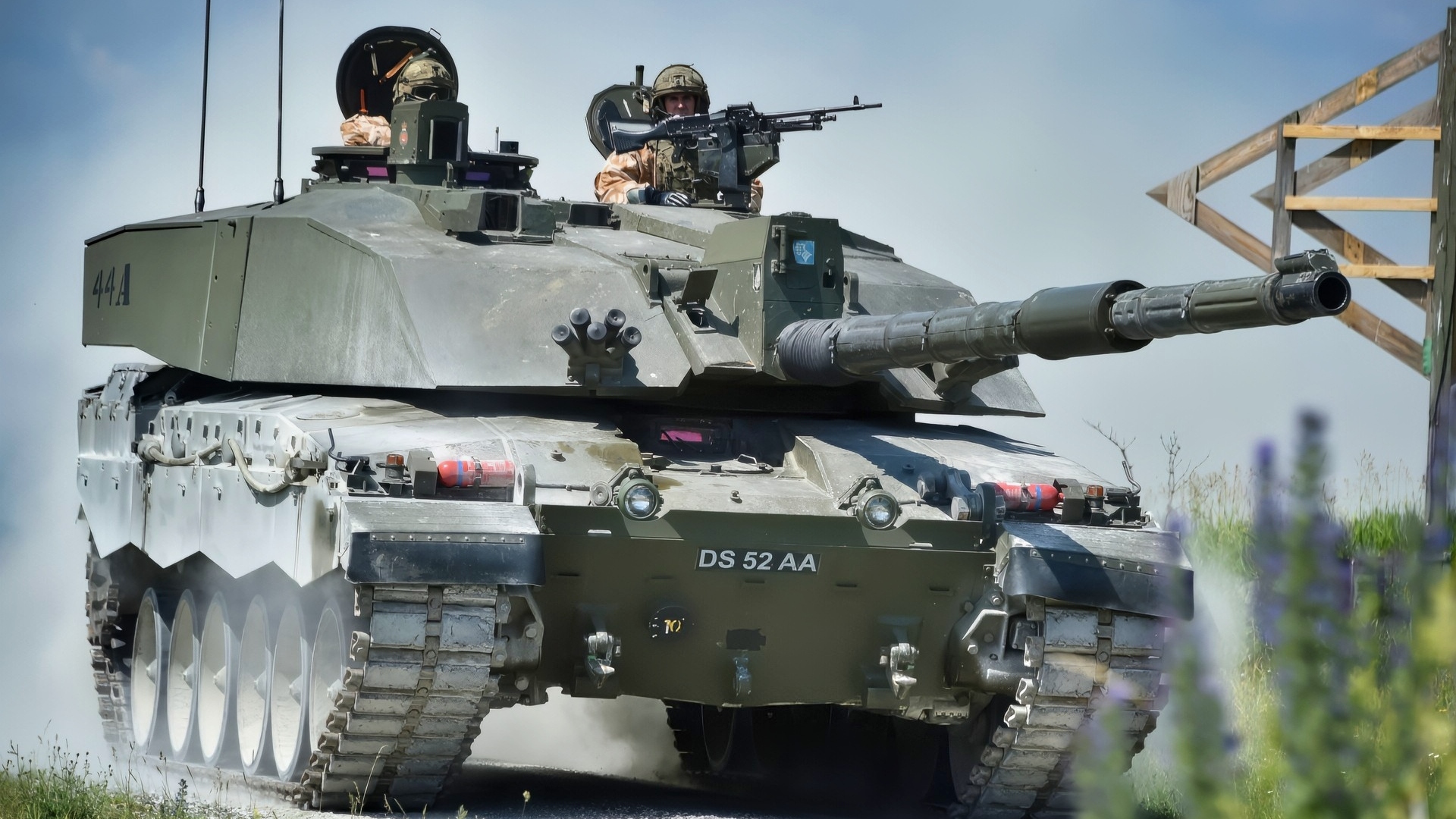
Challenger 2 Tank. Image Credit: Creative Commons.
The United Kingdom delivered only 14 Challenger 2s to Ukraine, making them one of the less common Western tanks in Ukrainian service – but the vehicles have seen combat in two of the most significant Ukrainian operations of the war.
They were used in the 2023 counteroffensive in southern Ukraine, and the subsequent Ukrainian offensive into Russia’s Kursk region.
And while Ukraine has lost some of them, Ukrainian crews have also praised the platform for its accuracy and ability to engage Russian forces from long range.
Meet the Challenger 2
The Challenger 2 is Britain’s current main battle tank, a significant upgrade over the Soviet tanks Ukrainian forces used in the early days of the campaign.
Developed by Vickers Defence Systems, the tank was introduced into British Army service in the 1990s. It weighs more than 60 tons and is designed to accommodate a crew of four people.
It was designed primarily to destroy enemy armor while providing its crew with substantial protection.

Challenger 2 Tank. Image Credit: Creative Commons.

Challenger 2 Tank. Image Credit: Creative Commons.
Its most distinctive feature is its 120mm L30A1 rifled main gun. Unlike the 120mm smoothbore guns used on American M1 Abrams and German Leopard 2 tanks, the Challenger’s rifled weapon uses unique ammunition and is particularly well suited to accurate long-range fire.
The tank saw action before Ukraine, too.
Challenger 2s have been deployed to Bosnia, Kosovo, and Iraq.
The British Army also claims none were lost to enemy action before their deployment to Ukraine. A record that was ended during heavy exchanges with Russians in recent years.
How the Challenger 2 Reached Ukraine
On January 14, 2023, Britain announced that it would provide Ukraine with a squadron of 14 Challenger 2s, as well as ammunition and armored recovery vehicles.
It was a major decision that set the tone for the rest of the war, with European countries giving advanced equipment to help Ukraine defend against the Russian invasion.
The decision mattered beyond the relatively small number of tanks involved: London was among the first Western governments to make that kind of commitment, helping pave the way for other deliveries from allies, including Leopard 2s and M1 Abrams tanks.
Crews of Ukrainian military personnel then traveled to Britain for weeks of training, where they learned to drive, maintain, and fight with the vehicles before returning home in March 2023.
The Challengers were assigned to Ukraine’s elite 82nd Air Assault Brigade and were first deployed in combat during the 2023 counteroffensive in the Zaporizhzhia region.
British soldiers with the Queen’s Royal Hussars move a Challenger II main battle tank down range during the Strong Europe Tank Challenge at the 7th Army Training Command’s Grafenwoehr Training Area, June 4, 2018. The U.S. Army Europe and the German Army co-host the third Strong Europe Tank Challenge, which is an annual training event designed to give participating nations a dynamic, productive and fun environment in which to foster military partnerships, form Soldier-level relationships, and share tactics, techniques and procedures. (U.S. Army photo by Gertrud Zach)
One tank was destroyed that September, making it the first Challenger 2 ever lost to enemy action. No plans were announced at the time to replace it.
Challenger 2 Goes to Russia
The tank was then put to the test again when Ukraine launched its surprise offensive into the Kursk region of Russia in August 2024.
The tank operated with the 82nd Brigade throughout the campaign, and while the operation was not an overall failure, a Challenger was lost during fighting.
A crewman, interviewed by Forces News, described how the vehicle was destroyed by a Russian loitering munition during the early days of the operation.
But Ukraine’s accounts of the operation showed just what the tank could do.
In a 2023 interview, a Challenger commander described the tank as a kind of battlefield “sniper,” allowing crews to engage Russian positions accurately from long distances and withdraw without approaching closely.
One Ukrainian soldier also said that his crew achieved a maximum rate of eight rounds per minute during combat, and crews also praised the tank for its mobility and ability to operate quietly from battery power.
A New Role Today
The battlefield has changed significantly since the early days of the war. Today, Ukraine is using its remaining Challenger 2s far more cautiously.
Rather than routinely sending the tanks forward to lead armored assaults, crews are using them as long-range direct-fire weapons, exploiting the accuracy of the Challenger 2’s 120mm L30A1 gun from concealed positions. The tank may be more vulnerable to drones, but it remains a perfectly good offensive weapon when used differently.
Ukrainian crews today describe how the tank operates several kilometers away from its targets, firing against Russian positions before being moved to avoid counterfire — a tactic known as “shoot and scoot.”
The change comes as Russia increasingly depends on first-person view (FPV) drones and loitering munitions.
With only 14 Challenger 2s originally delivered, and several confirmed lost, Ukraine cannot easily replace the tanks.
Crews, therefore, are focusing on concealing them and firing from a distance rather than betting the tank’s heavy armor will protect it against drones.
It’s still a frontline weapon, but it’s being used very differently today than it was just a handful of years ago.
About the Author: Jack Buckby
Jack Buckby is a British researcher and analyst specializing in defense and national security, based in New York. His work focuses on military capability, procurement, and strategic competition, and he produces and edits analysis for policy and defense audiences. He brings extensive editorial experience, with a career output spanning over 1,000 articles at National Security Journal, and has previously authored books and papers on extremism and deradicalization.


