


Key Points and Summary – The fate of Canada’s planned purchase of 88 F-35 fighter jets remains uncertain as Prime Minister Mark Carney’s government continues its review of the deal, originally agreed upon in 2022. Despite expectations for a decision by summer’s end, no announcement has been made.
-While the Department of National Defense is proceeding with preparations (“full steam ahead”), citing the F-35’s necessity against adversaries, significant political pressure exists to alter the plan.

An F-35 Lightning II connects to a KC-10 Extender fuel injection arm to refuel during an aerial training mission, during Operation Astral Knight 19 over the Adriatic Sea, June 3, 2019. Astral Knight is a joint, multinational exercise taking place throughout various locations in Europe, with more than 900 Airmen participating in the exercise. (U.S. Air Force photo by Staff Sgt. Joshua R. M. Dewberry)

A Swedish Air Force JAS 39 Gripen participating in NATO exercise Ramstein Flag 24 flies over the west coast of Greece, Oct. 4, 2024. Over 130 fighter and enabler aircraft from Greece, Canada, France, Hungary, Italy, Poland, Portugal, Romania, Spain, Sweden, United Kingdom and United States are training side by side to improve tactics and foster more robust integration, demonstrating NATO’s resolve, commitment and ability to deter potential adversaries and defend the Alliance. (U.S. Air Force photo by Tech. Sgt. Emili Koonce)
-Industry Minister Mélanie Joly is demanding greater industrial benefits from Lockheed Martin, threatening to scale down the order and potentially create a mixed fleet supplemented by Saab Gripens assembled in Canada.
-This reflects a broader strategy under Carney to assert Canadian economic independence, particularly amidst strained relations with the U.S. under President Trump. The final decision rests with the Prime Minister.
Canada F-35 Drama Not Over Yet
Is Canada planning to proceed with its purchase of 88 F-35 fighter jets, which was agreed upon by the former government of Prime Minister Justin Trudeau back in 2022? =
A little over a dozen F-35 fighters have been purchased and will head to Canada. But what about the rest?
The decision had been weighed as far back as 2010, when then-Prime Minister Stephen Harper announced plans to purchase 65 F-35As. This controversy persisted for much of the ensuing decade, as Trudeau, when running in 2015, had pledged not to purchase the jets.
In 2017, Canada launched the Future Fighter Capability Project (FFCP), a competition to choose a successor to Canada’s CF-18s. That process ended with the F-35 winning, beating out Saab’s JAS 39 Gripen E/F, after several other contenders dropped out.
Researcher Stephen Staples of the Canadian Centre for Policy Alternatives, had opposed the purchase at the time, and after Trudeau went ahead with the purchase in 2022, Staples accused him of “flip-flopping,” writing in early 2023 that the agreement was “less an announcement than a ‘cry uncle’—an admission of defeat by the Liberals in the face of the powerful American defence lobby in this country.”
Carney’s F-35 Switch
Earlier this year, after he came to power, new Prime Minister Mark Carney ordered a review of the 2023 fighter jet purchase, at a time of rising tensions, new tariffs, and President Donald Trump threatening to make Canada America’s 51st State.
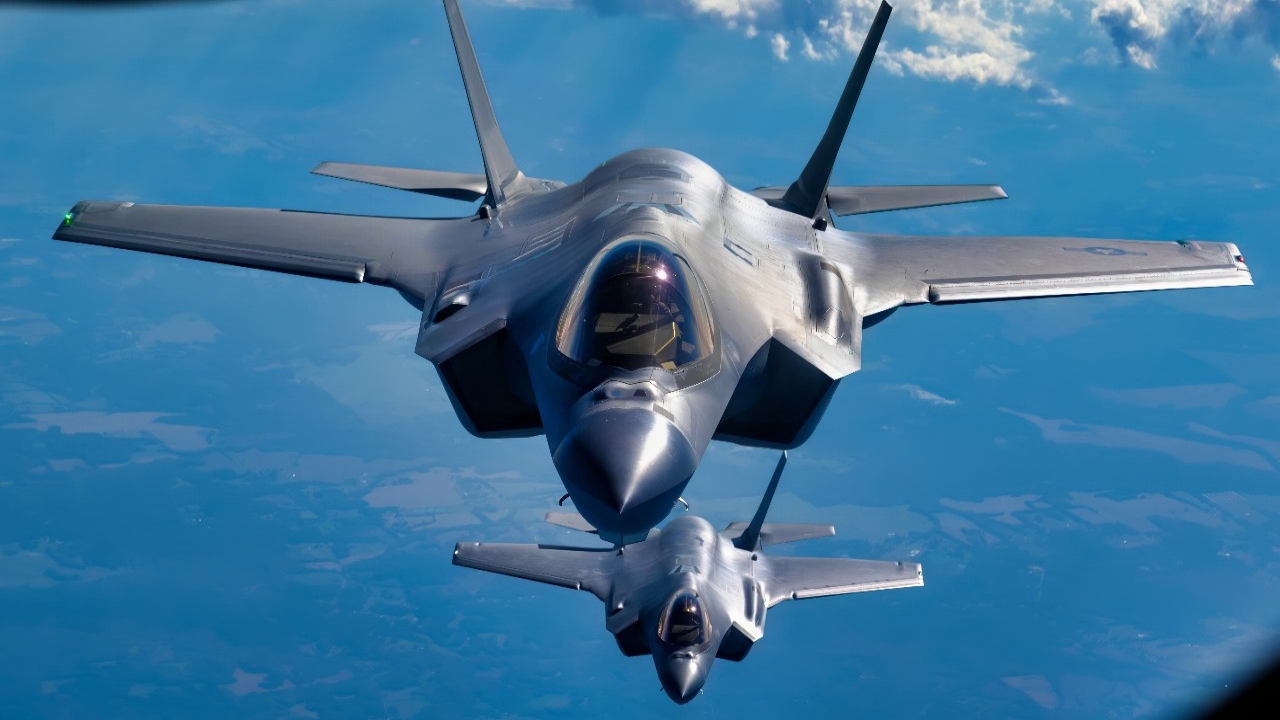
Two U.S. Air Force F-35A Lightning II aircraft, with the F-35 Demonstration Team, approach a U.S. Air Force KC-135 for in-flight refueling en route to their next airshow at Pensacola, Florida, on 28 October, 2024. The F-35 Demo Team travels to various bases to showcase the capabilities of the most advanced 5th generation fighter aircraft. (U.S. Air Force photo by Senior Airman Nicholas Rupiper)
Then, in June, Auditor General Karen Hogan released a report, stating that, per the CBC, the program was “facing significant challenges, including skyrocketing costs, a shortage of trained pilots and a lack of critical infrastructure.”
While the purchase was initially set at $19 billion, the estimated cost had jumped to $27.7 billion at the time of the June report from the auditor general. Canada is committing to buying 16 of the jets, and the question is whether the remaining ones will proceed.
In August, according to Reuters, a defense review recommended proceeding with the full purchase, although the larger review by the Department of National Defense remains pending.
Other options have included diversifying the purchase, perhaps by buying some non-F-35 jets from other countries instead.
Where the Review Stands
An answer was expected by the end of the summer, although we’re now well into October and there’s no review yet.
Back on October 7, a Canadian defense official was quoted by the CBC as saying the program was “full steam ahead,” unless they were told otherwise.
The statement came from Deputy Defense Minister Stefani Beck, who was testifying before the tri-party Public Accounts Committee.
“What we have as direction is to continue with the contract… with the arrangements that we have in place until we hear otherwise,” Beck said as part of the testimony. “We are full steam ahead, full steam ahead focused on making sure we’ve got the infrastructure, the pilots, the training in place for the arrival of those F-35s.”
Also, according to the CBC report, it appeared that the Conservative MPs were more enthusiastic about proceeding with the full purchase.
“It is impossible to underestimate the importance of having fifth-generation aircraft because that is what our adversaries have,” Beck said in that hearing.
The JAS 39 Gripen Option?
A new report now states that the Canadian government’s decision on purchasing the F-35s remains delayed.
According to Aerotime, the program is “facing renewed uncertainty as Prime Minister Mark Carney’s government weighs whether to proceed with its planned fleet.”

JAS 39 Gripen. Image Credit: Creative Commons.
Per that report, the prime minister’s office still “has not announced any outcome” for the review. The Royal Canadian Air Force remains in favor of the full F-35 purchase, and has expressed skepticism of the idea of Canada fielding a mixed fleet.
A Mixed Fleet?
However, some in the government are opposed, such as Minister of Industry Mélanie Joly, who has “raised concerns about the contract’s economic balance.”
Joly has, per a recent CBC report, asked F-35 manufacturer Lockheed Martin to “provide additional industrial benefits or risk seeing the order scaled down.”
Joly’s comments came in a recent French-language interview with Radio-Canada’s Les coulisses du pouvoir. She vowed that Canada should either gain greater benefits from Lockheed, or scale down the order.
“Ottawa could obtain further commitments from Lockheed Martin in exchange for maintaining the 88-fighter contract,” Joly said in an interview earlier this month, per Aerotime. “Otherwise, the government could procure fewer F-35s and complement them with Gripen Es assembled in Canada.”
Joly also downplayed concerns about Canada operating a mixed fleet, noting that all of the countries of the G7 have fleets that are mixed to some degree.
“It will be up to the prime minister to decide. But in the meantime, it is certainly my goal to be able to get more out of the F-35 contract from Lockheed Martin, and to continue discussions with Saab,” the minister said, per the CBC’s translation of the radio interview.
“You can be sure that at the decision-making table, the cabinet table, that’s what concerns me: ensuring that Canadian taxpayers’ money can be used wisely to reduce our dependence on the United States and also create jobs in Canada,” Joly said.
U.S./Canada Relations and F-35
One impetus for revisiting the fighter jet agreement has been the unusually harsh tone taken by the White House since Trump returned to office.
According to a Foreign Policy article published this week by columnist Agathe Demarais, Canada, under Carney, has been demonstrating to the world how to “neutralize” Trump’s trade tactics.
“For an open, democratic economy such as Canada, the end of the rules-based global order and the trade challenges stemming from both the United States and China are existential threats,” Demarais writes. “Not all is lost, though. As Carney puts it, countries can still ‘get on with what we can control.”
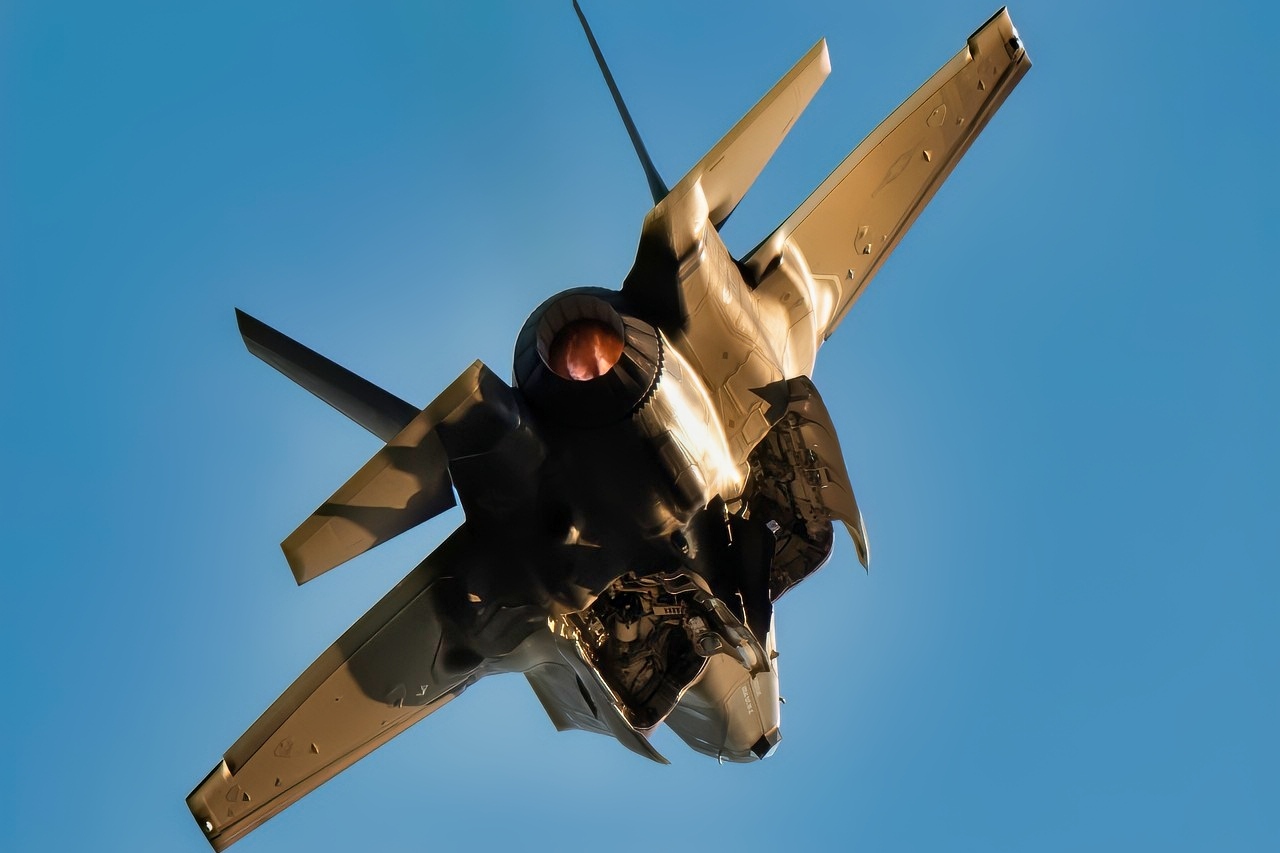
U.S. Air Force Major Kristin “BEO” Wolfe, F-35A Lightning ll Demonstration Team pilot and commander, flies during sunset over Mathers Airport, Calif., Sept. 24th, 2021, at the California Capital Airshow. The team consists of approximately 15 total Airmen to include the pilot and commander, pilot safety officers, superintendent, team chief, maintenance Airmen, aircrew flight equipment specialists, and public affairs personnel. (U.S. Air Force photo by Staff Sgt. Thomas Barley)
This demonstrates valuable lessons for other countries around the world.
“Focusing on areas where Canada retains some agency is exactly the point of many of the reforms that Ottawa has lately been adopting. For other open, developed economies—such as the European Union—these policies provide a blueprint for a sensible response to current economic challenges. They include supporting exporters through a deepening of the domestic market, doubling down on new free trade agreements, and leveraging existing assets to become a supplier of critical goods to like-minded allies.”
About the Author: Stephen Silver
Stephen Silver is an award-winning journalist, essayist, and film critic, and contributor to the Philadelphia Inquirer, the Jewish Telegraphic Agency, Broad Street Review, and Splice Today. The co-founder of the Philadelphia Film Critics Circle, Stephen lives in suburban Philadelphia with his wife and two sons. For over a decade, Stephen has authored thousands of articles that focus on politics, national security, technology, and the economy. Follow him on X (formerly Twitter) at @StephenSilver, and subscribe to his Substack newsletter.
More Military
No Fix’: China’s J-20 Stealth Fighter Has 1 Problem With No Solution
The Army’s ‘Super’ MBT-70 Tank Summed Up in 1 Word
Shinano: Japan’s ‘Super’ Aircraft Carrier Was the Biggest Warship Ever Sunk by A Submarine
Russia’s ‘New’ Tu-160M Blackjack Bomber Has A Mach 2 Message for the U.S. Air Force


