

Summary and Key Points: For weeks, the story has been sanctions, enrichment, and inspections. But the thing most likely to sink Trump’s Iran diplomacy may have nothing to do with any of them — and everything to do with a city several hundred miles west of Tehran. In a move few saw coming, Trump reportedly stopped Netanyahu from striking Beirut to keep the talks alive. Even that may not be enough: the problem facing these negotiations is one no deal can solve at the table — and a war in Lebanon could decide it.
The Real Threat to Trump’s Iran Diplomacy Is Unfolding in Lebanon

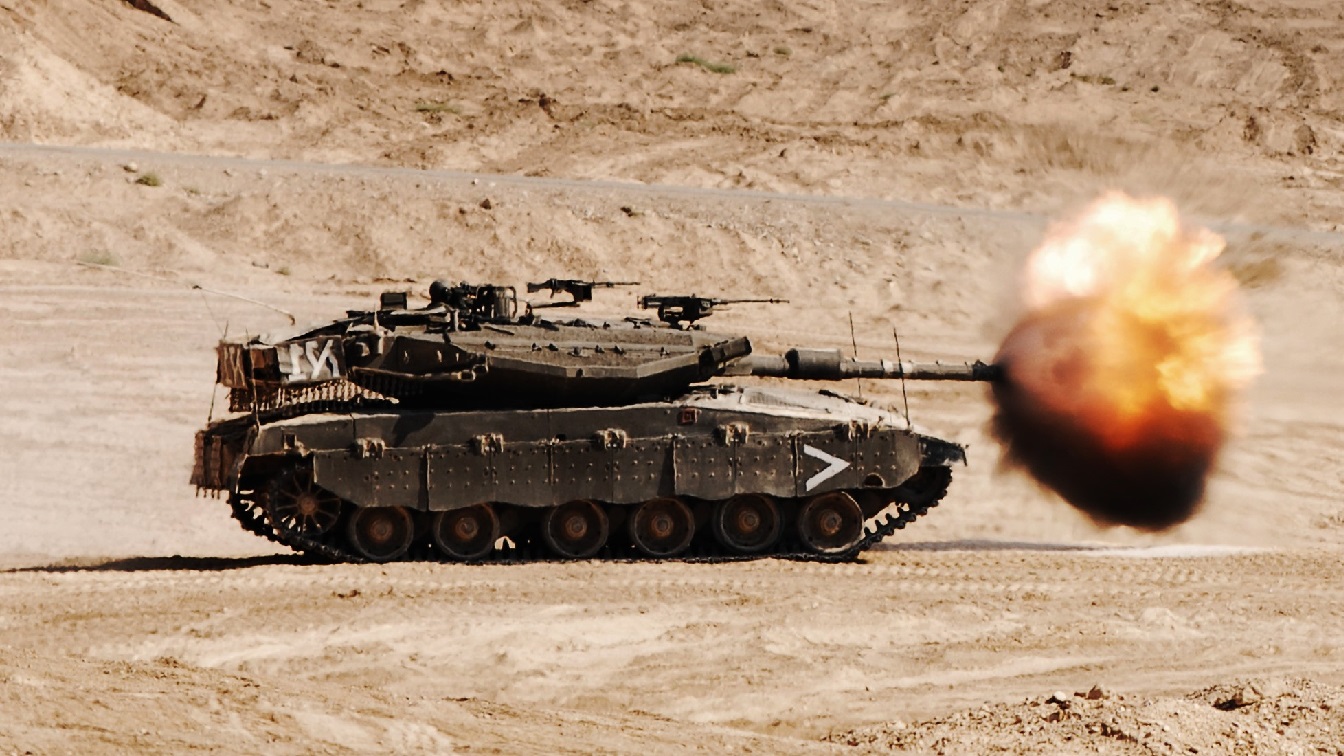
Merkava Tank Israel. Image Credit: Creative Commons.

Israel Merkava Tank. Image Credit: Creative Commons.

An Israeli Defense Forces Merkava Mark 4 tank fire 120mm canon shell
amazing action military photography 2022 2008(c)-Nehemia Gershuni Photograpy
The biggest threat to Trump’s diplomacy with Iran sits several hundred miles west of Tehran.
For weeks, most discussion of the administration’s negotiations with Tehran has focused on sanctions, enrichment, inspections, and the mechanics of a possible agreement. Those issues matter. They always matter when the subject is Iran. Yet recent events have exposed something more fundamental. The future of these talks may depend less on what happens across negotiating tables than on whether fighting between Israel and Hezbollah can be kept from spiraling into something larger.
That is why President Trump found himself doing something many observers did not expect. Rather than encouraging Israeli escalation, he reportedly intervened to stop Prime Minister Benjamin Netanyahu from carrying out a major strike on Beirut after Iran signaled that continued Israeli operations in Lebanon could jeopardize the diplomatic track. The significance of that moment extends well beyond Lebanon.
The Problem Is Not Tehran
By most accounts, the talks between Washington and Tehran remain fragile but alive. Both sides continue to exchange messages. Discussions regarding a broader ceasefire framework and possible follow-on negotiations have not collapsed, despite repeated crises.

An Israeli air force F-15I Ra’am taxis down the runway during Blue Flag 2019 at Uvda Air Base, Israel, November 4, 2019. The U.S. and Israel have a strong and enduring military-to-military partnership built on trust and developed over decades of cooperation. (U.S. Air Force photo by Airman 1st Class Kyle Cope)
That alone is noteworthy.
The United States and Iran have spent decades operating somewhere between hostility and open confrontation. Few diplomatic initiatives involving the two countries have enjoyed smooth sailing. There was never much chance that this one would.
The obstacles emerging now have less to do with centrifuges or inspection regimes than with the politics of a region that refuses to stay compartmentalized.
Iran has made it increasingly clear that it views Lebanon as inseparable from the broader diplomatic picture. Iranian officials have repeatedly linked progress in negotiations to Israeli military activity against Hezbollah. Tehran has accused Israel of undermining the atmosphere necessary for diplomacy and has suggested that continued attacks could render negotiations meaningless.
Washington may find that linkage frustrating. Tehran almost certainly sees it differently. If Hezbollah is central to Iran’s regional position, separating Lebanon from the talks was never going to be easy.
Why Lebanon Matters
Western analysts sometimes discuss Hezbollah as though it were merely another Iranian proxy. The reality is more complicated.
For more than four decades, Hezbollah has been central to Iran’s regional strategy — the most visible manifestation of Iranian influence in the Arab world, one that no government in Tehran was likely to watch degrade in the middle of sensitive negotiations with Washington.
Israeli calculations are not difficult to understand either.
The trauma of October 7 fundamentally altered Israeli threat perceptions. Israeli leaders increasingly view hostile armed groups on their borders through the lens of worst-case scenarios. Hezbollah possesses capabilities that Hamas never possessed. That reality shapes Israeli decision-making regardless of what diplomatic initiatives may be underway elsewhere.
Debates about who is being reasonable miss the point. Israeli and Iranian leaders are responding to very different strategic realities. Those realities were bound to collide.
The Limits of Leverage
Much of the media coverage treats the episode as a test of whether Trump can control Netanyahu. That framing obscures more than it reveals.
The United States possesses substantial leverage over Israel. Nobody seriously disputes that. The events of the last few days demonstrate that Trump can exert influence when he chooses to do so. Reports suggest that his intervention helped prevent a major Israeli strike on Beirut and contributed to a temporary pause in escalation.
Influence is not the same thing as control.
Israel is not an American province. It is not an American aircraft carrier parked in the eastern Mediterranean. It is a sovereign state with its own threat perceptions, domestic politics, military priorities, and strategic calculations.
Alliances have always generated this kind of friction. Partners rarely see every problem through the same lens, even when they share broad strategic goals. Washington and Jerusalem are no exception.
A Much Bigger Question
What has emerged over the past several days is a glimpse of a larger reality confronting American policymakers.
The dispute over Lebanon is easy to misread as another Middle Eastern crisis threatening another diplomatic initiative. There is some truth to that. Yet something else is visible beneath the surface. Washington increasingly finds itself dealing with partners and adversaries that possess far more room for independent action than they did a generation ago.
American power remains considerable. Few states can match it. Yet possessing influence is different from controlling outcomes, particularly in regions where local actors bear the immediate consequences of success or failure. Israeli leaders will make decisions based on Israeli security concerns. Iranian leaders will make decisions based on their understanding of Iranian interests. Neither government is likely to subordinate those concerns simply because Washington would prefer a quieter regional environment.
The result is a diplomatic landscape that has become harder to manage. Policymakers often behave as though one crisis can be managed over here while negotiations proceed over there. The Middle East has a habit of disrupting those assumptions.
Iran insists that Lebanon is connected to the broader ceasefire discussions. Israel insists that Hezbollah cannot be separated from its own security concerns. Hezbollah sees itself as part of a regional struggle rather than a local dispute. Every actor brings a different set of priorities to the table, and those priorities do not pause simply because diplomats are meeting somewhere else.
That makes diplomacy extraordinarily difficult. It also explains why Israeli strikes in Lebanon have become so politically significant. The battlefield consequences of individual strikes matter. What they do to the diplomatic environment matters even more.
Recent reporting suggests precisely that dynamic is already unfolding. Iranian officials have blamed Israeli operations in Lebanon for delaying negotiations. Tehran has suspended communications at various points and threatened to walk away altogether.
None of this guarantees that diplomacy will fail. But it changes the odds.
Beirut May Decide What Tehran Cannot
Trump’s challenge is no longer confined to negotiations with Iran. He now finds himself trying to manage decisions being made simultaneously in Jerusalem, Beirut, and Tehran. Every one of those capitals has agency. Every one of them can complicate the outcome Washington prefers.
That is why the recent dispute over Lebanon matters so much.
The administration may yet find areas of agreement with Iran. Negotiators can bargain over ceasefires, sanctions, maritime security, and a great deal else besides. The problem emerging in Lebanon is different. What is not negotiable is the sequencing problem those talks now face: whether Washington can keep Israel’s operations in Lebanon contained enough that Tehran doesn’t conclude the diplomatic track is being strung along while Hezbollah is dismantled.
That question has no clean answer, and no amount of progress at the negotiating table resolves it. A regional escalation would.
Trump may discover that the talks themselves are only part of the challenge. A diplomatic breakthrough means very little if events in Lebanon reshape the political landscape before negotiators can finish their work.
About the Author: Dr. Andrew Latham
Andrew Latham is a professor of international relations and political theory at Macalester College in Saint Paul, MN. You can follow him on X: @aakatham.


pagar
June 3, 2026 at 9:24 am
In my frank opinion, there’re three (3) big or massive threats to peace in the Persian gulf today.
Whaddaya them.
1) President trump’s duplicity. Trump is well known for endless flip-flopping. Too well-known, in fact.
2) The dangerous policies of Benjamin netanyahu, who wants to slay everybody in the middle east.
3) The testosterone-filled warmongering critics and armchair military experts and foreign policy pundits in the USA, and right now, in 2026, there’s no shortage of them.
Man, how to have peace. Impossible. Continue fightin’.
Swamplaw Yankee
June 3, 2026 at 1:35 pm
Capitals + Leaders have agency. OK. seems right on.
So, Tehran has exported a huge percentage of its “agency” into a nice spot to kicj the USA, CANADA. Yep, you can speak Farsi in the capital Ottawa, if you need to find a local Bazaar that sells fake Maple Syrup and Genuine Native Crafts .
Yeah, Canada of 1946-47 is vanished gone. Welcome to Israel, Tehran, Moscow. All have agency right next door to the inner beltway brain trust!!