

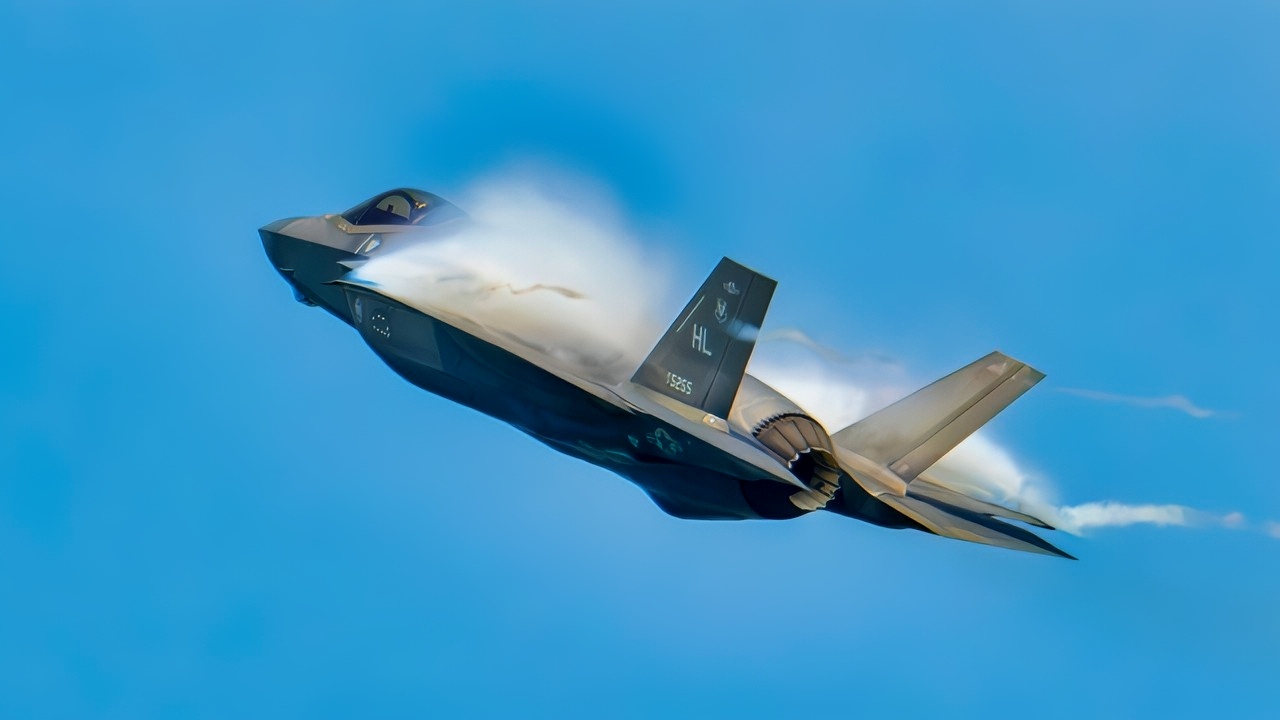
Key Points and Summary – A comparison between the U.S. F-35 and China’s J-20 and J-35 stealth fighters highlights two decisive American advantages: a head start in time and real-world combat experience.
-The F-35 program is decades older, resulting in a more mature and reliable platform.

Royal Netherlands Air Force F-35 Lighting II fighters fly in formation with Polish Air Force MiG-29 Fulcrums during a training sortie over Poland on 21 March 2023.

Dutch F-35s and Polish MiG-29s train together over Poland as part of NATO’s Air Policing mission
-Furthermore, the F-35 has been extensively “blooded” in combat by U.S. forces in Iraq and Afghanistan, while China’s jets have none.
-While Chinese fighters may boast on-paper advantages in range or speed, they lack the crucial, hard-won validation that only comes from years of operational use and actual combat.
China Has an F-35 Problem: Lack of Time and Experience
In the world of competing technologies, certain debates never seem to end.
For example, in the automotive world, you have the never-ending Ford vs. Chevy debate. (The correct position, of course, is that the Ford Mustang is the coolest classic car ever.)
Meanwhile, in the firearms world, you have the never-ending debates such as semiautomatic pistol vs. revolver, 9mm Parabellum vs. .45 ACP cartridge, double-action vs. single-action vs. striker-fired pistols, and so forth.
And in the world of 5th-generation stealth fighters in relation to Great Power competition, you have the never-ending debates about American-made (F-22 and F-35) vs. Chinese-made (J-20 and J-35) stealth jets.
(As for the Russian Federation’s gen-5 fighter, the Sukhoi Su-57 [NATO reporting name “Felon”], there’s a reasonably common consensus that it’s the weakest of the bunch.)

U.S. Air Force Capt. Melanie “MACH” Kluesner, F-35A Lightning II Demonstration Team pilot and commander, flies an aerial demonstration certification flight at Hill Air Force Base, Utah, Feb. 22, 2024. Upon the 388th Fighter Wing commander certification, the F-35 Demo Team pilot is required to complete the Air Combat Command Heritage Flight Training Course. (U.S. Air Force photo by Staff Sgt. Kaitlyn Ergish)

An F-35A Lightning II, flown by Maj. Kristin “Beo” Wolfe, F-35 A Lightning II Demonstration Team commander, performs aerial displays during the Joint Base Andrews 2022 Air & Space Expo, at JBA, Md., Sept. 18, 2022. Wolfe demonstrated several difficult maneuvers throughout her performance at the Air & Space Expo to provide an opportunity for people to see U.S. military air capabilities in action. (U.S. Air Force photo by Airman 1st Class Ben Cash)
To be certain, the J-20 and J-35 alike do have certain advantages (which we shall cover shortly). But American stealth fighter technology has two major advantages which the Communist Chinese war machine has not yet overcome: head starts in time and real-world combat experience alike.
NOTE: Since the F-22 Raptor is sadly no longer in production, we shall focus on its Lockheed Martin Skunk Works sister warbird, the F-35 Lightning II.
American Advantage #1: Time
The F-35 traces its roots all the way back to 1995, when the Joint Strike Fighter (JSF) program was officially designated. Long story short, Lockheed Martin’s entry into the JSF competition, known then as the X-35, beat out Boeing’s JSF contestant, the X-32.
(As a sidebar note, both an X-35 airframe and an X-32 specimen are now on display at the Patuxent River Naval Air Museum in Lexington Park, Maryland.)
From there, the F-35A (the US Air Force variant) made its maiden flight on December 15, 2006. and the F-35B (the US Marine Corps variant) was the first to attain operational status, doing so on July 31, 2015.
By contrast, the Chengdu J-20 Wēilóng (“Mighty Dragon;” NATO reporting name “Fagin”) first flew on January 11, 2011, and went operational on March 8, 2017, whilst the Shenyang J-35/J-35A (no official moniker yet, either homegrown or NATO-assigned) didn’t make its own maiden flight until October 29, 2021.
American Advantage #2: Combat Experience
Quoth that one famous saying by Mark Twain, “The person who had taken a bull by the tail once had learnt sixty or seventy times as much as a person that hadn’t.” The Lightning II has proven its worth in combat multiple times over. To cite just two examples:
-On 30 April 2019, the USAF used the F-35A, in combat for the first time. This took place during Operation Inherent Resolve (OIR), the aerial bombing campaign against the Islamic State/ISIS/ISIL/Da’esh terrorist group, and the location was Wadi Asahi, Iraq.
-Not to be outdone, the USMC was a year ahead of its USAF counterparts in “blooding” their own version of the Lightning II, the F-35B, doing so in the skies over Afghanistan during Operation Enduring Freedom (OEF), in strikes against the Taliban.
By contrast, though the Chinese Zodiac includes the Year of the Bull (more frequently called the Year of the Ox) every 12 years, the combined real-world combat experience of the J-20 and J-35 is precisely zero.
The Chinese Stealth Planes Do Have Some Advantages
In its current form, the F-35 has a ferry range of 1,500 nautical miles (1,700 statute miles, 2,800 kilometers) and a combat range of 669 nautical miles (770 statute miles, 1,239 kilometers) on internal fuel.
By contrast, the J-20 has a respective ferry range and combat range of 3,000 nautical miles (3,400 statute miles, 5,500 kilometers) and 1,100 nautical miles (1,200 statute miles, 2,000 kilometers). In addition, the “Mighty Dragon” has a max airspeed advantage over the Lightning II, to the tune of Mach 2.0 versus Mach 1.6.
As for the J-35, there are as yet unconfirmed rumors that it’s stealthier than the F-35.
This is clearly more than a trifle concerning.
It goes to show that despite the significant advantages of the F-35, America’s airpower advocates cannot afford to become complacent or rest on their collective laurels, lest a war against China break out sooner rather than later.
Fortunately, the fine folks at Lockheed Martin are taking this to heart, as evidenced by the so-called “Ferrari F-35” upgrades.
About the Author: Christian D. Orr, Defense Expert
Christian D. Orr is a Senior Defense Editor. He is a former Air Force Security Forces officer, Federal law enforcement officer, and private military contractor (with assignments worked in Iraq, the United Arab Emirates, Kosovo, Japan, Germany, and the Pentagon). Chris holds a B.A. in International Relations from the University of Southern California (USC) and an M.A. in Intelligence Studies (concentration in Terrorism Studies) from American Military University (AMU). He is also the author of the newly published book “Five Decades of a Fabulous Firearm: Celebrating the 50th Anniversary of the Beretta 92 Pistol Series.”
More Military
Canada’s F-35 Fighter Program Has Passed the Point of No Return
USS Oriskany: The Navy Essex-Class Aircraft Carrier That Was Sunk On Purpose
Nimitz-Class Nuclear Aircraft Carrier USS John C. Stennis ‘Out Action’ for 5 Years
Australia’s Mogami-Class Frigate Buy from Japan Is a Big Deal
The F-14 Tomcat Fighter Could Stop Enemy Tanks In Their Tracks


bis-biss
October 12, 2025 at 6:53 am
These ‘tactical’ aircraft, as in ‘small-time play-play’ assets ideal for local confrontational situations are merely like tiny weevils or bugs.
In a confrontation that spells out a life-changing ‘cataclysmic’ or ‘hellscape’ event, all these small bugs or weevils won’t do.
What thrn is/are more or truly relevant in catcalysmic confrontations.
They are the items below.
Spacebombers, spaceplanes, unmanned suborbital craft and space-based nuclear arsenals.