

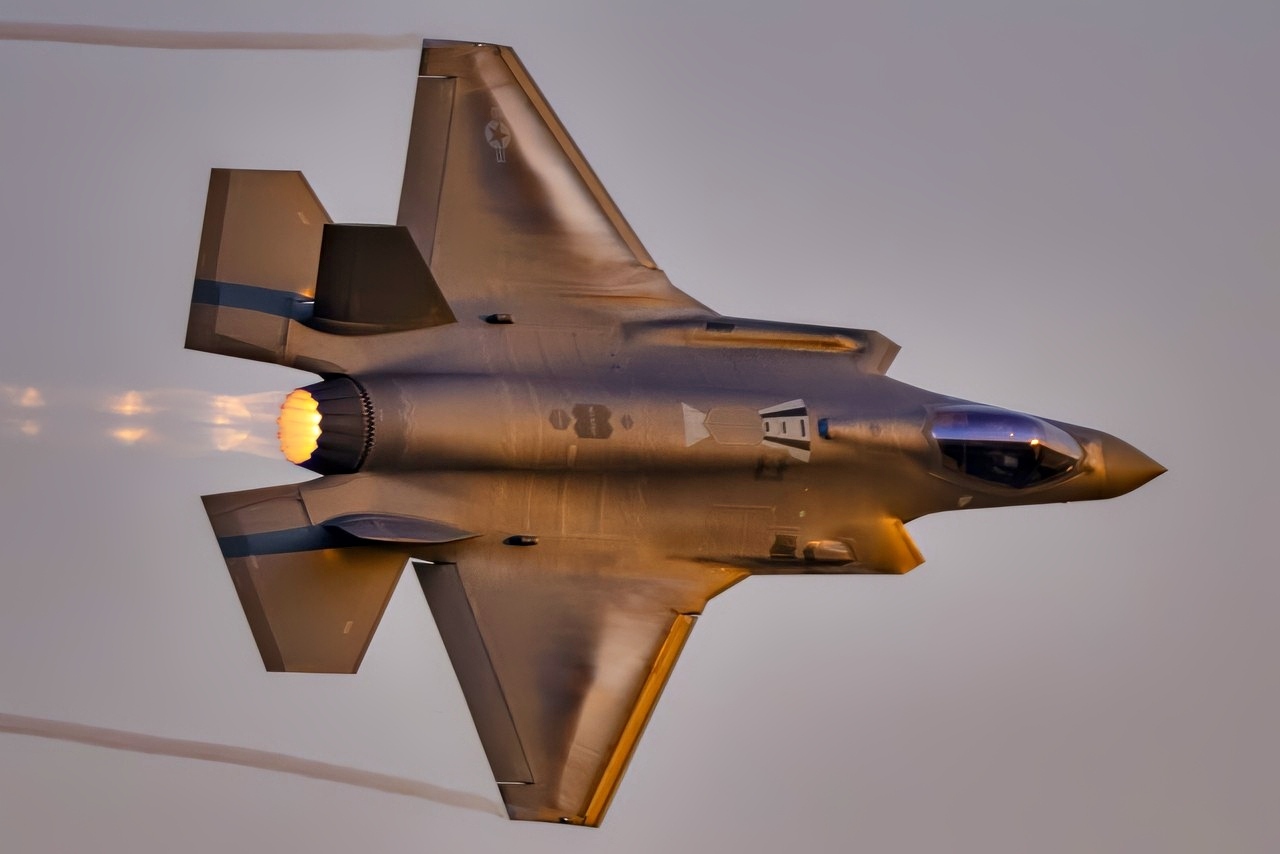
Key Points and Summary – Canada doesn’t have to choose between stock F-35s and a European jet. The piece argues for a deliberately configured “fifth-generation-plus” of what many call ‘Ferrari’ F-35 as a bridge to the U.S. F-47/NGAD.
-Front-loaded TR-3/Block 4 upgrades, hardened connectivity, long-range weapons, and mission-data prowess would improve Arctic reach, NORAD integration, and coalition lethality now, while positioning industry for sensors, autonomy, and networking that feed sixth-gen.
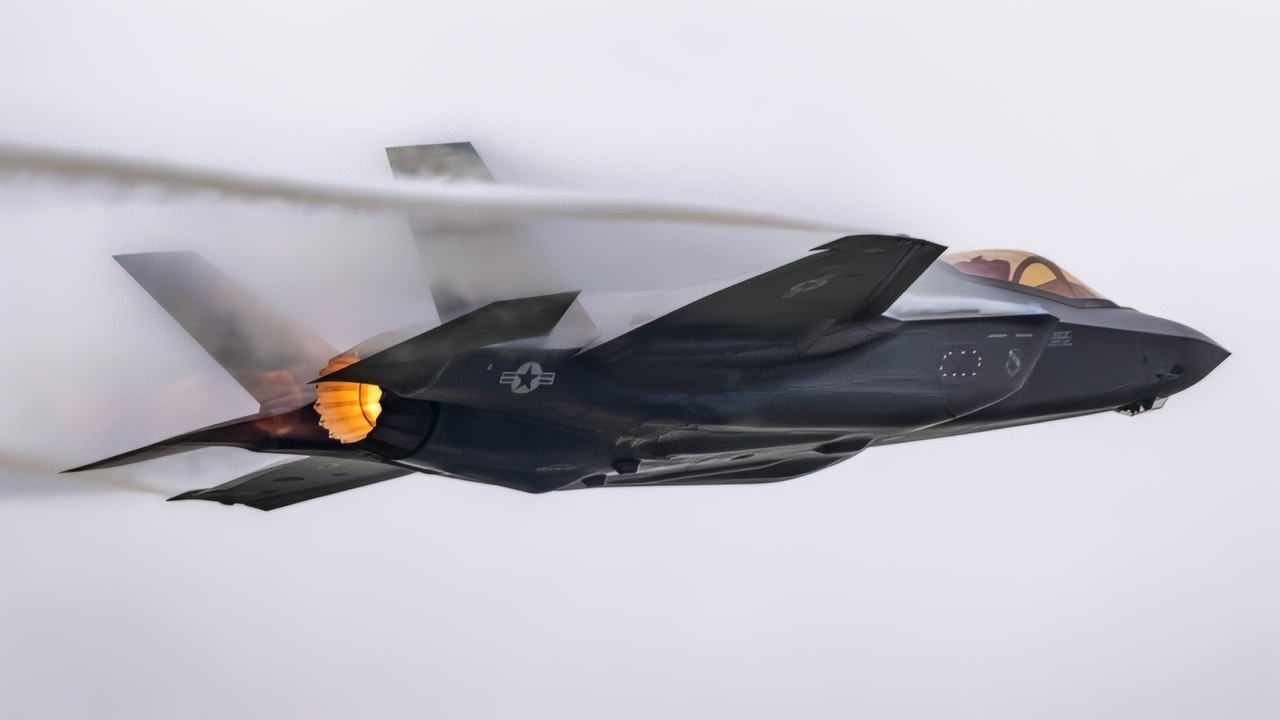
U.S. Air Force Maj. Kristin “BEO” Wolfe, F-35A Lightning II Demonstration Team pilot and commander, performs for F-135 engine maintainers assigned to the Oklahoma City Air Logistics Complex, at Tinker Air Force Base, Okla., May 25, 2021. The F-35A Demonstration Team put on the performance for the maintainers as a show of appreciation for keeping F-35s throughout the Department of Defense running and in the sky. (U.S. Air Force photo by Staff Sergeant Thomas Barley)
-Sequencing deliveries and upgrades avoids capability gaps and signals commitment.
-An explicit F-47 on-ramp—access to mission-data, teaming concepts, and resilient basing—future-proofs the RCAF without re-competition.
-Bottom line: buy a trajectory, not a snapshot. Deterrence today, dominance tomorrow, with allies aligned.
Ferrari F-35 Now, F-47 Future: Canada’s Possible Fighter Plan?
Canada’s fighter debate too often collapses into a false choice between buying a second tranche of standard F-35s and defecting to a European alternative.
There is, however, a third, more strategically coherent course: procure a deliberately configured “fifth-generation-plus” F-35 as a bridge to the United States’ sixth-generation F-47 (Next Generation Air Dominance) family.
Sequenced this way, Canada gains deep integration into the continental defense network now and a credible on-ramp to the cutting edge of airpower in the 2030s.
The bridge-to-F-47 approach offers the best of both worlds—interoperability and deterrence today, and future-proofing the Royal Canadian Air Force tomorrow.
The plan is simple: ‘Ferrari’ or upgraded F-35 now, F-47 NGAD for the future. Here are the reasons why:
F-35, Timing and Architecture
Timing and architecture make the choice plain. Canada has contracted for 88 F-35As, with training at Luke Air Force Base beginning in 2026, first deliveries in late 2028, and initial operational capability targeted in the 2029–2030 window.
In parallel, Ottawa and Washington are fielding a modernized NORAD sensor lattice—over-the-horizon radars, space and ground sensors, and a hardened command-and-control backbone. The standard F-35 Canada is slated to receive will plug into this network, but it also locks in limitations that will harden as the threat evolves. The smarter play is to pivot now from a “standard” buy to a fifth-generation-plus configuration and treat that aircraft as a deliberate bridge to the U.S. F-47 family.
This distinction is not semantic. The standard F-35 is a proven but essentially “as-is” fifth-generation jet: adequate computing and sensors for current tasks, certified legacy weapons, and a sustainment model tied to global pools. It will defend airspace and enforce sovereignty, but leaves little margin for range, payload, electronic warfare, and next-generation weapons integration—precisely where Canada’s Arctic and maritime missions require more.

NGAD. Image Credit. Lockheed Martin.
By contrast, a fifth-generation-plus F-35 is a growth-minded package: prioritized computing and sensor upgrades, next-generation long-range air-to-air and standoff weapons, survivability treatments for denser EW environments, agile mission-data reprogramming, hardened connectivity, and readiness for manned-unmanned teaming as it matures. Much of this headroom depends on TR-3/Block 4 upgrades that are arriving later than planned, so capability will phase in over time rather than all at once. One path buys a snapshot; the other buys a trajectory.
The Combat and Survivability Question
Combat capability argues decisively for the bridge aircraft. Canada’s problem set is reach and persistence across vast, sparsely based territory. A fifth-gen-plus configuration extends effective range through smarter weapon pairings, adds credible maritime strike and counter-air denial options, and improves off-board/on-board cueing in a contested electromagnetic spectrum. The result is earlier detection, higher-quality tracks, and longer-range kills against cruise-missile carriers or forward-screening fighters.
In coalition operations, a bridge F-35 can find, fix, and pass weapons-quality tracks that enable allied shooters to fire from sanctuary—turning Canada into a force multiplier rather than a consumer of others’ effects.
Survivability and sensing also improve over time. The baseline jet brings stealth and fusion; the bridge variant layers in more powerful processing, more sensitive electronic-support measures, and adaptive electronic-attack options to stay relevant as adversary sensors proliferate and harden. Practically, this means Canada can credibly undertake more demanding missions from day one—especially across the North Pacific and North Atlantic approaches—while avoiding the fate of becoming “exquisite but brittle” as threats mature.
Industrial policy points in the same direction. A standard F-35 buy keeps Canadian firms in the global supply and sustainment pipeline but largely as price-takers for a fleet Canada cannot shape. A fifth-gen-plus bridge paired to an F-47 destination, by contrast, redirects work toward mission-data reprogramming, resilient networks, advanced materials and sensors, and propulsion—areas that ladder directly into sixth-generation systems. Instead of supplying parts, Canada helps make capabilities, positioning its industry for the technologies that will define air dominance in the 2030s.
Detternce Matters
Deterrence signaling and alliance leverage likewise improve. A standard fleet says “good enough”; a bridge fleet says “committed and climbing.” Crucially, the bridge path is neither a risky re-competition nor a leap to an unproven European type.
It is a targeted configuration shift within the program Canada already joined, sequenced to infrastructure and training clocks. Ottawa can restructure deliveries—front-loading aircraft that meet fifth-gen-plus criteria, accelerating critical upgrades on early tails, and aligning weapons, spares, and mission-data timelines—so capability rises steadily without creating a gap. The alternative—accepting a baseline fleet now and hoping to add growth later—usually succumbs to budget politics, freezing the force near its starting point.

A joint team consisting of F-35 Patuxent River Integrated Test Force flight test members, U.S. Sailors and Marines, and the crew of the Japan Maritime Self-Defense Force Izumo-class multi-functional destroyer JS Kaga (DDH-184) are executing developmental sea trials in the eastern Pacific Ocean to gather the necessary data to certify F-35B Lightning II short takeoff and vertical landing aircraft operations. While aboard the MSDF’s largest ship, the Pax ITF flight test team has been gathering compatibility data for analysis in order to make recommendations for future F-35B operational envelopes, further enhancing the Japanese navy’s capabilities. The results of the testing will contribute to improved interoperability between Japan and the United States, strengthening the deterrence and response capabilities of the Japan-U.S. alliance and contributing to peace and stability in the Indo-Pacific region. Japan is an F-35 Joint Program Office foreign military sales customer planning to purchase 42 F-35Bs. The F-35 Joint Program Office continues to develop, produce, and sustain the F-35 Air System to fulfill its mandate to deliver a capable, available, and affordable air system with fifth-generation capabilities.
Defining the bridge also clarifies the destination. The F-47 (NGAD) family promises very-long-range sensing and weapons, large electrical and thermal margins for growth payloads, advanced survivability across the spectrum, and software-defined adaptability at scale—all exactly what continental defense will demand in the 2030s. Allied access and timing, however, are not yet defined and remain policy-dependent; a Canadian early-to-mid-2030s on-ramp should be presented as strategic intent, not a settled pathway.
Even so, a Canadian on-ramp tied to the bridge aircraft can set explicit milestones: basing resilience and cyber-secure connectivity; contributions to mission-data, autonomy, and collaborative-combat-aircraft experimentation; and industrial workshare mapped to Canadian strengths. Success is arriving in the early-to-mid-2030s able to transition a portion of the force into the F-47 ecosystem without sacrificing day-to-day NORAD readiness.
European sixth-generation projects – such as Global Combat Air Programme (GCAP) and Future Combat Air System (FCAS) – remain serious endeavors, but they are optimized for European geography, governance, and timelines. Buying into them would duplicate rather than reinforce the U.S.–Canada architecture and split Canadian leverage between two industrial ecosystems instead of concentrating it where continental security is actually underwritten.
A Path Forward for Canada on Next-Gen Fighters
The path from policy to practice is direct. First, do not proceed as though a “standard” F-35 is sufficient. Field a fifth-generation-plus F-35—configured for rapid software uptake, advanced weapons, and resilient northern operations—as the fleet’s nucleus. Second, negotiate a defined on-ramp to the F-47: access to the mission-data ecosystem that will determine sixth-generation performance, infrastructure and concepts tuned to manned-unmanned teaming, and delivery sequencing that preserves an early-to-mid-2030s transition window.
In sum, Ottawa’s choice is not between the F-35 and “something else,” but between freezing a baseline that will age quickly and building a bridge that converts adequacy into advantage. Field the fifth-generation-plus ‘Ferrari’ F-35 now and step into the United States’ F-47 ecosystem as a first-tier partner, and Canada moves from consumer to co-producer of deterrence across the Arctic and North Atlantic. Delay invites widening seams, higher costs, and shrinking leverage.
Resolve yields a force that protects the continent today and helps define the air domain tomorrow. Two countries, one sky—act accordingly.
About the Author: Dr. Andrew Latham
Andrew Latham is a Senior Washington Fellow with the Institute for Peace and Diplomacy, a non-resident fellow at Defense Priorities, and a professor of international relations and political theory at Macalester College in Saint Paul, MN. You can follow him on X: @aakatham. He writes a daily column for National Security Journal.
More Military
The B-2A Spirit Stealth Bomber Has a Message for Russia and China
China Has a Masterplan to Make the B-21 Raider Bomber Obsolete
The New B-21 Raider Is Far More Than Just A ‘Stealth Bomber’
The ‘New’ Arleigh Burke–Class Flight III Destroyer Has a Message for the U.S. Navy
France’s Mirage 2000: The Best Fighter You Never Heard of Fighting Putin in Ukraine


Swamplaw Yankee
September 17, 2025 at 10:39 pm
The concept of “False Choices” is imaginative deflection. Hurrah.
Canadian Tax payers are being hounded, pursued, low income seniors abused, by the CRA, the IRS of northern fat cat Federalistas. Old WW2 low income seniors are litigated by Federalista lawyers out of their WW2 era purchased homes for a few more measely bucks of federal tax.
Instant CRA Tax “Officers” right out of some third world country get to legally pursue, harass, threaten and kill old low income Canadians like the Canadian seniors lived in “Human Safari” Kherson Ukraine.
The CRA Federalistas want to close the blood sucking tax file of a low income senior like a ruusskie orc want- to- be a “Killer Ace” wants to close out the life of a Ukrainian living in downtown Kherson.
3T openly ran for his office on a very clear no-defence tax cash as did every other party. No party even burped for a 5% for GNP defence spending thought. It was all free tax paid housing and free health care for each and every illegal cross border crosser(s). 3T = Third Trudeau
The Inner beltway brains in Washington DC need to know that reality of most of Canada, especially when slimy touts for ka-billion dollar F-35 fantasies burp about on op-ed boards as if they were promoting shares in time-sharing “futurism” cons.
Many times, these futurist time-share slimers are told, go sell in Mexico, then return with evidence of the big huge legal contract that Mexico has signed for their “Future” !
The F-35 coward touts refuse to fly right into Mexico City and walk about handing out F-35 brochures in the “NO_GO” zones. As big ass F-35 touts harass Canada, their touts big ass never appears in any “NO GO” zone in Mexico.
Canada must demand that the US enforce the MAGA POTUS Principle of Ukraine. Touts only send their stable boy picks to Canada way, way after they prove they have legally sold their garbage to the huge, rich population of Mexico.
A single Mexican Cartel could purchase 50 F-35 air frames. The PRC CCP Xi regime would fund their Mexican Cartel fronts each for 1oo F-35 very easily.
Are the peer readers dealing with some form of autism? The same fella keeps returning with the same tout but on a different day and week. Is this an aviation Ground Hog day?
Fella, come back after you run for office in Mexico and sell the amigos on a couple dozen F-35 air frames. Then, Every other M.I.C. company will hire you on, + pronto. -30-
Phantom Piper
September 21, 2025 at 9:01 pm
Maybe consider taking your meds on a regular basis?
J smith
September 20, 2025 at 7:45 am
Pretty lame article
Canada does not need the F35, especially with all the conditions and control the Americans want to insist on. If we bought them, they would be under our control, yet the Americans insist on controlling software rights and parts issue. Unacceptable. We agreed to purchase these on good faith and that faith has been trampled on. This misinformation of an article insists we need the F47, before any costs or capabilities have been established. Canada has already begun investing in 6th gen fighters, just not American ones. Your corrupt, unstable egomaniac of a POTUS has ruined the great friendship we had with the USA. We can no longer trust you and as a result we need to seperate from you. The 6 gen fighter is a major step in that process. So all we really need, is a stopgap, such as the Grippen. Never again. This is not the first time we have had to defend our sovereign status from the USA. I doubt it will be the last.
Raptor1
September 20, 2025 at 9:35 am
Sure, just what everyone should conaider rational, buying into a souped-up version of a 25-year old aircraft that to date, STILL needs at LEAST 5 more years (documented) to deliver a watered-down version of its “definitive” core capability Block 4 – Including new engine, cooling, and clearly problematic software devs. And that doesnt even toucb on its maintenance and logistics issues that require that a global supply cbain be kicked into 3rd gear and engineers flown around the world to support it when it breaks down on a runway in some country not cleared to have it (India… 5 WEEKS, under British MP guard) – Kinda like buying a tv network because you love a great drama series.
Shawn
September 20, 2025 at 10:03 am
Purchasing the F-35 is an absolute mistake. It will weaken Canada economically and completely dominate its military at the hands of the United States. Canada’s sovereignty will effectively disappear!
Fred Scribner
September 20, 2025 at 1:38 pm
Oh so an American says we need to buy their overpriced pos aircraft now that doesn’t do what we need it to do controlled by an unstable US government threatening our sovereignty so that we can be in line to buy their overpriced next generation aircraft. FYI pal until you fix your government the major world threat to Canada is the United States and there are two consortiums building next gen aircraft from Europe who aren’t threatening our country that we can collaborate with and that aren’t devolving into a fascist state as the US currently is. No thanks we will take our chance with our sane allies.
Alex
September 22, 2025 at 11:26 am
We should stick with the the program to buy the F35s. We have invested too much in the program to cancel it now.
Canada should not play politics with its defence.
No wonder Donald Duck wants Canada as the 51st state. We can’t defend ourselves.
Buy the planes.
The United States is our ally. Donald Chump will be gone in 3.5 years. After the midterms he will probably be a lame duck president.
The European fighter aircraft are okay but we are allied with the United States to defend North America.
Buy the planes.