

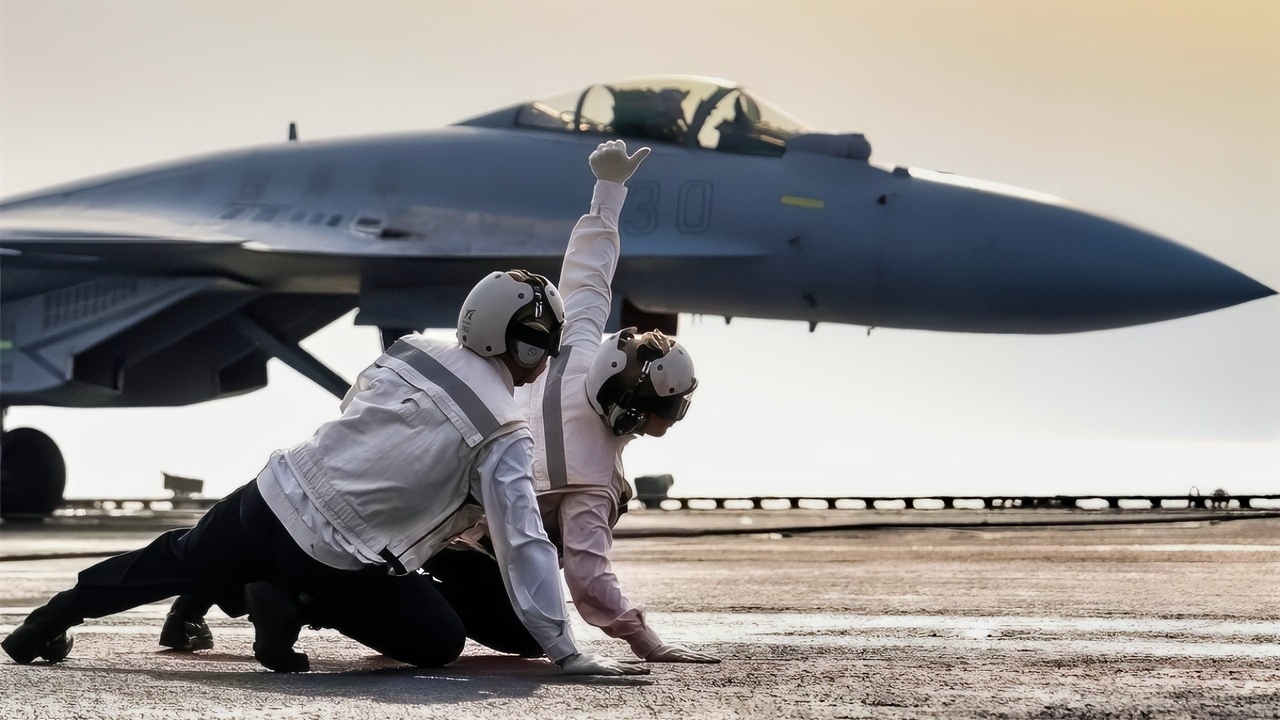
Key Points and Summary – China’s aircraft carrier program has progressed at a remarkable pace, transforming the People’s Liberation Army Navy into a major global sea power.
-In just over a decade, China has gone from refurbishing an old Soviet hull for training to launching its own advanced supercarrier, the Fujian.
-Unlike its predecessors, the Fujian features a U.S.-style electromagnetic aircraft launch system (EMALS), a major leap that allows it to launch heavier and more capable aircraft, including the new J-35 stealth fighter.
-This rapidly growing fleet is the centerpiece of Beijing’s strategy to challenge American naval supremacy in the Indo-Pacific.
The Remarkable Pace of China’s Aircraft Carrier Program—And What Comes Next
For decades, the CCP has been investing resources in the PLAN to counter the United States Navy in the region.
As part of this strategy, China has been investing considerable sums into its fleet of aircraft carriers.
Like many other sectors of China’s defense industry, it was originally dependent upon older Soviet designs.
However, China has recently been making progress in developing its carrier, comparable to America’s super carriers.
This new model enables China to project its naval power beyond its territory, directly challenging American maritime supremacy.
Soviet Origins
China’s first aircraft carrier was the Soviet-built Varyag, which was purchased from Ukraine in the late 1990s. After extensive refurbishment and modernization, it was commissioned as the Liaoning in 2012.
This carrier marked China’s entry into the realm of carrier operations, serving primarily as a training and development platform.
It uses a ski-jump ramp for aircraft launches, a design known as STOBAR (Short Take-Off But Arrested Recovery), which limits the types and weights of aircraft it can deploy. Despite these limitations, the Liaoning played a crucial role in helping China build foundational expertise in carrier operations, naval aviation, and pilot training.
Building on the experience gained from Liaoning, China launched its first domestically built carrier, the Shandong, in 2017 and commissioned it in 2019. While it shares the STOBAR configuration with Liaoning, Shandong features a larger flight deck and improved internal systems, allowing it to carry more aircraft and operate with greater efficiency. It represents a significant step forward in China’s carrier development, transitioning from a training platform to an operational asset capable of regional power projection.
China’s Fujian Aircraft Carrier
The most advanced carrier in China’s fleet is the Fujian, launched in 2022 and currently undergoing sea trials. Unlike its predecessors, Fujian is equipped with a CATOBAR (Catapult Assisted Take-Off But Arrested Recovery) system, including an Electromagnetic Aircraft Launch System (EMALS).
This technology enables the launch of heavier and more diverse aircraft, including early warning planes and fully loaded fighters, significantly enhancing the carrier’s combat capabilities. With a displacement estimated between 80,000 and 100,000 tons, Fujian is comparable in size and capability to U.S. supercarriers, marking a major leap in China’s naval capabilities.
China’s carrier-based aircraft have also seen notable advancements. The J-15, based on the Russian Su-33, has been the backbone of Chinese carrier aviation.
However, its heavy frame and limited compatibility with catapult systems have prompted the development of improved variants like the J-15T and J-15DT, which are designed for catapult launches and electronic warfare roles. More recently, China has been working on the J-35, a fifth-generation stealth fighter derived from the FC-31. With features such as folding wings and an elevated cockpit, the J-35 is designed for carrier operations and is expected to become a key component of future air wings.
China’s strategic vision includes the construction of at least three more carriers, with plans to operate a fleet of six by the early 2030s. Among these future carriers is the Type 004, a nuclear-powered CATOBAR vessel currently under development. This carrier is expected to surpass Fujian in size and capability, offering greater endurance and operational flexibility. Additional carriers, possibly designated Type 005 and Type 006, may incorporate advanced stealth features and drone integration, reflecting China’s emphasis on future-oriented naval technologies.
China is also exploring alternative carrier concepts, such as drone carriers and helicopter landing docks (LHDs). The Type 076 Sichuan, for example, features EMALS and may support unmanned aerial vehicle (UAV) operations, indicating a shift toward more versatile and technologically sophisticated platforms.
Trouble for Taiwan
The development of China’s aircraft carrier forces is direct challenge to the U.S. navy and its allies in the region. The PLAN aims to project power beyond the First Island Chain, extending its reach into the Western Pacific and Indian Ocean.
This capability supports China’s broader military objectives, including the ability to contest U.S. naval dominance, assert control over disputed maritime territories, and safeguard its growing overseas interests. Carrier strike groups provide a flexible and potent tool for deterrence, crisis response, and joint operations with other branches of the Chinese military.
Despite these advancements, China still has a long way to go before it is ready to challenge the U.S. Navy. The PLAN lacks the decades of operational experience possessed by the U.S. Navy, which has refined carrier doctrine through numerous conflicts and global deployments.
Additionally, some of China’s carrier-based aircraft, particularly the J-15, are limited by their design and performance characteristics. Sustaining a global carrier fleet also requires robust logistics and support infrastructure, which China is still in the process of developing.
Nevertheless, the pace of China’s aircraft carrier development is remarkable. Commissioning three carriers in just over a decade, with several more in the pipeline, demonstrates a level of industrial and strategic commitment unmatched by most other nations.
The integration of indigenous design, stealth technology, and drone capabilities suggests that China is not merely replicating existing models but innovating to meet future operational needs.
About the Author:
Isaac Seitz, a Defense Columnist, graduated from Patrick Henry College’s Strategic Intelligence and National Security program. He has also studied Russian at Middlebury Language Schools and has worked as an intelligence Analyst in the private sector.
Military Affairs
China’s Stealth Air Force Has 1 Mission


