


Key Points and Summary – China is fielding a layered airpower ecosystem that pairs new stealth fighters with big-sensor aircraft and long-endurance drones.
-The J-35 (land) and carrier-capable J-35A aim to be multirole, low-observable “sensor-shooters,” likely networked for cooperative targeting.
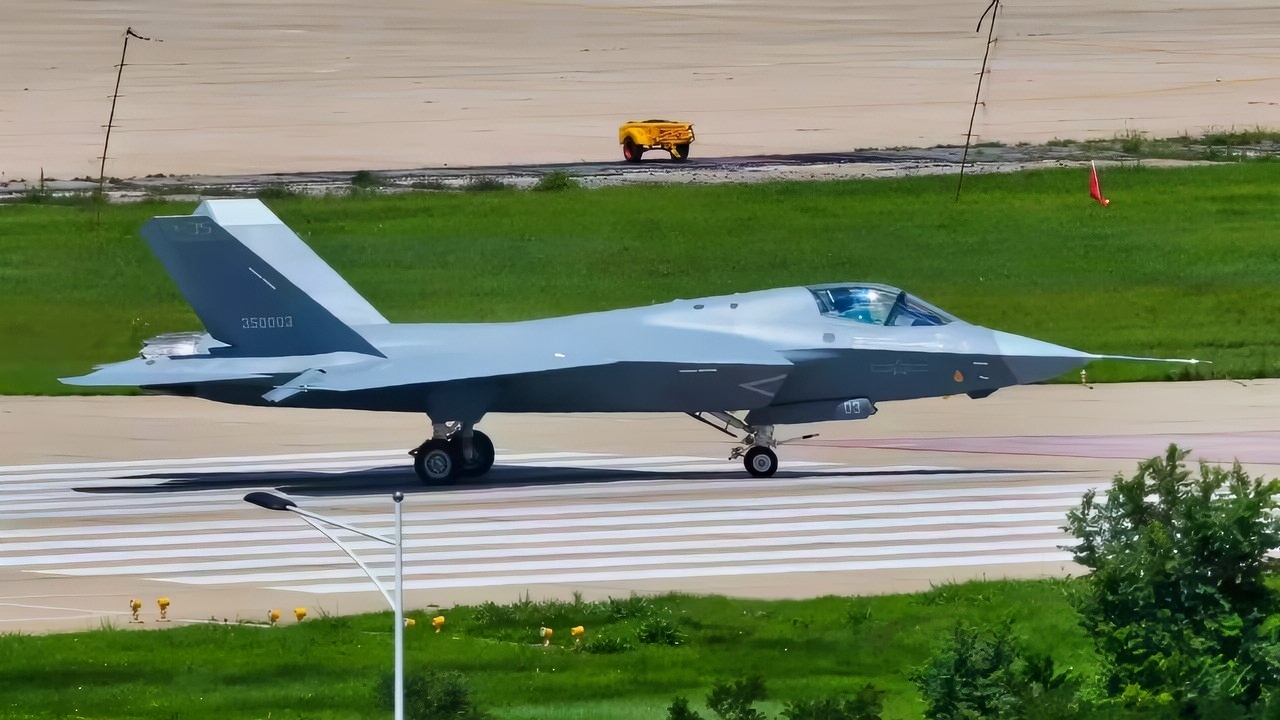
J-35 Fighter X Screenshot. Image Credit: X Screen Capture.

J-35 Stealth Fighter from China. Image Credit: Creative Commons.
-The KJ-3000 AEW&C provides wide-area surveillance and command-and-control to knit the battlespace together. More speculative projects—the Shenyang “J-50” and Chengdu “J-36”—are portrayed as larger, long-range stealth designs (and potential manned-unmanned teaming hubs), though details remain unverified.
-The WJ-700 HALE UAV adds persistent ISR with strike options. Taken together, the mix signals a push toward longer reach, better survivability, and denser sensing—designed to complicate opponents’ decisions and enable massed, coordinated effects, especially when paired with loyal-wingman drones.
China’s Air Force Fleet is Growing
New and seemingly novel aircraft indicate a concerted Chinese effort to boost capabilities, particularly in the realm of fifth– and sixth-generation stealth aircraft.
A raft of novel Chinese aircraft have been spotted in recent years, prompting some consternation in Western aviation circles. Commentary has focused on extrapolating individual aircraft capabilities from the limited photographic and video evidence available about the new aircraft, often brief clips seemingly taken just before takeoff.
Speculation about aircraft capabilities from limited evidence is a tricky business: projections about aircraft capabilities tend to follow the level of concern about said aircraft and, therefore, should be taken with a healthy dose of salt.
That being said, some more modest assumptions can be made about China’s newer aircraft.
J-35 & J-35A
The J-35 family of fifth-generation stealth aircraft has garnered significant criticism online for the jet’s resemblance to the similarly looking (and equally named) F-35 stealth fighter, an American-led, multinational defense project.
The accusation could be partly explained by the commonalities between stealth aircraft generally, rather than an outright case of defense espionage. That being said, defense and industrial espionage by China to further their own defense projects has been previously established.

J-35 Fighter. Image Credit: X/Screenshot.
The J-35 is the land-based variant and lead of the J-35 family, whereas the J-35A is a carrier-capable variant of the J-35.
To withstand the stresses of carrier operations, the J-35A likely sports a strengthened undercarriage as well as navalized components that can better resist the corrosive effects of operations from aircraft carriers.
Both aircraft are perceived to be multirole fighters.
As such, their ability to carry out strike missions and perform some air superiority missions is anticipated. Like the F-35, both Chinese aircraft likely serve as sensors in the broader information network, and both carry their weapons internally to preserve their stealth characteristics.
KJ-3000
As an ample airborne early warning & command (AEW&C) platform, the KJ-3000 is a theater-level command and radar aircraft, whose primary roles would be surveillance over vast areas, long-range radar picture generation, the early detection of aircraft and missiles, as well as management of the battlespace, including the direction of fighter assets and air defenses.
Given the KJ-3000’s large radar array and very likely complementary robust datalink, the aircraft is intended to enhance situational awareness and demonstrate command-and-control capabilities for broadly distributed air operations, serving as a force multiplier applicable to both offensive strike missions and control of the air via defensive postures.
J-50 Shenyang
The J-50 Shenyang appears to be an experimental stealth fighter, with its design prioritizing the ability to penetrate contested airspace and maintain air superiority.
It is unclear if the J-50 is a testbed or research aircraft. However, in either case, the J-50 features the kinds of fuselage contouring and design characteristics consistent with those of stealth aircraft.
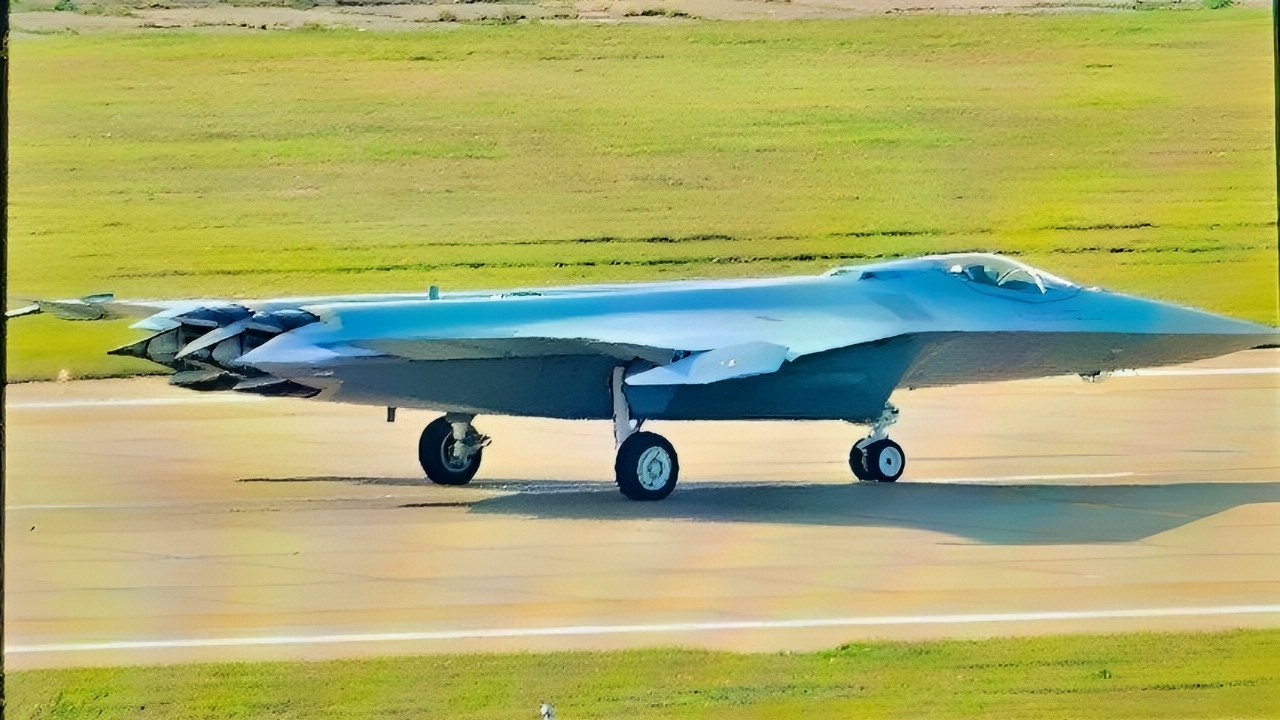
J-50 Fighter Image from X
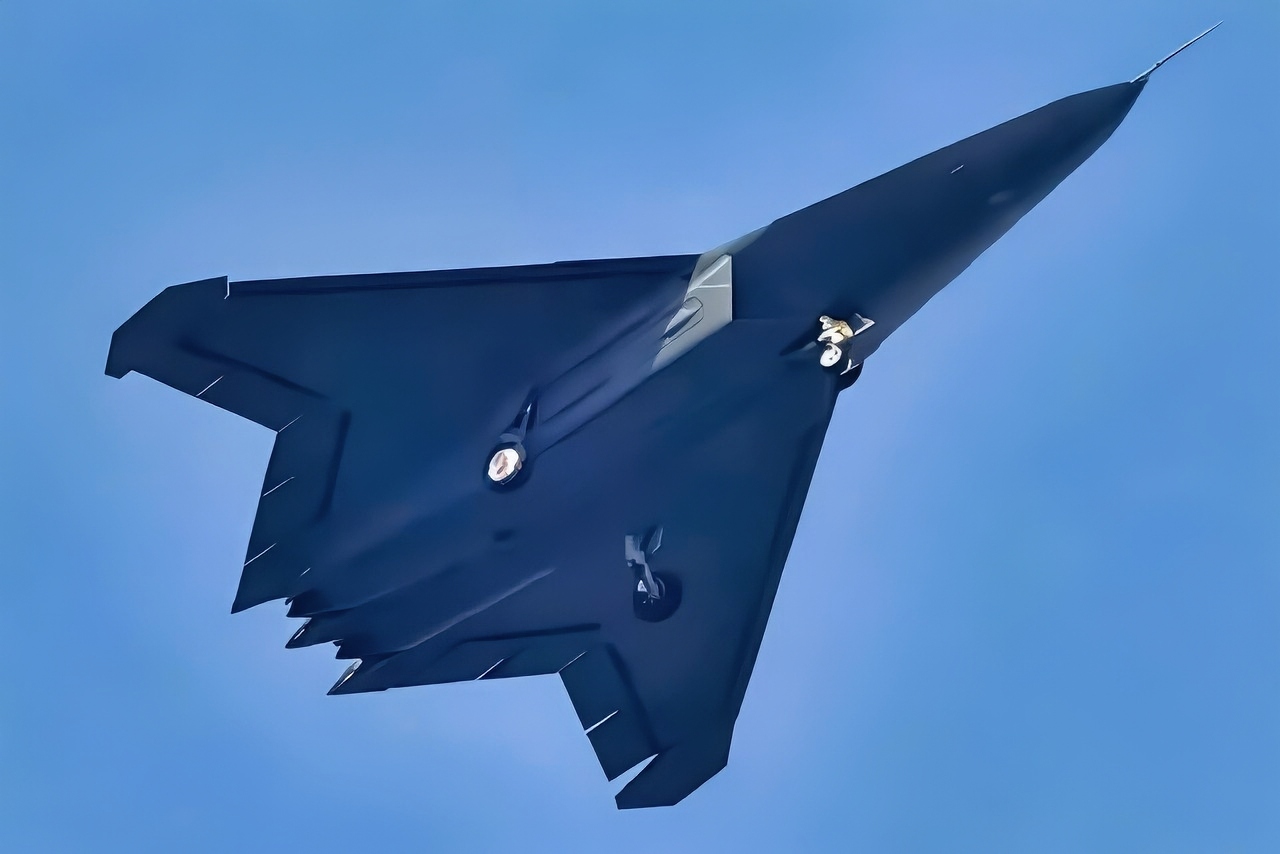
J-50 Fighter from China Weibo Image
The J-50’s control surfaces and possibly thrust-vectoring exhaust nozzles offer maneuverability while preserving stealth characteristics, as does the jet’s presumed large internal weapon bay.
Given the aircraft’s relatively large size, long-range interceptions and bomber escort could be potential applications for the J-50.
J-36 Chengdu
China’s J-36 is widely regarded as a heavy fighter with multi-mission capabilities, including long-range strike, air superiority, and potential utility as a command and control aircraft, which is beneficial for manned-unmanned teaming.
The J-36’s large size appears to prioritize range and payload, which are valuable for internal ordnance storage and accommodating large amounts of fuel. Interestingly, the J-36’s crew sits side by side in a tandem cockpit, and, unlike virtually all current fixed-wing aircraft, the J-36 is a three-engine aircraft.
It sports a dorsal air intake on top of the airframe, located at the rear of the cockpit.
WJ-700
China’s WJ-700 is a high-altitude, long-endurance (HALE) unmanned aircraft designed to provide persistent intelligence, surveillance, and reconnaissance capabilities, as well as strike capabilities.
To that latter end, the WJ-700 can be outfitted with air-to-surface munitions and guided missiles, and sufficient fuel to remain airborne for long periods of time.
It is operationally and visually not dissimilar to similar American aircraft, notably the Reaper and Predator drones that featured heavily during the Global War on Terrorism.
What Happens to China’s Air Force Now?
Taken all together, these platforms provide evidence of a multi-layered strategy: large AEW&C aircraft, such as the KJ-3000, and HALE UAVs, like the WJ-700, along with other aircraft, provide a persistent battlefield management and sensor presence that can gather vast amounts of important information from the sky and relay it onward to other fighters.
China’s upcoming generation of stealth fighters, such as the J-20 and the aforementioned J-35, J-50, and J-36, provide the ability to penetrate contested airspace and secure air superiority for strikes against high-value targets.
When operating in tandem with unmanned Loyal Wingmen-type aircraft, these effects are amplified, making battlefield decisions even more complex.
Aside from questions about which generation each individual aircraft falls into, what is more clear is that China’s abilities in the air are clearly on the up-and-up: becoming stealthier, farther-ranged, and with an increasingly capable sensor and weapon suite.
About the Author: Caleb Larson
Caleb Larson is an American multiformat journalist based in Berlin, Germany. His work covers the intersection of conflict and society, focusing on American foreign policy and European security. He has reported from Germany, Russia, and the United States. Most recently, he covered the war in Ukraine, reporting extensively on the war’s shifting battle lines from Donbas and writing on the war’s civilian and humanitarian toll. Previously, he worked as a Defense Reporter for POLITICO Europe. You can follow his latest work on X.
More Miliary
The U.S. Navy’s Constellation-Class Crisis Boiled Down to 4 Words
The F-20 Tigershark Light Fighter Boiled Down to 4 Words
China Claims New J-35 Stealth Fighter Is ‘Invisible’
The 5 Greatest U.S. Navy Aircraft Carriers Of All Time
The Navy’s New Ford-Class Aircraft Carriers Can’t Hide All The Problems Anymore


