


Key Points and Summary – This piece argues that five U.S. Navy aircraft carrier classes are one evolving idea.
-Essex delivered mass, repairability, and deck-edge flow to win a global war.
-Midway hardened the deck and systems for jets.

Image Credit: U.S. Navy.
-Forrestal designed the angled deck, steam catapults, and weapons flow into the hull for sustained tempo.
-Nimitz added nuclear endurance and industrial reliability so the model worked worldwide for decades.
-Ford rewires the airfield—EMALS, AAG, smarter weapons elevators, island shift—to boost throughput while shrinking crew.
-Together they prove a carrier is an airfield wrapped in a ship, built for tempo, resilience, and upgrade space for years ahead.
The Five Best U.S. Navy Carrier Classes—A Single, Evolving Idea Told Five Ways
If you look at the U.S. Navy’s carriers as five separate “winners,” you miss the magic.
Essex, Midway, Forrestal, Nimitz, and Ford are really one conversation stretched across eight decades: how do you turn a moving slab of ocean into the most reliable, lethal, and adaptable airfield on Earth—and then do it again when aircraft get heavier, missions get longer, and threats get meaner?

The world’s largest aircraft carrier USS Gerald R. Ford (CVN) 78 and the USNS Laramie (T-AO-203) conduct a refueling-at-sea in the Eastern Mediterranean Sea, Oct. 11, 2023. USS Gerald R. Ford is the Navy’s newest and most advanced aircraft carrier, representing a generational leap in the U.S. Navy’s capacity to project power on a global scale. The Gerald R. Ford Carrier Strike Group is currently operating in the Eastern Mediterranean Sea, at direction of the Secretary of Defense. The U.S. maintains forward deployed ready and postured forces to deter aggression and support security and stability around the world.(U.S. Navy photo by Mass Communication Specialist 2nd Class Jackson Adkins)
Each class answers the same question with the tools of its day and leaves room for tomorrow’s answer. That is why these five belong together.
Below, we’ll take them in a narrative arc rather than a strict ranking: where each came from, what it changed, what it made possible, and how the next class picked up the thread.
Essex-Class: The Wartime Workhorse That Made the American “Big Deck” Real
Essex wasn’t designed to be romantic. It was designed to be built—quickly, repeatedly, and with enough margin that a hard-hit ship could be mended, upgraded, and sent back out. That is its greatness. Essex took the lessons of Ranger and Yorktown—centerline elevators, hangar arrangements, radar control just coming into its own—and scaled them into a platform the Navy could multiply across the Pacific. The hull lines delivered thirty-plus knots and a steady deck, the machinery was robust and familiar to yard workers, and the layout got better as wartime refits rolled in.
The headline change that future generations would copy wasn’t glamorous: moving heavy aircraft without punching holes in the strength deck. The deck-edge elevator, pioneered in this era and then refined relentlessly, is a small miracle of carrier design. It freed the flight deck to be what it must be—a runway, not a crossroads—and let the ship choreograph launches and recoveries with fewer traffic jams and fewer ways to make a dangerous day more dangerous.
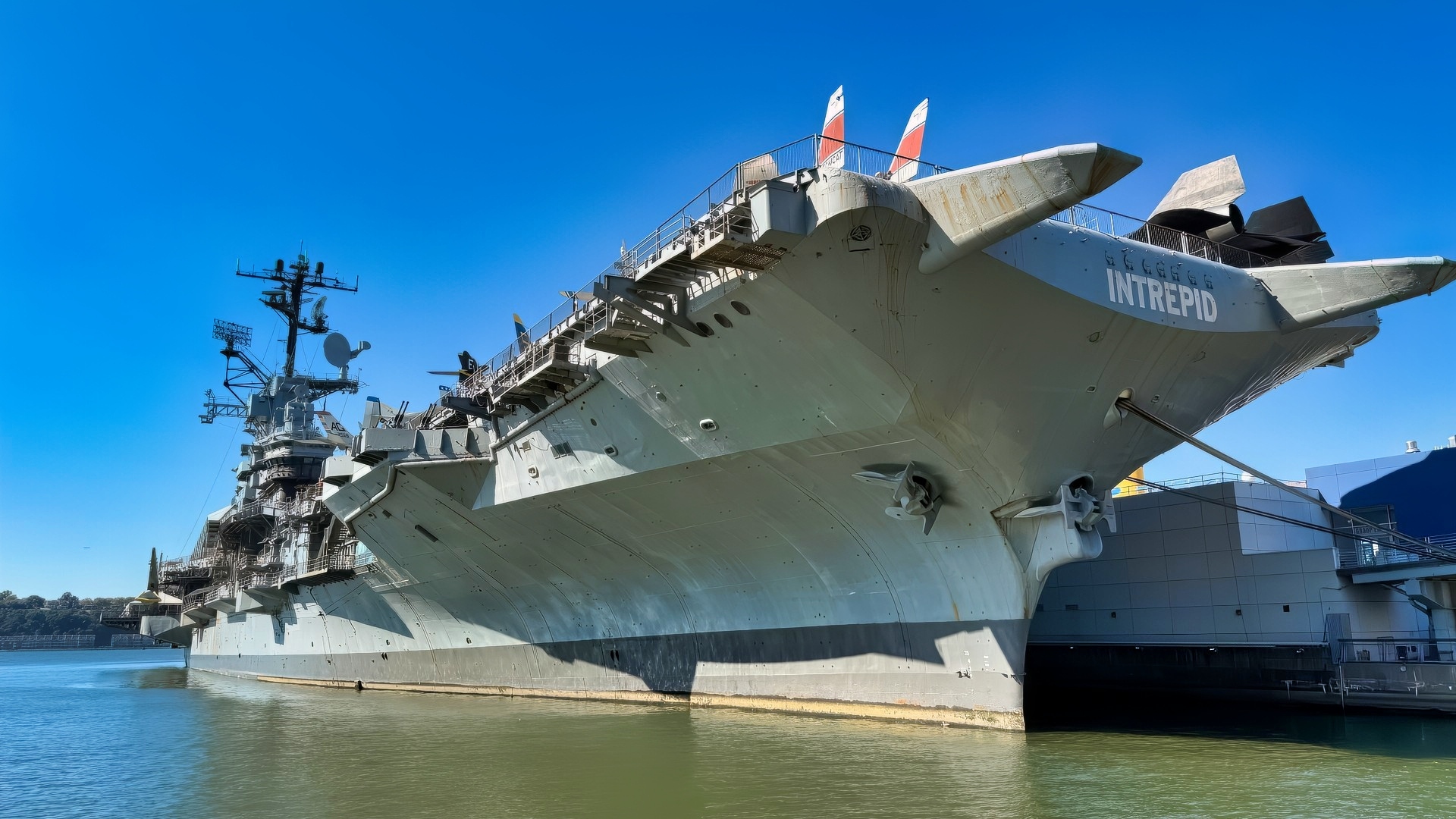
USS Intrepid Essex-Class National Security Journal Original Image. Taken by Jack Buckby on 9/18/2025.
Equally important was everything Essex taught the Navy about systems thinking. Radar direction, fighter direction, and ordnance handling matured together. The result wasn’t just that Essex could launch more airplanes; it could launch the right airplanes, on time, with the right weapons, and recover them without turning the hangar into a scrapyard. The class’s combat record—Central Pacific, Philippines, Okinawa—reads like a campaign plan made possible by repeatable engineering.
Essex also proved the value of volume and margin. After the war, when jets began landing hot and heavy, several ships received angled decks and stronger cats, and kept serving—into Korea and, for some, into Vietnam. That ability to accept a new era without starting from scratch is the essential American carrier trait. Essex invented it.
What the next class took from Essex: the conviction that the flight deck is the ship’s main battery and that you design the ship around moving aircraft, weapons, and fuel with as few crossed streams as possible. Also: always build in growth space and power, because naval aviation never stops getting heavier and hotter.
Midway-Class: From Piston to Jet—A Heavy Deck That Could Take the Punch
Midway looks like it belongs to another species because, in a way, it does. Conceived during World War II but completed just after, Midway brought a bigger, heavier, stronger flight deck and a displacement leap that anticipated jet behavior long before the air wing fully arrived. If Essex is the “just right” wartime machine, Midway is the first serious attempt to future-proof the runway at sea.
You see the shift in the steel. A stronger flight deck made with the jet’s brutal sink rates in mind; arresting gear that traded brute force for precise, predictable energy absorption; and catapults that grew from stopgaps into permanent muscle. The 1950s transformations—angled decks, steam catapults, and deck-edge elevators as standard practice—didn’t just make Midway usable in the jet age; they established a choreography that let a carrier launch forward and along the waist while simultaneously recovering on the angle. That “race track” geometry is the heartbeat of every American big deck since.

Midway-Class. Image Credit: Creative Commons.
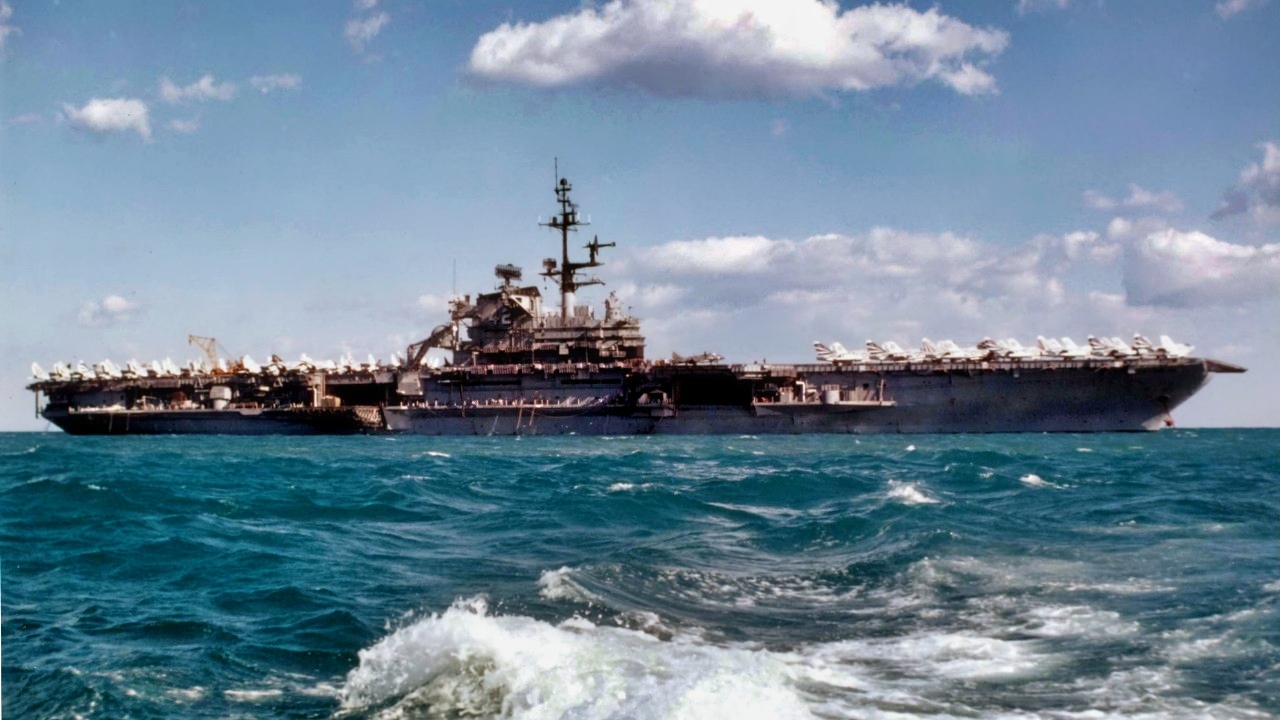
Midway-Class Aircraft Carrier. Image Credit: Creative Commons.
Midway’s operational life is a catalog of adaptation. Through the 1960s and 70s the ship cycled air wings that looked nothing like their 1940s ancestors: A-4s giving way to A-7s, Phantoms to Tomcats on other ships, Intruders bringing all-weather strike, Hawkeyes extending the carrier’s radar horizon. The 1970s–80s upgrades deepened magazines, modernized electronics, and improved deck cooling and jet blast management so the ship could run hotter, longer cycles. In 1991, USS Midway capped the story by flying early Desert Storm strikes—proof that a hull laid down for one era could, with enough design headroom, still matter in another.
Midway’s greatness isn’t that it was perfect; it’s that it absorbed the jet age without losing the deck’s rhythm. It scaled up everything Essex proved—deck flow, weapons handling, flight control—and hardened it so jets didn’t break the ship. The Navy learned that the flight deck itself must be the stiffest, strongest structural element—a literal strength deck—so the rest of the ship could flex around it.
What the next class took from Midway: the angle and the cats as organizing principles, not retrofits; the deck as strength deck by design; and the idea that you must treat the ship as an airfield with its own internal highways for weapons and fuel, not just a hangar with a runway on top.
Forrestal-Class: The First True American Supercarriers—Jet Ops Designed-In
With Forrestal, the Navy stopped adapting old ships to jet operations and designed a ship around jet operations. The angle wasn’t an add-on; the four steam catapults weren’t compromises; the island wasn’t wherever it fit—its placement optimized airflow, line of sight, and control. The deck-edge elevators were sized and sited to move fighters and attack jets without crossing busy landing areas. Weapons moved along protected, efficient paths below, and the whole ship was wired to treat sortie generation as the metric that mattered most.
This was the first class to fully internalize the hard lesson from the canceled postwar “bomber carrier” concept: a carrier is not a hull that happens to carry airplanes; it is an airfield wrapped in a ship. Forrestal made the airfield the ship’s reason for being, structurally and operationally. The result was a class that could generate more cycles, with fewer dead moments between them, and sustain that pace day after day.
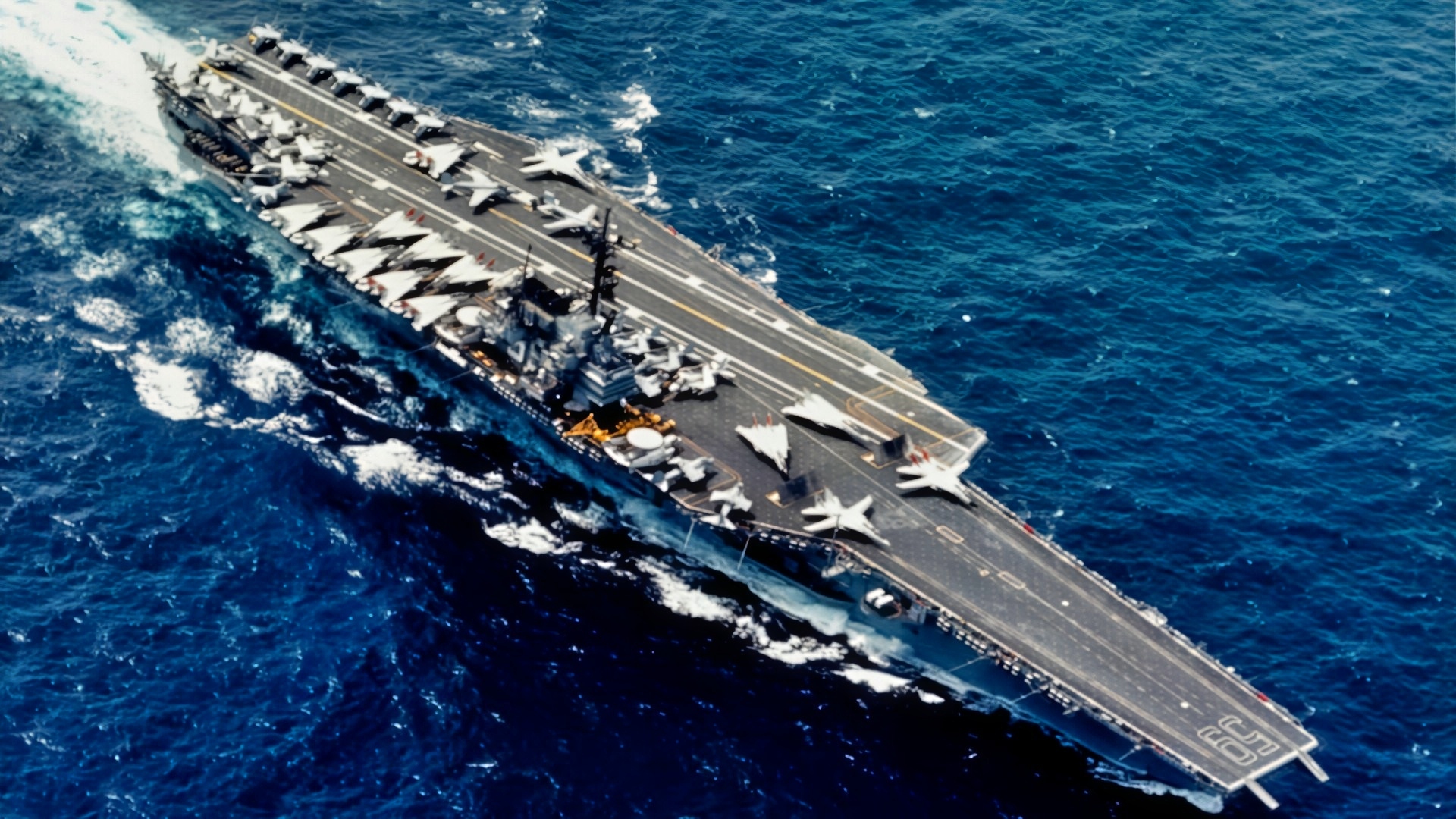
USS Forrestal Aircraft Carrier. Image Credit: Creative Commons.

USS Forrestal. Image Credit: Creative Commons.
Forrestal’s influence also comes from pain. The catastrophic 1967 fire aboard USS Forrestal rewrote the Navy’s approach to ordnance sequencing, flight-deck firefighting, training, and survivability. The class (and its near-siblings) became the carriers on which those reforms were implemented, tested, and then exported across the fleet. You can measure the success in the dullest possible way: fewer mass-casualty deck incidents in the decades that followed, despite more complex operations with hotter, heavier jets.
Operationally, Forrestal-class ships proved the supercarrier idea from Vietnam through the late Cold War. They launched and recovered cyclic ops at a scale that joined strategy to steel: when a carrier group showed up, it stayed—and kept tempo the entire time. That constancy of power projection is a defining American contribution to naval history, and Forrestal is where it becomes routine rather than aspirational.
What the next class took from Forrestal: the deck plan, the below-decks weapons/fuel “arteries,” and the doctrine that the entire ship exists to keep the deck’s choreography smooth. The next leap would be to give that choreography the endurance to live far from logistics for a very long time.
Nimitz-Class: Nuclear Endurance and Industrial Reliability at Global Scale
Nimitz takes the Forrestal pattern and removes its two biggest performance governors: ship fuel and electrical headroom. With two reactors, a Nimitz-class ship can run the airfield at sea for months without taking on ship’s fuel, and every gallon you don’t have to move to the carrier as fuel can be another pallet of weapons or spares for the air wing. That single change rearranges the entire strike group’s logistics, giving planners freedom to route, sprint, loiter, and surge in ways a conventional ship always pays for at the oiler.
Just as important—and less visible—is the industrial reliability story baked into ten hulls built over decades. The Navy and Newport News learned how to insert improvements without breaking the template: stronger cats and arresting gear as aircraft grew in weight, smarter jet blast deflectors and deck cooling to handle hotter exhaust, upgraded radars and combat information centers that fused more data into cleaner pictures for the captain and air boss. Magazines gained smarter handling systems; weapons elevators lifted more with fewer sailors; the island’s nerve center became a better brain every refit.

Norfolk Naval Shipyard welcomed USS George H.W. Bush (CVN 77) for a Planned Incremental Availability Jan. 11. In addition to equipment maintenance, this availability will improve ship safety along with communications and combat system upgrades.

(Jan 31, 2009) An F/A-18 Super Hornet assigned to the “Tomcatters” of Strike Fighter Squadron (VFA) 31 launches from the flight deck of USS Theodore Roosevelt (CVN 71). The Nimitz-class aircraft carrier and embarked Carrier Air Wing (CVW) 8 are operating in the 5th Fleet area of responsibility and are focused on reassuring regional partners of the United States’ commitment to security, which promotes stability and global prosperity (U.S. Navy photo by Mass Communication Specialist 3rd Class Jonathan Snyder/Released)
Because the design had volume and electrical margin, the class could absorb generational air-wing change: Phantoms and Intruders giving way to Tomcats and A-6Es, then F/A-18C/D Hornets, then Super Hornets, Growlers, and now F-35Cs. The ship didn’t need a new skeleton every time the wing changed its muscles. That is design discipline at carrier scale.
Nimitz is also where the modern idea of the Carrier Strike Group matures. Escorts optimized around air defense and long-range strike plug into the carrier’s battle rhythm; the E-2 Hawkeye becomes the wing’s quarterback; and joint networks let the ship fight as a node in something bigger. From Iran 1980 to Desert Storm, from the Balkans to Enduring Freedom and Inherent Resolve, the class proved that a big deck could be the centerpiece not just of a fleet, but of global strategy.
What the next class took from Nimitz: the same deck logic—but with a determination to reduce the manning and maintenance cost of the deck’s muscles and to build even more electrical and modernization headroom into the ship from day one.
Ford-Class: Rewiring the Airfield—More Throughput, Fewer Bottlenecks, Built-In Headroom
Ford is the first aircraft carrier class to look at the airfield’s energy flows and say: steam is not the future. EMALS (electromagnetic catapults) replaces steam with precise electric launch, improving control of end speed across a wider aircraft weight range, including light, unmanned aircraft that steam cats handle awkwardly. AAG (advanced arresting gear) brings the same logic to recoveries, absorbing and returning energy with exquisite control. To the pilot, a good trap is a good trap; to the ship, these systems promise lower maintenance, better diagnostics, fewer people, and steadier tempo once matured.
Ford also moves things you can see. The island shifts aft and slightly outboard, opening a cleaner expanse of flight deck forward for staging and turning aircraft. The Advanced Weapons Elevators pull ordnance up and forward along protected paths, away from the deck’s busiest lanes, which reduces the lift-and-carry burden on sailors and removes chokepoints that used to throttle the cycle. Below decks, the electrical plant and distribution aren’t just larger; they are designed with growth headroom for sensors, power-hungry defensive systems, and whatever needs a megawatt that future combat systems will demand.

The world’s largest aircraft carrier, USS Gerald R. Ford (CVN 78), conducts flight operations in the North Sea, Aug. 23, 2025. Gerald R. Ford, a first-in-class aircraft carrier and deployed flagship of Carrier Strike Group Twelve, is on a scheduled deployment in the U.S. 6th Fleet area of operations to support the warfighting effectiveness, lethality, and readiness of U.S. Naval Forces Europe-Africa, and defend U.S., Allied and partner interests in the region. (U.S. Navy photo by Mass Communication Specialist 2nd Class Maxwell Orlosky)
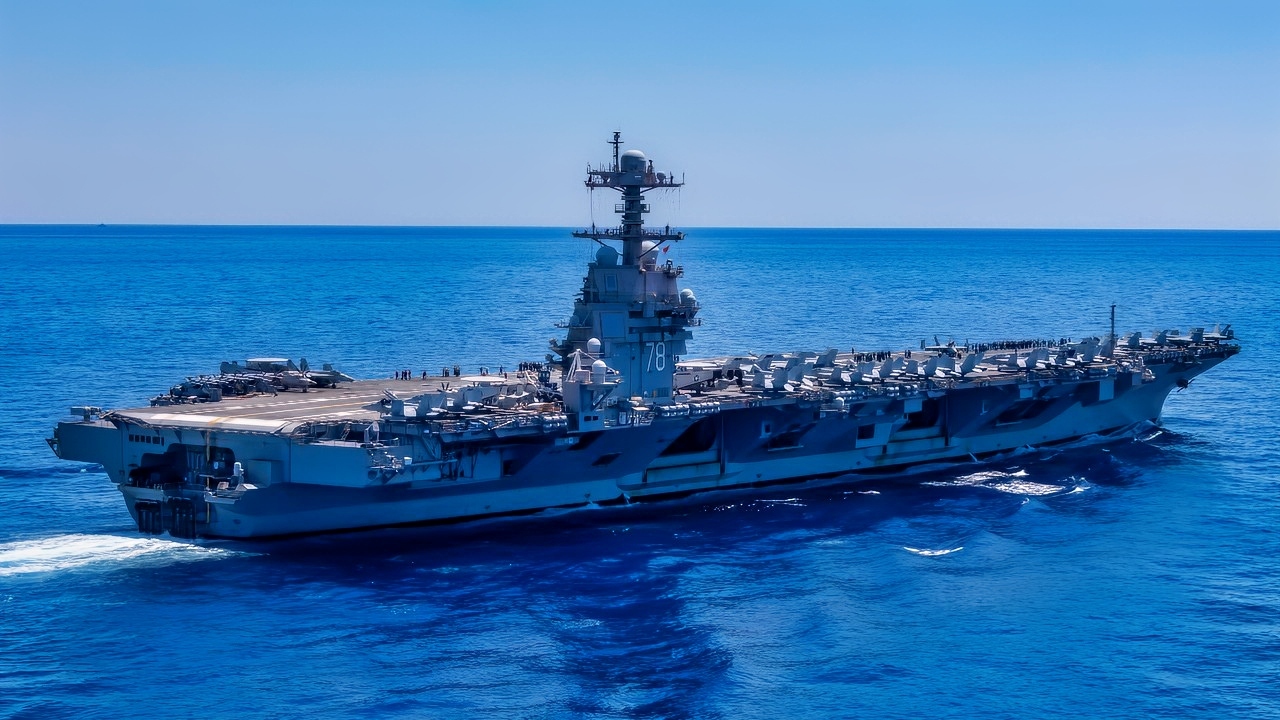
The world’s largest aircraft carrier, USS Gerald R. Ford (CVN 78) transits the Mediterranean Sea, August 1, 2025. Gerald R. Ford, a first-in-class nuclear aircraft carrier and deployed flagship of Carrier Strike Group Twelve, is on a scheduled deployment in the U.S. 6th Fleet area of operations to support the warfighting effectiveness, lethality, and readiness of U.S. Naval Forces Europe-Africa, and defend U.S., Allied, and partner interests in the region. (U.S. Navy photo by Mass Communication Specialist Seaman Brianna Barnett)
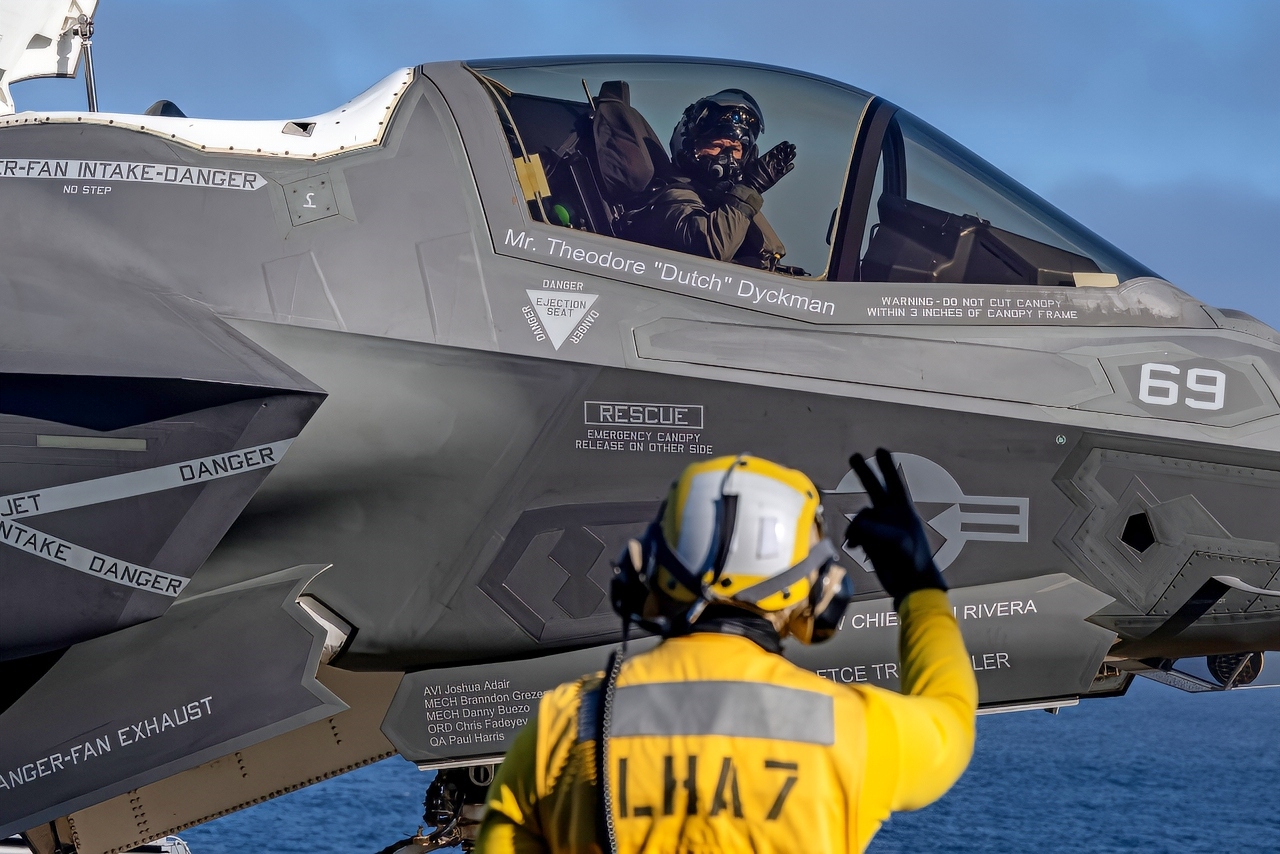
A joint team consisting of F-35 Patuxent River Integrated Test Force flight test members, U.S. Sailors and Marines, and the crew of the Japan Maritime Self-Defense Force Izumo-class multi-functional destroyer JS Kaga (DDH-184) are executing developmental sea trials in the eastern Pacific Ocean to gather the necessary data to certify F-35B Lightning II short takeoff and vertical landing aircraft operations. While aboard the MSDF’s largest ship, the Pax ITF flight test team has been gathering compatibility data for analysis in order to make recommendations for future F-35B operational envelopes, further enhancing the Japanese navy’s capabilities. The results of the testing will contribute to improved interoperability between Japan and the United States, strengthening the deterrence and response capabilities of the Japan-U.S. alliance and contributing to peace and stability in the Indo-Pacific region. Japan is an F-35 Joint Program Office foreign military sales customer planning to purchase 42 F-35Bs. The F-35 Joint Program Office continues to develop, produce, and sustain the F-35 Air System to fulfill its mandate to deliver a capable, available, and affordable air system with fifth-generation capabilities.
The class’s first-of-type challenges are real and well-publicized: weapons-elevator certification took time; EMALS and AAG reliability numbers had to climb out of the lab and onto the flight schedule; software and “human factors” wrinkles took sorting. But watch a Ford run long cyclic ops and you see the underlying bet paying out: shorter cycle times, smoother deck movement, fewer visible manning spikes, and a ship that feels like it was designed to be upgraded in place, not replaced.
Where Nimitz used nuclear power to free the ship from fuel logistics, Ford uses electrification and automation to try to free the airfield from manpower and maintenance drag, while keeping the door wide open for the unmanned systems and directed-energy defenses that are moving from theory to kit.
What Ford inherits from Nimitz and amplifies: the conviction that a carrier lives or dies by throughput per hour per sailor—and the insistence on building a plant and deck plan that can embrace future air-wing shapes without surgery.
How They Build on One Another—One Big Idea, Five Iterations
If you drew a single curve over these five aircraft carrier classes, it would track three things:
Deck as Main Battery: Essex discovered that aircraft flow is the whole game; Midway hardened the deck to survive jets; Forrestal codified deck geometry and below-decks arteries for high-tempo ops; Nimitz proved the template could be built again and again and improved without breaking; Ford rewired the muscles so the same choreography can go faster with less strain and more kinds of aircraft.
Margin and Headroom: Every class added space—literal cubic feet, electrical power, magazine depth, cooling capacity—and then spent it on new air-wing demands without wrecking the schedule. That discipline kept carriers relevant as aircraft doubled in weight, as weapons went from dumb iron to networked precision, and as sensors shifted from analog scopes to fused, software-defined suites.
Survivability through Operations: American carriers don’t win because they are indestructible; they win because they keep operating under stress. Essex taught redundancy and repair in combat; Midway made jet operations routine and safer; Forrestal’s hard-learned firefighting and ordnance handling became doctrine; Nimitz spread industrial reliability across ten ships; Ford makes reliability a design requirement for the deck’s largest machines.
There are other great U.S. carrier classes, of course. Enterprise taught the Navy how to live with nuclear propulsion at sea; Kitty Hawk refined Forrestal’s logic across three formidable ships. But if you want the backbone—the five chapters you need to understand why U.S. carriers look and fight the way they do—these are the ones.
Why These Five Still Matter in the Missile Age
A fair question hangs over any discussion of carriers today: missiles fly farther, faster, and smarter than ever; satellites and sensors shrink the ocean; why celebrate big decks now? The answer is the same one these five classes keep giving: a carrier is not just a runway. It is a network node that generates and sustains complex air operations from anywhere blue water touches. It brings fighters, early-warning aircraft, tankers, electronic attack, helicopters, and (increasingly) unmanned systems and ties them into a single, repeatable rhythm that allies can plug into and adversaries must plan around. No other ship does that, hour after hour, month after month, without someone else’s permission to use their land.
Essex proved that a carrier built in numbers could win a global war; Midway proved you could scale the idea into the jet age; Forrestal made the deck’s choreography the center of the ship; Nimitz took that choreography worldwide with endurance and reliability; Ford keeps the tempo high while preparing for a mixed manned-unmanned air wing and power-hungry defenses. If the ocean is a chessboard, these five are what let the United States put a queen on it—today, not in six months when basing is negotiated.
That continuity matters. The technology changes; the idea does not.
Closing Thought on the 5 Best Aircraft Carriers: One Airfield, Many Faces
Stand on Essex’s deck in 1944, on Midway’s in 1965, on Forrestal’s in 1972, on Nimitz’s in 1991, on Ford’s in 2025, and the view fools you. You see a strip of non-skid, a lineup of aircraft, a sea of helmets and wands, and a horizon that hasn’t moved an inch since the first sailor named it. But the airfield beneath your boots—its power, plumbing, sensors, nerves, and muscle memory—has been reinvented five times without losing a beat.
That, more than any one metric, is why these five classes are the best. They made the American big-deck carrier not just a ship type, but a method—a way of turning steel and sailors into a living airfield that learns faster than the threats do. And then they handed that method forward.
About the Author: Harry J. Kazianis
Harry J. Kazianis (@Grecianformula) is Editor-In-Chief and President of National Security Journal. He was the former Senior Director of National Security Affairs at the Center for the National Interest (CFTNI), a foreign policy think tank founded by Richard Nixon based in Washington, DC. Harry has over a decade of experience in think tanks and national security publishing. His ideas have been published in the NY Times, The Washington Post, The Wall Street Journal, CNN, and many other outlets worldwide. He has held positions at CSIS, the Heritage Foundation, the University of Nottingham, and several other institutions related to national security research and studies. He is the former Executive Editor of the National Interest and the Diplomat. He holds a Master’s degree focusing on international affairs from Harvard University.
More Military
No, You Can’t Make the A-10 Warthog Stealth
‘Flying Dorito’ A-12 Avenger II Aircraft Carrier Stealth Bomber Nightmare Had to End
The U.S. Navy’s Big F-15N Sea Eagle Fighter Mistake Still Stings


Gary Shoemaker
October 6, 2025 at 4:57 pm
I disagree. You left off the list the most important class, the Enterprise (CVN 65) class. While there was only one built, it proved the operational viability of nuclear propulsion which led to the design of the Nimitz class carriers. Additionally, the Big E was the face of the nuclear carrier age for decades. While the class was one, she did more to create the Nimitz and Ford classes than any other carrier class before her. It’s a shame you don’t see that.
Carol Walter
October 6, 2025 at 10:19 pm
Hey what about “The Super Sara” CVA 60. USS Saratoga? She was a wonder in it’s day!!
My brother Dan Fortney, served on the flight deck on the catapults.
She was a marvelous ship in her day!
Dave Wegner
October 6, 2025 at 11:33 pm
As a former crewmember on USSEnterprise, 5/71- 9/73, and a Nuc, I must echo exactly what Gary Showmaker said. Thank you Gary.Henry should do a little better research.
BRIAN K MCNEIL
October 7, 2025 at 2:59 pm
Nice article, but you Skipped the Kitty Hawk, JFK, and Enterprise Class carriers.
Gary Spector
October 7, 2025 at 3:30 pm
I noticed 2 titles with this article. 1st was to list the 5 best Aircraft Carriers and the 5 best classes of Aircraft Carriers. Some how, in both, you skillfully skipped over the Enterprise. In WW1, one of, if not the most decorated Carrier was CV-6 (6th Aircraft Carrier built but the 7th vessel in the US Navy to have that name), then to be outdone by CVN-65. If you just want to focus on class, CVN-65 was the 1st nuclear powered Aircraft Carrier.
On the list of Top 5 best, CV-6 was the only Yorktown to survive WW2.
With CVN-80, it will be the 9th vessel to have that name. With that lineage alone, it deserves its place in history as well as our future.