

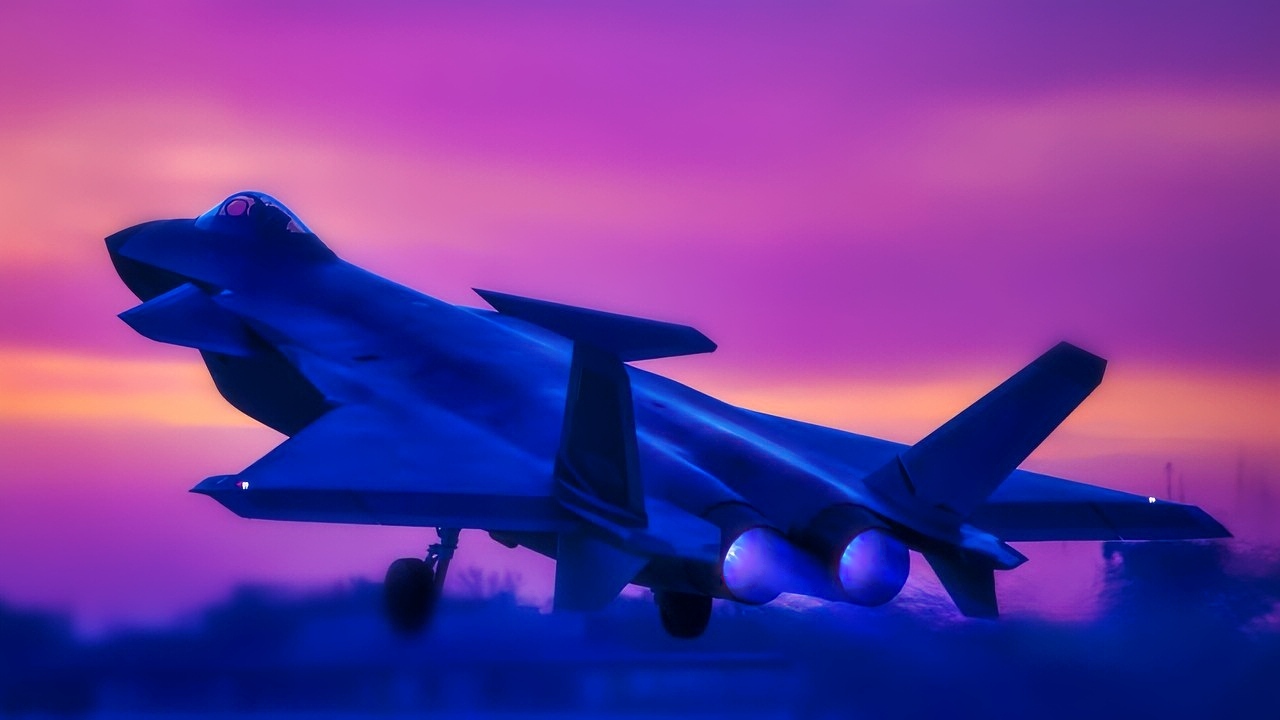
Key Points and Summary – Chinese state media have claimed that a J-20, the “Mighty Dragon” stealth fighter, flew undetected through the heavily monitored Tsushima Strait near Japan on July 27.
-U.S., Japanese, and South Korean radar networks constantly survey this strategic chokepoint.
-If the claim is valid, it represents a significant display of the J-20’s stealth capabilities and a potential intelligence failure for the West.
-While technical analysis suggests the F-35 should maintain a detection advantage, this alleged flight challenges those assumptions and signals that China may be closing the stealth technology gap faster than previously believed.”
China’s J-20 Stealth Fighter Made History
WARSAW, POLAND – Beijing conducted another military publicity stunt in the run-up to the Sept. 1 anniversary of Japan’s surrender in World War II. Chinese media outlets reported that a People’s Liberation Army Air Force (PLAAF) fifth-generation Chengdu J-20 stealth fighter made a flight through the strategic Tsushima Strait near Japan. This is an apparent first for the aircraft, and this flight was not reported by any other armed force in the region, several of which have the surveillance systems to detect it.
The flight was reported during an episode of a series that airs on the state-run China Central Television (CCTV) network. The flight took place on Sunday, July 27, with the network showing footage of the J-20 and reporting on July 29 that the elite 1st Aviation Brigade of the PLAAF now “flies missions over the Bashi Channel and Tsushima Strait, and conducts patrols around Taiwan.”
This particular PLAAF unit was among the first to receive the J-20. As could be expected given Chinese state secrecy, the CCTV broadcast never actually refers to the J-20 specifically. However, the report did make extensive use of footage of the aircraft and made no attempt to hide its shape, dimensions, and performance. Anyone who is familiar with the J-20 and knows its overall configuration would have no doubt about which fighter the report was discussing.
The J-20 first flew in January 2011, and it has been seen several times at public air shows in China, most notably at Air Show China in Zhuhai, Guangdong Province.
The Ghost Flight: J-20 Fighter Passing Through Undetected
The J-20 is much more readily identifiable than China’s other stealth aircraft, the Shenyang J-35. The 1st Aviation Brigade has also taken delivery of the J-35, making it the only unit in the PLAAF to operate both stealthy Chinese fighter types.
This unit was picked to fly through the Tsushima Strait because the latter is a narrow waterway with strategic value for all nations in the region. It separates South Korea from Japan, and it is a chokepoint that connects the Sea of Japan with the East China Sea. It is one of the most heavily monitored passages in the region.
The strait is well within the range of air defense radar networks operated by the U.S. military, the Japan Self-Defense Forces, and the ROK Air Force. The air and missile defense units covering the waterway include the U.S. THAAD anti-missile system installed in Seongju, South Korea, in 2016.
All of this is why the J-20’s transit through the waterway is so significant. The aircraft is China’s most advanced stealth fighter, and it appears to not have been detected by any of the nations in the region with surveillance radars trained on the strait 24 hours a day. If they did somehow manage to detect its presence, they are apparently not saying anything about it.
A Lower RCS Than Previously Thought?
Radar signature specialists in Taiwan claim to have calculated the radar cross section (RCS) of the J-20 based on what they have seen of the aircraft, plus what they have been able to record with their own radar installations.
According to their calculations, when the J-20 is “painted” by incident rays of 10GHz at a 90-degree angle – meaning from the side of the aircraft – there is a radar return with an RCS of approximately 5 square meters. In the frontal hemisphere, the RCS is calculated at 0.05 square meters, and from the rear aspect it is 20 square meters.
The J-20 is a much larger aircraft than the F-35, so the RCS of the Chengdu aircraft would always be greater than the F-35’s. The J-20 has a triangular design and a much wider frame, two large engines, and moveable canard foreplanes – all of which increase its RCS.
The J-20 is equipped with radar-absorbing material that is supplemented with electronic countermeasures (ECM) to significantly reduce the range at which the aircraft can be detected on radar.
The F-35 is rated as having an RCS equal to that of a metal golf ball, or about 0.0015 square meters.
This gives the F-35 a lower RCS than the F-117A. If the J-20 has a radar cross section of about 0.01 square meters, then it has an RCS between four and ten times larger than the F-35, depending on the aspect in which the radar tracking it is working. Using equally capable radars, the U.S. fighter would detect the J-20 at twice the distance from which the J-20 could identify it.
Fighters cover about 2 miles of distance every ten seconds when flying at the speed of sound. If two airplanes are flying at one another head-on, they would be closing the gap between them at about twice the speed of sound. Roughly, this would mean the lower-RCS F-35 would spot the J-20 about 1-2 minutes before the J-20 could detect the F-35 and obtain a firing solution.
The U.S. aircraft is still stealthier, but Chinese industry will most likely continue to close this gap in the coming years. Much depends on how much more can be wrung out of the F-35’s design by a new generation of on-board ECM and other electronic systems.
About the Author: Reuben F. Johnson
Reuben F. Johnson has thirty-six years of experience analyzing and reporting on foreign weapons systems, defense technologies, and international arms export policy. Johnson is the Director of Research at the Casimir Pulaski Foundation. He is also a survivor of the Russian invasion of Ukraine in February 2022. He worked for years in the American defense industry as a foreign technology analyst and later as a consultant for the U.S. Department of Defense, the Departments of the Navy and Air Force, and the governments of the United Kingdom and Australia. In 2022-2023, he won two awards in a row for his defense reporting. He holds a bachelor’s degree from DePauw University and a master’s degree from Miami University in Ohio, specializing in Soviet and Russian studies. He lives in Warsaw.
More Military
We Almost Touched the F-117 Stealth Fighter


Ammad Rohail
August 2, 2025 at 12:43 pm
I did not really hold your last article on j20 in high esteem because I dint agree with your notion.
With all that years of study, I would presume you would make a better judgement call especially, after the pak/India clash, where Chinese weaponry made a mark that it is far superior than what it is thought of.