

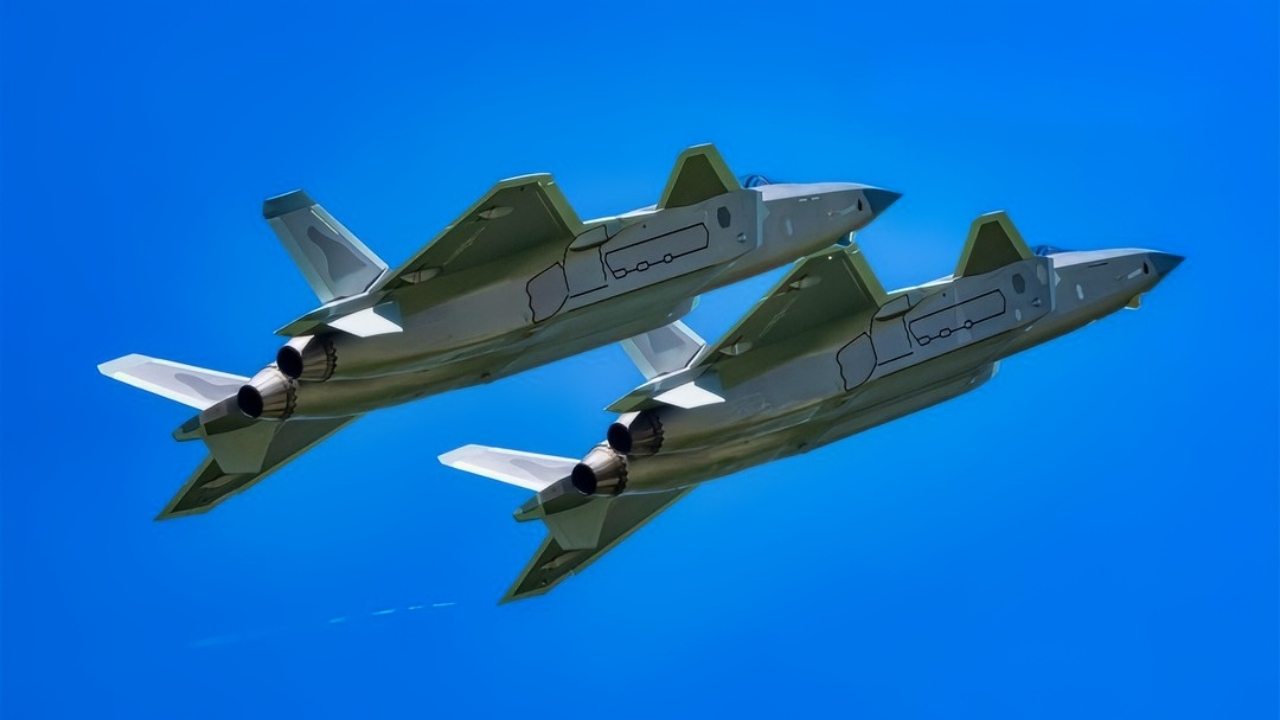
Key Points and Summary – China’s J-20 “Mighty Dragon” has evolved from a suspected F-22 knockoff into a formidable threat to American airpower.
-This analysis highlights five key reasons for its lethality: advanced (though still inferior) all-aspect stealth, a powerful new WS-15 engine enabling it to supercruise faster than the F-22, a sophisticated suite of avionics with 360-degree sensor coverage, a massive payload capacity that dwarfs the F-22’s, and a high production rate that has already put hundreds of the jets into service.
-These features combine to make the J-20 a true strategic asset for Beijing.
China’s J-20 Stealth Fighter Is No Joke
The Chengdu J-20 “Mighty Dragon” is China’s first and most prevalent fifth-generation stealth fighter.
Designed and built in the early 2000s, the J-20 was China’s response to the F-22 and later F-35.
Initially, many dismissed it as a cheap knockoff of the F-22, but as time went on, more and more upgrades were added to the fighter, making it a real threat to American airpower. There are many aspects of the J-20 that makes it a formidable aircraft.
Here, I have chosen the top five aspects which I believe make it so threatening.
Advanced Stealth Features
One of the most defining features of the J-20 is its advanced stealth design. Stealth is a critical component of fifth-generation fighters, allowing them to operate undetected in contested airspace.
While the J-20’s stealth features are considered inferior to those of its American counterparts, it still incorporates a wide range of stealth technology. Its blended wing-body design reduces radar cross-section by eliminating sharp angles and creating smooth transitions between surfaces.
The aircraft also uses diverterless supersonic inlets (DSI), which not only improve airflow efficiency but also reduce radar signature by eliminating the need for complex boundary layer diverters.
Additionally, the J-20 incorporates S-shaped engine intakes that obscure the engine’s compressor blades from radar detection, a technique also used in the F-22. The aircraft is coated with radar-absorbent materials, including advanced nanomaterial-based coatings that are more durable and easier to maintain than those used on earlier stealth aircraft.
While the F-22 may have superior frontal stealth, the J-20 is believed to offer better stealth from side and rear angles, giving it an advantage in multi-directional engagements and enhancing its survivability in dynamic combat environments.
High Performance
Another major strength of the J-20 lies in its propulsion system. The aircraft has undergone several engine upgrades, culminating in the integration of the WS-15 high-thrust turbofan engines.
These engines are designed to rival or even surpass the performance of Western counterparts. Each WS-15 engine produces over 18 tons of thrust, enabling the J-20 to achieve high speeds and rapid acceleration.
One of the most important capabilities enabled by these engines is supercruise. The J-20 can reportedly supercruise at Mach 1.8, slightly faster than the F-22’s Mach 1.7. Its top speed is estimated to be around Mach 2.8, placing it among the fastest operational fighter jets in the world.
The inclusion of thrust vectoring nozzles further enhances the aircraft’s maneuverability, allowing it to perform advanced aerial maneuvers and maintain agility in close-range dogfights. This combination of speed, supercruise, and maneuverability gives the J-20 the ability to engage or disengage from combat at will, dominate in beyond-visual-range (BVR) scenarios, and intercept high-value targets with precision.
Advanced Avionics
Equally important to the J-20’s combat effectiveness is its suite of advanced avionics and sensor fusion technologies. In modern air combat, information dominance is often more decisive than raw firepower.
The J-20 is equipped with an active electronically scanned array (AESA) radar, which provides long-range detection, tracking, and targeting of multiple airborne and ground threats. It also features an electro-optical targeting system (EOTS) that enhances passive tracking and targeting capabilities, especially useful in stealth operations where radar emissions must be minimized.
The aircraft is believed to include a distributed aperture system (DAS), which uses multiple infrared sensors placed around the airframe to provide 360-degree coverage for missile warning, targeting, and situational awareness.
These sensors are integrated through a sophisticated sensor fusion system that presents the pilot with a comprehensive and coherent picture of the battlespace. The J-20 also boasts advanced data-link capabilities, allowing it to share information in real time with other aircraft, drones, and command centers.
These capabilities enable the J-20 to detect and engage threats before being detected itself, operate effectively in network-centric warfare environments, and coordinate complex missions with other assets.
Payload Capacity and Versatility
The J-20’s weapons systems and payload capacity further enhance its versatility and lethality. Although it was designed mainly for air superiority, the J-20 can still perform both air superiority and precision strike missions.
It features internal weapons bays that preserve its stealth profile while carrying long-range air-to-air missiles such as the PL-15 and PL-21. These missiles are equipped with active radar homing and have ranges that exceed those of most Western counterparts, giving the J-20 a significant advantage in BVR combat.
For non-stealth missions, the aircraft can also use external hardpoints to carry additional payloads, including bombs and anti-ship missiles.
The J-20 is capable of deploying precision-guided munitions for ground attack missions, making it effective in both offensive and defensive roles.
It can also be equipped with electronic warfare pods that disrupt enemy radar and communications, further increasing its survivability. With a maximum payload of over 12,000 kilograms, the J-20 can carry more than three times the payload of the F-22, giving it unmatched flexibility in mission planning and execution.
High Production Rates
Finally, one of the greatest strengths of the J-20 Mighty Dragon is its sheer numbers. Unlike some fifth-generation fighters that are produced in limited numbers, the J-20 is being mass-produced, with over 400 units reportedly built.
This scale of deployment transforms the J-20 from a technological showcase into a strategic asset capable of shaping regional power dynamics. This fact is a major point of concern for the U.S. and its regional allies like Taiwan.
Furthermore, the J-20 is constantly being upgraded and improved. Most recently, a twin-seat variant of the J-20 has been spotted and is likely to enter service soon.
The PLAAF has also developed supporting platforms such as electronic warfare aircraft and aerial refueling tankers to extend the J-20’s operational range and effectiveness.
These force multipliers enable the J-20 to operate far from home bases, project power across the Indo-Pacific region, and deter adversaries through a credible and flexible air combat capability.
About the Author:
Isaac Seitz, a Defense Columnist, graduated from Patrick Henry College’s Strategic Intelligence and National Security program. He has also studied Russian at Middlebury Language Schools and has worked as an intelligence Analyst in the private sector.
More Military
We Almost Touched the F-117 Stealth Fighter


