


Key Points and Summary – China’s J-20 Mighty Dragon blends stealth with a “beast mode” loadout, swapping low observability for sheer firepower.
-Recent footage shows eight PL-15 BVR missiles on external pylons, complementing internal bays and the short-range PL-10.
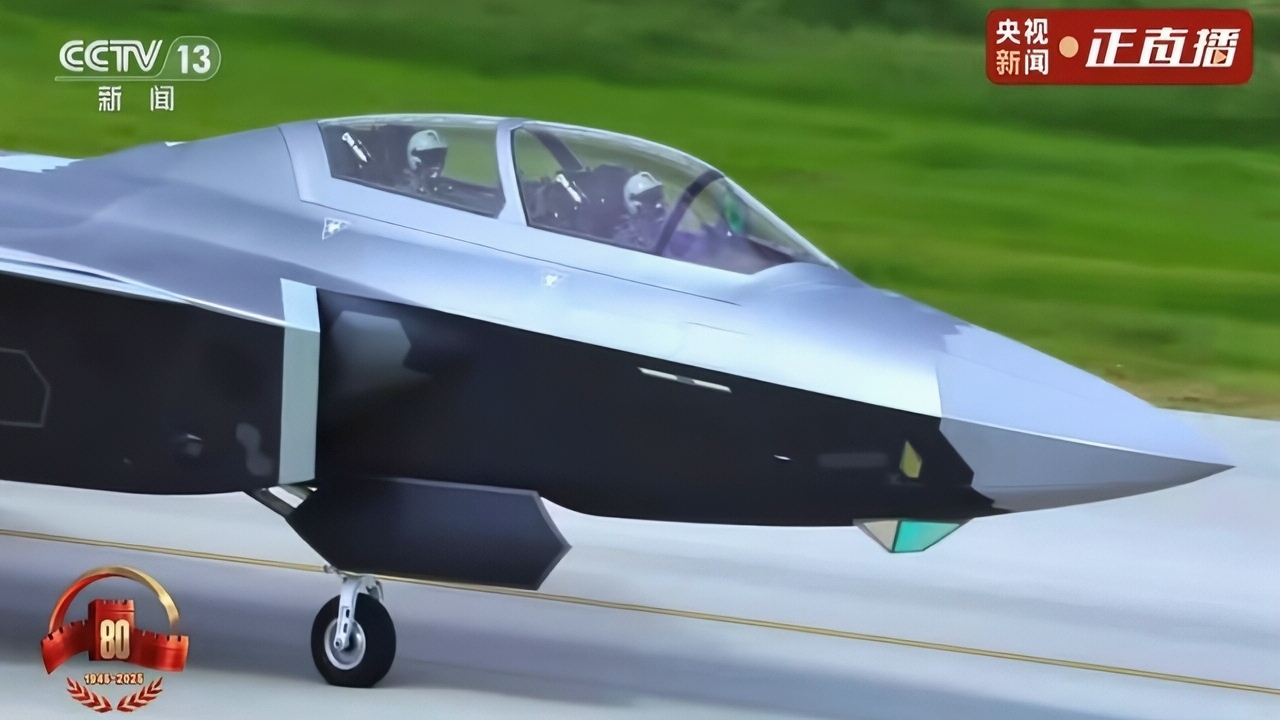
J-20 Fighter CCTV Screen Pull. Imave Credit: Creative Commons.
-The concept lets the PLAAF mass missiles to push back U.S. tankers and AEW platforms and saturate defenses—especially where China holds air superiority.
-Limits remain: no internal air-to-ground bombs, carrier inoperability, and range roughly comparable to an F-35.
-Still, advanced sensors, networking, and growing output—250+ jets and rising—make the J-20 a mounting factor around Taiwan and the first island chain, even if it’s no F-35 peer.
The Chinese J-20 Mighty Dragon “Beast Mode” Bomb Truck
China’s J-20 Mighty Dragon represents a significant leap in the country’s military aviation. The J-20 is a fifth-generation stealth fighter designed to challenge Western air dominance – notably to contend against the U.S. F-22 and F-35.
Aviation experts disagree on whether the J-20 is truly a game-changer – a jet that shifts the global power balance in China’s favor – or whether it is another project whose problems have been glossed over by a government-controlled press. China touts the aircraft’s stealthiness, its domestically built WS-15 engine, and its enormous weapon-carrying capacity.
The J-20 Can Operate In “Beast Mode”
The J-20, with its robust sensors, long-range missiles, and stealth design, poses a serious threat to U.S. Air Force refueling, early warning, and other support planes. Warding off these logistical planes with patrolling J-20s could allow China to keep the U.S. at arm’s length in a conflict.
Although the Chinese claim it is the equivalent of or superior to the American aircraft it would counter in air-to-air combat – fighters such as the F-22 or the F-35 – it may actually serve best as a strike weapon, laden like a bomb truck.

J-20 Fighter with Jet Stream. Image Credit: Weibo.
The term “bomb truck” refers to a mode in which the fighter acts in a non-stealthy, fully loaded configuration. It sacrifices stealth for increased payload, carrying substantial amounts of ordnance externally.
Recently, a video captured a J-20 Mighty Dragon in flight in this so-called Beast Mode, carrying what appear to be eight PL-15 medium-to-long-range air-to-air missiles mounted in pairs on four underwing pylons. The footage follows an earlier screen grab that circulated in late 2023, which had initially drawn questions regarding its authenticity.
While originally designed as a stealth fighter, the J-20’s large internal weapons bay and external hardpoints allow it to carry a wide array of weapons, and some analysts suggest this bomb truck mode signals a key mission for the aircraft, especially in areas where China has established air superiority.
It could also be used in conjunction with other aircraft to knock out an enemy’s defenses. It could be used in this way in Taiwan. The J-20 can carry nearly 28,000 pounds in Beast Mode, which is 10,000 pounds more than a similarly outfitted F-35. It could thus deliver a massive amount of ordnance in a single mission.
However, while the J-20 has a larger internal fuel payload than the F-35, it is also larger. The J-20’s range will be similar to or shorter than the F-35’s. Also, unlike the F-35, the J-20 cannot carry air-to-ground bombs internally, which is a fundamental limitation, according to Kim Minseok, a research fellow at the Korea Defense and Security Forum, cited by Newsweek after an interview this June.
Strategic Implications
The dual-mode capability of the J-20 – its option to act as a stealthy air superiority fighter or a heavily armed strike platform – offers greater flexibility to the People’s Liberation Army Air Force (PLAAF).
However, like the F-22, the J-20 is a land lover and does not have the capability to take off and land on an aircraft carrier. This limits its ability to project power far out in the reaches of the Indo-Pacific. This is one reason China has put down airfields on disputed islands they have claimed in the region.
The J-20’s Missiles Are Very Good
The simple ability to operate in beast mode is not enough. With China’s intent to keep U.S. fighters at a distance while doing so, the aircraft’s missiles have to be good – and they are.
The shorter-range PL-10 air-to-air missile is a fourth-generation weapon. The PL-10 “adopts advanced infrared imaging guidance and can distinguish real enemy aircraft from fake target decoys.
It can also be launched by a helmet sight worn by the pilot. To effectively strike high maneuverability targets, the missile uses thrust vectoring technology, according to Global Security.
The PL-15 has a more extended range, and its reduced radar signature makes it a formidable opponent. Further, the J-20’s dual-pulse rocket motor extends the PL-15’s range, resulting in high-speed attacks, wrote Dr. Brent Eastwood.
These two PLAAF missiles are forcing the United States to search for alternatives to its Advanced Medium-Range Air to Air Missiles. The U.S. Air Force worries PLAAF missiles, in aerial combat, could overwhelm an F-35 or F-22.
Regardless of the debate about the overall worthiness of the aircraft, the J-20 is very stealthy.
J-20 Fleet Growing Larger
The PLAAF has a fleet of more than 250 J-20 stealth fighters, with production rates exceeding 100 aircraft annually. It is a significant component of China’s overall air power. This rapidly growing fleet serves as the backbone of the PLAAF’s strategic air dominance hopes and is deployed across all five theater commands.
There is no doubt that we’ll be seeing much more of the J-20 in the near future. It is not the match of the F-35. And that is good news for the U.S.
About the Author: Steve Balestrieri
Steve Balestrieri is a National Security Columnist. He served as a US Army Special Forces NCO and Warrant Officer. In addition to writing on defense, he covers the NFL for PatsFans.com and is a member of the Pro Football Writers of America (PFWA). His work was regularly featured in many military publications
More Military
The F-35’s ‘Air Dominance’ Could Be At Risk
The U.S. Air Force Isn’t Ready for What Is Coming
Eurofighter Typhoon vs. China’s New J-20S Stealth Fighter: Who Wins?


