


Key Points and Summary – China won’t export its J-20 ‘Mighty Dragon’ for the same reason the U.S. never sold the F-22: protecting sensitive fifth-gen tech.
-Beijing touts the jet’s sophistication, but other factors loom—suspected reliance on stolen U.S. and Russian designs, unknown reliability in combat, and messy politics with buyers.
-Chinese officials signal that partners will instead be offered the FC-31, a less sensitive alternative.
-Analysts also note China’s uneven arms-export record and point to its 2015 Su-35 buy as a credibility gap.
-Until the J-20 proves itself and trust deepens, Beijing is likely to keep its flagship stealth fighter at home.
J-20 In Three Words: Not For Sale
China does not export the J-20 Mighty Dragon stealth fighter primarily to protect its advanced, top-secret fifth-generation technology, which was probably stolen from potential enemies like the United States and possibly Russia.
This policy is similar to the United States’ ban on exporting its F-22 Raptor. Beyond technological security, factors such as the lack of established international trust, concerns about the J-20’s reliability in real-world combat, and potential political entanglements hinder its export prospects, despite its capabilities.
China Insists The J-20 Is So Advanced, It Can’t Be Sold
But China insists that it is because its technology is so advanced. Song Zhongping, a former officer in Beijing’s strategic missile force, revealed the export ban in a December 2014 interview with China’s Phoenix TV news program.
“The export of advanced Chinese military technology is prohibited,” Song said. “This is in order to keep J-20’s fifth-generation technology out of hostile hands.”
Song added that since the US was only providing its allies with the less capable F-35 Joint Strike Fighter (JSF), China would only sell to its allies the FC-31, supposedly at the same technological and performance level as the F-35, which it is not, but that isn’t the critical factor right now.
Stolen Technology From The US And Its “No Limits” Ally
The year to remember is 2007. Before that, China had no stealth fighters. In 2007, it was the first time that it was reported that Chinese espionage had breached US aviation technology files, specifically the F-22.
Then, a Chinese national was arrested in Canada in 2014, named Su Bin (aka Stephen Su), and two unidentified mainland Chinese cohorts were charged with stealing over 630,000 files relating to American aviation, including the C-17 Globemaster, the F-22, and the F-35 stealth fighters.
China unveiled the J-20 in 2016, and it wasn’t just the US that was aware of its stolen technology. Russian aircraft designers were furious. They claimed that Chengdu looked like a copy of the MiG-1.44.

J-20 Fighter. Image Credit: Chinese Weibo Screenshot.
The Chengdu’s rear closely resembles a MiG-1.44, while its nose is almost indistinguishable from an F-22. Thus, the J-20 is a combination of stolen Russian and American technology.
What Could Be Another Reason Not To Sell?
There could be another underlying reason not to sell the J-20 on the foreign market.
China bases much of its aviation assets on either Russian technology it purchased or from the US, which was stolen.
In 2015, China bought 24 Russian SU-35 multirole fighters for $2 billion. Why would a nation that claims its fighters are on par with those of the F-22 and F-35 purchase a Russian aircraft, in its many variants, that has been in service for over two decades?
Loro Horta, an aviation analyst, believes China is not offering the J-20 for export because no one is likely to take it. The FC-31, also known as the new J-35, is unlikely to fare any better.
China has followed Russia’s lead in that it overestimates the capabilities of everything it produces. However, China’s only military sales are for low-tech equipment, such as trucks, armored vehicles, transport aircraft, artillery, patrol boats, and light weapons.
China’s military aviation industry has performed even more poorly in the international arms market. And many analysts believe that the main reason is that they don’t want anyone else to see how far behind they are in relation to the US.
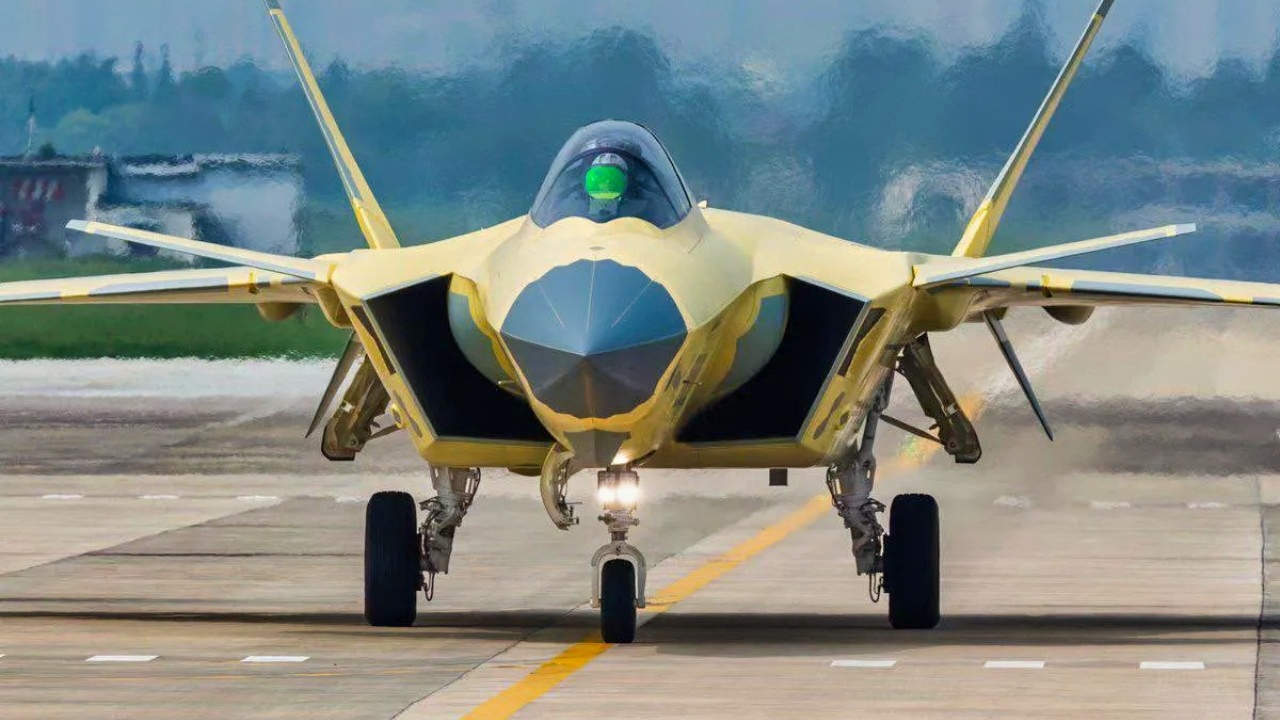
J-20 Fighter. Image Credit: Chinese Weibo.
That’s why they insist on placing the J-20 on the same level as the F-22. It is one thing to steal plans of stealth fighters. It is another one to build them and develop the aircraft through the glitches that develop.
The Chinese believe that the FC-31 or J-35 is the equivalent of the F-35. When the Chinese or one of the few countries willing to buy one conducts airstrikes like US-made F-35s did in Iran recently, then the world will be much more willing to incorporate the Chinese fighters into air forces.
About the Author: Steve Balestrieri
Steve Balestrieri is a National Security Columnist. He served as a US Army Special Forces NCO and Warrant Officer. In addition to writing on defense, he covers the NFL for PatsFans.com and is a member of the Pro Football Writers of America (PFWA). His work was regularly featured in many military publications.
More Military
SR-72 Mach 6 Mistake the Air Force Needs to End
The U.S. Navy’s Ohio-Class Missile Submarine Nightmare
America Has Mini-Aircraft Carriers
Russia’s Su-57 Felon Stealth Fighter: Made in India?
F-22 Raptor vs. J-20 Stealth Fighter: Hope This Never Happens


Nasir Mirza
September 20, 2025 at 7:26 am
We are so advanced can’t protect our advanced technology wow
Bobo the Bonobo
September 21, 2025 at 3:20 pm
I’ll some up the J-20 in three words.
Not very stealthy