

Key Points and Summary – GAO’s new report warns the F-35 program is slipping even further despite incentives: all 110 deliveries in 2024 were late by an average of 238 days.
-Block 4 modernization is $6B over plan, five years behind, and being “reimagined” into a scaled sub-program with fewer capabilities, unknown costs, and a likely delay to at least 2031.

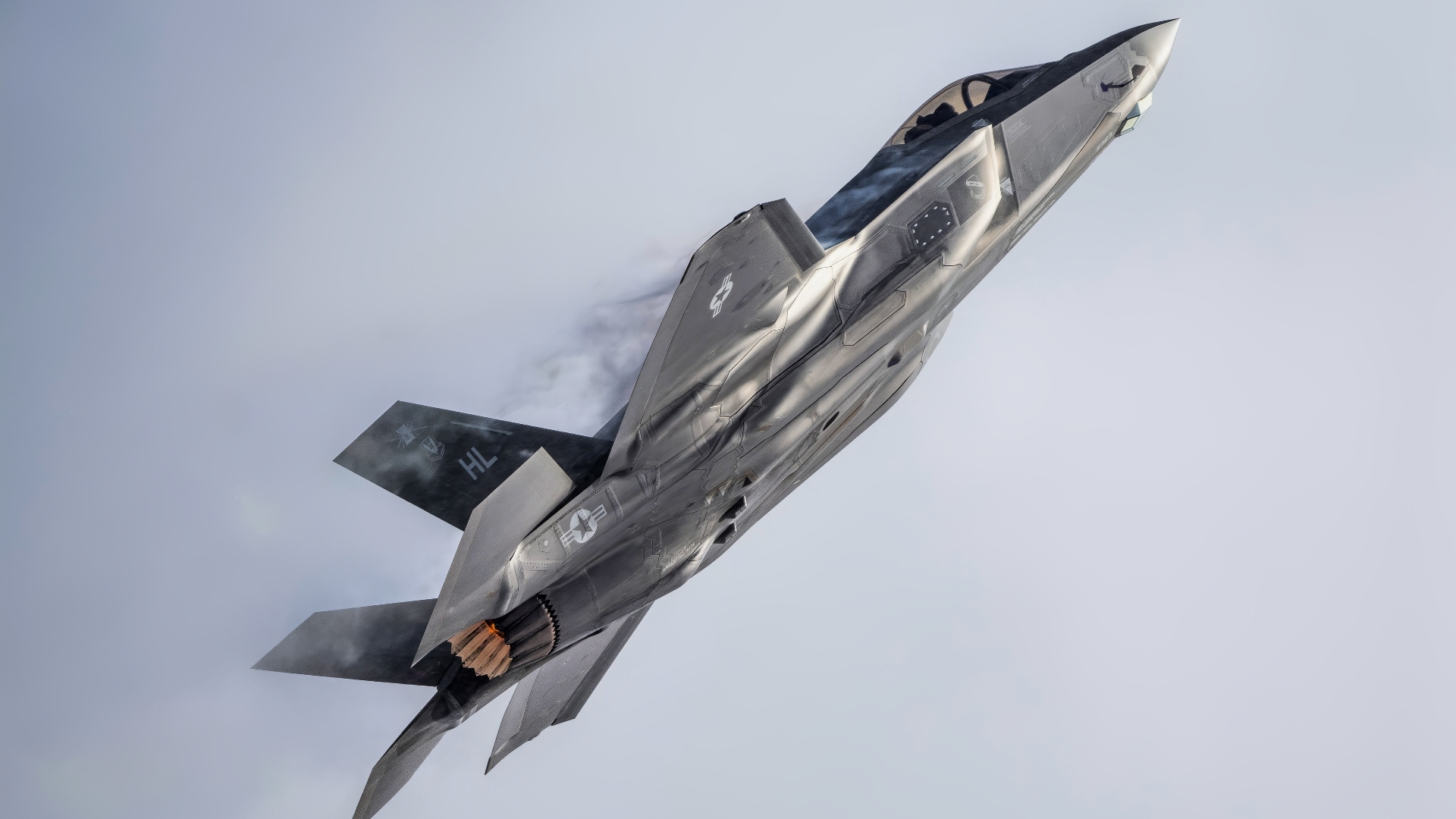
U.S. Air Force Maj. Melanie “Mach” Kluesner, pilot of the F-35A Demonstration Team, performs aerial maneuvers at the Sun ‘n Fun Airshow in Lakeland, Florida, April 4, 2025. The demonstration team showcases the skill and precision U.S. Air Force pilots and aircraft are capable of. (U.S. Air Force photo by Senior Airman Nicholas Rupiper)
-The turbulence is already directly hitting Europe: Poland’s first six F-35s slide from Mar–Jun 2026 to Nov–Dec 2026, with four more pushed to late 2027.
-Analysts in Warsaw fear rising costs and cancellations—Portugal is cited—could pressure sustainment as frontline states wait on critical capability.
GAO Sounds Alarm Bells on F-35 Problems, Polish Deliveries Delayed
WARSAW, POLAND – The latest report from the US General Accountability Office (GAO) is sounding alarm bells over continuing and worsening problems with the US F-35 fighter aircraft program.
This document, originally dated September 3 and subtitled “Actions Needed to Address Late Deliveries and Improve Future Development,” assesses that increased budgeting for the program has failed to stop slippages despite efforts to improve delivery schedules.
Among those looking at the program delays and nervously trying to assess how it will impact them is Poland, which has already ordered a batch of the aircraft. The Polish Air Force is counting on the capabilities that the aircraft delivers to make a difference, should there be a future conflict with Russia.
“In 2024, aircraft deliveries were late by an average of 238 days. To encourage timely delivery, among other things, DoD [US Defense Department] paid the contractors hundreds of millions in incentives over the last several years.” Reads the GAO report. “Nonetheless, delivery time frames continued to worsen—but DOD continued to pay incentives.”
The Pentagon intends to increase the production rate for the F-35; nevertheless, even if the deliveries by the main airframe contractor, Lockheed Martin (LM), and the engine manufacturer, Pratt & Whitney, continue to fall well behind the approved schedule. By way of example, in 2024, Lockheed delivered a total of 110 aircraft. All of these, however, arrived late by an average of 238 days, which was an increase from 61 days in 2023.

A U.S. Air Force F-35A Lightning II assigned to the 60th Fighter Squadron, flies overhead after conducting a live weapons drop at Camp Shelby, Miss., Oct 25, 2023. During the exercise, pilots tested various munitions including the GBU-12s, GBU-31v1s, and 362 rounds of 25mm Training Munitions from the gun.
The F-35 program has progressed through years in which attempts to modernize both its hardware and software have suffered continued cost growth and schedule delays for the most modern configuration, which is designated as Block 4.
In an attempt to put the processes that were instituted to resolve difficulties with the aircraft’s modernization back on course, the Department of Defense (DOD) is creating a new major subprogram to help meet cost, schedule, and performance goals.
In other words, said a long-time observer of the program, “DoD need to find a way to fix the ‘fixing process’ that is supposed to fix the program. That sounds problematic to me.”
Block 4 Difficulties for Stealth Fighter
At present, the costs for the Block 4 configuration are US$6 billion more than initially planned and budgeted for, and its completion is at least 5 years behind the original program timeline estimates.
The result is that the program office will now scale back the objectives for the Block 4 so that aircraft can be delivered with at least some enhanced capabilities, but at a rate more predictable than what has been experienced to date.
The new program plan will now likely see the Block 4 upgrade delayed until at least 2031. Which capabilities will be inserted into the production process now, and which will be moved to the right and made part of the 2031 program objective, will not be detailed until sometime this autumn. Also, the costs associated with this change in the program will not be released until later this year.
Last year, the previous program director, Lt. Gen. Michael Schmidt, explained that the F-35’s Block 4 will be “reimagined.”
He described the upgrade as excessively ambitious and concluded there were planned improvements that were not justified given their cost or the other resources required to realize them.

An F-35 Lightning II from the 115th Fighter Wing flies alongside a KC-135 Stratotanker with the 121st Air Refueling Wing after being refueled over the skies of Wisconsin, March 20, 2024. The F-35 II’s aerodynamic performance and advanced integrated avionics will provide next-generation stealth, enhanced situational awareness, and reduced vulnerability for the United States and allied nations. (U.S. Air National Guard photo by Senior Airman Ivy Thomas)
Marine Corps Lt. Gen. Gregory Masiello succeeded Schmidt this past summer and will now oversee a Block 4 upgrade that will “have fewer capabilities, will experience schedule delays, and will have unknown costs”, reads the GAO document.
The unknowns are due to the F-35’s Joint Program Office (JPO) still finalizing the separation of Block 4 into a sub-program and calculating new cost estimates.
Way Forward on F-35?
The way forward is of prime concern to customers for the aircraft in Central Europe, namely the Polish, Czech, and Finnish Air Forces—all front-line nations that have Russia as a neighbor. Poland initially signed for 32 aircraft in 2020 and has reportedly been considering a second batch. But such a procurement would likely take place only after 2030.
Deliveries of the 32 F-35s for Poland were initially scheduled for the March-June 2026 timeframe.
Still, this delivery of the initial six F-35 aircraft is now expected to occur during the November-December 2026 timeframe. Four more aircraft are consequently pushed back in the schedule until late 2027 instead of the first half of the year.
“Much now depends on how the program carries on from here,” said a Polish defense analyst who spoke to National Security Journal. “If more nations cancel their orders as Portugal already has and if Block 4 costs increase dramatically then this program could become very difficult to sustain.”
About the Author: Reuben F. Johnson
Reuben F. Johnson has thirty-six years of experience analyzing and reporting on foreign weapons systems, defense technologies, and international arms export policy. Johnson is the Director of Research at the Casimir Pulaski Foundation. He is also a survivor of the Russian invasion of Ukraine in February 2022. He worked for years in the American defense industry as a foreign technology analyst and later as a consultant for the US Department of Defense, the Departments of the Navy and Air Force, and the governments of the United Kingdom and Australia. In 2022-2023, he won two awards in a row for his defense reporting. He holds a bachelor’s degree from DePauw University and a master’s degree from Miami University in Ohio, specializing in Soviet and Russian studies. He lives in Warsaw.
More Military
The F-22 Raptor’s Biggest Problem in 1 Word
The B-21 Raider Has a Weakness
Europe Has a Message for the F-35 Stealth Fighter
The Super Dassault Rafale: Can It Surpass the F-35?
Eurofighter Typhoon vs. F-47 NGAD 6th Generation Fighter: Who Wins in 4 Words


