

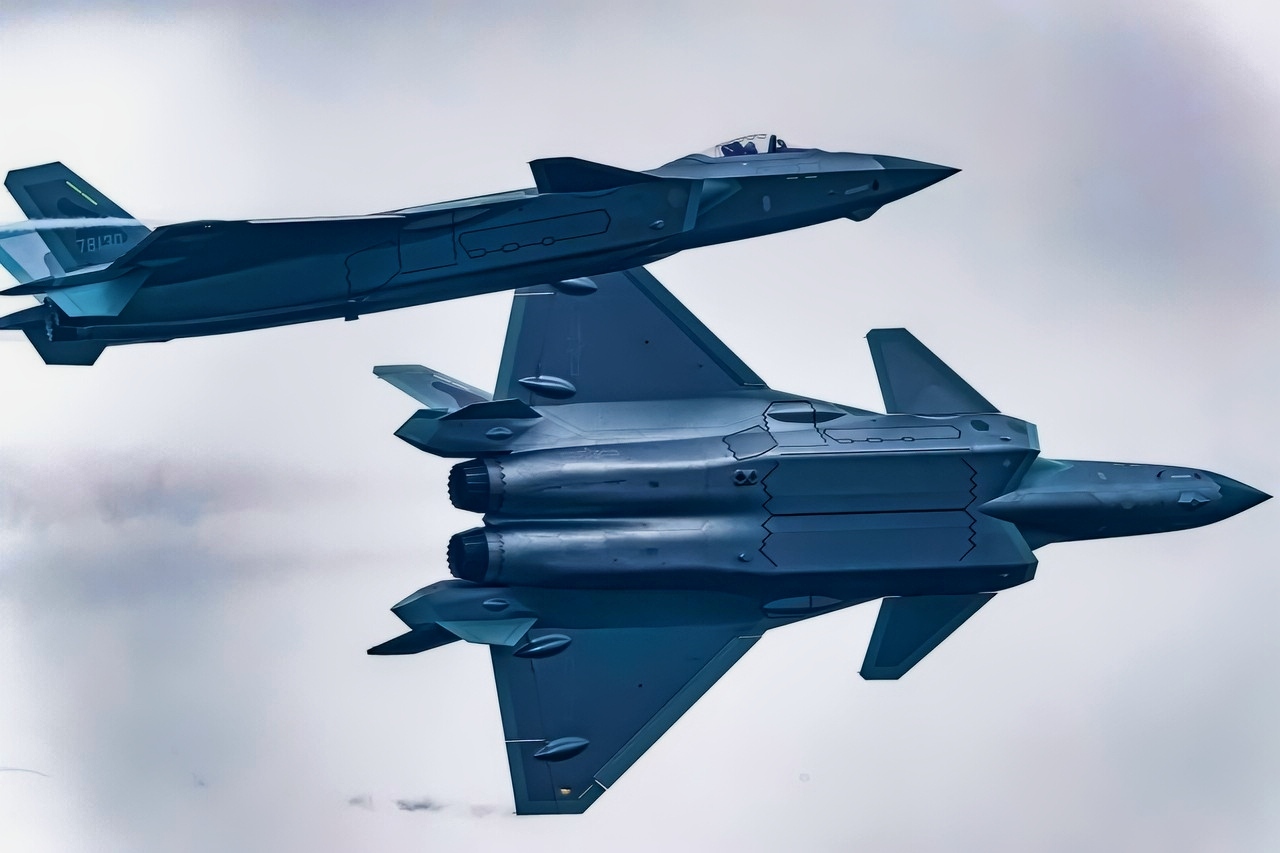
Key Points and Summary: For over a decade, China’s advanced J-20 stealth fighter was critically hampered by its greatest weakness: its engines.
-The program initially relied on older Russian models and struggled to produce reliable copies, while a wary Moscow blocked sales of its more advanced powerplants.
-This long and difficult journey, filled with failed attempts and tense negotiations, finally culminated in a domestic breakthrough.
-The development of the powerful, homegrown WS-15 engine has “unleashed” the J-20’s full potential, marking a major victory for China’s technological self-reliance and a pivotal moment for its aerospace industry.
The Story Behind the Engines on China’s J-20 Mighty Dragon
China has often turned to Russia over the years to improve its military hardware.
This is especially true of China’s fighter jets. Just take a look at the fifth-generation J-20 Mighty Dragon. This stealth airplane is China’s crown jewel. It matches up well against many different fighters. The J-20 boasts enviable radar-evasion qualities among its technological innovations.
But the J-20 originally needed Russian-made engines. Without this boost from Moscow, the Mighty Dragon would have endured a far more difficult path to serial production. China first used Saturn AL-31 turbofan engines for the J-20.
These two powerplants were borrowed from Su-27s that China introduced into service in the mid-1980s. The Saturn turbofans were old. This hamstrung the promise of the J-20 program and held back the Mighty Dragon’s performance.
Initial Attempts at Reproduction Failed
China then tried to copy the Saturn AL-31, with limited success. The reproductions were a maintenance nightmare, and performance was mediocre. The Chinese version of the AL-31 did little to push the J-20 to greater success.
Would Russia Provide the Inspiration for a New Homegrown Engine?
But China had another trick up its sleeve. The Russian T-50 PAK-FA fifth-generation fighter jet also flew with the Saturn AL-31, but this model had a different designation – 117S. It pushed out Mach-plus supercruise speed without afterburners, and it could create 32,000 pounds of thrust.
China thought the 117S variant would be ideal for powering the J-20.
Perhaps the Russian Su-35 Would Yield the Engine for the J-20
China tried to buy the 117S variant from Russia in 2010, but Moscow refused.
Meanwhile, another deal was brewing that had more potential. China wanted to purchase a whopping 48 Su-35s from Russia in a deal valued at $4 billion. The final acquisition saw 24 Su-35S aircraft delivered to the PLAAF at a cost of $2 billion.
The People’s Liberation Army Air Force (PLAAF) was excited to acquire the Su-35’s highly regarded engines. Two next-generation AL-41F1C engines were on each Su-35S, and the PLAAF thought these would be perfect for the J-20.
The AL-41F1C could generate speeds beyond Mach 2, and Russia eventually installed them on the T-50 PAK-FA.
Could China Just Copy the Engine?
Russia began to suspect PLAAF engineers and designers were going to reverse-engineer the powerful AL-41F1C engine. This set off alarms in Moscow, given how much Russia had invested into the propulsion system. The Kremlin would only agree to China buying the Su-35 whole, with no loose components – this would make the Russian engines more difficult to copy. China hesitated. They knew the J-20 program really didn’t have the correct powerplant installed.
Finally, a breakthrough came: Moscow allowed China to equip the J-20 with AL-31FM2 engines.
Still, the J-20 powerplant continued to not test well. It did have sufficient power, but it was not stable enough for repeated use on the Mighty Dragon.
WS-10 Gives Way to WS-15
When the PLAAF decided it wanted the J-20 to have thrust-vectoring engines, the WS-10 was born. Chinese engineers installed a “zigzag design nozzle” to achieve better acceleration. This also allowed the engine to cool better. The new powerplant had substantially reduced infrared radiation, making it harder to detect. But Chinese engineers were especially proud of the 2D thrust-vectoring nozzles. They kept working, and soon the WS-10 evolved into the WS-15, which had even better thrust vectoring. An answer had been found for the J-20.
The PLAAF purported to believe the WS-15 gave the J-20 even more thrust than the F-22 and F-35, although this claim might be mere propaganda. But the WS-15 was capable – it allowed high maneuverability and Mach 2+ speed. China nicknamed the WS-15 the “Emei,” and it has maximum thrust of 16 tons. The J-20 was finally in business with a homegrown engine by 2023.
The Mighty Dragon was then ready for prime time, and the PLAAF never looked back. The J-20 has become China’s premier fifth-generation fighter, and pilots are impressed by its performance. The Mighty Dragon has excellent range and payload, with a high thrust-to-weight ratio.
“After 12 years since the J-20’s maiden flight in 2011, the Chinese air force finally got the engine it had long been waiting for,” the South China Morning Post wrote.
One thing we can learn from this story is that the PLAAF just refused to give up. Engineers and designers were never satisfied until they developed a homegrown powerplant they could be proud of.
This never-say-die mentality demonstrated to the world that China can deliver the goods even when the odds are stacked against it. It presages more relentless ingenuity by China. The PLAAF has demonstrated its ability to develop its own technology, even though it has sometimes been accused of copying others in the past.
About the Author: Dr. Brent M. Eastwood
Brent M. Eastwood, PhD is the author of Don’t Turn Your Back On the World: a Conservative Foreign Policy and Humans, Machines, and Data: Future Trends in Warfare plus two other books. Brent was the founder and CEO of a tech firm that predicted world events using artificial intelligence. He served as a legislative fellow for U.S. Senator Tim Scott and advised the senator on defense and foreign policy issues. He has taught at American University, George Washington University, and George Mason University. Brent is a former U.S. Army Infantry officer. He can be followed on X @BMEastwood.
Military Matters
The F-22 Raptor Just Keeps Getting Better


