

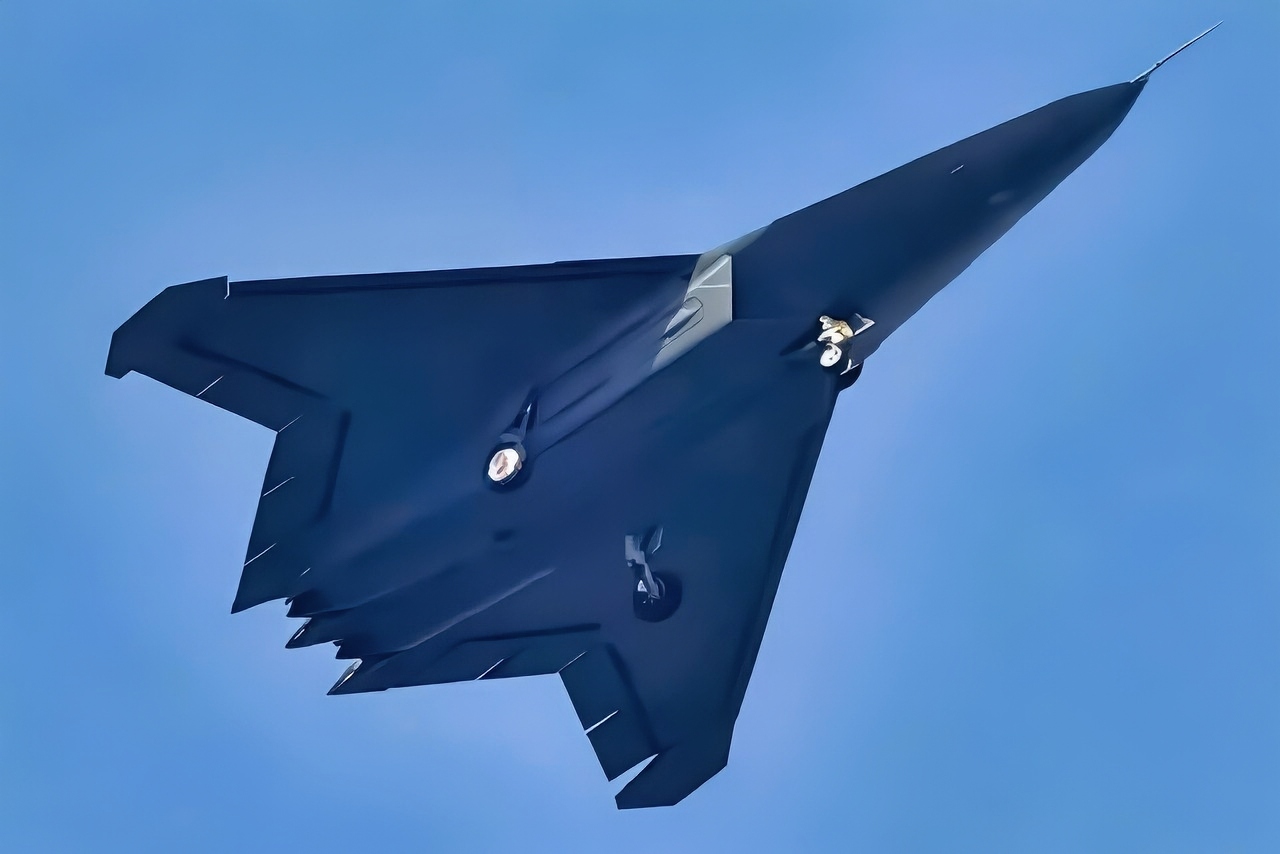
Key Points and Summary – Shenyang’s alleged J-50 (aka J-XD/J-XDS) is China’s other 6th-generation fighter effort alongside Chengdu’s programs.
-Rumored to have first flown in Dec 2024, a fresh 16-second clip (Sept 15, 2025) shows the prototype in flight and lowering its gear.

J-50 Fighter. Image Credit: Creative Commons.
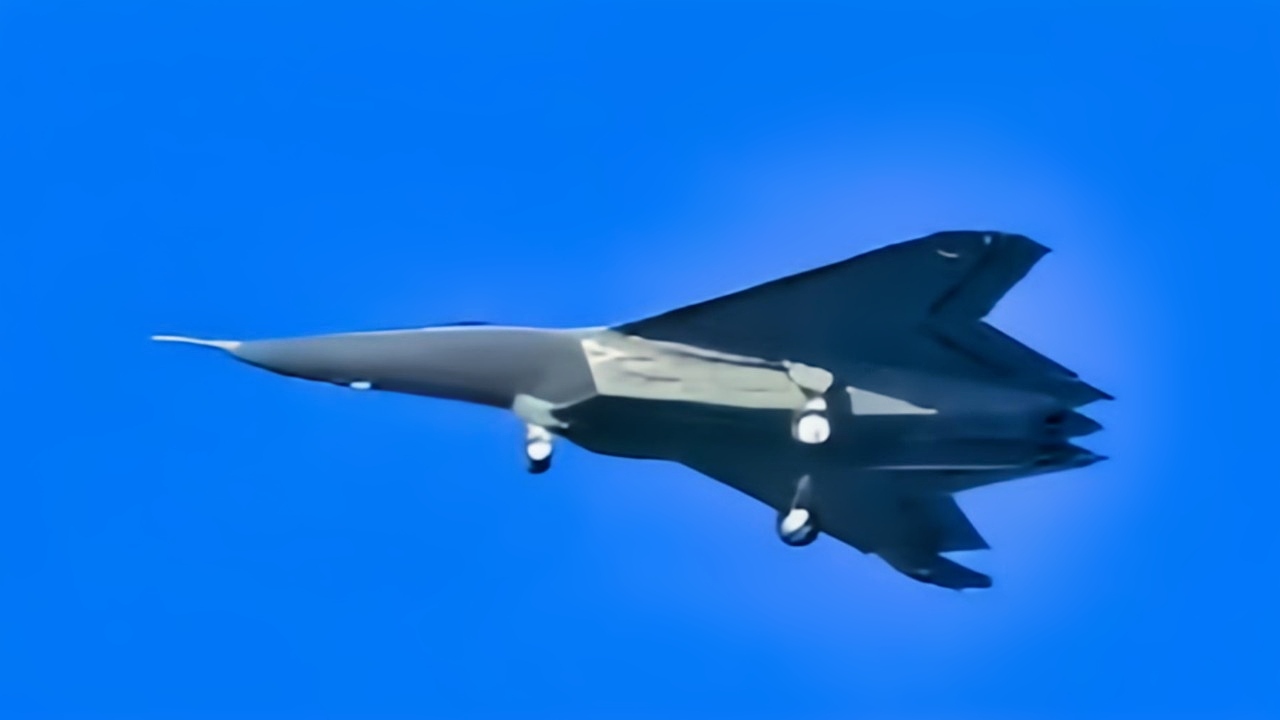
J-50 Fighter from China. Image Credit: Creative Commons.
-Imagery analyses describe a smaller-than-J-36, tailless “lambda-wing” twinjet with swiveling outer wingtips for control, side intakes likely using DSI, twin engines with apparent 2D thrust-vectoring nozzles, tricycle gear with twin-wheel nose strut, and a nose-under-cockpit bulge suggestive of an EOTS-type sensor.
-Specs remain opaque (including whether it carries a gun), no in-service date is known, and PLAAF priorities may still favor the J-36/JH-XX.
China’s J-50 Stealth Fighter: What We Think We Know
One good Chinese stealth fighter story deserves another, whether it’s 5th-generation or 6th-generation warbirds. (By “good,” rest assured, of course, we mean the quality of the journalism, not a moral assessment of the despotic Chinese Communist Party [CCP] regime).
First, there was the 5th-generation Chengdu J-20 Weilong (“Mighty Dragon;” NATO reporting name “Fagin”) and the 5th-generation Shenyang J-35/J-35A. Next in line is the J-36 6th-generation fighter-bomber, presumably also built by Chengdu.
Now we come back full circle to a Shenyang 6th-generation fighter in the works, the J-50, AKA the J-XD or J-XDS. (One gen-5 and one gen-6 apiece for Chengdu Aircraft Corporation [CAC] and Shenyang Aircraft Corporation [SAC] alike; just the sort of communist egalitarianism that would make Karl Marx and Chairman Mao proud. Also, interesting numerical sequence: J-20 + 15 = J,-35; J-35 + 15 = J-50. Mere coincidence? So, what exactly do we know about the J-50?
As it turns out, we can break this all down in one word: mystery.
J-50 (J-XD/J-XDS) Initial History and Concept
The J-50 reportedly traces its roots back to 2018, when SAC (obviously not to be confused with Strategic Air Command)apparently developed prototypes for 6th-generation aircraft.
Rumor has it that the J-50 made its maiden flight on 20 December 2024. Still, the first credibly reported signing took place six days later (conveniently coinciding with Chairman Mao’s birthday), on the same day that the J-36 (AKA JH-XX) made its maiden flight.
As per a 27 December 2024 article by Bill Sweetman for the Royal Aeronautical Society (RAeS): “And then came the debut of another stealth design, an apparently unmanned, smaller demonstrator from Chengdu sister company Shenyang. Some pictures were dated from a week ago, so this seems to have been an internal release rather than a necessarily public first flight from Chengdu.”
It appears to be a twinjet tailless lambda wing aircraft. For the benefit of our readers not familiar with the concept of lambda wing aircraft (heck, prior to conducting the research for this article, this reporter certainly fell into that category), we turn to Syam Narayanan, Y. Gangurde, and P. Rajalakshmi of the Journal of Applied Fluid Mechanics, ”Lambda wings are delta wings with a modification to the trailing edge in the form of a crank connecting two ‘V shaped patterns (Chaplin & Birch, 2012). The term ‘lambda wing’ comes from the shape of the trailing edge crank, which resembles the Greek letter ‘lambda’ in lowercase.”
J-50 Technical Specifications and Vital Stats (or Lack Thereof?)
Understandably, we know very little in this arena, given (1) the prototype status of the plane, and (2) the hush-hush nature of any 6th-generation program, especially one in a closed society like the People’s Republic of China (PRC).
However, thanks to imagery analysis provided in respective January 2025 and May 2025 articles by the ever-savvy Thomas Newdick of TMZ and Stefano D’Urso of The Aviationist, we can at least glean this much:
-Swiveling outer wingtip sections, which serve as major control surfaces, are significant, as they would help mitigate the stability issues that come with a tailless design
-Smaller in size than the J-36 (which is considered a medium-sized fighter-bomber)
-Twin engines with what appears to be 2D thrust vectoring nozzles
-Air inlets positioned on the sides of the fuselage, each feeding one engine; these could be Diverterless Supersonic Inlets (DSI)
-Tricycle landing gear, with the nose landing gear being a twin wheel
A bulge on the fuselage just below the cockpit could house an electro-optical sensor, similar to the Electro-Optical Targeting System (EOTS)-equivalent developed for the J-35
Armament-wise, it will be interesting to see if the J-50 (assuming it actually goes operational) will omit the gun like the J-20 does. The American stealth fighters, namely the Lockheed Martin Skunk Works F-22 Raptor and F-35 Lightning II alike, retain the gun, and presumably so will America’s 6th-generation entries, the F-47 Next Generation Air Dominance (NGAD) and F/A-XX platforms. Ditto for the Russian Federation’s Sukhoi Su-57 “Felon.”
J-50 Operational History in (Very) Brief
Not much to report here. However, the inspiration for this article comes from this nugget of news from the X (the artist formerly known as Twitter) page of International Defence Analysis (@Defence_IDA), dated 15 September 2025: China’s J-50 has conducted a new test flight after a gap. A new short video clip shows Shenyang Aircraft Corporation’s J-XDS in flight.“ The video clip lasts a total of 16 seconds; at the 8-second mark, we see the plane lower its landing gear and begin its descent.
(NOTE: IDA describes itself on its homepage as “a leading provider of in-depth analysis and insights on the global defence and security industry” and “a trusted resource for defence professionals and industry stakeholders.” No physical address or location is listed, so presumably it is an exclusively online entity, unlike another IDA, namely the Institute for Defense Analyses, which is headquartered in Alexandria, Virginia.)
The Way Forward for the J-50?
As far as this reporter can ascertain, no estimated operational date for the J-50 is officially available yet (if any of our dear readers know otherwise, please let us know in the Comments section). Evidently, the People’s Liberation Army Air Force (PLAAF; Zhōngguó Rénmín Jiěfàngjūn Hǎijūn Hángkōngbīng)is prioritizing the J-36/JH-XX as far as 6th-generation fighter development is concerned; that particular plane could be operational as soon as 2030. Time will tell, so please stay tuned, dear readers.
About the Author: Christian D. Orr, Defense Expert
Christian D. Orr is a Senior Defense Editor. He is a former Air Force Security Forces officer, Federal law enforcement officer, and private military contractor (with assignments worked in Iraq, the United Arab Emirates, Kosovo, Japan, Germany, and the Pentagon). Chris holds a B.A. in International Relations from the University of Southern California (USC) and an M.A. in Intelligence Studies (concentration in Terrorism Studies) from American Military University (AMU). He is also the author of the newly published book “Five Decades of a Fabulous Firearm: Celebrating the 50th Anniversary of the Beretta 92 Pistol Series.”
More Military
The F/A-18 Hornet Fighter Has a Message for the U.S. Navy
F-15E Strike Eagle Has Just 1 Mission
Russia’s Su-27 Flanker Fighter: Moscow’s Best Warplane Ever? You Decide
Iowa-Class Battleship USS Wisconsin Has a Message for the U.S. Navy
The U.S. Navy’s USS Connecticut Seawolf-Class Nuclear Attack Submarine Summed Up in 4 Words


Jay
September 21, 2025 at 2:01 pm
An F-15 X is better then any Chinese 6 gen
Everett
September 26, 2025 at 8:45 pm
Agree completely Jay!!! We are overestimating everything China does.We (the press)did the same thing with the Soviet Union during the Cold War. Truthfully I wouldn’t be surprised if a F 4 Phantom could give this Chinese piece of junk a run for its money!!! Lol