

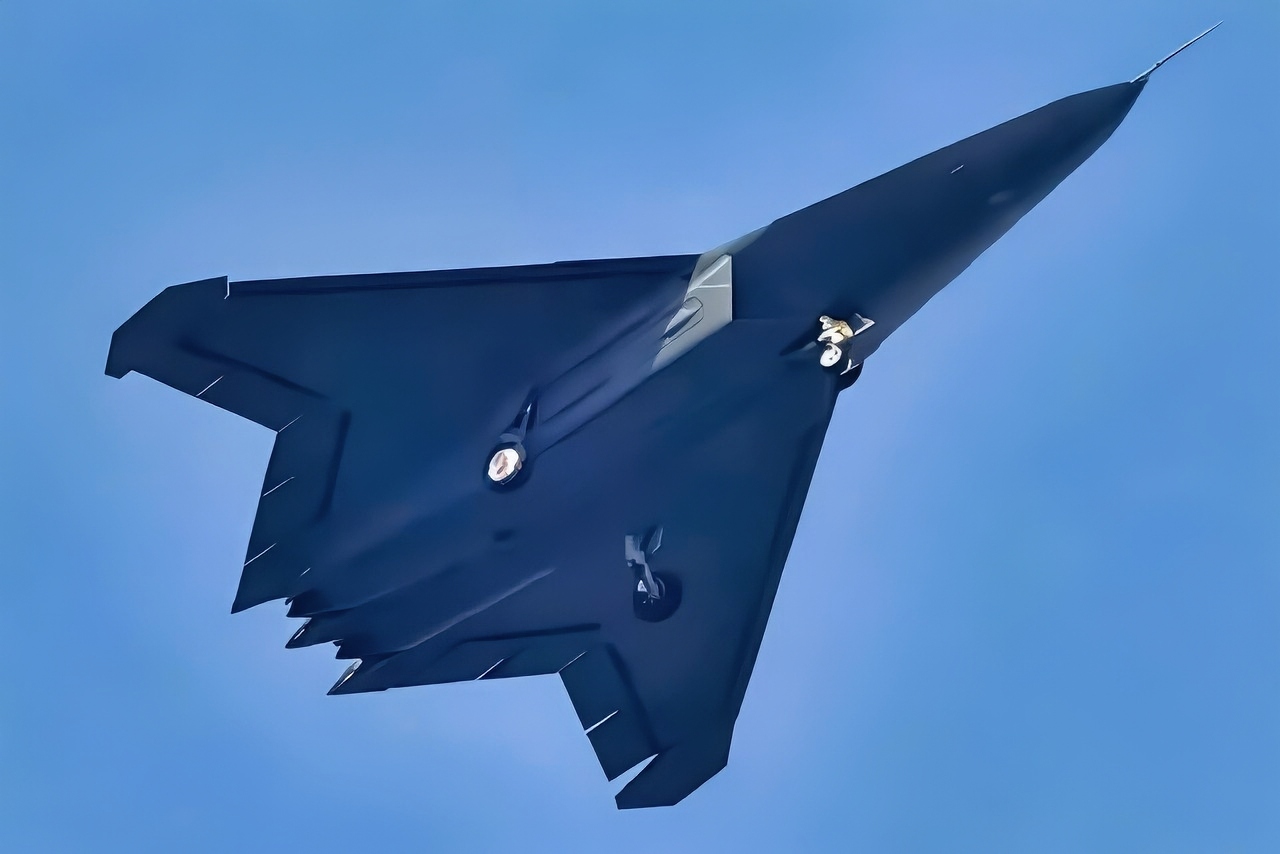
Key Points and Summary – China’s smaller ‘J-50’ prototype surfaced near Shenyang days after the J-36, fueling talk of a second sixth-generation effort.
-Imagery suggests a tailless, cranked-arrow lambda wing with swiveling tips, DSI inlets, and a chin EOTS—features that emphasize stealth and agility.

J-36 Fighter. Image Credit: Screenshot from X.
-Analysts speculate twin advanced engines with thrust-vectoring and internal bays for PL-15/PL-17 could support air-superiority, deep-strike, or anti-ship roles. But key data—engine type, radar/sensor suite, bay size, AI, production status—remain unknown.
-The airframe could be a technology demonstrator rather than an operational jet. Even so, its debut signals China’s intent to iterate quickly while U.S. NGAD timelines wobble for now only.
Meet the J-50 6th Generation Fighter
In December 2024, the world witnessed the newest aircraft that China had to offer. The J-36 captured headlines all around the world with its distinct but unconventional design. Since then, more footage of the aircraft has appeared, giving analysts a more comprehensive picture of the aircraft.
However, another aircraft also made its first flight around that time which has not garnered nearly as much attention.
Unofficially dubbed the J-50 (or J-XD/J-XDS), this smaller fighter also boasts an unconventional design layout, leaving experts worldwide to speculate about its role and capabilities.
Unfortunately, there is almost no concrete information to work with on this fighter, so as with the J-36, most analysis is just speculation at this point.
China’s Second Sixth-Generation Fighter
The development of the J-50 reportedly began around 2018, although the project was kept under tight secrecy.
The aircraft was first publicly observed on December 26, 2024, during a test flight near SAC’s facilities in Shenyang, Liaoning Province. This sighting coincided with the appearance of another advanced Chinese aircraft, the Chengdu J-36, a larger, three-engine stealth fighter developed by Chengdu Aircraft Corporation. Analysts believe the J-50’s maiden flight occurred just days earlier, on December 20, 2024, though this has not been officially confirmed.
One of the most distinctive features of the J-50 is its tailless lambda wing design. This cranked arrow configuration is sharply swept and includes articulating, swivelable wingtips that function as control surfaces. The lambda wing improves aerodynamic efficiency and stealth by reducing radar cross-section and drag.
The aircraft’s adaptive wingtips can move independently, enhancing maneuverability at low speeds and during complex aerial maneuvers. It also features differential leading-edge extensions and multiple trailing-edge control surfaces, which contribute to its agility and control authority.
Design and Development
The fuselage of the J-50 is sleek and angular, with a long, wide nose radome that houses a prominent chine line. Beneath the nose is a chin-mounted Electro-Optical Targeting System (EOTS), similar in concept to the systems found on the F-35. The aircraft uses diverterless supersonic inlets (DSI), which blend smoothly into the fuselage and contribute to its stealth profile.
These intakes eliminate the need for complex moving parts and reduce radar reflections. The landing gear configuration is tricycle-based, with a twin-wheeled nose gear and single-wheeled main gears. The aircraft appears to be medium-sized, possibly optimized for carrier operations, although this remains speculative.
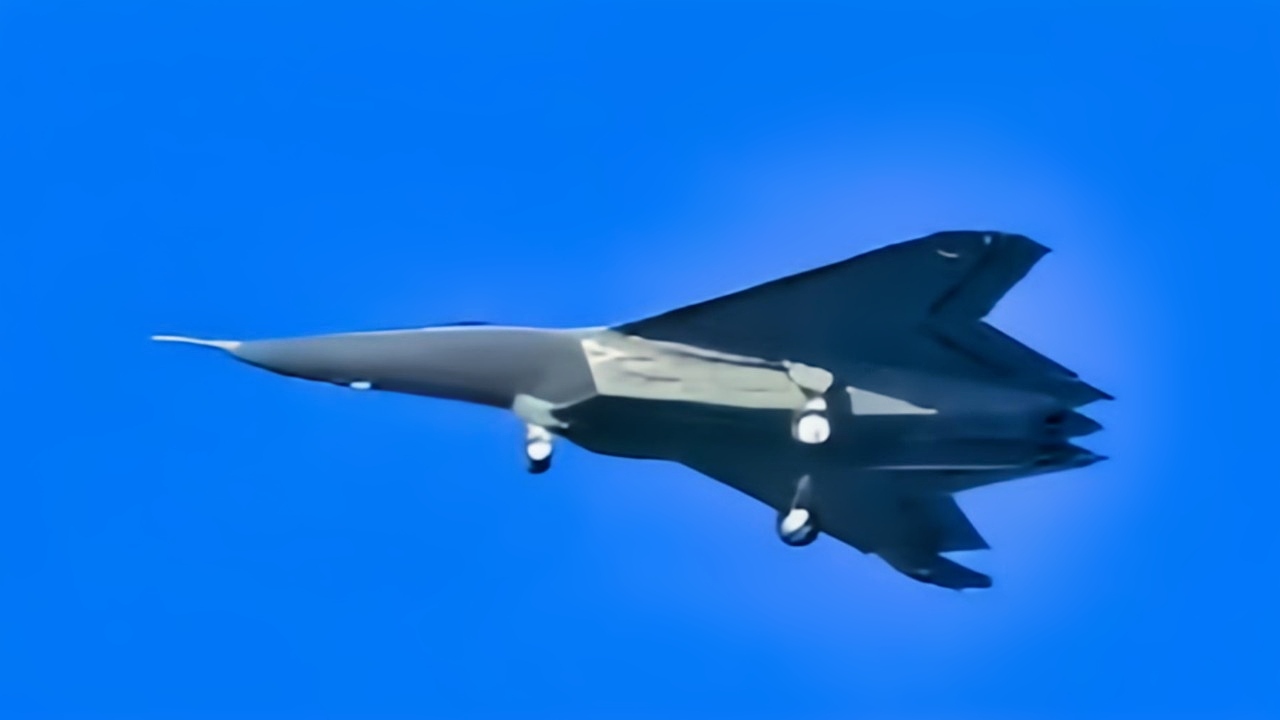
J-50 Fighter from China. Image Credit: Creative Commons.
In terms of propulsion, we can only guess. Some analysts suspect that the J-50 is powered by twin Advanced Combat Engines (ACE), which are believed to offer thrust vectoring capabilities based on the angular shape of the exhaust vents. These engines provide high agility and operational redundancy, especially useful for long-range or carrier-based missions.
The aircraft’s performance metrics are currently unknown. Estimates guess that the fighter possesses a top speed of Mach 2.0, a combat radius of approximately 2,200 to 2,500 kilometers, and a service ceiling of approximately 20,000 meters. These specifications place the J-50 in the realm of high-performance, long-range fighters capable of deep-strike missions and air superiority roles. It is essential to reiterate that this is entirely speculative.
Assessing What Little We Have of China’s Latest Fighter
Based on the current images we have of the J-50, the fighter is designed for stealth missions.
It incorporates radar-absorbing materials, internal weapons bays, and a tailless configuration to minimize its radar signature. The lambda wing and DSI intakes further reduce its radar cross-section. While exact details of its avionics remain speculative, the J-50 is believed to feature an advanced Active Electronically Scanned Array (AESA) radar, electro-optical targeting systems, and network-centric warfare capabilities.
Currently, there are no good images that show off the J-50’s weapons bays. I would like to advise readers to approach AI-upscaled images with caution, as AI can easily distort and misrepresent low-resolution images.
As such, it is unknown how many weapons bays the J-50 has or what their dimensions are.
Based on the current images we have, the fighter has at least two identifiable weapons bays.
Known or speculated weapons include the PL-15 and the PL-17, designed for high-value targets such as AWACS and bombers. This loadout would suggest that the J-50 is capable of air superiority, interception, deep-strike, and anti-ship missions, making it a versatile multirole platform.
The J-50: Real Threat or Paper Tiger?
It is no accident that the J-36 and J-50 were demonstrated so closely together. It was a strategic posturing to the U.S., demonstrating China’s advancing aerospace industry. Where China was once known for copying old Soviet designs, now its fourth advanced stealth fighter has taken its first flight. The J-50 was also revealed during a time when the U.S.’ NGAD project was facing uncertain prospects and delays. The revelation of the F-47 was very likely a response from the Trump administration to China’s newest fighters.
Despite the growing body of imagery and analysis, many aspects of the J-50 remain unknown. These include the exact engine type and thrust output, the full capabilities of its radar and sensor suite, the level of AI integration, and its production status and deployment timeline. Some analysts caution that the J-50 could be a technology demonstrator or even a mockup, designed to project capability rather than represent an operational platform. Others argue that the aircraft is part of a broader strategy to test and refine technologies that will eventually be integrated into a full production model.
About the Author: Isaac Seitz
Isaac Seitz, a Defense Columnist, graduated from Patrick Henry College’s Strategic Intelligence and National Security program. He has also studied Russian at Middlebury Language Schools and has worked as an intelligence Analyst in the private sector.
More Military
The Massive B-36J Bomber Has a Message for the U.S. Air Force
Russia’s Su-47 Fighter: Moscow Only Made 1 For Good Reason
B-52J vs. B-21 Raider: The Air Force Might Have a Bomber Problem


