

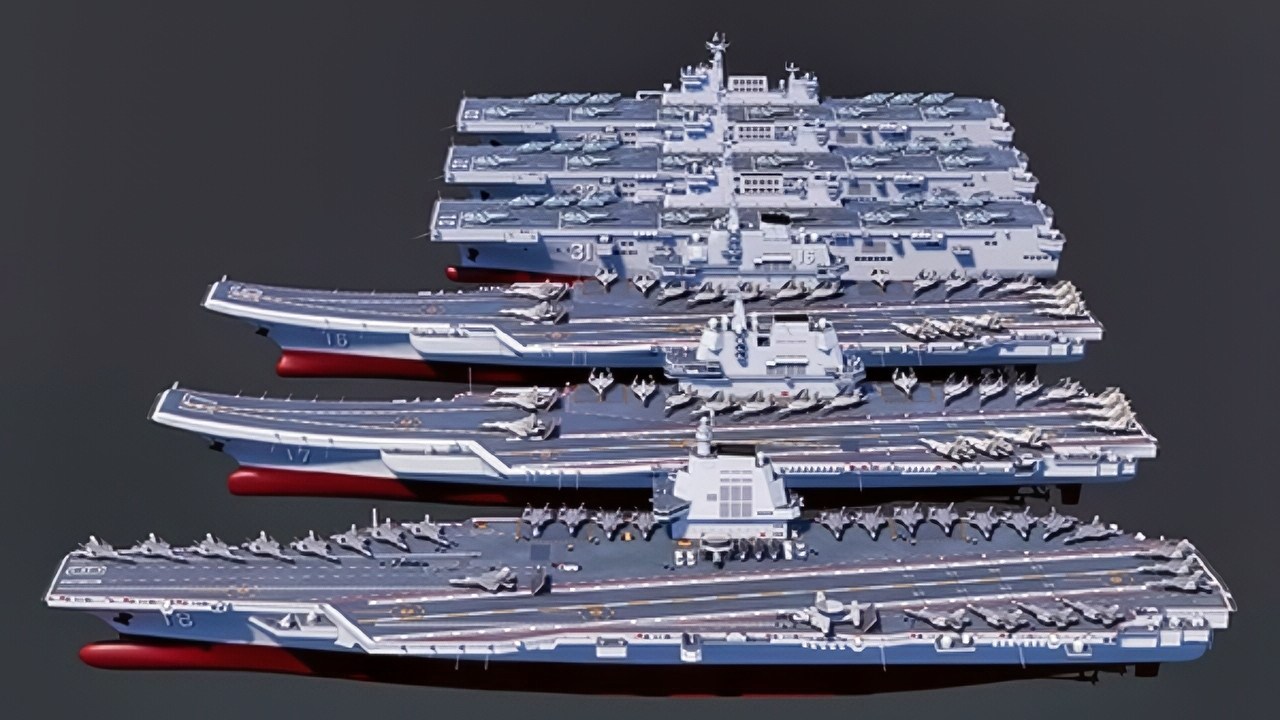
Key Points and Summary – China has commissioned its third carrier, the 80,000-ton Fujian, featuring three electromagnetic catapults to launch heavier, more capable air wings, including J-35s and the KJ-600 AEW&C.
-Beijing says the ship will “make regular appearances” on the high seas. Yet EMALS/AAG tech has proven challenging on the U.S. Ford, and critics argue that Fujian’s deck layout could cap sortie rates at 60% of a Nimitz-class rate.
-President Trump has even mused about returning to steam catapults, though no order has followed.
-Many see Fujian as a stepping stone toward a nuclear Type 004, tightening the carrier competition—and forcing fresh U.S. countermeasures.
Fujian Is In: China’s EMALS Aircraft Carrier—and What America Does Next
China officially commissioned its new Fujian aircraft carrier last week.
According to The War Zone, the commissioning ceremony for the carrier highlighted its electromagnetically powered catapults, with President Xi Jinping even pushing the launch button himself.
Footage has surfaced of the ceremony, which took place on November 5 at the naval port in Sanya, in China’s island of Hainan.
Per the War Zone, the carrier is conventionally powered and has been undergoing sea trials since its initial launch in 2022.
TWZ added that there had been signs it was getting close to operational service, including that it had been in port for over a month, alongside the Shandong, another aircraft carrier that’s part of the Chinese Navy.
The Fujian is China’s third aircraft carrier and, per the Associated Press, the first that it has designed and built on its own.
“Carriers are key to Chinese leadership’s vision of China as a great power with a blue-water navy,” Greg Poling, director of the Asia Maritime Transparency Initiative at the Center for Strategic and International Studies, told the AP.
According to USNI News, the new carrier is 80,000 tons.
“Aside from bolstering Beijing’s aircraft carrier force to three flattops, the Fujian brings catapult-launch capabilities to Chinese naval aviation. The first two PLAN carriers, CS Liaoning (016) and Shandong (017), used Russian-styled short take-off but arrested recovery (STOBAR) designs,” USI News reported of the ceremony.
“With the vessel’s three electromagnetic catapults, Chinese forces can sortie fighter jets with heavier payloads and larger aircraft—including the new KJ-600 airborne early warning and command aircraft.”
Straight From the Ministry
The Chinese Ministry of National Defense released photos and more information on its English-language website, although the release was somewhat light on details.
“Xi, also general secretary of the Communist Party of China Central Committee and chairman of the Central Military Commission, boarded the aircraft carrier to inspect the vessel at a naval port in Sanya city,” the release from the Ministry said. “The Fujian was launched in June 2022 and named after Fujian province. The aircraft carrier Fujian completed its maiden sea trial in May 2024.”
A separate release from the Ministry stated that the carrier will “make regular appearances” on the high seas.
Senior Captain Leng Guowei said in what was described as a “written interview” that while the carrier will be based at the Sanya military port, its “true home” will be “the vast ocean.”
“While the Fujian was under construction, the development and testing of supporting equipment, including carrier-based fighter jets such as the J-35, J-15T and J-15D, the KongJing-600 early warning aircraft and the Z-20 series helicopters, was progressing steadily as planned, according to Leng,” the release said. “It won’t be long before the Fujian is fully outfitted with its carrier-based aircraft.”

(Aug. 8, 2017) The Nimitz-class aircraft carrier USS George H. W. Bush (CVN 77) at sea during exercise Saxon Warrior 2017, Aug. 8. Saxon Warrior is a United States and United Kingdom co-hosted carrier strike group exercise that demonstrates allied interoperability and capability to respond to crises and deter potential threats. (U.S. Navy photo by Mass Communication Specialist 1st Class Theron J. Godbold /Released)
Leng also said, in the release, that “China’s efforts in the development and improvement of weapons and equipment do not target any other country or specific objective, nor do such endeavors pose threats to other countries or regions.
These initiatives are aimed at safeguarding national sovereignty, security, and development interests.”
According to an AP report about the commissioning, the new carrier will allow China’s Navy, already the largest in the world, to “expand its power farther beyond its own waters.”
About EMALS
The Fujian, per TWZ, is one of only two flattop carriers in the world to feature an electromagnetic aircraft launch system (EMALS), along with the U.S. Navy’s U.S.S. Gerald Ford.
The site noted, though, that the technology has proved “hard to master,” at least in the U.S. Navy’s experiences with it.
“The carrier’s catapults, as well as the companion electronically-controlled Advanced Arresting Gear (AAG), have struggled with technical and reliability issues over the years,” TWZ said. “The ship also has electromagnetically powered elevators for moving munitions and other stores between its magazines and the flight deck, which were plagued with problems in the past.”
President Donald Trump has assailed those difficulties, and even said last month that he would sign an executive order compelling the Navy to return to steam-powered catapults on future carriers.
It’s something of a longtime hobbyhorse for Trump, who for several years has been critical of the EMALS and Advanced Weapons Systems on the U.S.S. Gerald Ford.
The remarks came aboard the U.S.S. George Washington during the president’s visit to Japan last month.
“I’m putting out an order, I’m going to sign an executive order, when we build aircraft carriers, it’s steam for the catapults and it’s hydraulic for the elevators,” Trump said, adding that he’s worried that “water” could disturb Ford‘s electromagnetic systems. “We’ll never have a problem.”
In the two weeks since, there has been no announcement that Trump has actually signed any such executive order.
Only 60 Percent as Powerful as Older Nimitz-Class Carriers from the U.S. Navy

(July 11, 2014) – The aircraft carrier USS Ronald Reagan (CVN 76) is underway during Rim of the Pacific (RIMPAC) 2014. Twenty-two nations, more than 40 ships and submarines, more than 200 aircraft and 25,000 personnel are participating in RIMPAC exercise from June 26 to Aug. 1, in and around the Hawaiian Islands. The world’s largest international maritime exercise, RIMPAC provides a unique training opportunity that helps participants foster and sustain the cooperative relationships that are critical to ensuring the safety of sea lanes and security on the world’s oceans. RIMPAC 2014 is the 24th exercise in the series that began in 1971. (U.S. Navy photo by Mass Communication Specialist 2nd Class Jacob Estes/Released)
A CNN report back in late October looked at the new carrier and quoted former U.S. officers in stating that it might not be as capable as some older Nimitz-class U.S. carriers that will slowly be retired over the next few years.
The Fujian, the officers say, “may only be able to conduct air operations at about 60% the rate of a 50-year-old US Navy carrier.” And that’s thanks to its configuration.
“The Fujian’s operational capability is only about 60% of that of the Nimitz class,” Carl Schuster, a former US Navy captain and veteran of carrier deployments, told CNN. On the Chinese carrier, the “longer landing area and the narrower deck angle reduce the space for repositioning the recovered aircraft,” Schuster added.
Another former officer was skeptical about China’s plans.
“Building a shiny new carrier is nice, but I would postulate that the Chinese ‘don’t know what they don’t know’ about carrier ops,” Lt. Cmdr. Keith Stewart, a former US naval aviator, told CNN.
The CNN story also posited the belief that Fujian is “more likely a stepping stone” for the Chinese Navy.
At the same time, another carrier, known as “Type 004,” will ultimately serve as its successor.
About the Author: Stephen Silver
Stephen Silver is an award-winning journalist, essayist, and film critic, and contributor to the Philadelphia Inquirer, the Jewish Telegraphic Agency, Broad Street Review, and Splice Today. The co-founder of the Philadelphia Film Critics Circle, Stephen lives in suburban Philadelphia with his wife and two sons. For over a decade, Stephen has authored thousands of articles that focus on politics, national security, technology, and the economy. Follow him on X (formerly Twitter) at @StephenSilver, and subscribe to his Substack newsletter.
More Military
The Russian Military Is In Crisis
The U.S. Military’s Superpower Status Is Slipping Away
The F-35 Looks Like It Might Be In Real Trouble Now
The F-22 Raptor Has 1 Enemy It Can Never Beat (Not Russia or China)


