


China’s H-20 stealth strategic bomber will give Beijing a capability it has never possessed—a survivable, recallable, long-range nuclear strike platform that completes the country’s nuclear triad. But despite the hype, the bomber will likely fall well short of America’s B-21 Raider and possibly even the older B-2 Spirit, with thermal signature problems, weaker side-aspect stealth, and avionics systems still below U.S. standards.
The H-20 Stealth Bomber Is Coming

H-20 Bomber Mock Up. Image Credit: X Screenshot.

H-20 Bomber Mock Up. Image Credit: Creative Commons.

H-20 Bomber from China. Image Credit: Creative Commons.
The Xi’an H-20 is China’s first true stealth strategic bomber. Officially revealed in 2016, the H-20 is still in development and not yet operational, but is expected to enter service sometime in the 2030s.
Despite China’s massive missile arsenal, the H-20 is not redundant, filling key gaps in flexibility, survivability, and global reach that missiles alone cannot provide. And while the bomber should offer China capabilities it has never had before, the platform is believed to fall well short of the American B-21 Raider, and perhaps even the B-2 Spirit.
Missiles Aren’t Enough
Missiles are launched from fixed launch sites with predictable trajectories; they can be used only once.
These are significant limitations.
The H-20, meanwhile, can loiter, retarget, and adapt mid-mission. Mobile targeting enables engagement with carrier strike groups and moving formations in ways ballistic missiles do not. Bombers are also recallable, which gives China enhanced escalation control. Missiles, on the other hand, once deployed, are irreversible. In sum, the bomber is far more flexible than missiles alone.
China’s Nuclear Triad
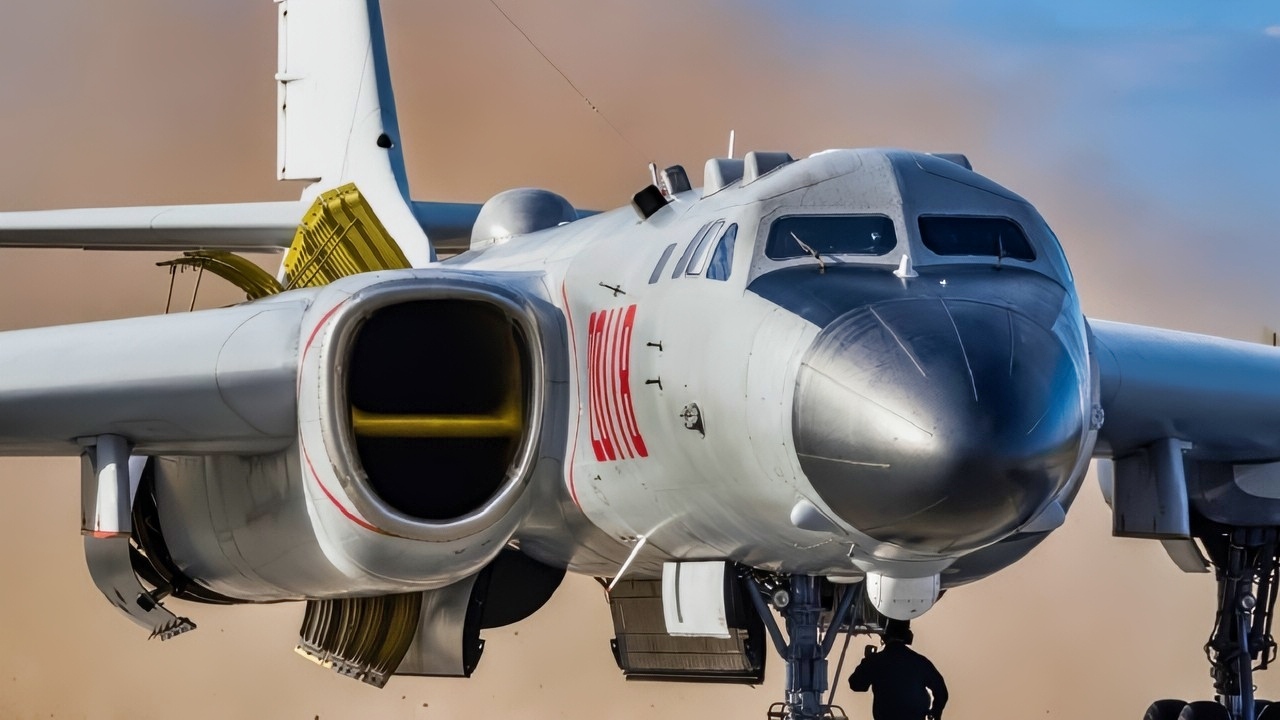
Currently, China’s nuclear triad is complete—but the air component is weak. On land, China has ICBMs; at sea, China has ballistic missile submarines; but in the air, China has only the H-6 bomber, a 1950s-era design that lacks survivability in denied airspace.

PLAAF Xian H-6M makes a turn over central Changzhou.
H-6 Bomber from China. Image Credit: Creative Commons.
The H-20 offers an immediate upgrade to the air component of China’s nuclear triad because the H-20 is a stealth penetrator with the ability to deliver nuclear weapons. The H-20 also gives China another survivable second-strike option. In effect, the H-20 transforms China from a partial nuclear power into a fully balanced triad power.
Shaping the Campaign
The H-20 is not just a bomber but a “tactical quarterback” capable of performing “campaign-shaping” functions.
For example, the bomber offers ISR (intelligence, surveillance, reconnaissance), targeting coordination, and sensor fusion.
This helps address a gap in China’s kill chain, which lacks robust over-the-horizon targeting. The H-20 contributes by identifying targets and then feeding data to missiles and other platforms. Like most modern weapons, the H-20 is being designed not as a standalone platform that can deliver the occasional bomb, but as part of a broader strike network.
Targeting Enhancement
The bomber helps China to target islands within the second island chain, including Guam. Currently, US bases in this region are considered relatively safe. But the H-20 should have the stealth and the range to strike these bases without the need for aerial refueling.
Viable targets include runways, fuel depots, and command centers.
The strategic implication here is that it forces the US to disperse assets and harden bases, simply because the H-20 exists.
Technical Limitations
Yet the H-20 is not expected to be a perfect platform. China, nor any nation outside of the US, has ever fielded a stealth strategic bomber; the H-20 will be the first—and it will likely be flawed.
The bomber’s stealth performance was likely optimized for the frontal aspect, with weaker performance on the sides and rear. The H-20 may also have engine issues, namely heat signature and efficiency issues, owing to reliance on the WS-10 and WS-15.
Thermal management is expected to be a major issue, which increases IR detectability. System maturity in avionics is likely below the standards of a US bomber. So the finished product will give China abilities it has never had before.
But the bomber is not the B-21, or even the B-2, and will not offer China true parity with the US in terms of a stealth strategic bomber.
Development Delays
The H-20’s timeline has kept slipping. Originally, the bomber was supposed to enter service in the early 2020s.
Obviously, that didn’t happen. The hope now is for a 2030s entry. But China has stumbled in solving the complexities of stealth geometry and engine development.
Repeated delays and unclear milestones show that the program has struggled to reach maturity, underscoring just how far ahead of its time the B-2 was when it entered service a generation ago.
The bomber will narrow the gap between China and US strategic stealth capability, but won’t close the gap.
The B-21 will benefit from decades of B-2 refinement, offering the US a stealth bomber that likely dwarfs the H-20 in terms of performance.
About the Author: Harrison Kass
Harrison Kass is a writer and attorney focused on national security, technology, and political culture. His work has appeared in City Journal, The Hill, Quillette, The Spectator, and The Cipher Brief. He holds a JD from the University of Oregon and a master’s in Global & Joint Program Studies from NYU. More at harrisonkass.com.


