

Key Points and Summary – Cut off from U.S. spares after 1979, Iran kept its 79 F-14 Tomcats flying via improvisation, cannibalization, and sourcing—then used them to shape the air war.
-‘With the AWG-9 radar and scarce AIM-54 Phoenixes, Tomcats doubled as early-warning nodes and long-range interceptors, deterring Iraqi raids and scoring an estimated 120–150 kills.

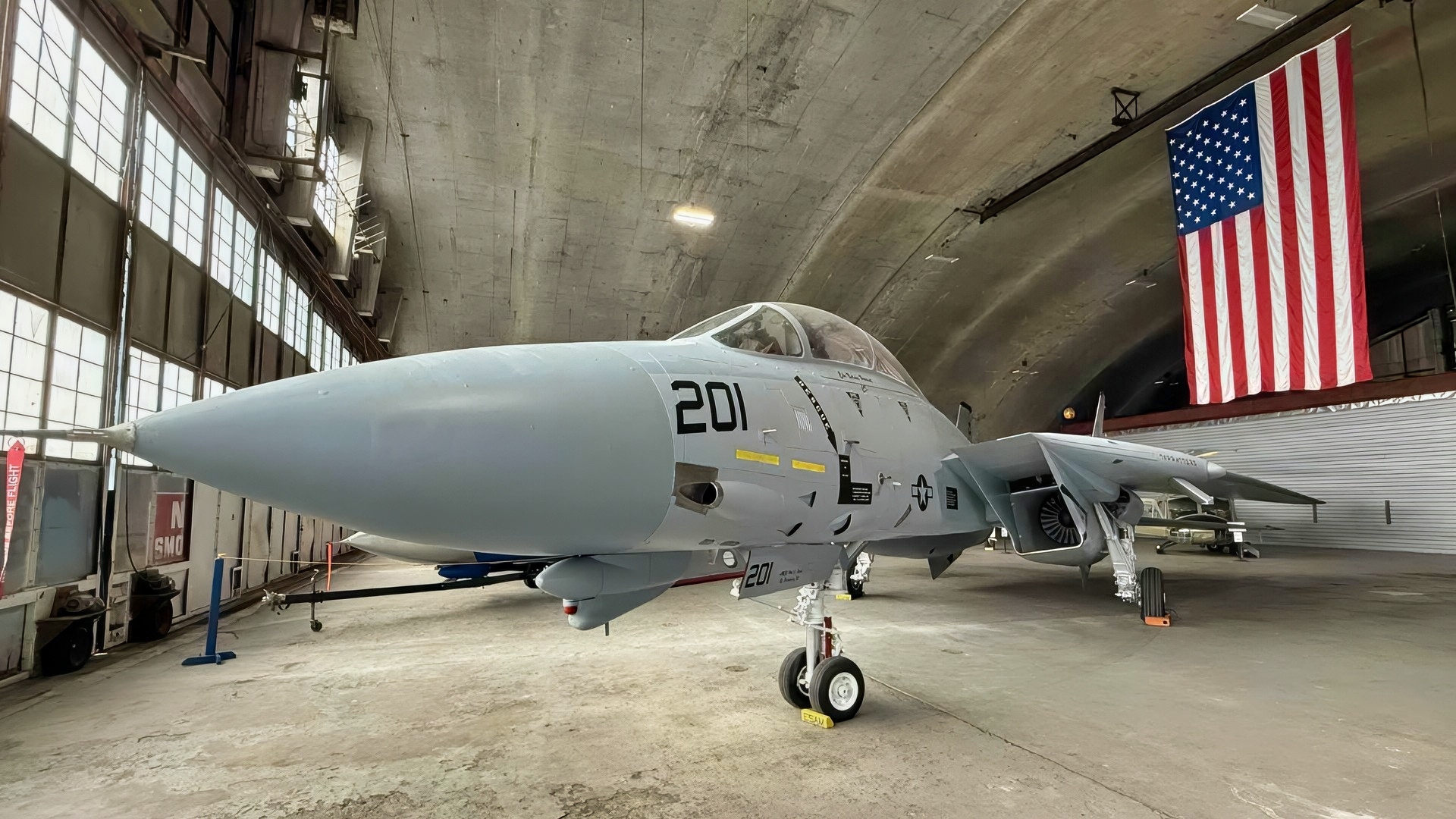
Meet the F-14 Tomcat Museum. Image Credit: Creative Commons.
-Pilots praised dogfight agility, yet maintenance demands and a thinned cadre shrank readiness—from dozens early on to roughly 15–20 aircraft by war’s end.
-Both sides husbanded fighters as deterrents. Today, Iran’s Tomcat force is likely marginal, but the episode informs current debates over U.S. parts control and allied dependence.
No Parts, No Problem: Keeping the F-14 Tomcat Combat-ready During the Iran-Iraq War
Cut off from Iran’s pipeline of American spare parts, Iranian air crews begged, borrowed, and stole the parts they needed to keep their F-14 Tomcats combat-ready. Their efforts ensured the F-14’s value as a force multiplier throughout the Iran-Iraq War.
Iran’s use of American-supplied F-14 Tomcats during the 1980-88 Iran-Iraq War is a remarkable chapter in the history of that now-retired Cold War-era fighter. Iran purchased 79 F-14s in the mid-1970s, a purchase calibrated to counter the Soviet Union’s probing MiG-25 reconnaissance flights—flights meant as tests to track the porosity of the Iranian border and the robustness of Iran’s response to aerial incursions.
Following the Iranian revolution in 1979 and subsequent overthrow of the Shah, Washington put the kibosh on further F-14 exports—Iran was the only country that ever imported the fighter jet—while also putting a stranglehold on the supply of spare parts and consumable components that kept Iran’s F-14 fleet airborne. The American-made AIM-54 Phoenix air-to-air missiles that armed the Tomcats also stopped arriving.
When Iraq invaded in September 1980, Iran’s F-14 fleet became one of the country’s most important military assets, even with a truncated supply of cutting-edge air-to-air munitions. The Tomcat’s powerful AWG-9 radar meant Iran’s F-14s could both operate as small early-warning and control aircraft and spot massed formations of incoming Iraqi aircraft; the aircraft used that same radar to lock onto far-off targets. Cognizant of the threat the F-14-Phoenix combination posed, Iraqi pilots avoided any airspace guarded by the American-built fighters.
The Tomcat’s performance in Iranian hands was positive. Iranian, Iraqi, and Western sources on F-14 combat kills vary widely, but the consensus is somewhere in the neighborhood of 120 to 150 kills of various kinds. On one fact virtually all sources agree: The F-14 was Iran’s most potent interceptor, and its long-range radar served as a force multiplier despite a steadily shrinking stockpile of spare parts and AIM-54 missiles.
An account of the war published in Smithsonian Magazine explained that “the most intense periods of air combat were the first two months of the war, which began September 22.” An Iranian pilot identified as Captain Javad, “who was involved in the early actions against the Iraqi air force recalled, ‘There was little on the ground to stop the massed Iraqi Army from rolling east…[however,] our air force intercepted Iraqi fighters over the border, bombed the Iraqis on the ground, and launched air strikes deep into enemy airspace.’”
Because the Iranian F-14s were “equipped with the AWG-9 pulse Doppler radar, the Iranian pilots could hit an enemy aircraft from 100 miles away, but the pilots also appreciated the airplane’s fighting abilities close in,” Smithsonian explained.

F-14 Tomcat. Image Credit: Creative Commons.
Another Iranian pilot, Major Farhad, talked about the fighter’s maneuverability. “The capability of the F-14A to snap around during the dogfight was unequalled,” Major Farhad said. “After only 100 hours of training, I learned to pitch the nose of my Tomcat up at a 75-degree [angle of attack] in just over a second, turn around, and acquire the opponent either with Sidewinders or the gun.”
During the war, both Iran and Iraq made careful use of their fighter jets. They did not wish to sacrifice the planes quickly in combat. Similarly to how the Soviet Union and the United States used their respective nuclear arsenals as a powerful deterrent force, fighters were often kept in reserve, held back for cases of extreme need. During this war, in the air at least, the conservation of fighters was prioritized.
At first, Iran “attempted to keep some 60 Tomcats in operational condition, but intensive flying and lack of qualified maintenance personnel—not the lack of spare parts, as is commonly believed—forced it to scale back the number of operational F-14s to 40 by 1984, and to 25 by 1986,” Smithsonian writes.
Spare Parts, Export Regimes, Embargoes
The issue of spare parts has resurfaced more recently. Several U.S. allies in Europe have voiced fears that if NATO member-states’ relationships with the United States were to sour, the U.S. stranglehold on the global flow of spare parts would effectively serve as an off switch for European stealth fighters.
Danish lawmaker Rasmus Jarlov expounded upon this line of reasoning on X: “The USA can certainly disable the planes by simple stopping the supply of spare parts,” Mr. Jarlov wrote. “Therefore, buying American weapons is a security risk that we can not run. We will make enormous investments in air defence, fighter jets, artillery and other weapons in the coming years, and we must avoid American weapons if at all possible.”
F-14 Still Flying?
Is Iran’s F-14 force still viable today? It seems unlikely.
The F-14 is a notoriously maintenance-heavy aircraft, even when all support is available. By the mid-1980s, Iran’s Tomcat fleet readiness had declined significantly from its pre-war zenith, with only around 15 to 20 aircraft able to be ready for combat at any given time.
The gutting of the F-14’s officer cadre before the war severely hampered Tomcat operations, an issue that would be exacerbated by pilot and aircrew combat losses as the war dragged on.
About the Author: Caleb Larson
Caleb Larson is an American multiformat journalist based in Berlin, Germany. His work covers the intersection of conflict and society, focusing on American foreign policy and European security. He has reported from Germany, Russia, and the United States. Most recently, he covered the war in Ukraine, reporting extensively on the war’s shifting battle lines from Donbas and writing on the war’s civilian and humanitarian toll. Previously, he worked as a Defense Reporter for POLITICO Europe. You can follow his latest work on X.
More Military
Fact: The F-35 Can’t Be Replaced
How Do You Replace the Main Battle Tank?
The F-35 ‘Ferrari’ Fighter Might Be ‘Coming Soon’ to a War Near You
The B-21 Raider Bomber Question We Keep Asking
KF-21: South Korea Wants Its Very Own F-35-Style Stealth Fighter


