


Key Points and Summary – Could Venezuela actually threaten the USS Gerald R. Ford carrier strike group in the Caribbean? Expert Reuben F. Johnson’s answer is essentially no.
-Caracas’ only meaningful assets are a small, poorly maintained Su-30MK2V fleet and short-range Kh-31 anti-ship missiles, all hampered by failing radars, thin logistics, and no serious ISR or maritime patrol aircraft.
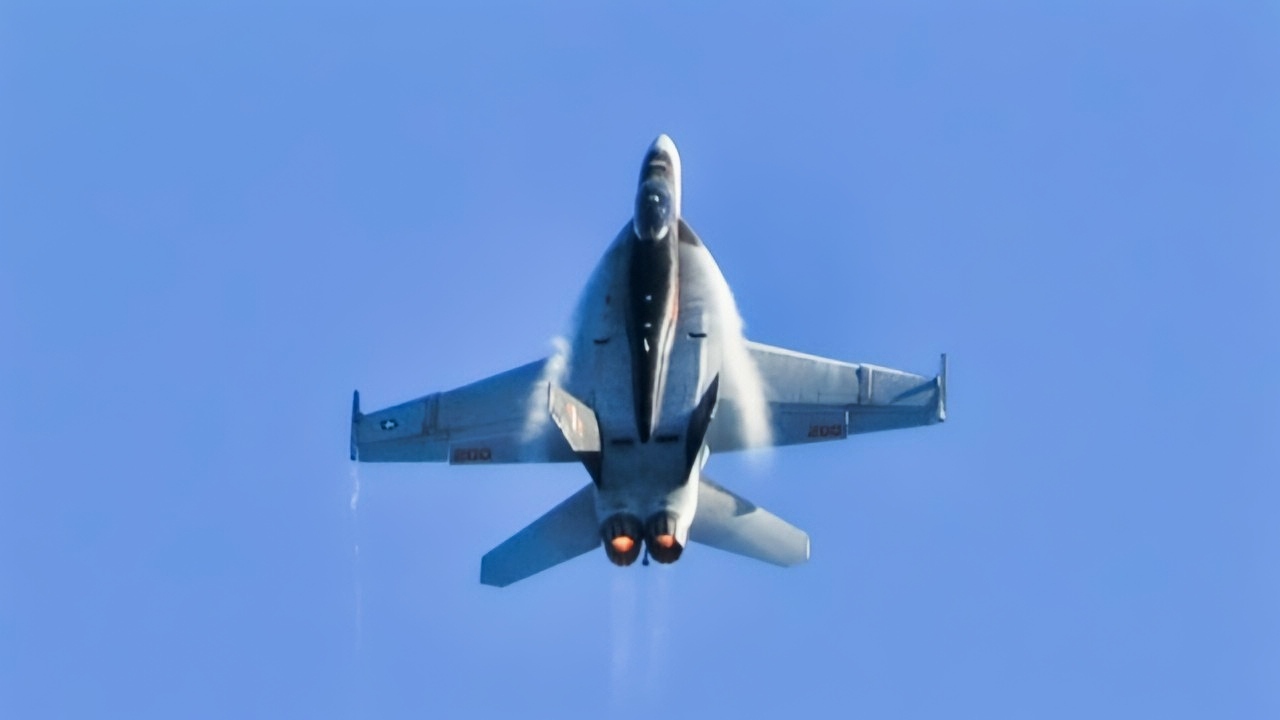
A U.S. Navy F/A-18E Super Hornet aircraft assigned to Strike Fighter Squadron (VFA) 147 performs maneuvers above the aircraft carrier USS Nimitz (CVN 68) during the departure of Carrier Air Wing (CVW) 11 Dec. 10, 2013, in the Pacific Ocean. CVW-11 fixed wing aircraft flew off the Nimitz to return home after being deployed to the U.S. 5th, 6th and 7th Fleet areas of responsibility. (U.S. Navy photo by Mass Communication Specialist Seaman Apprentice Kelly M. Agee/Released)
-By contrast, the Ford sails with F/A-18E/F fighters, E-2D Hawkeyes, EA-18G jammers, layered surface-to-air defenses and CIWS guns.
-Any Venezuelan strike package would be detected far out and likely destroyed before weapons release.
-Attacking a U.S. Navy aircraft carrier, Johnson argues, would be a massive mistake.
Could Venezuela Attack the USS Gerald R. Ford Aircraft Carrier?
Fort Lauderdale, Florida – There is a question of whether Venezuela could mount an attack on the USS Gerald R. Ford and the strike group currently on station in the Caribbean.
The supposition is that the carrier is the lead element in this flotilla, positioned to launch attacks on Venezuela to topple the government of Nicolás Maduro Moros.
The short answers are the following. First, one would only attack a US aircraft—no matter where it is in the world—if the entity had some sort of a death wish.
Aircraft carriers are among the most well-protected naval assets the US military operates, and the multiple layers of defense they have at their disposal are—one should remember—designed to ensure the carrier is survivable against peer competitors like Beijing’s People’s Liberation Army Navy (PLAN).
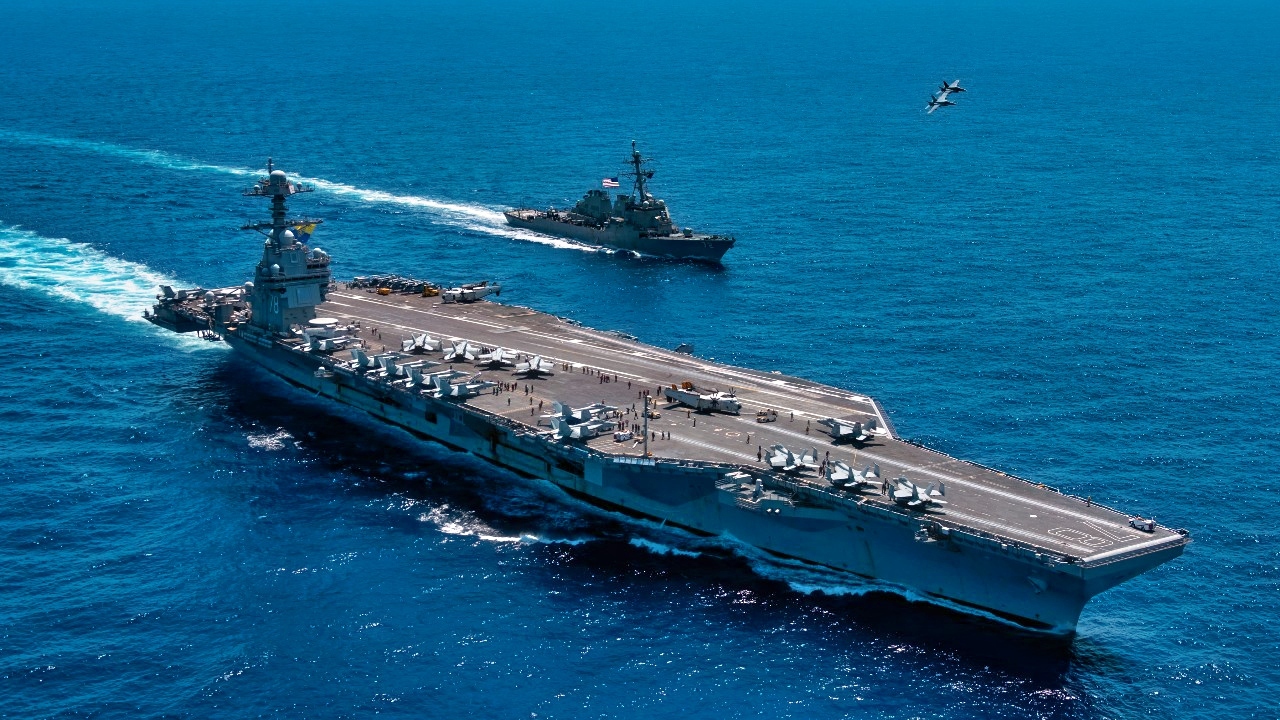
An F/A-18F Super Hornet, attached to the “Blacklions” of Strike Fighter Squadron (VFA) 213 and a F/A-18E Super Hornet, attached to the “Golden Warriors” of Strike Fighter Squadron (VFA) 87 fly over the world’s largest aircraft carrier, USS Gerald R. Ford (CVN 78), the Arleigh Burke-class guided-missile destroyer USS Mahan (DDG 72), April 11, 2025. The Gerald R. Ford Carrier Strike Group is underway in the Atlantic Ocean completing integrated naval warfighting training. Composite Training Unit Exercise (COMPTUEX) is the Joint Force’s most complex integrated training event and prepares naval task forces for sustained high-end Joint and combined combat. Integrated naval training provides America’s civilian leaders and commanders highly-capable forces that deter adversaries, underpin American security and economic prosperity, and reassure Allies and partners. (U.S. Navy photo by Mass Communication Specialist 2nd Class Maxwell Orlosky
So, given the comparatively parlous state of Venezuela’s military, there is no chance for a successful attack on a US Navy aircraft carrier.
The only assets the country has that it could bring to bear are its small fleet of Su-30MK2V Flanker multirole fighters, 24 of which were delivered between 2006 and 2008.
But according to previous reports dating back to 2018, only five airframes of the platform were still operational.
Secondly, even if 21 of these survive in service today, and within that remaining group, there is an even larger question of how many are available on any given day.
According to a report at the end of last month, Maduro had resorted to sending a personal letter to Russian President Vladimir Putin, to be hand-delivered by a Venezuelan minister who was scheduled to visit Moscow, that was to be delivered to the former KGB Lt. Col who has ruled Russia since 2000.
Ramshackle Air Force for Venezuela vs. a Navy Aircraft Carrier
The letter was reportedly a request for some fairly extensive support from Moscow to repair and refurbish elements of Venezuela’s air defense system, most of which was focused on these fighter aircraft operated by the Aviación Militar Bolivariana Venezolana, AMBV, or the Bolivarian Venezuelan Military Aviation service.
Maduro specifically requested overhauls of eight Su-30MKV2 AL-31F jet engines and five radars.

Su-30. Image Credit: Creative Commons.
The list of items he asked for also included unspecified requirements for Moscow to provide “logistical support” not only for these aircraft but also for some of the country’s ground-based air defense systems.
These aircraft, while one of the more advanced Russian designs, date back to the 1990s.
The Venezuelan variants were reportedly a specialized modification of the Su-30MK2, initially developed for the Chinese People’s Liberation Army Navy (PLAN).
The Venezuelan aircraft were also reported to be more capable than the version sold to China, as they were retrofitted with some more advanced on-board systems that were initially developed for the Su-35 program.
But while, more than a decade ago, these Venezuelan aircraft had been touted as the most advanced in all of Latin America, more recent reporting on these fighters states that, “while cutting edge for its time,” the avionics on board these Su-30 models are “increasingly considered out of date.”
Sighting and Finding is Harder Than You Think
Without any reconnaissance and surveillance platforms and nothing that performs the role of the US Boeing P-8 Poseidon Maritime Patrol Aircraft, these Su-30MKV2s would struggle to find the Ford carrier at sea, then fight their way through, and not be shot down by the US Navy’s F/A-18E/F air defense fighter grouping.
Those US fighters would also be supported by E-2D Hawkeyes AEW&C aircraft and EA-18G electronic attack platforms.
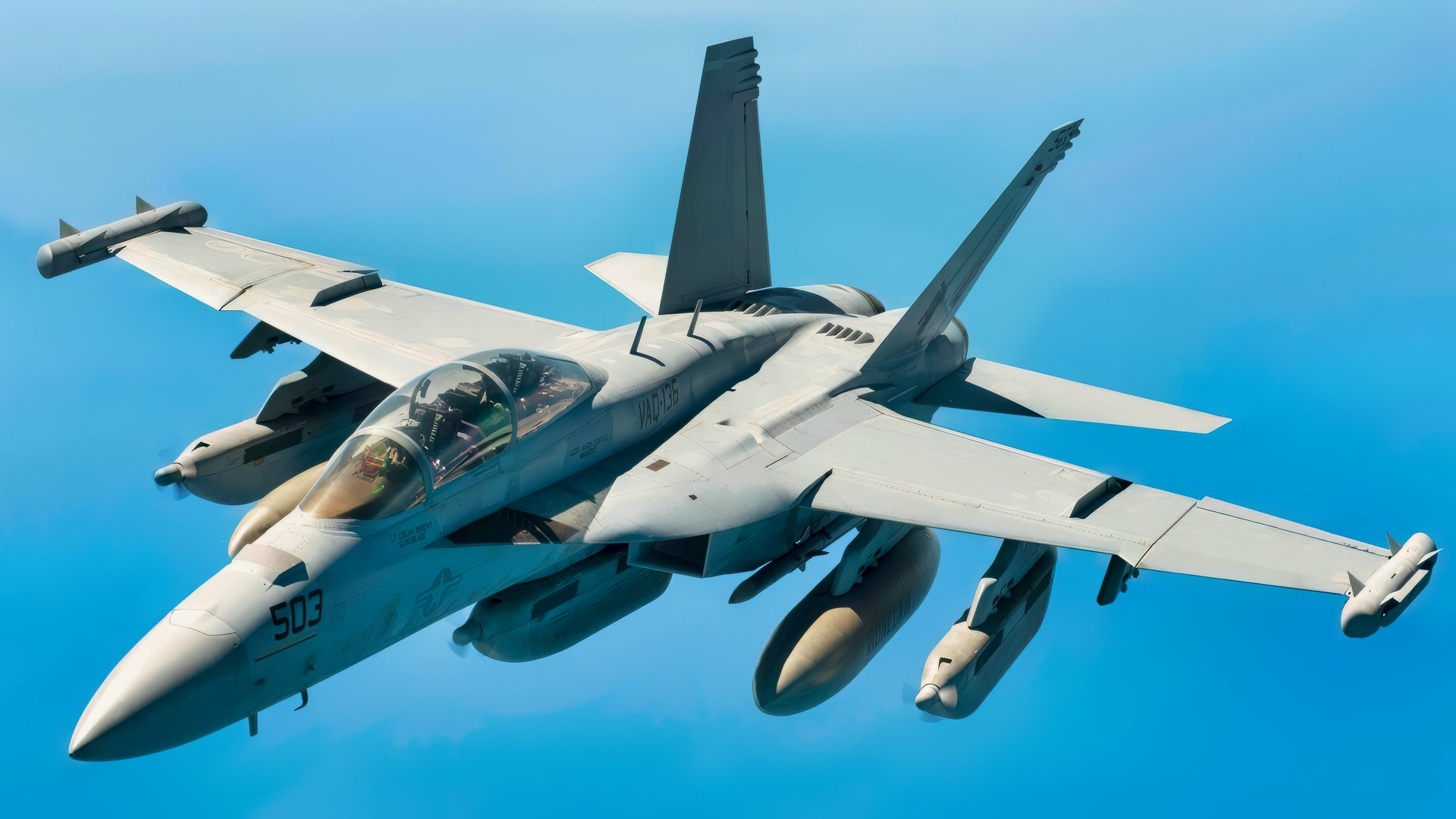
A U.S. Navy EA-18G Growler assigned to the USS Carl Vinson breaks away from a U.S. Air Force KC-135 Stratotanker from the 909th Air Refueling Squadron after conducting in-air refueling May 3, 2017, over the Western Pacific Ocean. The 909th ARS is an essential component to the mid-air refueling of a multitude of aircraft ranging from fighter jets to cargo planes from different services and nations in the region. (U.S. Air Force photo by Senior Airman John Linzmeier)
Any Venezuelan attempt to attack the Ford from the air would also be detected from hundreds of miles away and would most likely be shot down well before they reached the launching range for their weapons.
The only weapon the Venezuelans could fire against the carrier, if they could get within range, would be the Russian-made Kh-31 supersonic air-to-surface missiles.
The missiles are known by their NATO Codename as AS-17 Krypton, and are propelled by a ramjet motor.
Kh-31 versions sold and exported before the missile was equipped with a multi-mode seeker would be fitted with an anti-ship or anti-radiation version.
The anti-ship missile has a range of only 38 nautical miles.
Its seeker only has a lock-on range of about 18 miles, which is almost within visual range.
US naval vessels have been equipped with close-in weapon systems (CIWS), which are Gatling-style, high-speed guns designed to shoot down these kinds of missiles.
While an attack on the Ford aircraft carrier sounds theoretically possible, there is virtually no conceivable scenario in which that could ever take place.
About the Author: Reuben F. Johnson
Reuben F. Johnson has thirty-six years of experience analyzing and reporting on foreign weapons systems, defense technologies, and international arms export policy. Johnson is the Director of Research at the Casimir Pulaski Foundation. He is also a survivor of the Russian invasion of Ukraine in February 2022. He worked for years in the American defense industry as a foreign technology analyst and later as a consultant for the U.S. Department of Defense, the Departments of the Navy and Air Force, and the governments of the United Kingdom and Australia. In 2022-2023, he won two awards in a row for his defense reporting. He holds a bachelor’s degree from DePauw University and a master’s degree from Miami University in Ohio, specializing in Soviet and Russian studies. He lives in Warsaw.


