

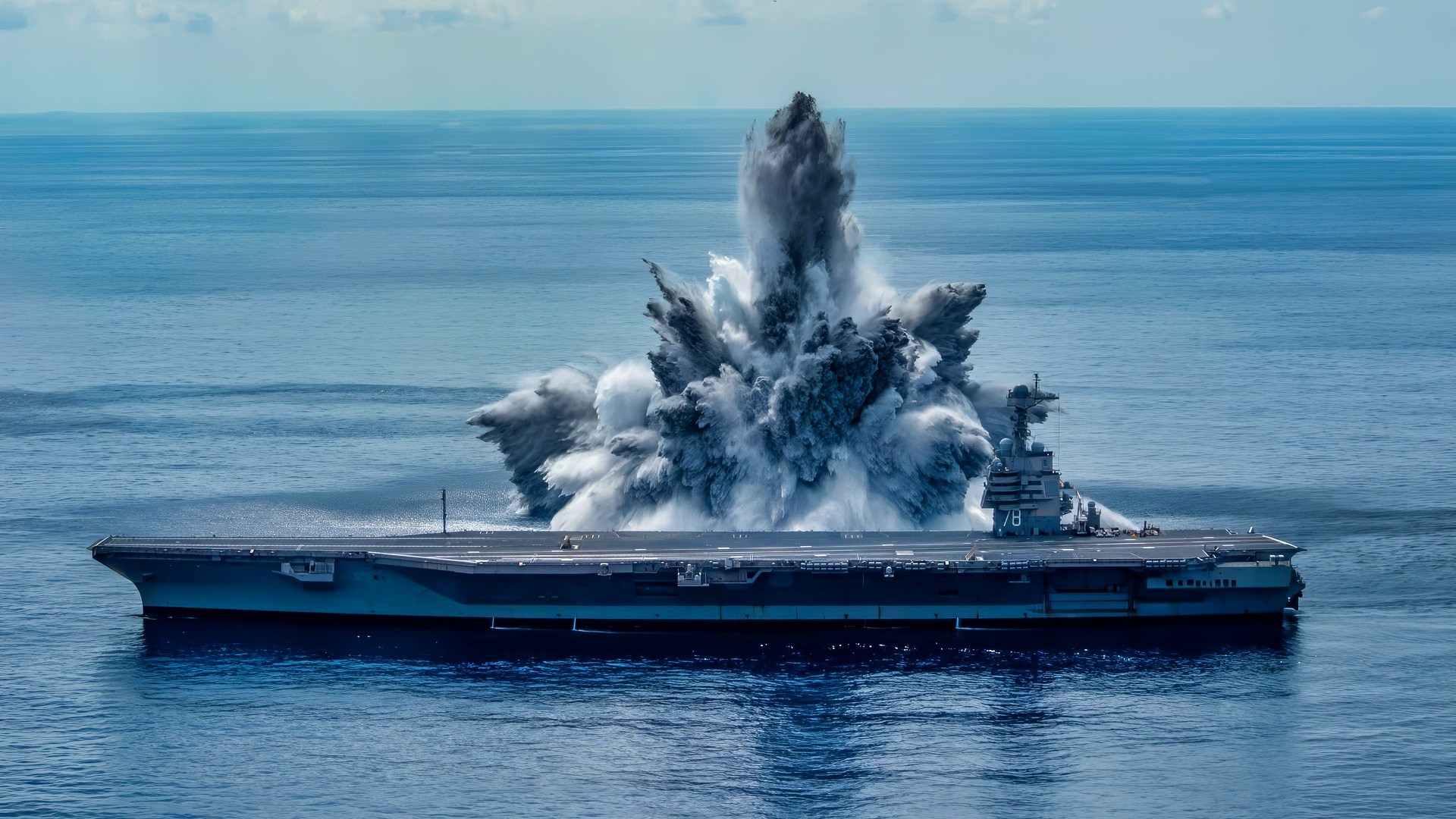
Key Points and Summary – With USS Gerald R. Ford headed to Latin America to deter Venezuela, it’s worth asking what real offensive power a modern carrier strike group brings to a crisis.
-The short answer: a balanced mix. Stealthy F-35C fighters find and fix targets while F/A-18E/F Super Hornets deliver heavy ordnance—including long-range anti-ship missiles.
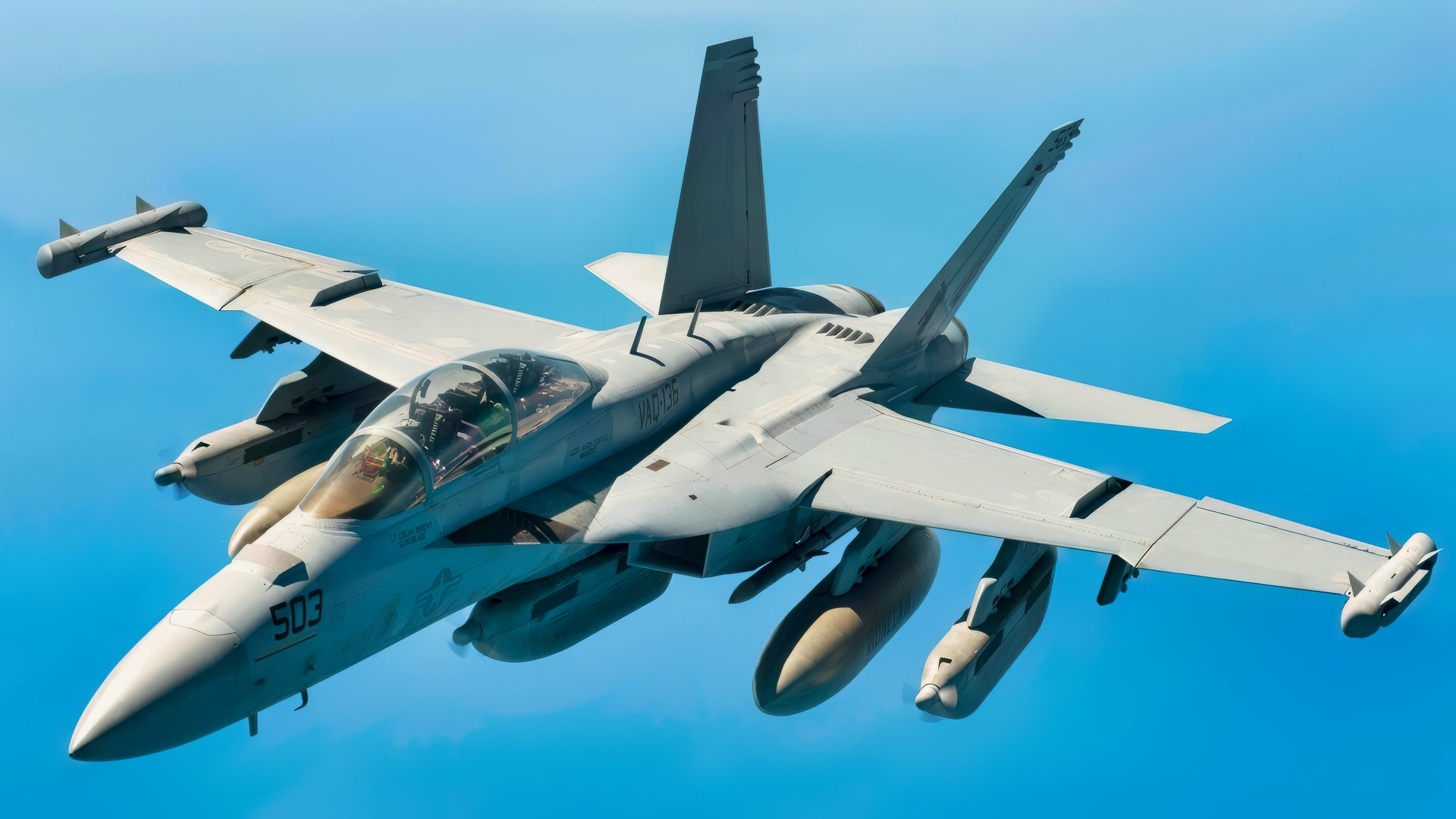
A U.S. Navy EA-18G Growler assigned to the USS Carl Vinson breaks away from a U.S. Air Force KC-135 Stratotanker from the 909th Air Refueling Squadron after conducting in-air refueling May 3, 2017, over the Western Pacific Ocean. The 909th ARS is an essential component to the mid-air refueling of a multitude of aircraft ranging from fighter jets to cargo planes from different services and nations in the region. (U.S. Air Force photo by Senior Airman John Linzmeier)
-Destroyers (and often a trailing attack submarine) can fire Tomahawk cruise missiles from far offshore, striking fixed targets without risking the air wing.
-EA-18G Growlers jam and blind defenses, using anti-radiation weapons to pry open airspace. Add a nuclear-powered attack sub’s stealthy punch, and the group can act quickly, precisely, and—if ordered—decisively.
Note to Venezuela: A Strike Group’s Power Isn’t Just the Aircraft Carrier
Headlines focus on the big deck, but the striking power of a carrier group lives in the combination: the air wing, the destroyers, and the often-unseen submarine working as one.
That’s by design.
Fighters and electronic-warfare jets shape the air picture; surface ships and subs hold prompt, long-range shots; the carrier’s sensors and command team stitch it together.
If the White House ever directed offensive operations against Venezuela, as the USS Gerald R. Ford is now on the way to Latin America, commanders would choose from multiple tools that overlap in range and effect.
Here are the five that matter most—and why.
1) F-35C Lightning II: The Silent Scout That Also Hits Hard
When a crisis turns murky, the F-35C’s value isn’t just “stealth.” It’s awareness.
The jet hoovers up radar, radio, infrared, and visual cues, fuses them into a clear picture, and quietly shares that picture with the rest of the force. That makes it a near-ideal first mover: slipping in to map what’s real, mark what’s a decoy, and—if policy allows—strike with precision weapons such as GPS-guided bombs or small diameter munitions designed for moving targets.
Just as important, the F-35C can “quarterback” for others: cueing a ship’s cruise missile, guiding a Super Hornet’s long-range shot, or calling off an attack if the scene changes.
Why it’s potent: It reduces uncertainty for everyone else. In modern war, certainty is often the most lethal weapon in the room.
2) F/A-18E/F Super Hornet: The Heavy Hitter With Reach
The Super Hornet is the group’s dependable bruiser.
It carries diverse loads—precision bombs for fixed sites, glide weapons for defended areas, and, crucially, long-range anti-ship missiles that let the air wing threaten hostile combatants from well beyond the horizon.

At sea (Mar. 1, 2007) – Capt. Craig “Animal” Williams (front) in a F/A 18C Hornet (front) and Capt. Richard “Rhett” Butler (back) in an F/A 18C Hornet look up for a photo as they fly over USS Ronald Reagan (CVN 76). Capt. Williams, a 22-year Naval Aviator who graduated from the United States Naval Academy, was relieved as Commander, Carrier Air Wing Fourteen (CVW-14) by 21-year Naval Aviator, Capt. Butler, a graduate of the University of Kentucky during an aerial change of command ceremony. The Ronald Reagan Carrier Strike Group is currently underway in the Pacific Ocean on a surge deployment in support of U.S. military operations in the Western Pacific. Official U.S. Navy photo by Lt. Cmdr. Tam Pham
(RELEASED)
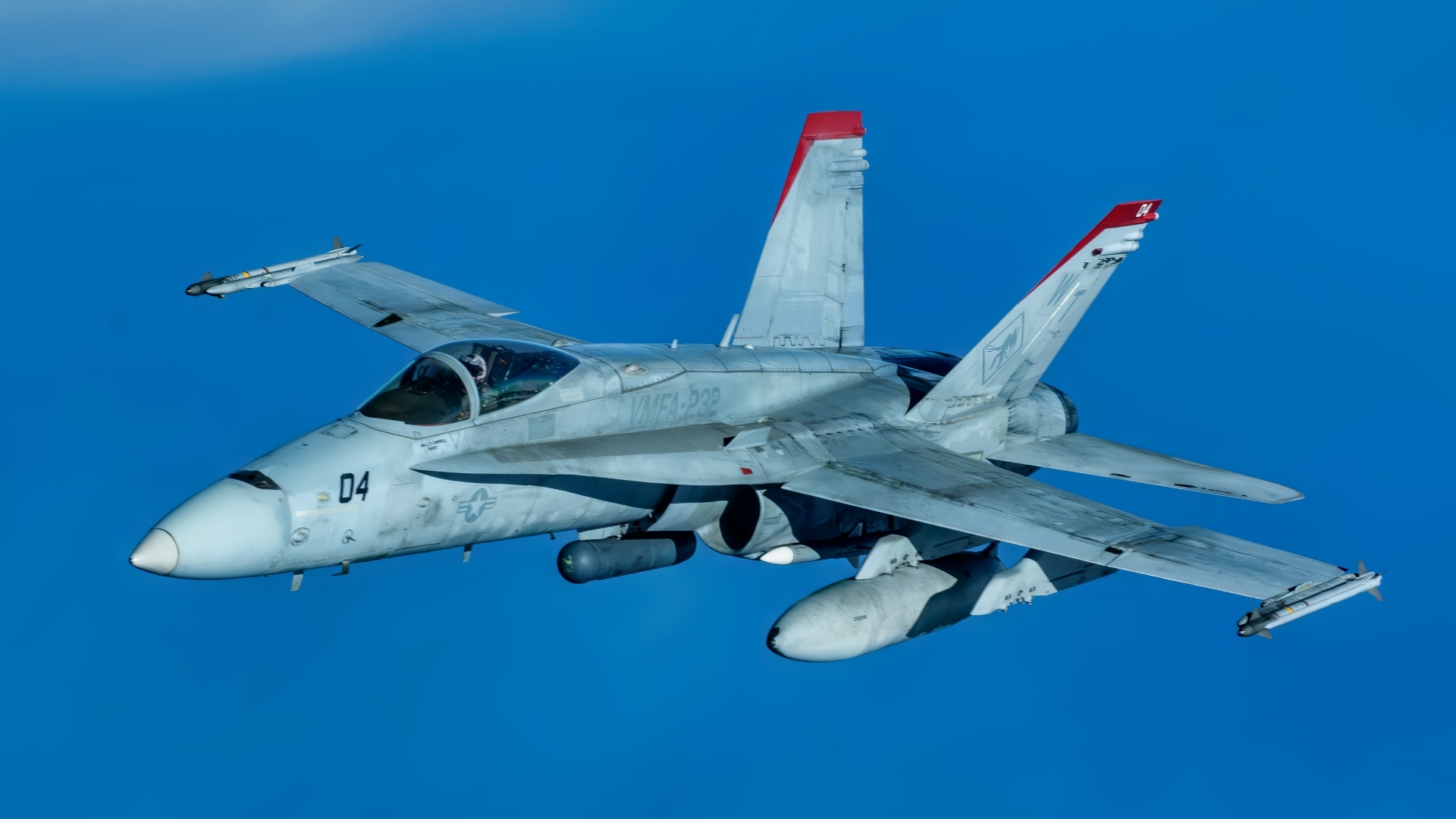
A U.S. Marine Corps F/A-18 Hornet pulls away from a U.S. Air Force KC-135 Stratotanker from Kadena Air Base after refueling over the Pacific Jan. 3, 2024. Conducting joint operations enhances the lethality and readiness of U.S. forces and its ability to project superior airpower to the Indo-Pacific region. (U.S. Air Force photo by Senior Airman Cedriue Oldaker)
It can also launch a new-generation missile that homes on enemy radars, a key tool for poking holes in an integrated air defense. Thanks to buddy-tankers (and soon, routine unmanned tanking), Super Hornets can push far enough to matter without dragging the carrier close to shore.
Why it’s potent: Flexibility. It can do air-to-air in the morning and kick down a door that night—at scale.
3) Tomahawk Cruise Missiles From Escorts (And Often, a Submarine)
If the order is “hit fixed targets, now,” the destroyers flanking a carrier—and frequently, a Virginia-class attack submarine riding ahead—can salvo Tomahawk cruise missiles from hundreds of miles away.
That matters for two reasons. First, the shot arrives without warning; there’s no takeoff to detect, no flight deck to watch. Second, the missiles fly low and smart, weaving through terrain to their aimpoints. Newer variants add improved seekers and upgraded electronics, keeping a proven design relevant against modern defenses and tricky coastal targets.
Why it’s potent: It buys time and safety—striking early, precisely, and from well offshore, before aircrew ever cross a coastline.
4) EA-18G Growler + Anti-Radiation Weapons: Making Air Defenses Blink
Every modern strike starts with a blunt question: can you survive the air defenses?
The Navy’s answer sits in the same hangar as the fighters—the EA-18G Growler. It listens for hostile radars, jams what it can, deceives what it can’t, and, when necessary, fires anti-radiation missiles designed to home on those emitters.
Think of Growlers as electricians in a fistfight: they darken the right circuits so everyone else can get through. Paired with F-35Cs painting a live picture of sites and decoys, Growlers turn a dangerous sky into one pilots can manage.
Why it’s potent: It doesn’t just protect; it enables. When defenses blink, the rest of the playbook opens.
5) A Lurking Virginia-Class Attack Submarine: The Shot No One Sees
You won’t see it in photos, but a fast-attack submarine almost always shadows a carrier group.
Against a capable opponent, that submarine is the group’s most unpredictable weapon. It can fire Tomahawks from a concealed perch, tail hostile naval units, or simply force an adversary to assume it’s everywhere at once.
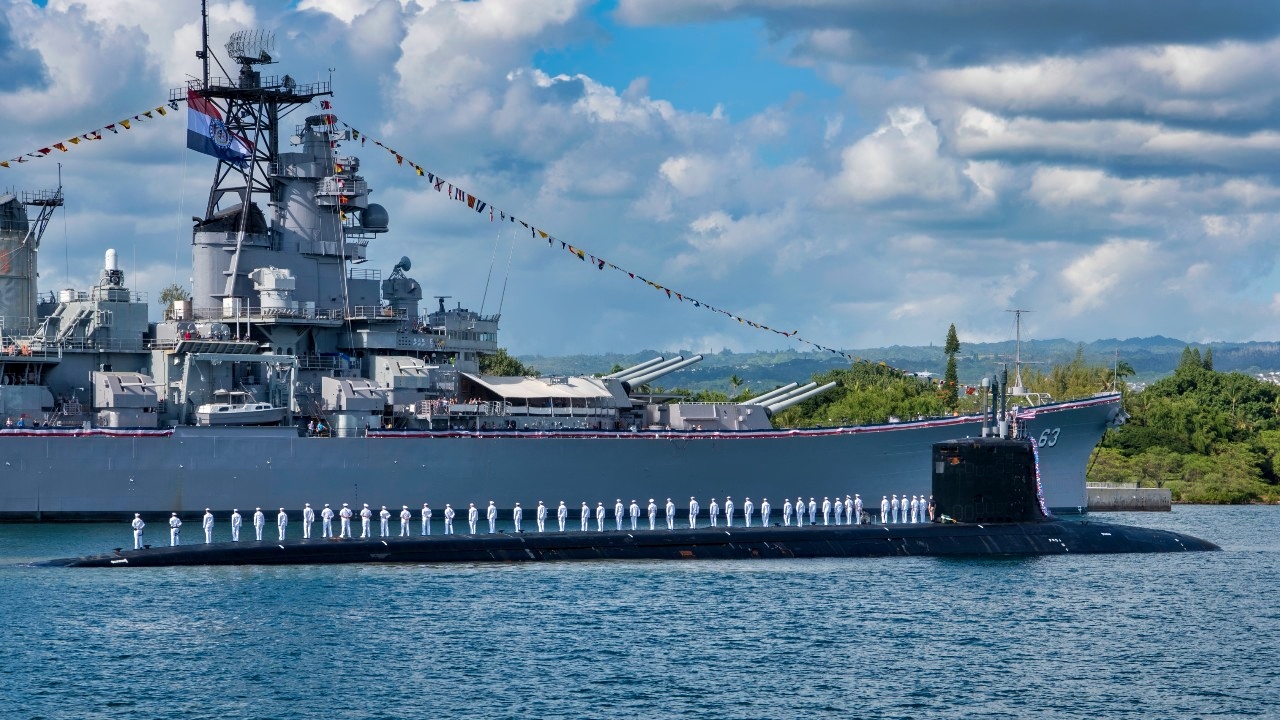
The crew of the Virginia-class fast-attack submarine USS Missouri (SSN 780) render honors to the Battleship Missouri Memorial following a homeport change from Groton, Connecticut. (U.S. Navy photo by Mass Communication Specialist 2nd Class Michael H. Lee/ Released)
In practical terms, that means an opponent must guard coasts and harbors, protect ships at sea, and waste time on false contacts—while the United States chooses when to reveal the sub with a sudden strike.
Why it’s potent: Pressure without presence. It warps an adversary’s planning before a single missile flies.
How These Five Fit Together
No single tool does it all. Together, they let commanders combine stealthy scouting (F-35C), heavy conventional punch (Super Hornet), standoff precision (Tomahawk), electromagnetic suppression (Growler), and unseen threat (attack submarine).

Aviation Boatswain’s Mate (Equipment) 3rd Class Mark Ruiz, assigned to Air Department aboard the world’s largest aircraft carrier, USS Gerald R. Ford (CVN 78), prepares a Carrier Air Wing 8 F/A-18E Super Hornet attached to Strike Fighter Squadron 37 for launch on the flight deck, Aug. 1, 2025. Gerald R. Ford, a first-in-class aircraft carrier and deployed flagship of Carrier Strike Group Twelve, is on a scheduled deployment in the U.S. 6th Fleet area of operations to support the warfighting effectiveness, lethality and readiness of U.S. Naval Forces Europe-Africa, and defend U.S., Allied and partner interests in the region. (U.S. Navy photo by Mass Communication Specialist 2nd Class Mariano Lopez)
In an actual operation, those roles would blur: a Growler might cue a ship’s missile; a Super Hornet might carry radar-hunting weapons while F-35Cs sling bombs; the sub’s presence might pin enemy ships in port while airpower works ashore.
The point isn’t a checklist—it’s options.
Two Ground Rules Worth Remembering
First, capability is not policy. Having tools doesn’t mean using them; employment is a political decision with legal and human consequences. Second, a carrier’s real strength is endurance. It can loiter for weeks, show force without firing, and then act quickly if leaders decide the line has been crossed.
That patience-with-teeth is why a single strike group can change behavior far from home.
The USS Gerald R. Ford Aircraft Carrier Strike Group Should Make Venezuela Pause
If the USS Gerald R. Ford strike group is asked to do more than show the flag, it has a deep bench to draw from. Stealthy eyes to find the truth, heavy hitters to act on it, jammers to pry open the door, and a submarine to keep adversaries guessing.
That blend—speed, reach, deception, and endurance—explains why no other navy fields anything quite like a U.S. carrier strike group.
It’s not one ship. It’s an ecosystem built to move fast, strike clean, and leave on its own terms.
About the Author: Harry J. Kazianis
Harry J. Kazianis (@Grecianformula) is Editor-In-Chief and President of National Security Journal. He was the former Senior Director of National Security Affairs at the Center for the National Interest (CFTNI), a foreign policy think tank founded by Richard Nixon based in Washington, DC. Harry has over a decade of experience in think tanks and national security publishing. His ideas have been published in the NY Times, The Washington Post, The Wall Street Journal, CNN, and many other outlets worldwide. He has held positions at CSIS, the Heritage Foundation, the University of Nottingham, and several other institutions related to national security research and studies. He is the former Executive Editor of the National Interest and the Diplomat. He holds a Master’s degree focusing on international affairs from Harvard University.
More Military
The Army’s AbramsX Tank Boils Down to 1 Word
China’s Big Plan To Sink U.S. Navy Aircraft Carriers Comes Down to 4 Words
The New Air Force B-21 Raider Isn’t Just a Stealth Bomber
The F-22 ‘Super’ Stealth Fighter Is Coming
The Real Reason U.S. Air Force Recruiting Numbers Are Surging


