


Key Points and Summary – Russia’s Su-35 “Super Flanker,” its top 4.5-generation fighter, has been making headlines for mixed reasons. One was reportedly shot down by a Ukrainian F-16, marking the first air-to-air loss for the type.
-Another, flown by China, engaged in an “unsafe and unprofessional” interaction with an Australian P-8 patrol plane.

Su-35 Fighter. Image Credit: Creative Commons.
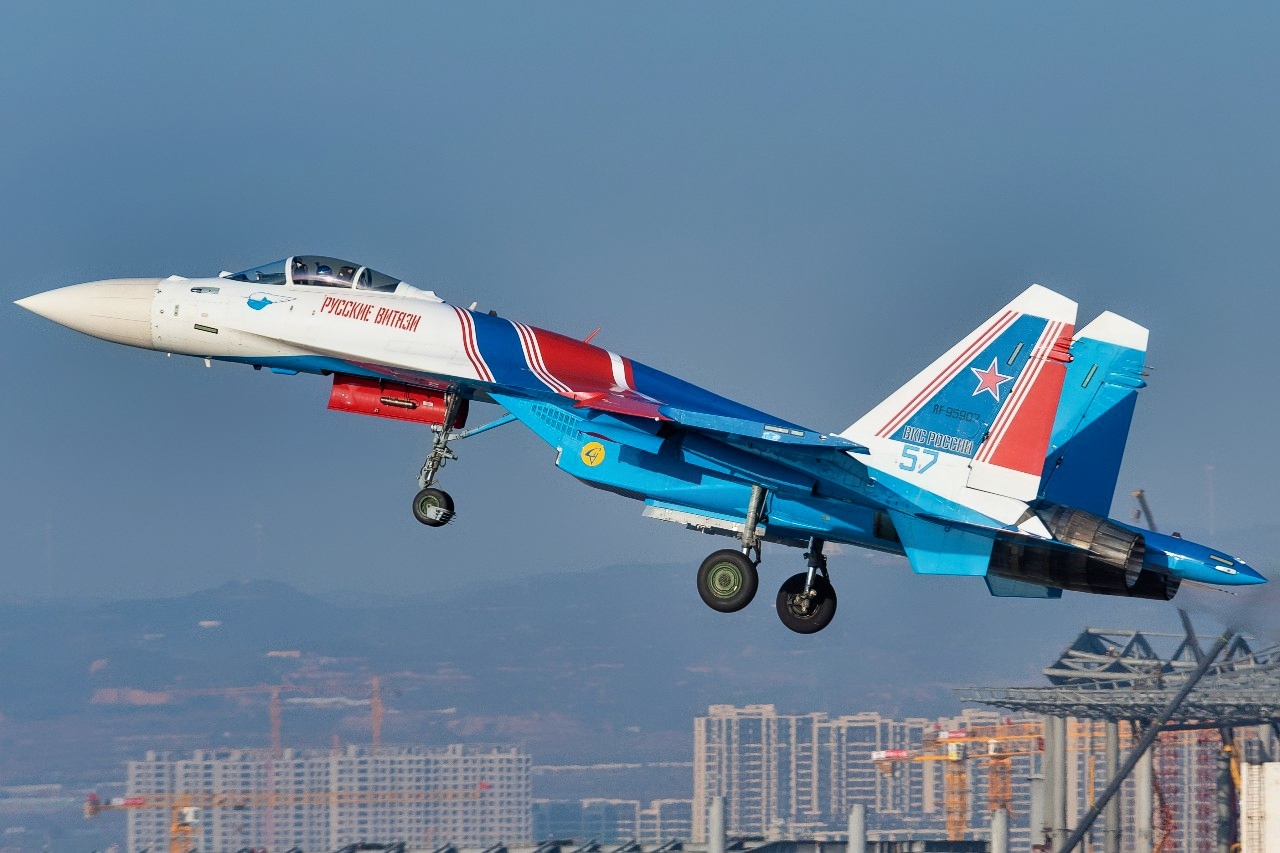
Su-35. Image Credit: Creative Commons.
-Meanwhile, reports suggest a major deal to supply Iran with Su-35s may finally be moving forward.
-Despite its advanced features and maneuverability, experts assess the Su-35 struggles in beyond-visual-range (BVR) combat against Western fighters due to inferior radar performance, limiting its overall effectiveness.
The Su-35 Is Great in a Dogfight, But Can’t Beat Stealth
The Su-35 has been in the news quite a bit lately, whether it’s entanglements in the sky in two different parts of the world, or a possible deal to sell a bunch of them.
According to Sofrep, Ukraine successfully shot down a Russian Su-35S Super Flanker in June, with a Dutch F-16AM Fighting Falcon jet fighter, being used by Ukraine, doing the honors, over the Kursk region of Russia.
This was described in the report as the first-ever air-to-air shootdown of a Super Flanker and the ninth shot down since the start of the war, although surface-to-air missiles did most.
Sofrep describes the Su-35S as Russia’s “very latest, fourth-generation-plus, non-stealth fighter,” featuring a N035 Irbis-E airborne radar, OLS-35 electro-optical/infrared tracking sensor, and 12 weapon stations.
Per the report, which cited the Ukrainian Air Force, the pilot safely ejected near an open field in Korenovo, Russia, and was rescued by a Russian combat search-and-rescue (CSAR) team.
This week, there was another skirmish involving an Su-35, this time involving China and Australia in the South China Sea.

Su-35. Image Credit: Creative Commons.
Australia vs. China
Australia’s Defence Ministry released a statement on October 20, alleging that the government has “expressed its concerns to the Chinese Government following an unsafe and unprofessional interaction with a People’s Liberation Army–Air Force (PLA-AF) aircraft.”
According to the Australian government statement, the incident took place on October 19, when the Royal Australian Air Force (RAAF) P-8A Poseidon maritime patrol aircraft “experienced an unsafe and unprofessional interaction with a PLA-AF Su-35 fighter aircraft.”
While no injuries were reported, Australia stated that the “PLA-AF aircraft released flares in close proximity to the RAAF P-8A aircraft.”
According to the New York Times, this incident took place shortly before the Australian Prime Minister, Anthony Albanese, was scheduled to meet with President Donald Trump at the White House. Australia, per the Times, “is trying to navigate between its close alliance with the United States and its economic dependence on China, its largest trading partner.”
China’s government, per a translation, alleged in a statement of its own that “an Australian P-8A military aircraft illegally intruded into China’s Xisha airspace without the approval of the Chinese government,” and that ” the Southern Theater Command mobilized naval and air forces to track, monitor, forcefully counterattack, and issue warnings to expel the aircraft in accordance with laws and regulations. Australia’s actions seriously infringe upon China’s sovereignty and are highly likely to lead to maritime and air incidents.”
Jets to Iran?
Meanwhile, per a Middle East Eye report in late September, an Iranian lawmaker has claimed that Russia has delivered MiG-29 and Sukhoi Su-35 fighter jets to Iran. Abolfazl Zohrevand, a member of the Iranian parliament’s National Security Commission, said in a recent video interview that the MiG-29 jets were already in Iran, and also that “Su-35 fighters, as well as the S-400 and Chinese HQ-9 defence systems, were also on their way.”
However, the claim at the time was questioned. Per Middle East Eye, “no official sources in either country have confirmed it.”
A subsequent report, from Israeli news outlet Israel Hayom, cited “leaked documents” showing that a “major deal” had been agreed to between Russia and Iran, under which Iran would receive 48 Sukhoi-35 aircraft, with a price tag of $6.5 billion.

Su-35. Image Credit: Creative Commons.
The report, which cited documents unearthed and released by a pro-Ukraine hacker group called Black Mirror, added that the planned sale of the aircraft has been known for some time. However, various and often conflicting reports about the delivery schedule have surfaced periodically. As of now, the jets have not yet been delivered.”
An Asia Times analysis of the Iran/Russia jets deal, published earlier this month, couched the jet deal as Russia helping an ally, Iran, while “avoiding Middle East entanglement.” The story also called it possibly the largest military export by Russia since the invasion of Ukraine.
“The deal reportedly stems from barter arrangements involving Iranian drones and oil since 2022 and follows January 2025 statements by an Iranian Revolutionary Guard Corps (IRGC) commander confirming a finalized Su-35 contract,” Asia Times said. This followed reports this summer of tensions between Russia and Iran, after Russia reached a deal to produce drones, which have been crucial to the Russian war effort in Ukraine, inside Russia.
But what can the Su-35s really do?
A Specialist Speaks on Su-35
An Aviation Geek Club report, published this week, looked at the capabilities of the Su-35 Fanker, which the site described as a version of the Su-27 that is “deeply modernized to achieve a significant increase in its combat effectiveness against aerial, ground, and sea-surface targets.”
The report, however, also looked at the jet’s limitations and the possibility that it could struggle in beyond visual range (BVR) engagements with Western fighters.
The site cited a Quora question answered by Eric Wicklund, a former US Navy Operations Specialist.
‘The Su-35 is going to struggle with Western designs in BVR (Beyond Visual Range) engagements,’ Wicklund said on the site.
In “realistic conditions,” Wicklund wrote, the jet’s detection range is about 200 km, going up to 350 km in “optimal” conditions.
“Whereas Western 4th gen fighters, like the F-16 with the AN/APG-83 radar, have a reportedly longer detection range of 370kms while performing a realistic, full volume search,” he wrote on Quora. “Other aircraft, such as the F-15, F-35, and F-22, all have even better radar performance than that.”
And while Su-35 may hold the advantage within visual range against some Western jets, that becomes “near-s**cidal” against stealth fighters.
“A good pilot plays to his/her advantage, not the enemy’s. Western pilots will try to win engagements at BVR, where they hold the advantage,” Wicklund said in the Quora answer.
“If they cannot succeed (on that particular day), it’s time to retreat and fight another day. What works in the Western fighters’ advantage is that ALL air combat occurs first at BVR, and only after that portion is concluded, both sides close to WVR.”
About the Author: Stephen Silver
Stephen Silver is an award-winning journalist, essayist, and film critic, and contributor to the Philadelphia Inquirer, the Jewish Telegraphic Agency, Broad Street Review, and Splice Today. The co-founder of the Philadelphia Film Critics Circle, Stephen lives in suburban Philadelphia with his wife and two sons. For over a decade, Stephen has authored thousands of articles that focus on politics, national security, technology, and the economy. Follow him on X (formerly Twitter) at @StephenSilver, and subscribe to his Substack newsletter.
More Military
Montana-Class: The U.S. Navy’s Superbattleships That Never Sailed
The F-35 Stealth Fighter Feels Like a Black Hole of Trouble
Russia’s Admiral Nakhimov Kirov-Class Battlecruiser Has a Warning for the Russian Navy
China’s Yuan-Class AIP Stealth Submarine Has A Warning for the U.S. Navy
Mach 6 SR-72 Darkstar Could Soon Be the ‘Fastest Plane on Earth’


