

Key Points and Summary – The USS Gerald R. Ford’s arrival in the Caribbean marks Washington’s most assertive move toward Venezuela in years, pairing a terror designation for Caracas’s Cartel de los Soles with America’s newest, most expensive carrier.
-The deployment is meant to deter drug trafficking and malign activity, but it doubles as a real-world stress test for a ship still wrestling with reliability issues in its EMALS catapults, arresting gear, and weapons elevators.
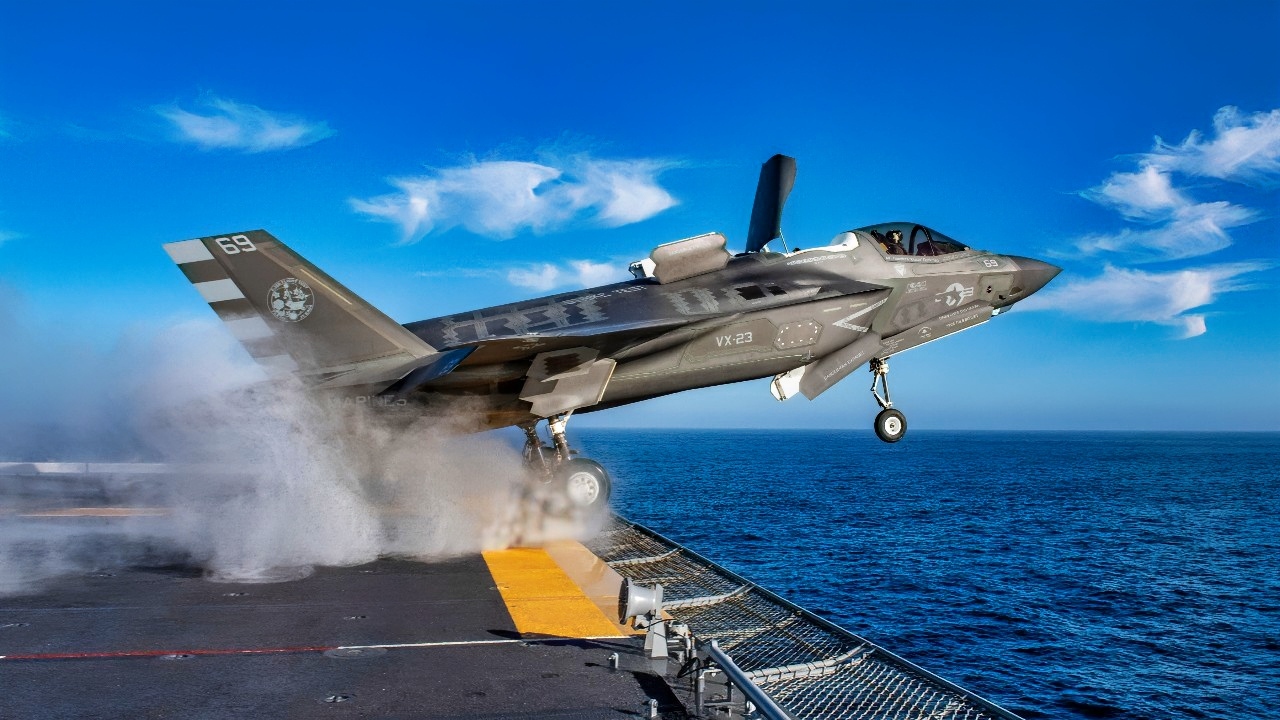
A joint team consisting of F-35 Patuxent River Integrated Test Force flight test members, U.S. Sailors and Marines, and the crew of the Japan Maritime Self-Defense Force Izumo-class multi-functional destroyer JS Kaga (DDH-184) are executing developmental sea trials in the eastern Pacific Ocean to gather the necessary data to certify F-35B Lightning II short takeoff and vertical landing aircraft operations. While aboard the MSDF’s largest ship, the Pax ITF flight test team has been gathering compatibility data for analysis in order to make recommendations for future F-35B operational envelopes, further enhancing the Japanese navy’s capabilities. The results of the testing will contribute to improved interoperability between Japan and the United States, strengthening the deterrence and response capabilities of the Japan-U.S. alliance and contributing to peace and stability in the Indo-Pacific region. Japan is an F-35 Joint Program Office foreign military sales customer planning to purchase 42 F-35Bs. The F-35 Joint Program Office continues to develop, produce, and sustain the F-35 Air System to fulfill its mandate to deliver a capable, available, and affordable air system with fifth-generation capabilities.
-If those systems falter under operational tempo, the failure will be public—undermining deterrence not just toward Venezuela, but in the eyes of bigger adversaries watching how the Ford performs.
The USS Gerald R. Ford Aircraft Carrier Deployment to Venezuela Is Risky
The nuclear-powered aircraft carrier USS Gerald R. Ford (CVN-78) arrived in the Caribbean Sea on Sunday, according to Carrier Strike Group 12, marking one of Washington’s most significant regional deployments in years.
The ship’s appearance follows a recent uptick in U.S. activity off Venezuela’s coast, including an American strike in late October that sank a vessel the Pentagon said was linked to narcotics trafficking, killing three on board.
Just days earlier, on October 30, the State Department confirmed that the U.S. intends to designate Venezuela’s Cartel de los Soles as a foreign terrorist organization, citing drug-trafficking activities and ties to senior members of Nicolas Maduro’s government.
Between the new terrorist designations and the Ford’s arrival, the regional security environment has quickly changed – and it’s clear what the U.S. is doing. The carrier’s deployment is intended to bolster U.S. operations and deter further malign activity.
Placing America’s newest carrier in the middle of a rapidly evolving crisis proves that the White House is willing to take action – and Venezuela could be forced to do the same.
For the Ford, which has long been criticized for its cost overruns and unproven new systems, the timing of the deployment is relevant, too.
This is effectively a high-visibility test of whether the Navy’s most expensive warship can perform in the conditions it was built for.

The Ford-class aircraft carrier USS Gerald R. Ford (CVN 78) and the Italian aircraft carrier ITS Cavour (CVH 550) transit the Atlantic Ocean March 20, 2021, marking the first time a Ford-class and Italian carrier have operated together underway. As part of the Italian Navy’s Ready for Operations (RFO) campaign for its flagship, Cavour is conducting sea trials in coordination with the F-35 Lightning II Joint Program Office’s Patuxent River Integrated Test Force to obtain official certification to safely operate the F-35B. Gerald R. Ford is conducting integrated carrier strike group operations during independent steaming event 17 as part of her post-delivery test and trials phase of operations. (U.S. Navy photo by Mass Communication Specialist 3rd Class Riley McDowell)
Meet America’s Newest Carrier Put Under Pressure
Commissioned in 2017, the Ford class was designed as the next-generation backbone of U.S. naval aviation, intended to succeed the Nimitz-class carriers and secure American naval power projection for decades more.
Among the most radical innovations onboard are the Electromagnetic Aircraft Launch System (EMALS), which replaces steam catapults, and Advanced Arresting Gear (AAG) for aircraft recovery.
There are new advanced weapons elevators to speed up ordnance movement, and a whole new design aimed at increasing sortie generation and reducing the crew required through automation.
The strategy behind building the Ford should be clear: the U.S. Navy can increase the pace and general flexibility of air operations, giving U.S. forces an edge in future high-end operations. The Ford also reduces overall lifecycle cost and manpower requirements. And in the Caribbean and near Venezuela, this all matters. The ability to sustain a continuous presence and launch air operations rapidly is exactly what U.S. planners need in a region where escalation risk and adversary presence – notably from Russia – are possible.
The Ford is a capable and formidable vessel, but it has struggled – in many senses – to live up to its promise. Its procurement cost ballooned from initial estimates of around $10.5 billion to more than $12.9 billion. Technical reviews by the U.S. Government Accountability Office (GAO) and others have also noted that the lead ship incorporated dozens of new technologies while still under construction, contributing to its cost growth, schedule delays, and integration risks.
And on key systems, the performance technically remains below expectations. The EMALS system, for example, is still achieving only hundreds of cycles between failures while the design requirement targeted thousands. The AAG recovery system similarly has endured reliability issues that are still ongoing, and deficits like these are matters not just for engineers but also for crew members. They impact real-world operations.
An aircraft carrier whose launch and recovery systems are not reliably available at high tempo cannot fully deliver on the promise of rapid power projection, making the new technology, in many ways, not worth the time, effort, and money spent developing it. For the U.S. Navy, the Ford remains a work-in-progress platform, rather than a mature warfighting asset. At least, for now.
Why It Matters Now
While they don’t necessarily pose a significant risk to such an enormous and powerful American asset like the Ford, Venezuelan forces are indeed mobilizing.
The Nicolas Maduro regime ordered large-scale militia enrolment and civilian weapons training ahead of Ford’s arrival.
Reports indicate that Venezuela is preparing for guerrilla-style resistance in the event of direct confrontation, while also deploying Russia-made weapons.

Su-30. Image Credit: Creative Commons.
Washington has framed the deployment of the Ford as part of counter-narcotics operations and general security reinforcement in the region.
“The USS Gerald R. Ford Carrier Strike Group’s deployment represents a critical step in reinforcing our resolve to protect the security of the Western Hemisphere and the safety of the American Homeland,” Adm. Alvin Holsey, commander of U.S. Southern C command, said in a statement issued on Sunday.
Deploying the Ford – a ship whose systems are still maturing – into such an environment naturally generates risk. If failures occur, the world will see it, and that could undermine the deterrent effect the deployment is intended to generate.
The region is one where the U.S. expects to deploy dynamic force, which refers to short-duration, high-impact missions designed to shape adversary behavior. If the carrier’s sortie/recovery capability fails here, it would be a significant embarrassment for the United States – and signal weakness not just to Venezuela, but to larger nations that pose more of a threat.
In this sense, the Ford’s deployment is not just about Venezuela, but proving to every adversary watching that the United States is prepared and can still field credible power where and when it chooses.
About the Author:
Jack Buckby is a British author, counter-extremism researcher, and journalist based in New York. Reporting on the U.K., Europe, and the U.S., he works to analyze and understand left-wing and right-wing radicalization, and reports on Western governments’ approaches to the pressing issues of today. His books and research papers explore these themes and propose pragmatic solutions to our increasingly polarized society. His latest book is The Truth Teller: RFK Jr. and the Case for a Post-Partisan Presidency.
More Military
JASSM: The ‘Stealth’ Cruise Missile That Keeps Russian Generals Up at Night
The Day a B-2 Stealth Bomber Disintegrated on Takeoff
The U.S. Military’s Superpower Muscles Are Getting Old
The Mach 6.7 X-15 ‘Hypersonic Rocket Plane’ Has a Message for the U.S. Air Force


