
The United States launched another wave of strikes against Iran on Tuesday following a series of strikes over the weekend that ended a roughly month-long period of relative calm.
Washington evidently still has the firepower to keep hitting Tehran hard, but the latest round of attacks raises a difficult question that President Trump undoubtedly plays over in his head every minute of every day: exactly how long can the U.S. keep doing this?

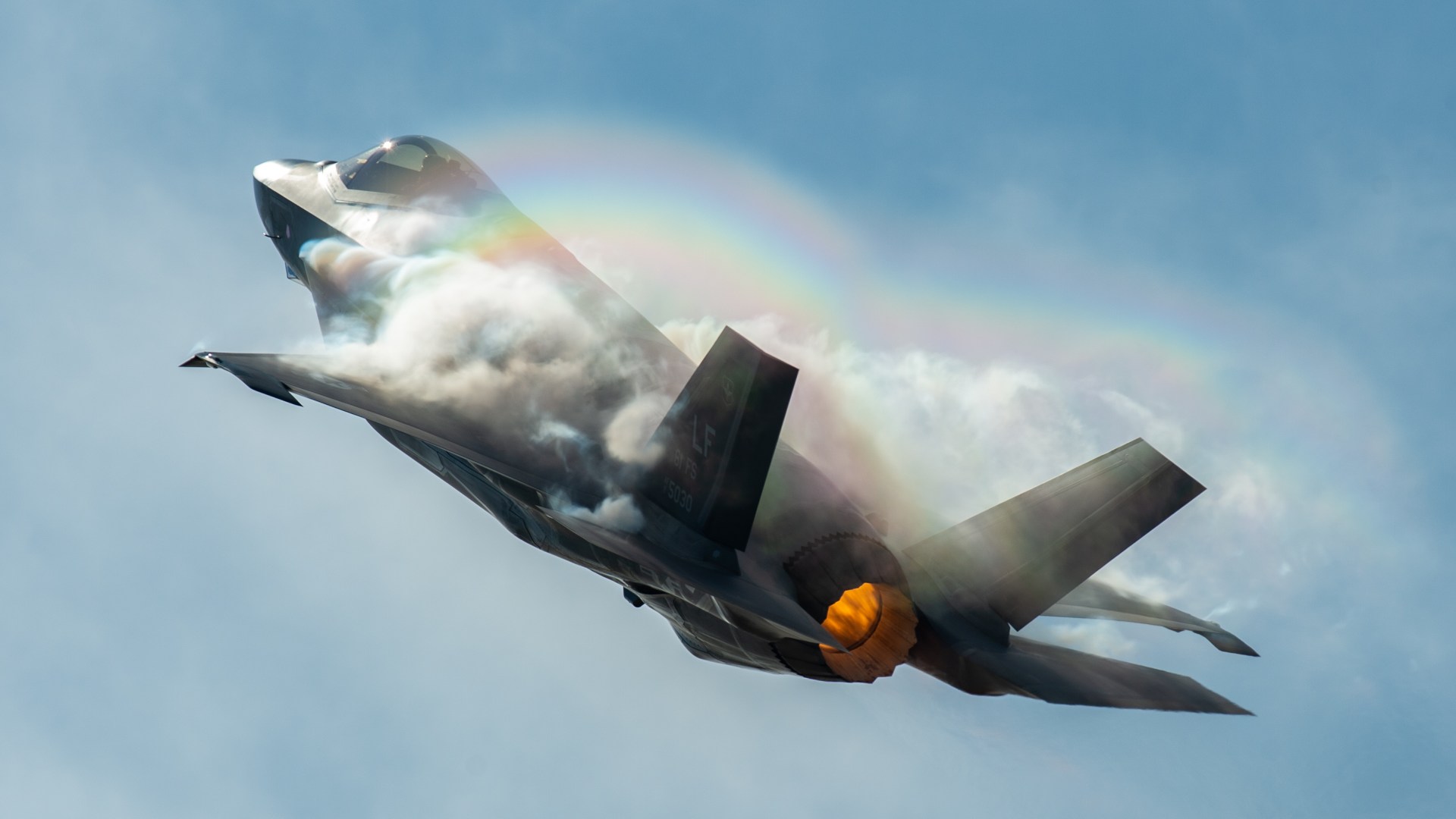
DAYTON, Oh.–An F-22A Raptor from the 1st Fighter Wing conducts flying operations during a solar eclipse, April 8, 2024. The aircraft is from the 27th Fighter Squadron stationed at Joint Base Langley-Eustis, Va. The squadron was conducting dissimilar formation training in unfamiliar airspace.(U.S. Air Force Tech. Sgt. Matthew Coleman-Foster)

A U.S. Air Force F-22A Raptor aircraft flies over Colorado after in-flight refueling by a KC-135R Stratotanker aircraft from the 336th Air Refueling Squadron on May 30, 2006. The Raptor is attached to the 53rd Test and Evaluation Group.
(DoD photo by Tech. Sgt. Rick Sforza, U.S. Air Force. (Released))
U.S. Central Command said American forces began striking Islamic Revolutionary Guard Corps targets at noon Eastern time on Tuesday, following what it described as attempted Iranian attacks on commercial shipping in the Strait of Hormuz and American military personnel in the region.
Explosions were reported around Bandar Abbas, Qeshm Island, Chabahar, Jask, and Sirik.
Iran then quickly began firing back, according to Iranian media, launching a series of missiles and drones and promising a more “crushing and devastating” response through the rest of the night.
The escalation also comes only days after senior U.S. military commanders reportedly warned Defense Secretary Pete Hegseth that the U.S. military is already struggling to sustain the resources committed to the Iran war, with the Navy particularly struggling to keep up. The campaign against Iran cannot go on forever – and Iran knows it. So what now?
U.S. Launches New Wave of Strikes
A series of “limited” strikes began over the weekend that ended a period of relative calm, after President Trump said he was pursuing a new strategy of “low-keying it” with Iran, and then U.S. Treasury Secretary Scott Bessent subsequently announced Operation Economic Outcast, a sanctions plan designed to strangle Tehran. That has since escalated into a significant bombing campaign.
American forces struck two Iranian launchers on Larak Island on Sunday, with CENTCOM saying IRGC personnel were preparing to launch rockets carrying naval mines into the Strait of Hormuz.
Iran responded by firing ballistic missiles toward U.S. forces in Jordan, eight of which were intercepted, according to Jordan. Then on Tuesday, CENTCOM announced attacks on IRGC targets across southern Iran.
President Trump also warned Tehran not to respond.
“If the failed Nation of Iran retaliates for this very justified attack, they will be hit again at a much harder and higher level, but it will not be the biggest attack of them all, that is waiting in the wings,” Trump warned on Truth Social.
Iran did, however, respond.
Iran Can Keep Making America Spend
While Iran can, at present, only keep attempting to rebuild military infrastructure and launch sites, it can also keep forcing the United States to expend valuable missiles and waste resources that would otherwise be spent preparing for potential contingencies with far greater powers.
Every Iranian ballistic missile or drone aimed at an American base can force the U.S. to expend another defensive interceptor.
Every attack on shipping can require additional surveillance aircraft, warships, fighters, and other assets to protect commercial vessels and keep shipping lanes open.
The burden on Washington and the U.S. military is enormous.
The U.S. already has roughly 50,000 troops in the region, along with numerous warships supporting operations against Iran and enforcing the blockade designed to prevent Iran from generating revenue from its oil industry.
And, despite Washington’s best efforts to keep oil moving through the Strait of Hormuz, the waterway remains heavily disrupted.
That’s Iran’s doing.
The Army Is Losing Its Leadership
While President Trump touts Iran’s military losses, the U.S. Army is itself losing senior leaders.
Army Secretary Dan Driscoll submitted his resignation Monday after telling the administration he had concerns about Army readiness and transformation and Hegseth’s handling of the generals responsible for those efforts, Reuters reported.
Deputy Undersecretary of the Army Dave Fitzgerald, who focused on innovation, is also expected to resign.
Driscoll’s departure also follows the firing of Army Chief of Staff Gen. Randy George in April, and the removal of a number of other senior officers, including Gen. Christopher Donahue, formerly the Army’s top general in Europe.
The Army could also now be left without a Senate-confirmed civilian secretary while thousands of soldiers are deployed in the Middle East.
Trump Needs An Offramp
The growing problems for the U.S. military are becoming harder to ignore.
Senior commanders warned Hegseth in August in a classified assessment that prolonged operations against Iran are becoming unsustainable, and that assessment is no longer a secret.
Trump knows it is impossible to maintain the current pace against Iran while also remaining prepared for a contingency with Russia or China, meaning Washington needs an off-ramp.
Luckily for Trump, Iranian President Masoud Pezeshkian is offering one in the form of a chance to return to the conditions of the failed June ceasefire agreement – but that would only be another temporary deal, and it still wouldn’t mean Iran drops its most maximalist demands of Washington.
Trump needs an off-ramp, but it’s becoming obvious that there isn’t one that ends with the United States’ demands being met.
About the Author: Jack Buckby
Jack Buckby is a British researcher and analyst specializing in defense and national security, based in New York. His work focuses on military capability, procurement, and strategic competition, producing and editing analysis for policy and defense audiences. He brings extensive editorial experience, with a career output spanning over 1,000 articles at National Security Journal, and has previously authored books and papers on extremism and deradicalization.


