
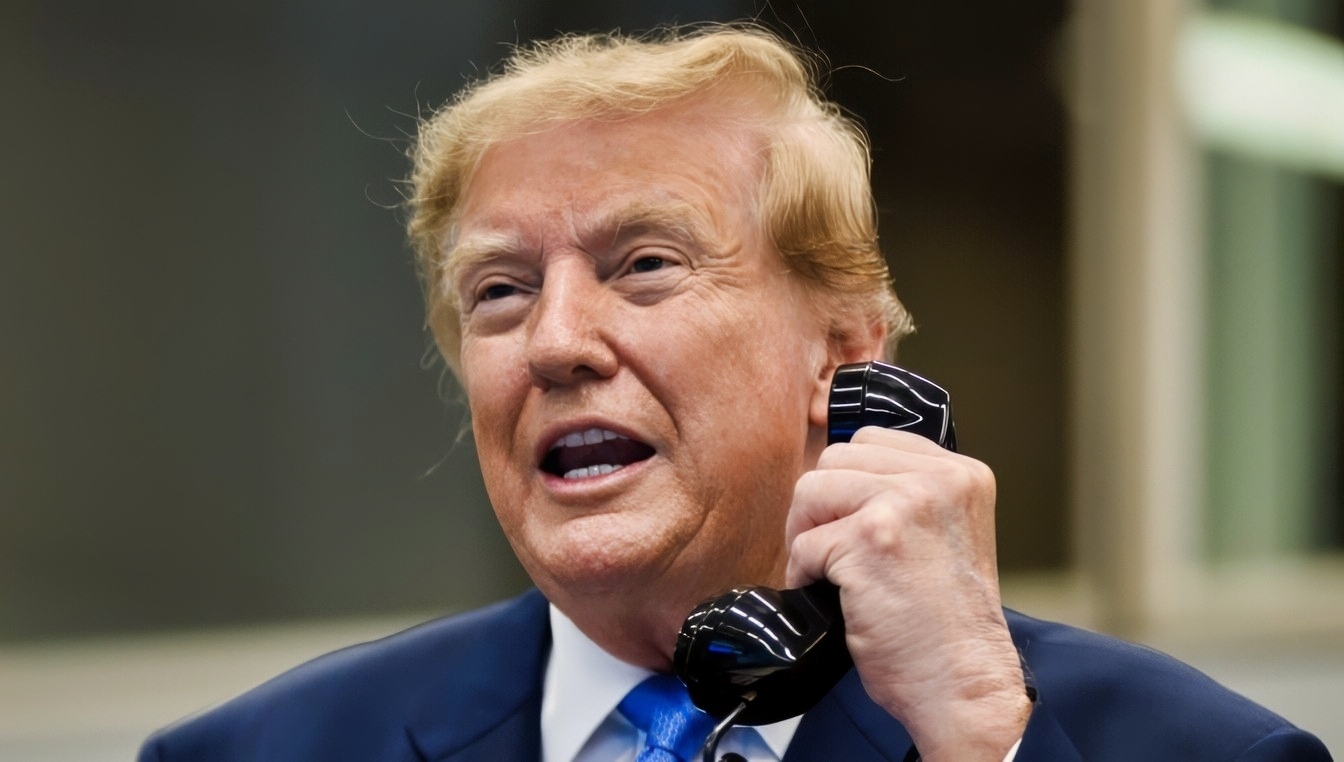
Iran: “We Have No Money” – President Donald Trump’s months-long campaign of “low-keying it” with Iran, in which the United States piles on economic pressure against Iran with a combination of tightening sanctions and a naval blockade, appears to be working. While Trump considers the possibility of a resumption of major military strikes, Iranian President Masoud Pezeshkian is acknowledging the severity of the economic crisis now facing his country. The Iranian government is struggling to maintain public subsidies on essential goods and services, and the naval blockade is depriving Tehran of its oil revenue.
Iran’s President Describes Bleak Economic Picture

An F-35 Lightning II from the 115th Fighter Wing flies alongside a KC-135 Stratotanker with the 121st Air Refueling Wing after being refueled over the skies of Wisconsin, March 20, 2024. The F-35 II’s aerodynamic performance and advanced integrated avionics will provide next-generation stealth, enhanced situational awareness, and reduced vulnerability for the United States and allied nations. (U.S. Air National Guard photo by Senior Airman Ivy Thomas)

A U.S. Air Force F-35 Lightning II performs during the Fairchild Skyfest 2024 airshow at Fairchild Air Force Base, Washington, June 23, 2024. Team Fairchild hosted the Skyfest 2024 airshow June 22 and 23 to thank the local community for their support and partnerships. During the event, attendees observed performances by the A-10 Thunderbolt II Demonstration team, Wings of Blue parachute team, UH-1N Huey and various other aerial acts, as well as static displays. Events like SkyFest allow communities within the Inland Northwest to witness U.S. military air capabilities and the Air Force’s premier air refueling wing in action. (U.S. Air Force photo by Airman 1st Class Matthew Arachikavitz)
Pezeshkian has warned that the country is now engaged in an economic war that is more difficult to contend with than the military campaign launched by the U.S. and Israel in February, and a report from The Wall Street Journal on Wednesday, November 25, reveals just how severe the problems have become, with growing signs of dissatisfaction among Iranian workers. The outlet also noted that, in a recent televised address, Pezeshkian said, “we have no money.”
Speaking at a capital markets conference in Tehran in November, the Iranian president acknowledged the difficulties of maintaining industrial production during an energy crisis and economic squeeze. His comments came as the Iranian currency continues to lose value, with the rial falling below 2.85 million to the U.S. dollar on November 24.
The depreciation of Iran’s currency is causing a range of issues, including making imported goods more expensive for Iranian businesses and consumers. The government is also increasingly struggling to offset those price increases through subsidies.
Iran Prepares for Difficult Winter
Even as one of the world’s largest producers of natural gas, Iran is struggling to generate enough electricity to meet domestic demand. Last week, Iranian government spokeswoman Fatemeh Mohajerani warned that the country could face a daily shortfall of 430 million cubic meters of natural gas this winter, with the problem expected to worsen due to damage to gas processing facilities in the first round of U.S. strikes.
Tavanir, Iran’s national electricity company, has announced plans to implement rolling blackouts beginning on December 1, but electricity rationing measures have already been implemented in several major cities, including Tehran and Isfahan.
And that energy crisis is doing more than just making Iranian citizens’ homes cold: it’s contributing to rising unemployment. Iranian legislator Nasrallah Pejmanfar has claimed that electricity shortages in Iran have already caused 600,000 people to lose their jobs over the last six months alone. A report by Turkish newspaper Hurriyet Daily News said Pejmanfar warned the number could surpass one million if gas shortages persist.
Trump Goes After Iran’s Remaining Sources of Revenue
On Wednesday, November 25, U.S. Treasury Secretary Scott Bessent said that Iran had exhausted its supply of oil stored on tankers outside of the naval blockade. Bessent said that Iran had not loaded another tanker since August. While Iranian officials have worked to increase the volume of goods exported via land routes, Iranian economists are questioning whether the country even has the infrastructure to transport sufficient quantities of petroleum products to other states. In recent weeks, the United States has already begun operations intended to significantly reduce the flow of goods into and out of Iran by land.
Writing for Iranian newspaper Shargh on November 2, energy expert Hamid Hosseini estimated that the country may be able to export up to 300,000 barrels of oil per day via alternative routes to five regional markets — a small fraction of the roughly 1.5 million barrels Iran was exporting before the U.S. implemented the blockade.
The Trump administration is also taking steps to make it harder for Tehran to access any money it does generate from its remaining exports. On November 23, the Treasury Department announced a series of new sanctions targeting the network of businesses and intermediaries Iran uses to circumvent American sanctions.
Could the Economic Crisis Prompt An Uprising?
Since the beginning of the U.S. campaign against Iran, President Donald Trump has publicly called on the Iranian people to take the opportunity to overthrow the regime. After almost nine months, however, the Iranian people have grown discontented but have not been capable of organizing and ousting a regime that maintains a tight grip on the country’s military resources. But there are indications that some Iranians are becoming more willing to publicly express their dissatisfaction with the government, even after the regime cracked down violently on protesters in January.
The Critical Threats Project noted in a November assessment with the Institute for the Study of War, citing reports from Iranian opposition media, that truck drivers have been striking in several Iranian cities over the rising cost of maintaining their vehicles. Trade union demonstrations have also been organized in the country following an accident that killed 13 petrochemical workers in Abadan, during which protesters reportedly expressed their opposition to the regime.
A protest or two is a far cry from the uprising Trump hopes the economic sanctions campaign will achieve—but who knows what happens after months more turmoil?
About the Author: Jack Buckby
Jack Buckby is a British researcher and analyst specializing in defense and national security, based in New York. His work focuses on military capability, procurement, and strategic competition, and he produces and edits analysis for policy and defense audiences. He brings extensive editorial experience, with a career output spanning over 1,000 articles at National Security Journal, and has previously authored books and papers on extremism and deradicalization.


