

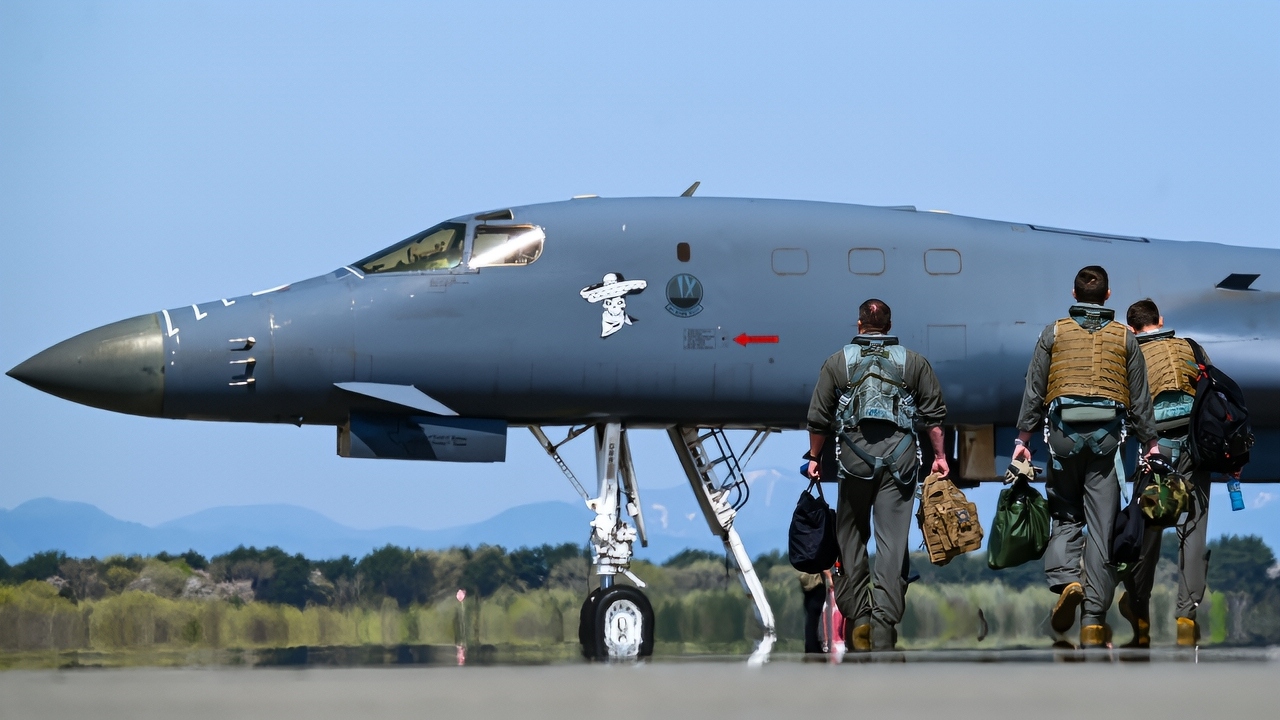
PUBLISHED on August 12, 2025, 1:59 PM EDT – Key Points and Summary – The Rockwell B-1B Lancer, originally designed as a supersonic nuclear bomber, underwent a critical transformation after the Cold War.
-With its nuclear mission deactivated in 1994, the “Bone” was converted to carry conventional munitions and quickly proved its effectiveness.
-It became a workhorse in conflicts from Operation Desert Fox to the Global War on Terror, delivering a massive percentage of ordnance in operations over Iraq and Afghanistan.
-Though it missed the first Gulf War, its subsequent combat record, impressive payload, and survivability have solidified its role as a key conventional strategic bomber for the U.S. Air Force.
B-1B Lancer: It Can’t Drop Nuclear Bombs Anymore
Though not as venerable or as battle-tested as the Boeing B-52 Stratofortress AKA the “BUFF”, the Rockwell B-1B Lancer has nonetheless turned out to be a highly effective strategic bomber in the conventional (as in non-nuclear) role for the United States Air Force (same can be the Northrop B-2 Spirit, the original “Stealth Bomber”).
But it took quite a while for the Lancer, AKA the “Bone,” to prove its effectiveness as a conventional bomber, as it had originally been designed strictly for doomsday missions, i.e., nuclear strike. National Security Journal now takes a brief look at the Bone’s conversion story.
B-1 Lancer (“Bone”) Initial History
The Bone started life as the B-1A, which was envisioned as a supersonic, lower-altitude replacement for the B-52. It made its first flight in 1974 but was subsequently cancelled a mere two years later.
However, as part of the revitalized defense buildup under the Reagan Administration, the bomber was given a new lease on life as the B-1B; the redesign went into effect in 1981 and made its maiden flight in prototype form in 1983. The first production phase B-1B was unveiled in 1984, and it finally entered official operational service with the USAF on October 1, 1986 (right on time for the beginning of a new Fiscal Year). A total of 102 airframes were built, with the last specimen delivered on May 2, 1988.
As noted by defense expert Reuben F. Johnson, “The mission profile shifted several times, and the threat profile presented to the American strategic bomber force became more formidable … These developments created a revised design that became the B-1B, heavier and slower than the B-1A. But it also carried more payload and had a significantly improved radar … A redesigned inlet and other modifications also reduced the aircraft’s radar cross-section (RCS) – roughly 10 percent of the B-1A.”
“Heavier” as in a maximum takeoff weight of 477,000 lb. (216,364 kg), “more payload” as in an increase of 74,000 lb. (33,566 kg), and “slower” as in a still-supersonic Mach 1.2 (as opposed to the Mach 2.2 of the B-1A).
In addition to the reduced RCS, the ”B” variant of the Bone also received a significant boost to its survivability via an impressive onboard self-protection suite consisting of an electronic warfare (EW) system, radar warning receiver (ALQ-161), and countermeasures (chaff and flare) system—plus a towed decoy system (ALE-50).
However, a mere five years after the B-1B attained operational status, the Cold War ended, and thus the Bone never got to fulfill its originally intended nuclear mission. What’s more. It missed out on the 1991 Persian Gulf War, AKA Operation Desert Storm, as it wasn’t yet converted to carry conventional bombs, so instead it was the “BUFF” crews that got to have all the fun carpet-bombing then-Iraqi strongman Saddam Hussein’s elite Republican Guard troops.
In 1994, as part of the post-Cold War so-called “peace dividend,” the B-1B’s nuclear capabilities were deactivated, and the switch to conventional munitions capacity commenced.
Proof of Concept: The Post-Nuclear Bone’s Operational History/Combat Performance
It was during Operation Desert Fox from 16 to December 19 1998 that the Bone was finally first “blooded” in combat; this bombing campaign was initiated in response to Saddam’s continued refusal to cooperate with United States weapons inspectors, and the primary mission was to strike military targets in Iraq that contributed to its ability to produce, store, maintain, and deliver weapons of mass destruction (WMD).
From there, the B-1B’s combat record took off in both the literal and figurative sense, as noted by the official US Air Force Fact Sheets:
“In 1999, six B-1s were used in Operation Allied Force, delivering more than 20 percent of the total ordnance while flying less than 2 percent of the combat sorties…During the first six months of Operation Enduring Freedom, eight B-1s dropped nearly 40 percent of the total tonnage delivered by coalition air forces. This included nearly 3,900 JDAMs, or 67 percent of the total. In Operation Iraqi Freedom, the aircraft flew less than 1 percent of the combat missions while delivering 43 percent of the JDAMs used.”
Reportedly, one such B-1B sortie during Operation Iraqi Freedom narrowly missed killing Saddam in a precision strike on one of his underground command bunkers in downtown Baghdad.
The Way Forward for the Bone
Though originally built by the now-defunct Rockwell International, the B-1B contract now falls under the purview of Boeing, which is more than a tad ironic, seeing how Boeing is the manufacturer of the “BUFF” that the Bone had been intended to replace in the first place. These two mighty bombers now complement each other nicely as members of America’s strategic bomber arsenal, with the B-1B expected to remain in faithful service out to 2040 and beyond.
About the Author: Christian D. Orr, Defense Expert
Christian D. Orr is a Senior Defense Editor. He is a former Air Force Security Forces officer, Federal law enforcement officer, and private military contractor (with assignments worked in Iraq, the United Arab Emirates, Kosovo, Japan, Germany, and the Pentagon). Chris holds a B.A. in International Relations from the University of Southern California (USC) and an M.A. in Intelligence Studies (concentration in Terrorism Studies) from American Military University (AMU).
Military Matters
The F-22 Raptor Just Keeps Getting Better


