
The United States is facing a growing shipbuilding crisis that, if not fixed, could prevent the U.S. from expanding its fleet fast enough to meet emerging global threats.
Multiple programs are running over budget and budget schedule or have been canceled outright, and the number of operational ships has stagnated despite rising spending on naval construction.

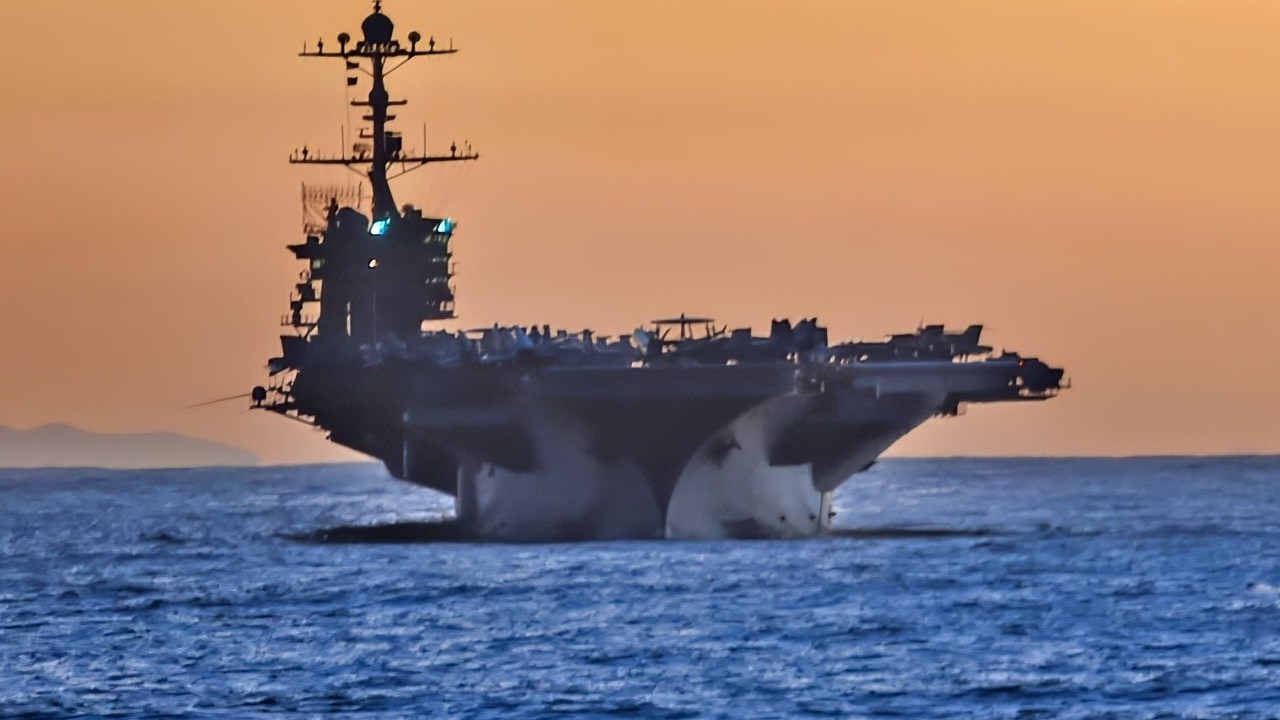
A U.S. Navy F/A-18E Super Hornet aircraft assigned to Strike Fighter Squadron (VFA) 14 participates in an air power demonstration near the aircraft carrier USS John C. Stennis (CVN 74) April 24, 2013, in the Pacific Ocean. The John C. Stennis Carrier Strike Group was returning from an eight-month deployment to the U.S. 5th Fleet and U.S. 7th Fleet areas of responsibility. (U.S. Navy photo by Mass Communication Specialist Seaman Apprentice Ignacio D. Perez/Released)
Government watchdogs have repeatedly warned that shipbuilding programs are plagued by persistent cost overruns and delivery delays, and it remains unclear whether the problem willbe fixed in the short term.
In fact, the problem is so bad that roughly 82 percent of ships currently under construction are running behind schedule.
The crisis comes at a particularly difficult moment. China now operates the world’s largest navy by ship count, and its industrial base is capable of producing warships far more rapidly than the United States.
This new reality, where China is beginning to field naval assets mirroring the size and capability of those already in operation with the U.S. Navy, is forcing planners and policymakers to confront a difficult question: can the United States realistically rebuild its fleet while its shipbuilding system is struggling to deliver new vessels on time already>
A Shipbuilding Crisis
The crisis facing the U.S. shipbuilding industry has been described by some as a “doom loop” – a cycle in which delays, cost overruns, and shrinking industrial capacity are reinforcing one another. Despite nearly doubling its shipbuilding budget over the past two decades, the Navy has struggled to expand its fleet as planned.
Per the Government Accountability Office, major programs are now being delivered late and cost significantly more than originally projected, with some ships delayed by as much as three years.

Aircraft Carrier USS Nimitz Coming Home. Image Credit: Creative Commons.

(March 7, 2016) An F/A-18E Super Hornet assigned to the Warhawks of Strike Fighter Squadron (VFA) 97 performs a flyby during an aerial change of command ceremony above USS John C. Stennis (CVN 74). Providing a ready force supporting security and stability in the Indo-Asia-Pacific, Stennis is operating as part of the Great Green Fleet on a regularly scheduled 7th Fleet deployment. (U.S. Navy photo by Mass Communication Specialist Seaman Tomas Compian/Released)

A U.S. Navy MH-60S Seahawk helicopter with Helicopter Sea Combat Squadron (HSC) 9 transfers ammunition between aircraft carriers USS George H.W. Bush (CVN 77), foreground, and USS Harry S. Truman (CVN 75) in the Atlantic Ocean Feb. 17, 2011. (U.S. Navy photo by Mass Communication Specialist 3rd Class Leonard Adams/Released)
There are several structural factors driving these problems. The U.S. shipbuilding sector has shrunk dramatically since the Cold War, leaving only a small number of specialized shipyards capable of building complex naval vessels. At the same time, the Navy often begins construction before shop designs are fully mature, which increases the likelihood that major changes will be required mid-construction – one of the main causes of rising costs and delays.
The result is a system in which warships take longer and longer to build while the U.S. Navy simultaneously retires aging vessels.
U.S. Navy Programs Going Off the Rails
Several high-profile naval programs illustrate the problem quite clearly.
Among the most controversial is the Littoral Combat Ship (LCS) program. The ships were originally intended to be relatively cheap and modular vessels designed for operations close to shore. Instead, the program suffered from mechanical problems, cost increases, and mission systems that failed to perform as intended.
Some vessels were retired early despite costing hundreds of millions of dollars to build.
The Zumwalt-class destroyer program is another example. Initially envisioned as a fleet of 32 advanced stealth destroyers, the program was ultimately reduced to just three ships after costs spiraled out of control.
Each vessel ended up costing roughly $7-8 billion, and the ships’ primary weapon system proved too expensive to operate because the specialized ammunition cost hundreds of thousands of dollars per round.
More recently, the Constellation-class frigate program has run into its own difficulties. The design was originally supposed to be based closely on an Italian warship in order to reduce risk, but design changes and delays have plagued the program and forced the Navy to reconsider the program.
All of these programs have consumed tens of billions of dollars while delivering far fewer ships than original planned.
China Raises the Stakes
The U.S. Navy’s shipbuilding problems are especially concerning because they unfold as China rapidly expands its maritime power.
China now operates the largest navy in the world by ship count, and its shipbuilding industry has become the dominant force in global maritime manufacturing.
Chinese shipyards produce more vessels than their American counterparts and benefit from a massive commercial shipbuilding sector that supports naval production. By contrast, the United States now accounts for only a tiny fraction of global shipbuilding output – and it’s that imbalance that matters.
In a prolonged conflict, particularly in the Indo-Pacific, the ability to build and repair ships quickly could become a decisive factor.
Even if the United States retains quantitative edges in areas like nuclear submarines and carrier aviation (for now), a shrinking fleet could well make it harder to sustain a global naval presence. These problems must, then, be addressed – and sooner rather than later.
About the Author: Jack Buckby
Jack Buckby is a British researcher and analyst specialising in defence and national security, based in New York. His work focuses on military capability, procurement, and strategic competition, producing and editing analysis for policy and defence audiences. He brings extensive editorial experience, with a career output spanning over 1,000 articles at 19FortyFive and National Security Journal, and has previously authored books and papers on extremism and deradicalisation.


