


Key Points and Summary: Eurofighter Typhoon Heads Close to Russia
Germany has deployed five Eurofighter Typhoons and about 150 Luftwaffe personnel to Malbork in northern Poland to conduct NATO’s Air Policing mission, reinforcing the alliance’s eastern flank under Operation Eastern Sentry.
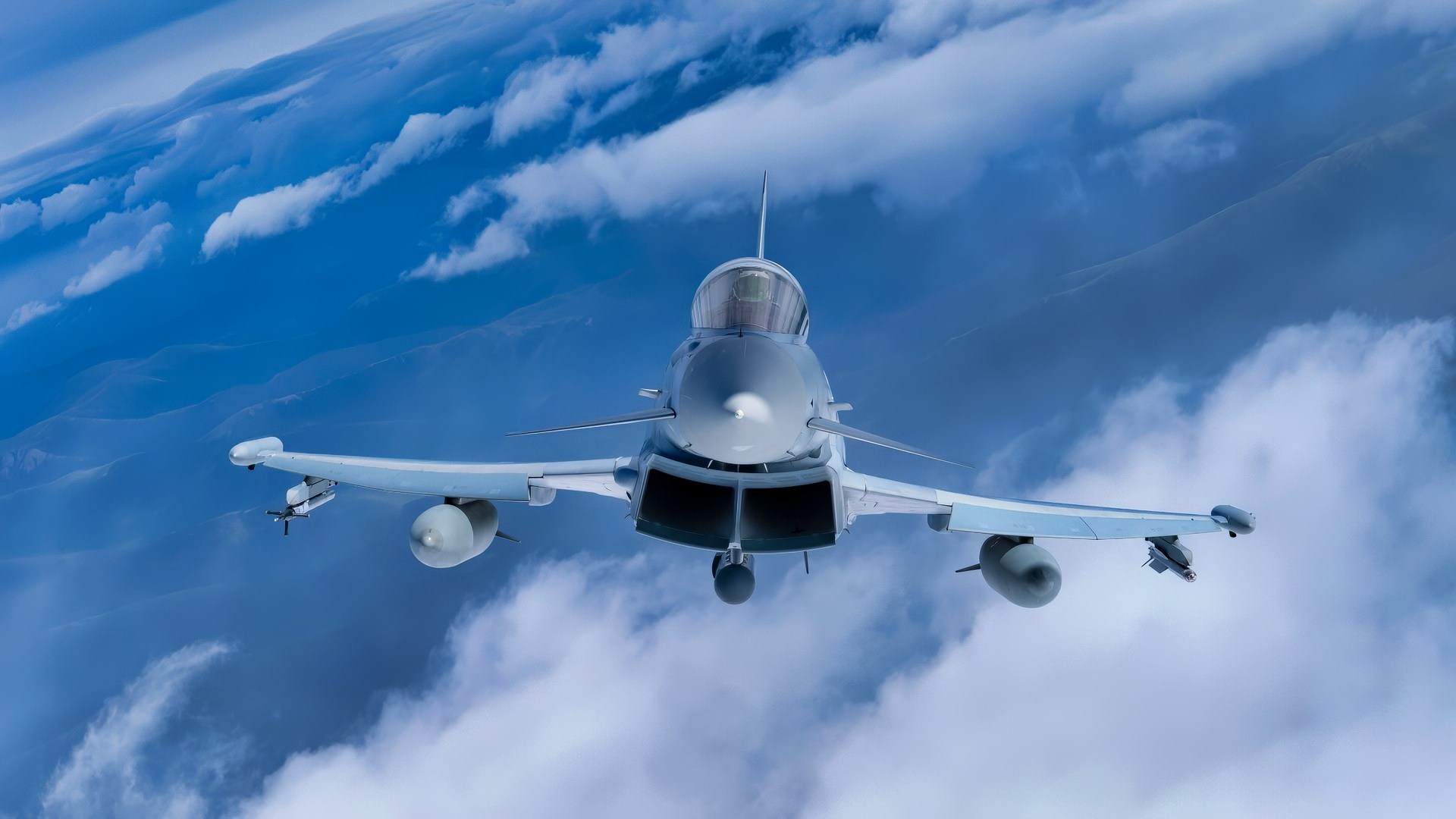
A German Air Force Eurofighter Typhoon flies over Alaska during exercise Arctic Defender 24 at Joint Base Elmendorf-Richardson, Alaska, July 8, 2024. Arctic Defender is a German Air Force-led exercise that provides a unique opportunity to integrate various forces into joint, coalition and multilateral training from simulated forward operating bases and is part of several exercises under Pacific Skies 24. Pacific Skies is a combination of several exercises in the Indo-Pacific theater in which German, French and Spanish air forces participate with U.S. forces. (U.S. Air Force photo Senior Airman Shelimar Rivera Rosado)
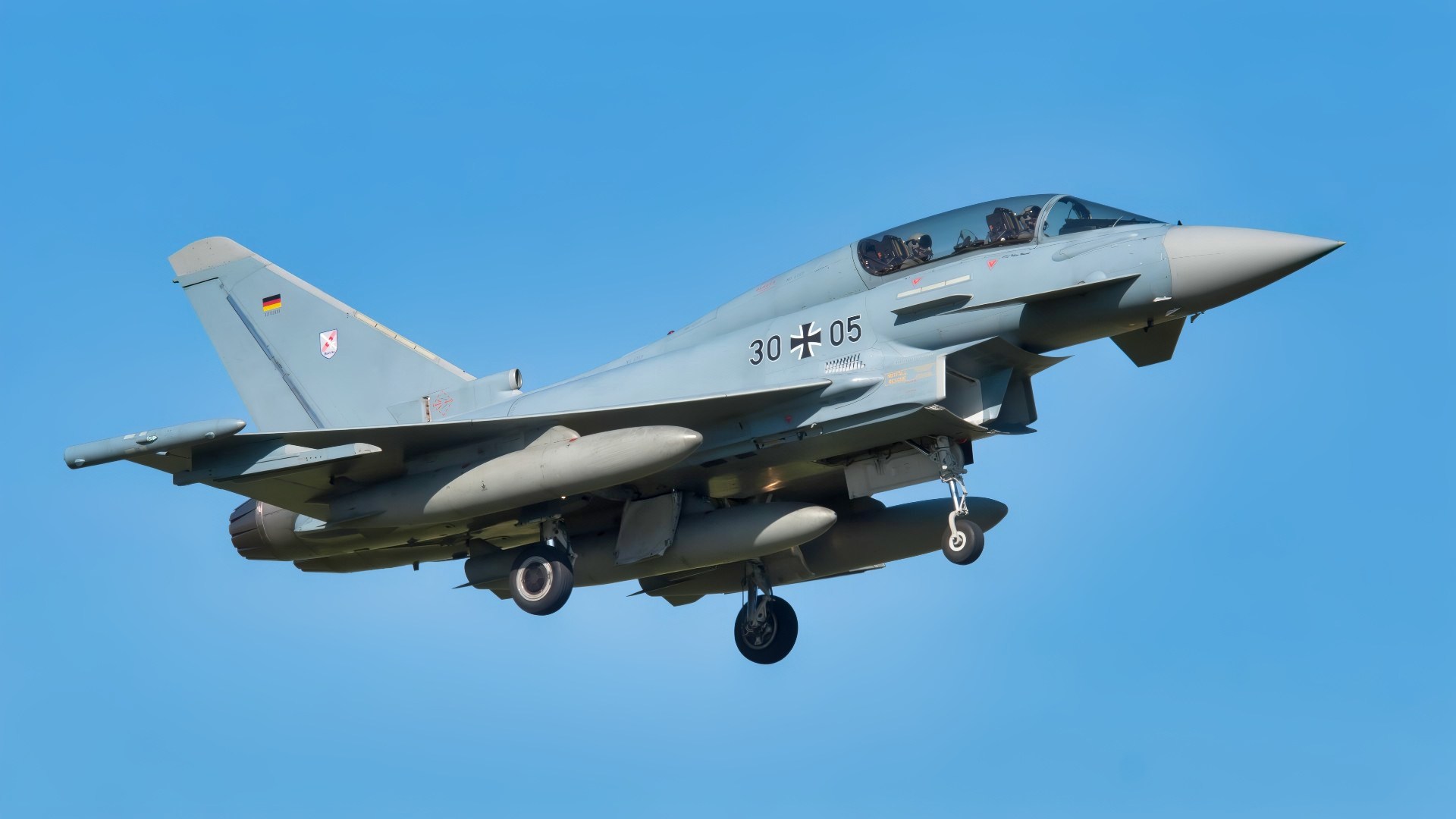
Eurofighter Typhoon Training in Sky. Image Credit: Creative Commons.
-Operating from the 22nd Tactical Air Base until at least March 2026, the German detachment will work with Poland’s F-16s, FA-50s, and remaining MiG-29s, providing 24/7 quick-reaction coverage for Baltic and regional NATO airspace.
The mission underscores the Eurofighter consortium’s enduring frontline role and highlights how export customers—from Austria to Turkey and key Gulf monarchies—have helped keep Europe’s flagship 4.5-generation fighter program viable ahead of next-gen replacements.
German Luftwaffe Eurofighters Deploy to Poland for Air Policing Mission
Germany recently deployed two sections of Eurofighter Typhoons to Malbork, Poland, for NATO’s Air Policing mission.
The aircraft are now based in Poland to bolster the eastern flank of the alliance against Russia in the region and to defend the airspace of the Baltic NATO-member states, which lack adequate air power assets. The German aircraft will be working alongside Poland’s armed forces to provide 24/7 airspace security as part of Operation Eastern Sentry.
The NATO Air Policing mission is a joint activity shared on a rotational basis among alliance members.
The deployments, which generally last about four months, are focused on deterrence and the capacity to respond rapidly to unidentified aircraft that approach or violate the airspace of alliance states.
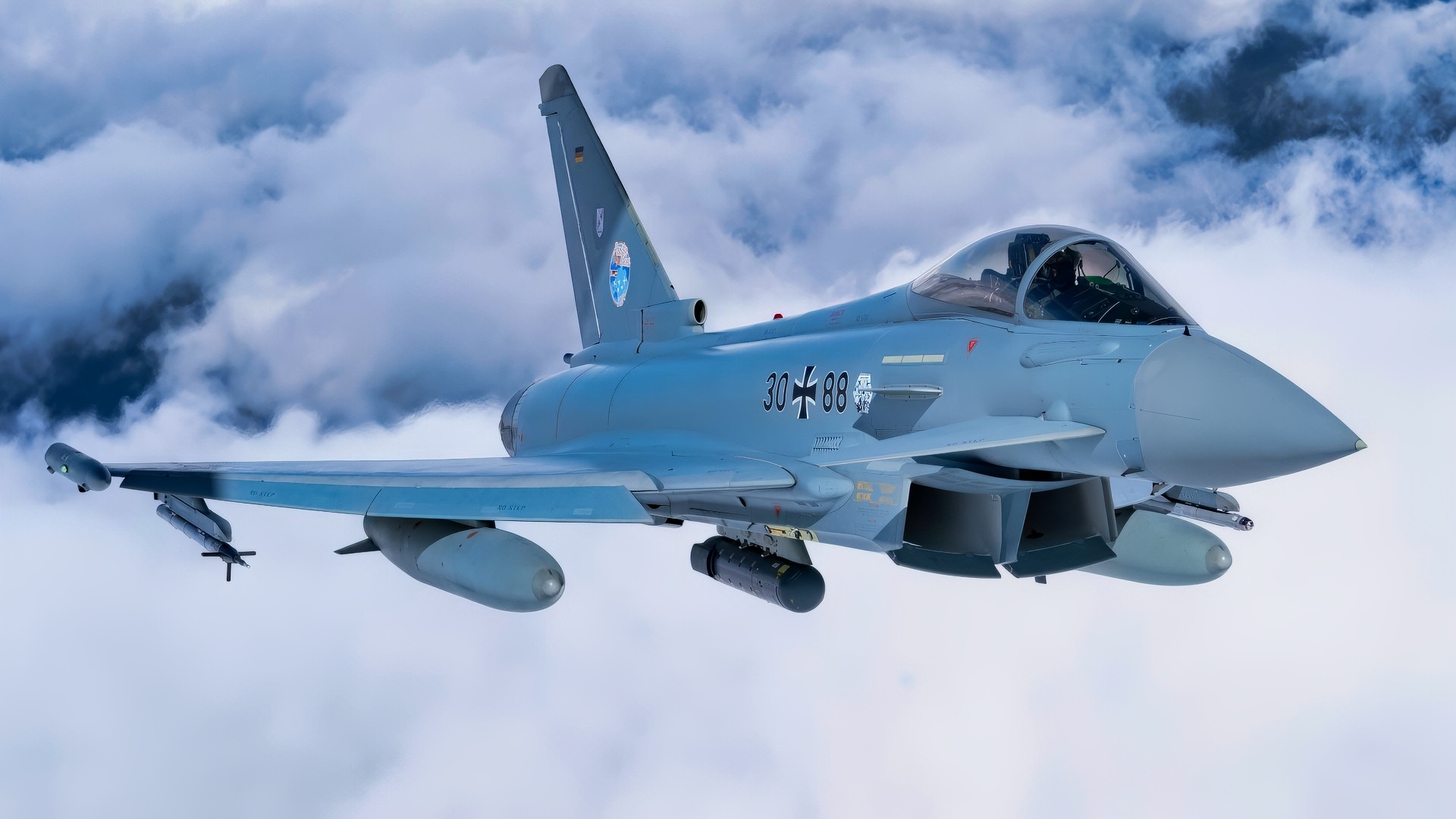
A German Air Force Eurofighter Typhoon flies over Alaska during exercise Arctic Defender 24 at Joint Base Elmendorf-Richardson, Alaska, July 8, 2024. Arctic Defender is a German Air Force-led exercise that provides a unique opportunity to integrate various forces into joint, coalition and multilateral training from simulated forward operating bases and is part of several exercises under Pacific Skies 24. Pacific Skies is a combination of several exercises in the Indo-Pacific theater in which German, French and Spanish air forces participate with U.S. forces. (U.S. Air Force photo Senior Airman Shelimar Rivera Rosado)
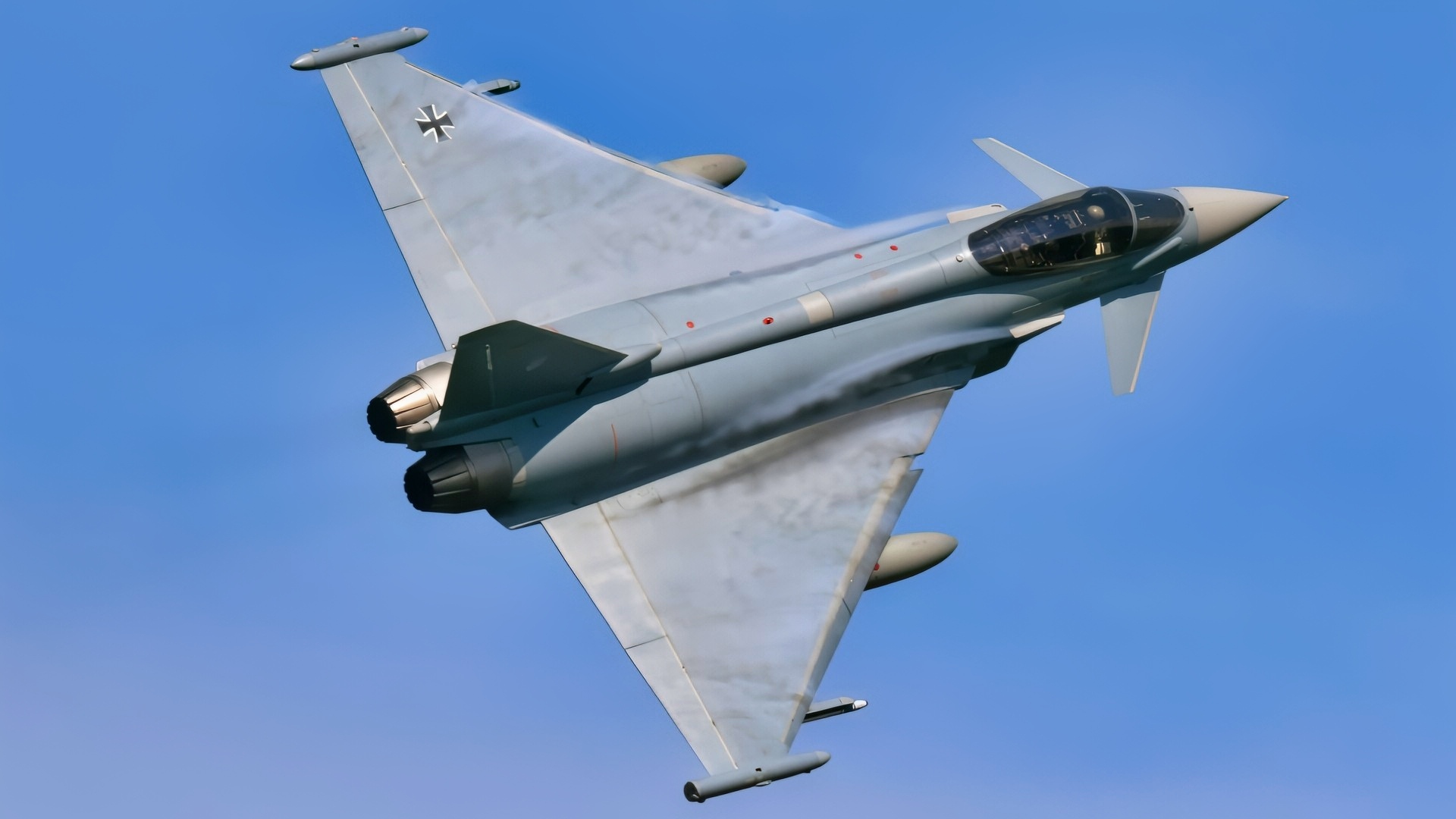
A German Air Force pilot, assigned to the German Air Force Weapons School, conducts strafing runs with an Eurofighter Typhoon in conjunction with U.S. Air Force Joint Terminal Attack Controller assigned to 2d Air Support Operations Squadron identifying targets on the ground at the 7th Army Training Command’s Grafenwoehr Training Area, Germany, June 9, 2021. (U.S. Army photo by Gertrud Zach)
The Luftwaffe deployment consists of five Eurofighter aircraft and approximately 150 personnel. This temporary detachment is deployed to the 22nd Tactical Air Base in Malbork, Poland.
As of today, this Luftwaffe unit will be in place until sometime in March 2026.
This deployment could be extended or augmented with additional aircraft depending on how the security situation in the region develops.
The German Eurofighters will operate in conjunction with the Polish Air Force (PS) and the NATO Combined Air Operations Centre (CAOC) in Uedem.
These Eurofighters will be alongside the PS fleet of US-made F-16 aircraft, the Korean-made FA-50, and some of the Russian-made Mikoyan MiG-29 fighters that Poland was initially supplied with during the Cold War period when the nation was under Soviet occupation.
The Eurofighter Typhoon Consortium
A four-nation consortium of the original partner nations of the UK, Germany, Spain, and Italy produces the Eurofighter Typhoon.
All four nations operate the aircraft in their armed forces, and there are production centers for the aircraft in the four nations, as well as flight test facilities and individual subsystem R&D and production sites.
The UK, Germany, and Italy are also operating the US-made F-35, and Spain has long been a customer of the US F/A-18. But, despite the “Euro” in the Eurofighter’s name -originally meaning that it was an aircraft that many nations on the continent were expected to procure for their armed forces – only Austria ended up buying the aircraft.
The neutral, non-NATO country acquired 15 Eurofighters and has recently been in the process of upgrading these aircraft. Since 2022, the Austrian forces have been considering replacing them with the F-35 in a future armed forces modernization program.
The only other buyer in the region has been Turkey, which will take 20 new models of the aircraft as a stopgap arrangement.
At the same time, it engages in protracted negotiations over the F-16V Block 70. According to the UK government, this deal is worth up to £8 billion (US$10.7 billion) and will support some 20,000 British jobs.
The UK expects to begin delivering the new-build fighters to Turkey in 2030. In a separate deal, London is facilitating the sale of 24 secondhand Eurofighter Tranche 3A jets sold initially to the air forces of Oman and Qatar. These are low-hour use jets that Turkey expects will begin deliveries of in 2026.
The Key Market and the Kingdoms
Although the original partner nations are collectively the largest buyers of the aircraft, the key to making the program economically viable has been, as with the Tornado before it, securing substantial sales to Arab Gulf monarchies.
The most important of these has been Saudi Arabia, which has acquired 72 of the aircraft and could order more.
In second place is Qatar, which has ordered 24, and then Oman, which has signed for 12.
Kuwait had previously concluded a deal to purchase 28, but the number delivered thus far are still unclear.
The small oil-rich nation recently also signed an agreement with the Italian partner company, Leonardo, to extend support for these Eurofighters until 2029.
Its European users will eventually replace the Eurofighter with one of the next-generation fighters being developed by two different teams of different nations, plus, in the case of the Global Combat Aircraft Program (GCAP), the major defense firms of Japan.
About the Author: Reuben F. Johnson
Reuben F. Johnson has thirty-six years of experience analyzing and reporting on foreign weapons systems, defense technologies, and international arms export policy. Johnson is the Director of Research at the Casimir Pulaski Foundation. He is also a survivor of the Russian invasion of Ukraine in February 2022. He worked for years in the American defense industry as a foreign technology analyst and later as a consultant for the U.S. Department of Defense, the Departments of the Navy and Air Force, and the governments of the United Kingdom and Australia. In 2022-2023, he won two awards in a row for his defense reporting. He holds a bachelor’s degree from DePauw University and a master’s degree from Miami University in Ohio, specializing in Soviet and Russian studies. He lives in Warsaw.


