


Article Summary – This piece pits Europe’s Eurofighter Typhoon against Russia’s Su-57 Felon in a straight-up fight.
-The Typhoon brings superb agility, strong AESA radar, and top-tier weapons like Meteor and IRIS-T—but it is still a non-stealth jet.

Su-57 Felon Fighter Stealth. Image Credit: Creative Commons.
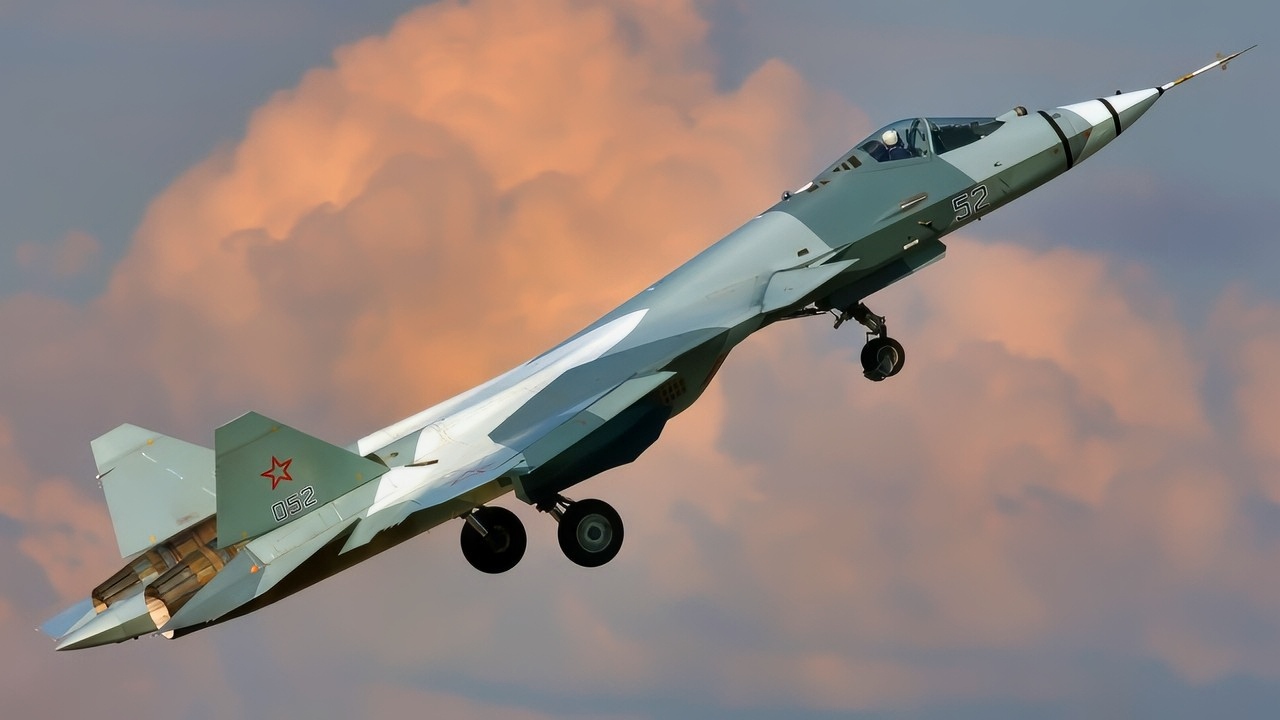
Su-57 Felon Stealth Fighter in the Sky. Image Credit: Creative Commons.
-The Su-57, while no F-22, offers a much smaller frontal radar cross-section, internal weapons bays, powerful sensors, and thrust-vectoring engines.
-In beyond-visual-range combat, the Felon’s lower signature and long-range missiles likely give it first-shot advantage.
-In a knife fight, its post-stall tricks tilt the odds further. With an ace Typhoon pilot it’s not hopeless—but on balance, the Su-57 usually has the edge.
Eurofighter Typhoon vs Su-57: Who Really Wins This Air War?
The Eurofighter Typhoon is one of the most advanced aircraft built in Europe. It features state-of-the-art avionics, high-performance engines, and highly lethal armament, making it a terrifying opponent in almost any circumstance.
However, as Europe prepares for a potential conflict with Russia, the Eurofighter faces some steep competition.
The Su-57 (NATO designation: Felon) is Russia’s only fifth-generation fighter jet in service. Once considered a laughingstock by the rest of the world, Russia has been slowly improving its aircraft to enhance its stealth profiles and update its powerplants.
But is it good enough to take on the Eurofighter?
The EU vs Russia: Who Wins?
The Typhoon’s airframe uses a canard-delta wing configuration, which makes it deliberately unstable for maximum maneuverability.
Advanced flight control systems keep this instability in check, allowing the aircraft to perform tight turns and rapid energy changes.
While the Typhoon incorporates radar-absorbent materials and aerodynamic shaping to reduce its radar cross-section, its RCS is still significantly larger than that of an actual stealth fighter. The aircraft is relatively light, with an empty weight of about 11,000 kilograms and a maximum takeoff weight of 23,500 kilograms.
The Su-57, on the other hand, features a blended wing-body design with all-moving tailplanes and thrust-vectoring nozzles.
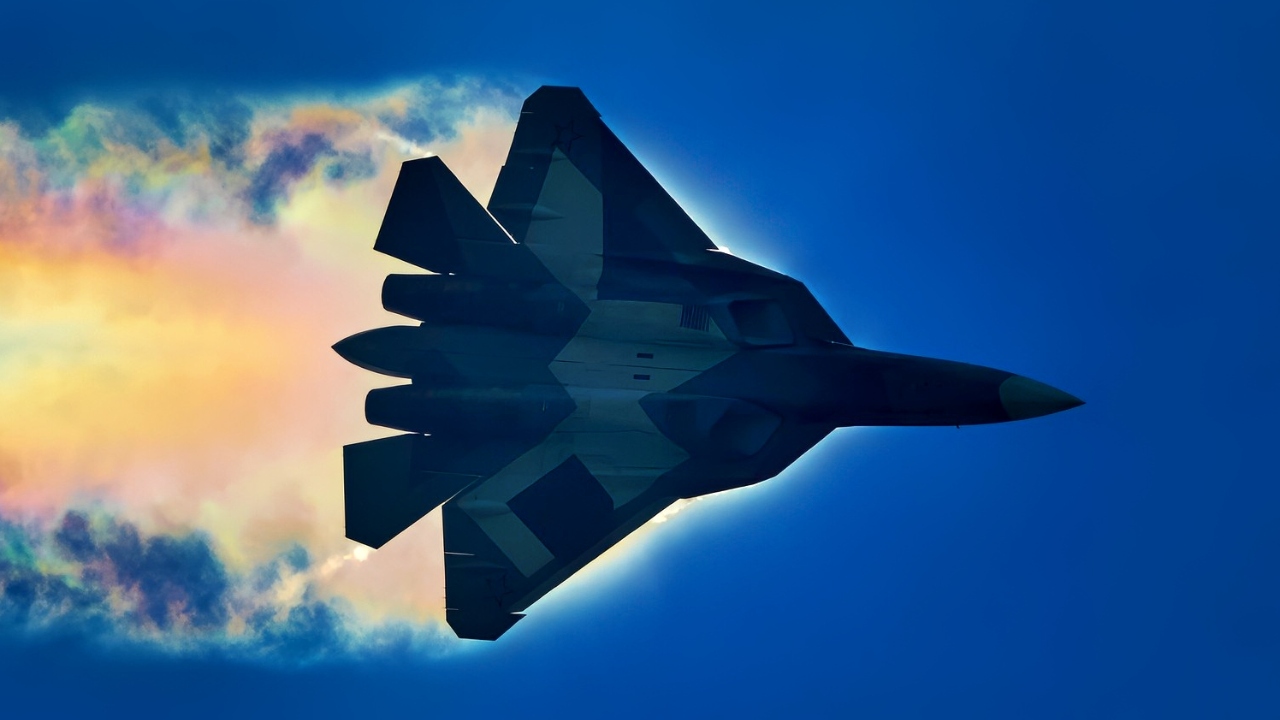
Su-57 Felon Fighter with Trail. Image Credit: Creative Commons.
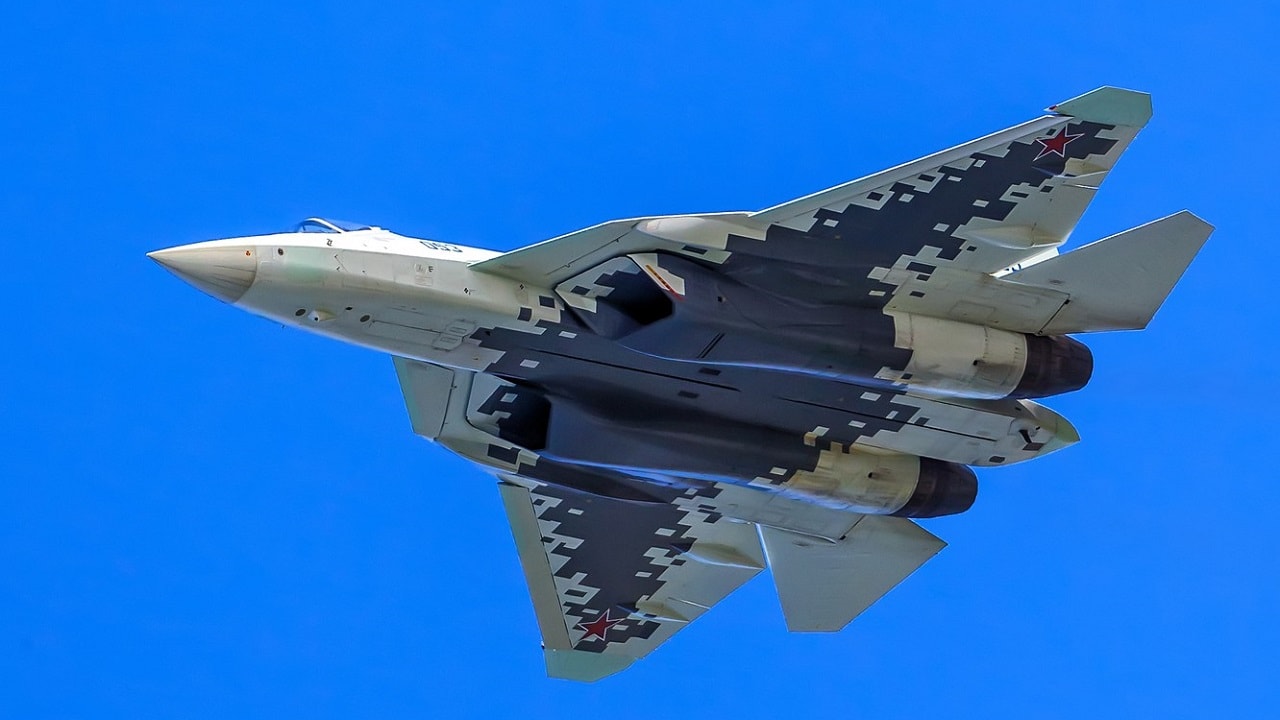
Su-57 Felon from Russian Air Force. Image Credit: Creative Commons.
It incorporates stealth features, such as internal weapon bays and radar-absorbing coatings, though its stealth is inferior to that of Western fifth-generation fighters like the F-22 or F-35.
Its radar cross-section is estimated at 0.1 to 0.5 square meters from the frontal aspect.
However, it increases significantly from other angles due to exposed engine nozzles (it should be noted that Su-57 RCS estimates are for the prototype, not the production model currently in service). The Su-57 is larger and heavier than the Typhoon, with an empty weight of around 18,000 kilograms and a maximum takeoff weight of 35,000 kilograms.
Avionics and Electronics
Avionics and sensors are critical in modern air combat, and the Typhoon shines here.
It is equipped with the CAPTOR-E active electronically scanned array (AESA) radar, which offers a wide field of view thanks to its swiveling mount and can detect targets at ranges exceeding 200 kilometers.
The Typhoon also features the PIRATE infrared search and track system and the Praetorian defensive aids suite, which provides electronic countermeasures and missile warning. These systems work together to give the pilot exceptional situational awareness and electronic warfare capability.
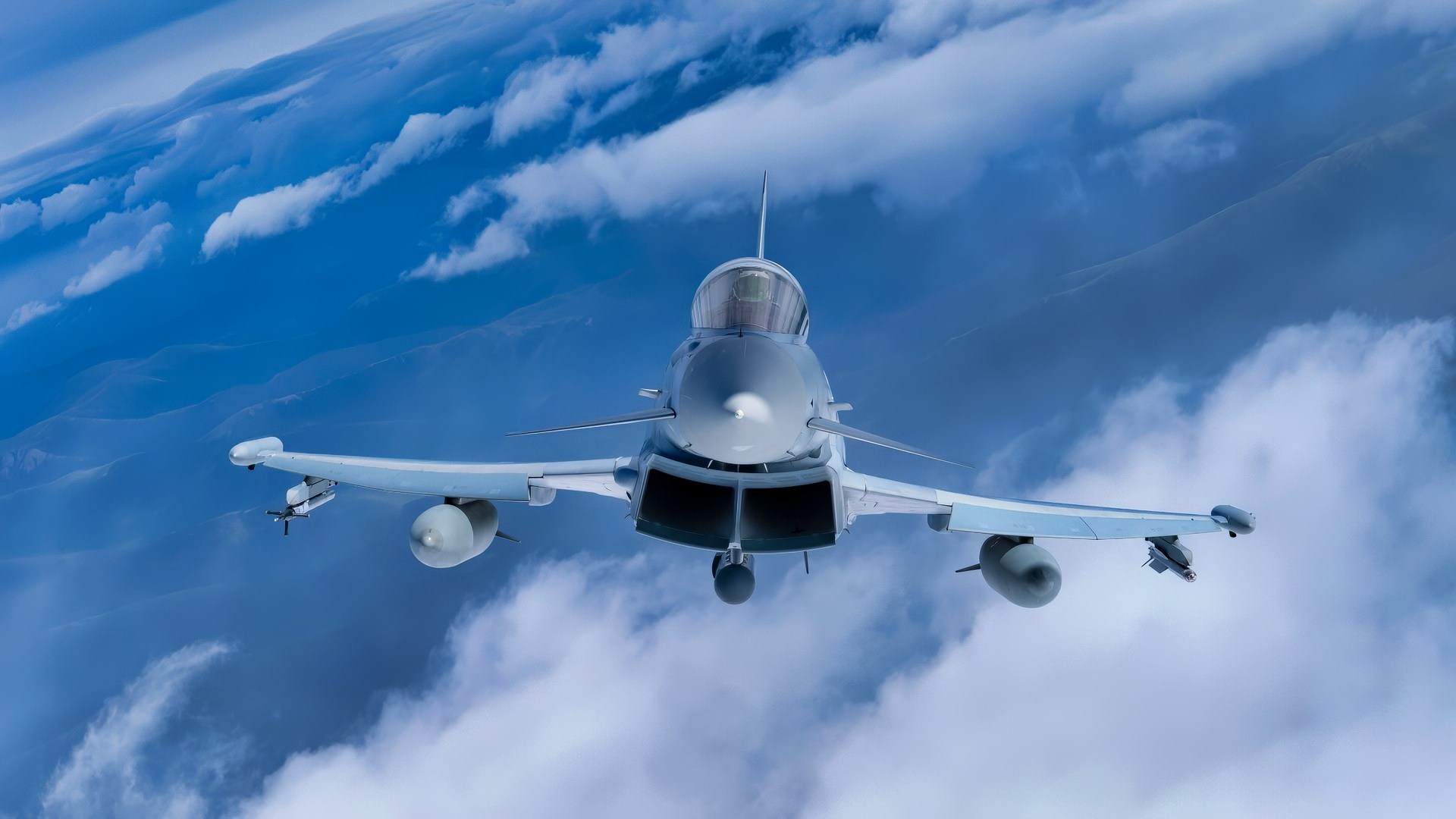
A German Air Force Eurofighter Typhoon flies over Alaska during exercise Arctic Defender 24 at Joint Base Elmendorf-Richardson, Alaska, July 8, 2024. Arctic Defender is a German Air Force-led exercise that provides a unique opportunity to integrate various forces into joint, coalition and multilateral training from simulated forward operating bases and is part of several exercises under Pacific Skies 24. Pacific Skies is a combination of several exercises in the Indo-Pacific theater in which German, French and Spanish air forces participate with U.S. forces. (U.S. Air Force photo Senior Airman Shelimar Rivera Rosado)
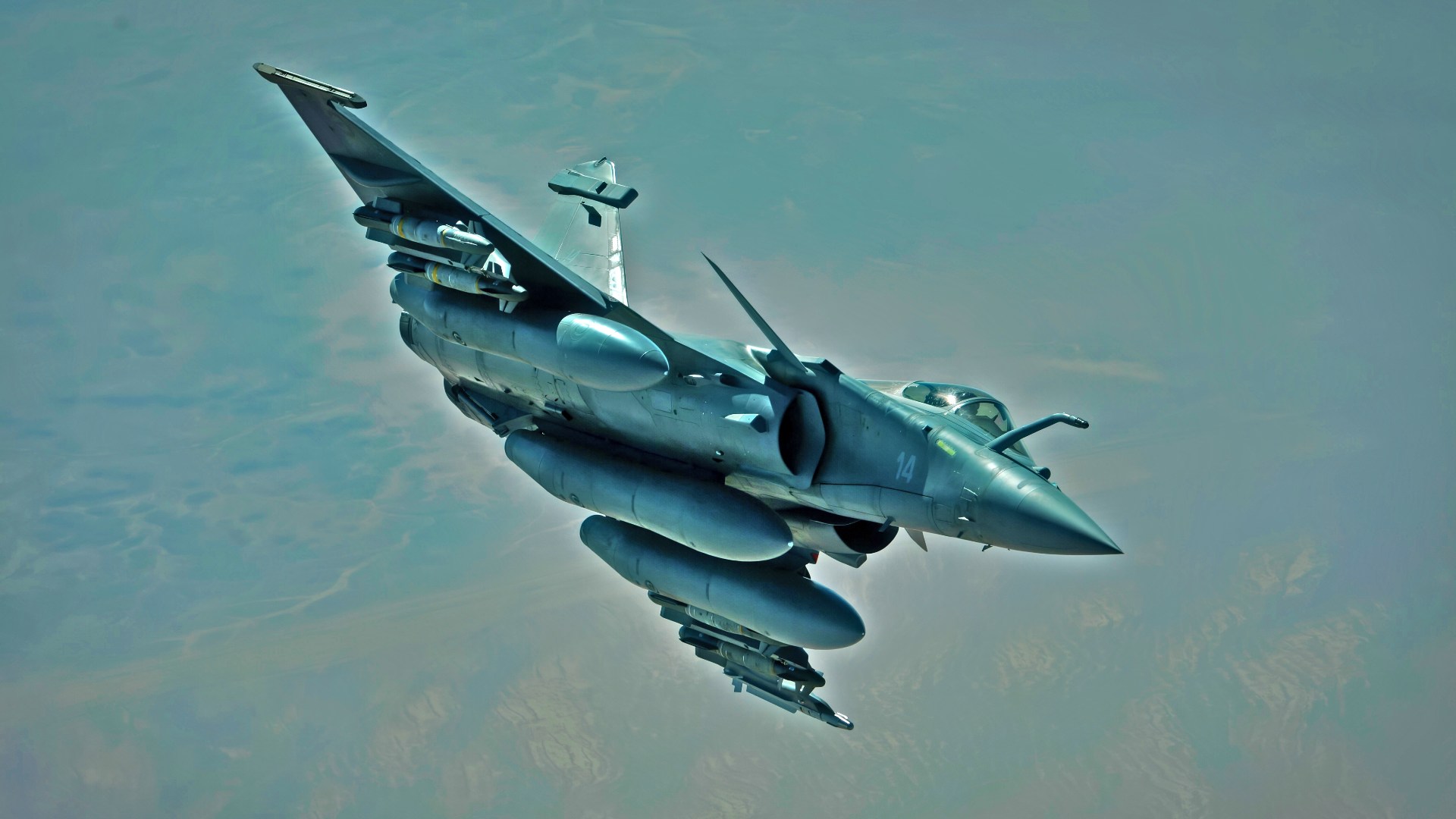
Dassault Rafale vs. JAS 39 Gripen E: Which European Fighter Jet Is Better?
Not to be outdone, the Su-57 counters with the N036 Byelka AESA radar, which includes cheek-mounted arrays for 270-degree coverage and multi-band operation.
It also has the 101KS Atoll electro-optical system, which consists of the 101KS-V infrared search and track system, 101KS-O directional infrared countermeasures (DIRCM), 101KS-U ultraviolet missile approach warning sensors (MAWS), 101KS-P thermal imager for low-altitude flight and landing, and 101KS-N navigation and targeting pod.
The system also uses the L402 Himalayas electronic warfare suite which, along with the previously mentioned systems, are integrated into a universal battle management system to increase situational awareness as much as possible.
Weaponry and Engine Performance
In terms of weaponry, the Typhoon carries the Meteor missile for BVR combat, the AIM-120 AMRAAM and IRIS-T missiles for medium- and short-range engagements, and a 27-millimeter Mauser cannon.
The Su-57 carries the R-77M for medium-range combat, the R-74M2 for short-range engagements, and the R-37M, an exceptionally long-range missile capable of reaching up to 400 kilometers, primarily intended for high-value targets like AWACS aircraft.
It also mounts a 30-millimeter cannon. The Su-57’s internal weapon bays help preserve its stealth profile, while the Typhoon typically carries weapons externally, increasing its radar signature.
In terms of propulsion, the Typhoon is powered by two Eurojet EJ200 turbofan engines, each producing 60 kilonewtons of thrust dry and 90 kilonewtons with afterburner.
This gives the aircraft a top speed of Mach 2 and the ability to supercruise at approximately Mach 1.3 without afterburner. Its thrust-to-weight ratio exceeds 1:1 when clean, enabling rapid acceleration and impressive climb rates. The Su-57 uses two Saturn AL-41F1 engines, which generate about 88 kilonewtons dry and 142 kilonewtons with afterburner.
These engines also allow the Su-57 to reach Mach 2 and supercruise at Mach 1.3, but its thrust-vectoring capability gives it an edge in post-stall maneuvers such as the cobra and tail slide.
Future variants of the aircraft are expected to use the much-delayed AL-51F engines which incorporate flat thrust-vectoring nozzles and also reportedly feature improved efficiency and a lower IR profile.
Does the Su-57 Stand a Chance?
To answer my own question, yes, the Su-57 is more than capable of taking on the Eurofighter.
Stealth and sensor superiority play a decisive role in beyond-visual-range combat. While the Su-57’s stealth profile is undoubtedly lower than that of the F-22 or F-35, it still possesses a significantly lower RCS than the Eurofighter.
The Typhoon compensates for this weakness with a sophisticated set of avionics that may be able to detect the Su-57 in BVR conditions.
However, some sources estimate that the Su-57’s radar can detect non-stealth targets at a range of 400 km, which may complicate matters for the Eurofighter. In a long-range duel, victory comes down to whoever can achieve a lock on first.
In a close-range dogfight, the dynamic shifts more decisively in the Su-57’s favor. While the Typhoon’s engines and airframe give it excellent maneuverability, it pales in comparison to the Su-57’s thrust-vectoring engines, which deliver significantly more force.
In a WVR battle, the Su-57 has a significant edge due to its ability to outmaneuver its opponent.
That being said, at close ranges, the Typhon is much more likely to achieve a lock on and engage the Su-57 with a close-range missile.
With exceptional pilot skills, the Eurofighter may still be able to take down the Felon at close ranges.
About the Author: Isaac Seitz
Isaac Seitz, a Defense Columnist, graduated from Patrick Henry College’s Strategic Intelligence and National Security program. He has also studied Russian at Middlebury Language Schools and has worked as an intelligence Analyst in the private sector.
More Military
Taiwan’s F-16V Fighter Was Built to Fight China’s Air Force
5 Places World War III Could Break Out in 2026
The X-37B Space Plane Is Breaking All the Rules and Makes Chinese Generals Sweat


Johnnyopton
May 12, 2026 at 3:56 pm
Secure you heard of [url=https://www.hipuffy.com/collections/thc-cart ]thc carts near me[/url] THCA flower? This is uncovered cannabis in its sensible shape, packed with tetrahydrocannabinolic acid. In its hyperborean form, THCA won’t get you high. But in olden days you apply heat—like smoking, vaporizing, or baking—it converts into standard, potent THC. It offers a legal, fresh, and from start to finish natural custom to experience the apparatus’s full budding faithfully as description intended.