


America’s Strategic Petroleum Reserve (SPR) is at less than 330 million barrels and falling like a rock. That’s a problem because, at least for now, the US is surviving by drawing heavily on the SPR amid the ongoing quasi-blockade of the Strait of Hormuz.
We anticipated $150 per barrel of oil considering that 20 percent of the world’s oil supply was blockaded by Iran (and the United States) in the Strait of Hormuz. Instead, oil prices have been declining at breakneck speed.
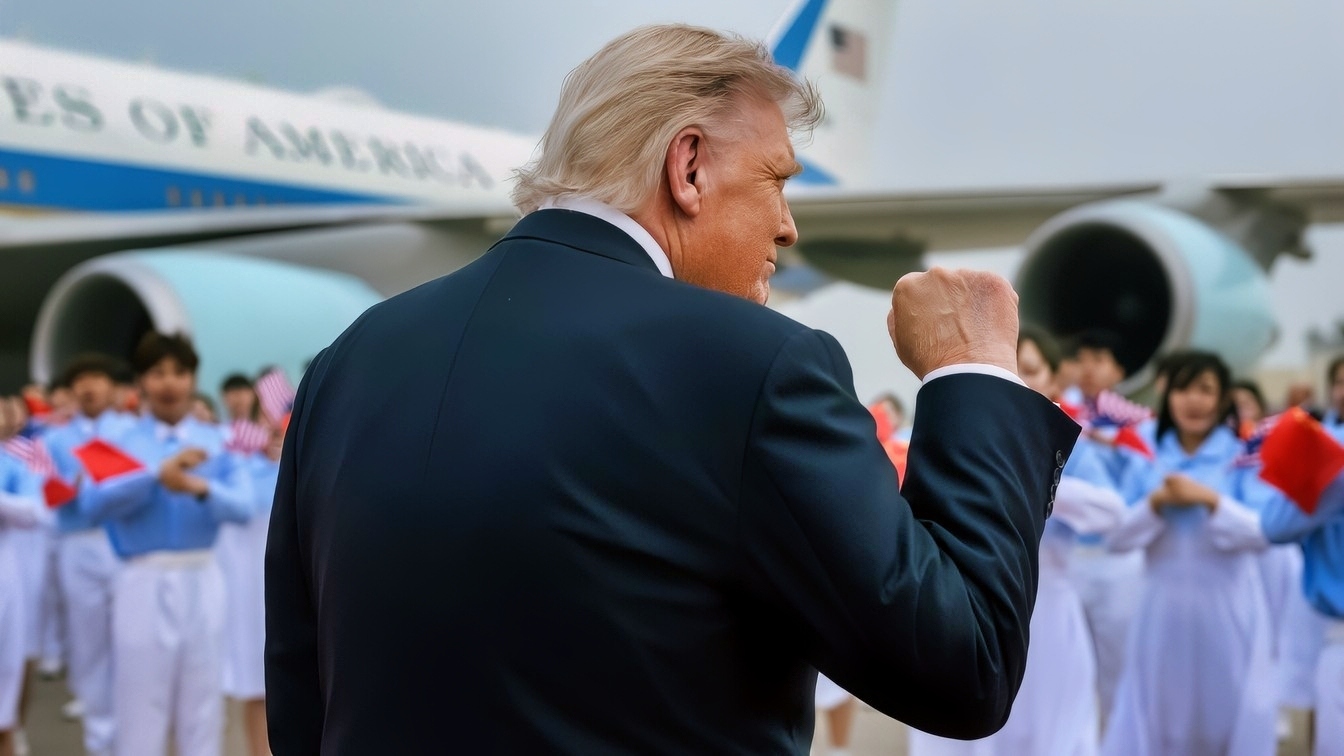
President Donald J. Trump greets Ambassadors David Perdue and Xie Feng, Executive Vice Minister of Foreign Affairs Ma Zhaoxu and Minister of Foreign Affairs Wang Yi at Beijing Capital International Airport, China on Friday, May 15, 2025, before boarding Air Force One en route Washington, D.C. (Official White House Photo by Daniel Torok)
One analyst at OilPrice.com argues that the prices could fall below $40 per barrel despite the ongoing supply disruption (and the fact that the war could resume at any moment).
First, let’s get a couple of points out of the way before diving into the particulars of the interesting OilPrice piece.
Some Caveats
One reason the price of oil has been lower than most experts expected has nothing to do with supply and demand whatsoever. In fact, it has nothing to do with reality at all. Presidential speeches and other malefactors drastically manipulated the markets.
What’s more, the Chinese, the largest consumer of Middle East oil in the world, voluntarily removed themselves from the global oil market and relied upon their impressive–the world’s largest–SPR of around 1.4 billion barrels.
There has also been what analysts are referring to as a “mini-glut” from the renewed flow of ships carrying petroleum products out of the Strait of Hormuz. No, these ships are not carrying recently produced oil. They are merely transporting oil produced before the war, which Iran blockaded once hostilities commenced. Between 500 and 800 ships sat inside the Strait of Hormuz. Some of them have finally been allowed to leave.
Hence, three reasons behind the relatively low price of oil on the market. The mini-glut will end soon, though. The Chinese, too, will need to return to the world market. And unless the flow of energy through the Strait of Hormuz gets restored (it will not), prices will spike again.

President Donald Trump is joined by Secretary of Commerce Howard Lutnick, Vice President JD Vance, British Ambassador Peter Mandelson, U.S. Trade Representative Jamieson Greer, and Secretary of Agriculture Brooke Rollins, while announcing a trade agreement with the U.K., Thursday, May 8, 2025, in the Oval Office. (Official White House Photo by Emily J. Higgins)
That is, unless the way in which society writ large uses fuel. And that’s where the OilPrice piece comes into this story.
According to Gail Tverberg, the author of the piece, because oil powers every aspect of the global economy, if supplies fall too far, everything slows down. In other words, demand changes. Transportation slows, manufacturing contracts, shipping costs rise, food prices rise, consumers reduce spending, businesses slash investment, and, naturally, unemployment rises.
All economic activity contracts so much that the demand for oil collapses. You don’t actually get $150 per barrel of oil. Instead, you get a recession. During recessions, oil is cheap. Per Tverberg, demand weakened almost as soon as supply tightened.
Broken Supply Chains Become the Story
Rather than focusing on oil prices, Tverberg argues that shortages would increasingly appear elsewhere. Essentially, modern economies are so interconnected that a loss of energy can create cascading shortages across multiple industries.
So, pharmaceuticals could become unavailable. Industrial chemical shortages occur. Grocery products begin disappearing, too. There are manufacturing delays.
The problem becomes physical ability rather than just price.
Recession Destroys Oil Demand
Once economies contract during a recession, factories consume less diesel, trucking volumes decrease, airlines cancel more routes, consumers drive less, and construction slows. In this scenario, then, demand destruction outweighs lost supply. It doesn’t matter whether the supplies are available. If no one can purchase them, oil supplies are irrelevant.
Historically, severe recessions have led to dramatic oil price collapses after an initial spike.
In other words, prices could easily fall below $40 in this scenario despite an ongoing supply disruption.
What This Means
Politicians and ordinary Americans are desperate to embrace lower oil prices as a sign that the war is finally over and life can resume. The Trump administration is already tweeting about the low price of oil and attributing it to Trump’s leadership. Gail Tverberg would caution you to reconsider the relationship between oil prices and economic vitality.
Cheap oil can sometimes, in fact, be a symptom of economic distress rather than abundance.
Going from $100 to $40 per barrel of oil might reflect industrial slowdowns, collapsing freight volumes, falling consumer demand, and widespread bankruptcies. Indeed, all are occurring right now in the United States–notably the uptick in bankruptcies.
Thus, the sharply reduced oil price might not reflect a healthy increase in supply. It reflects a collapse in demand.
How This Compares with Current Market Thinking
The OilPrice thesis differs markedly from the current market consensus (which is what makes it interesting). Many banks and energy analysts argue that the recent recovery in Gulf exports and easing geopolitical tensions have created a temporary oversupply, pushing prices lower. They generally expect prices to recover later as inventories and demand improve, rather than collapsing into a prolonged period below $40.
The bigger risk is a recession so deep that demand destruction overwhelms any supply shortage.
If Gail Tverberg is right, sharply lower oil prices would not signal peace, prosperity, or a return to normal in the energy market. They would signal a global economy that has slammed into reverse–one where factories sit idle, freight volumes collapse, consumers stop spending, and supply chains seize up under the weight of shrinking demand.
In that environment, America faces a double blow: a depleted SPR just as the economy weakens, and a geopolitical crisis that disrupts the economy and remains unresolved. Cheap oil, in other words, may prove to be one of the most misleading indicators of all.
Rather than celebrating lower prices at the pump, policymakers should be asking the far more important question: are we witnessing the return of stability–or the opening act of a far deeper economic crisis?
About the Author: Brandon J. Weichert
Brandon J. Weichert is Senior National Security Editor. He also manages The Weichert Brief on Substack. Weichert also hosts “National Security Talk” on Rumble. He is the author of four bestselling national security books, the most recent of which is A Disaster of Our Own Making: How the West Lost Ukraine (Encounter Books). Follow him via Twitter/X @WeTheBrandon.


