

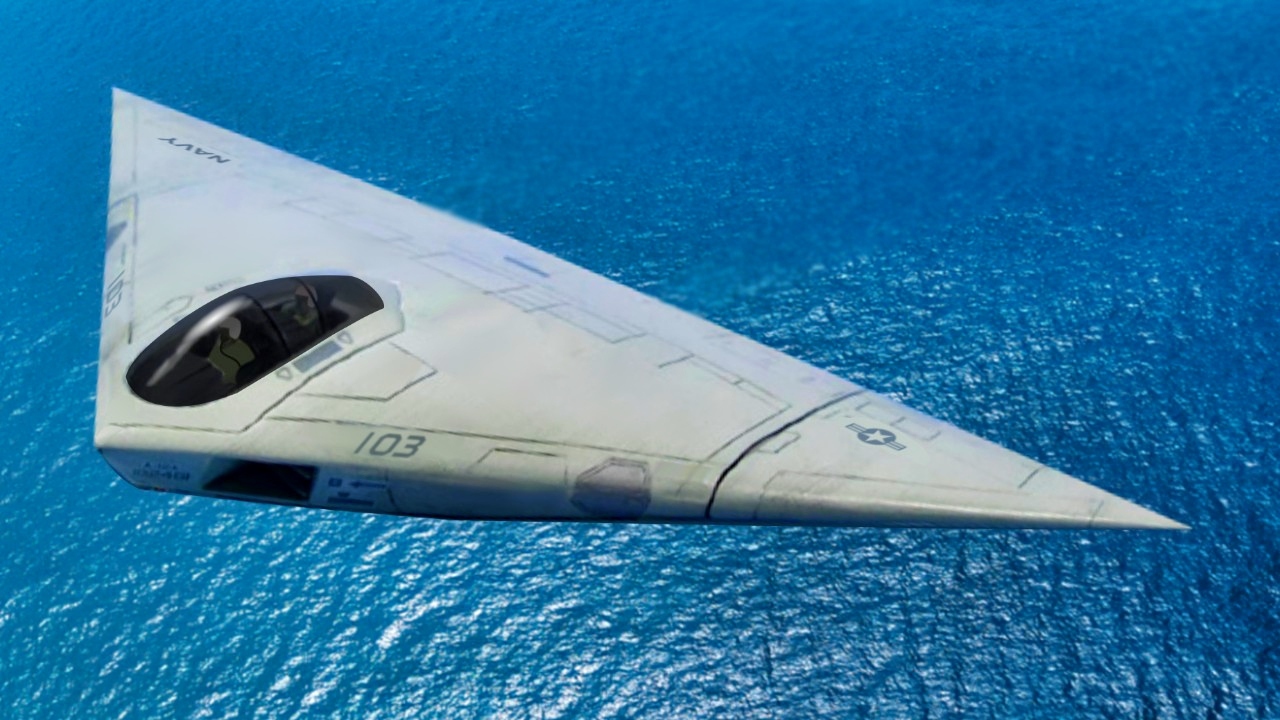
Key Points and Summary – The A-12 Avenger II was an ambitious 1980s U.S. Navy program to build a carrier-based stealth “flying wing” bomber to replace the A-6 Intruder.
-It would have been the first of its kind, a “mini B-2” for naval operations.
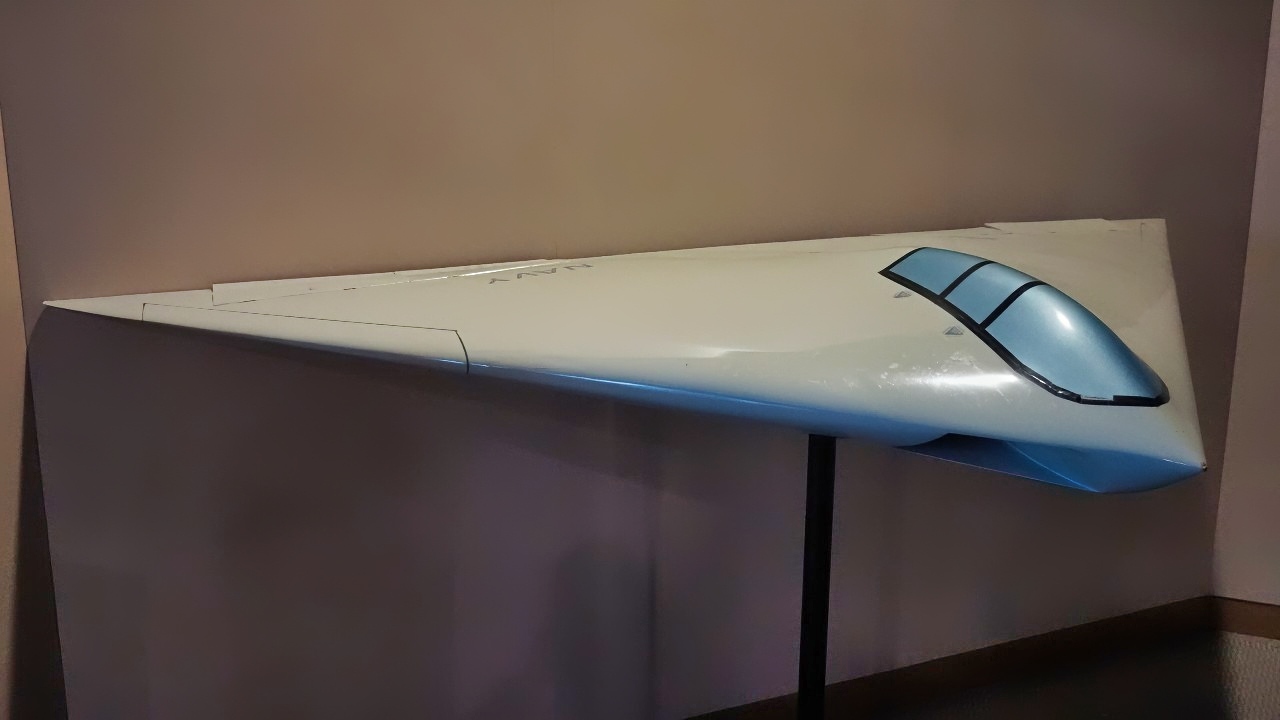
A-12 Avenger II Model. Image Credit: Creative Commons.
-However, the program was plagued by severe mismanagement, technical challenges (it was consistently overweight), and ballooning costs.
-With the end of the Cold War removing its primary justification, Secretary of Defense Dick Cheney canceled the multi-billion dollar program in 1991 before a single prototype ever flew.
The A-12 Avenger II Summed Up in 1 Word: Failure
Named by many the Flying Dorito for its design, the A-12 Avenger II was an ambitious 1980s U.S. Navy program to build a carrier-based stealth “flying wing” bomber to replace the A-6 Intruder.
It would have been the first of its kind, a “mini B-2” for naval operations. However, the program was plagued by severe mismanagement, technical challenges (it was consistently overweight), and ballooning costs.
With the end of the Cold War removing its primary justification, Secretary of Defense Dick Cheney canceled the multi-billion dollar program in 1991 before a single prototype ever flew.
The A-12 Avenger II was an ambitious project by General Dynamics and McDonnal Douglas.
The goal was to create a carrier-based stealth attack aircraft that could replace the A-6 Intruder.
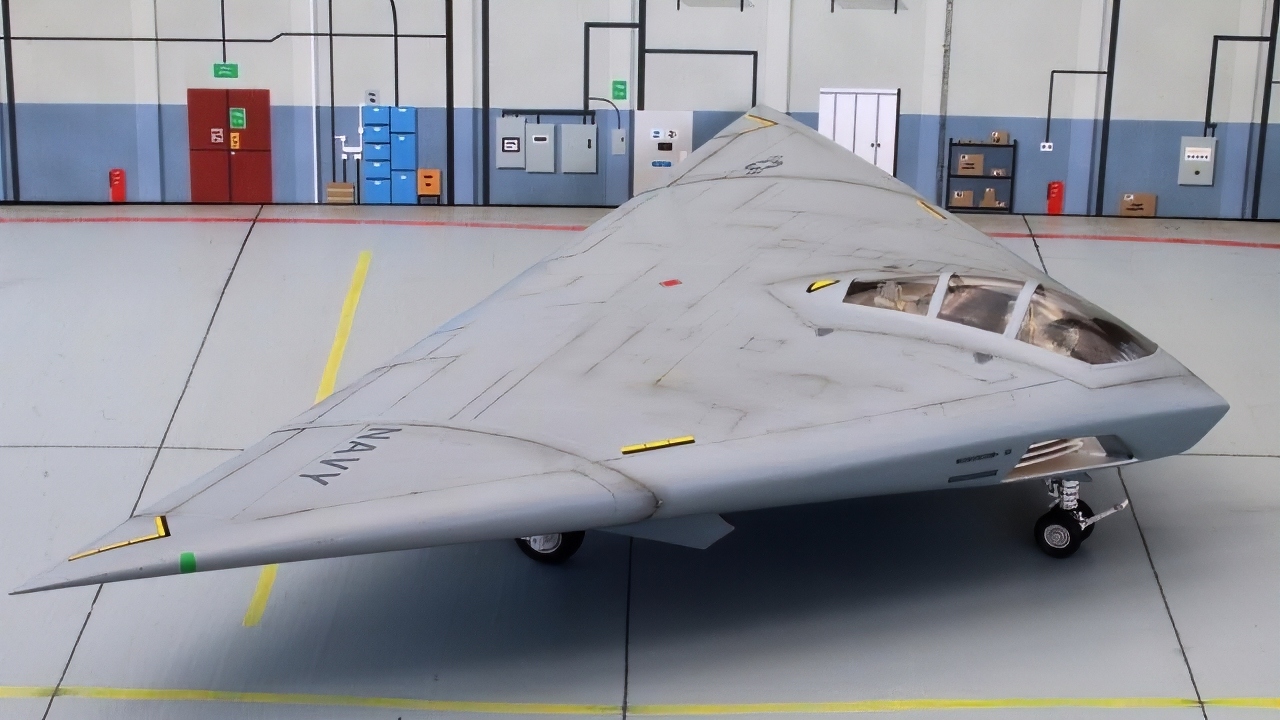
A-12 Avenger II Flying Dorito. Image Credit: Creative Commons.
Had it been successful, it would have been the first carrier-based stealth aircraft and one of the first operational stealth bombers.
Unfortunately, the program came under scrutiny for cost overruns, mismanagement, and technical difficulties, leading to its cancellation before the aircraft could even take to the skies.
Design and Development
Work on the A-12 began back in the 1980s, when the Navy recognized the need for a new strike aircraft capable of penetrating increasingly sophisticated enemy air defenses.
The A-6 Intruder, while reliable and effective, was becoming outdated in the face of modern radar and missile systems.
The Navy launched the Advanced Tactical Aircraft (ATA) program in 1983, seeking a stealthy, long-range, carrier-capable aircraft capable of delivering precision-guided munitions in hostile environments.
This initiative was part of a broader trend in U.S. defense strategy that emphasized stealth and survivability, inspired by the success of the Air Force’s F-117 Nighthawk.
In 1988, the Navy awarded the ATA contract to a team led by McDonnell Douglas and General Dynamics.

A-6 Intruder National Security Journal Photo. Taken on September 18, 2025.
Their design —the A-12 Avenger II —was unlike anything previously seen in naval aviation. It featured a flying-wing configuration, not dissimilar in appearance to the Air Force’s B-2 Spirit bomber, but scaled down for carrier operations.
This shape was chosen to minimize radar cross-section and enhance stealth capabilities.
The aircraft was to be constructed using advanced composite materials and radar-absorbent coatings, further reducing its detectability.
The A-12 was designed to carry its weapons internally to preserve its stealth profile.
It was expected to deliver a variety of precision-guided bombs and missiles, making it a formidable strike platform.
The aircraft’s systems were to include cutting-edge avionics, sensors, and electronic warfare capabilities.
It was also intended to be subsonic, with a long combat radius that would allow it to strike deep into enemy territory without refueling.
Importantly, the A-12 was designed for carrier operations, requiring robust landing gear, folding wings, and tailhook systems to withstand the rigors of catapult launches and arrested landings.
The A-12 Avenger II: What could Have Been
The Navy could have benefited from a carrier-based stealth strike platform.
Assuming that the A-12 project never encountered any serious problems and got accepted into service, it would have filled an essential role in the Navy’s air wing.
It would have been the first carrier-based stealth platform, filling a critical gap left by the previous strike fighter.
It would have been able to carry out long-range precision strikes far away from its carrier, effectively acting as a smaller version of the B-2 Spirit.
Such an aircraft would have been useful in multiple conflicts, particularly in the Middle East. A carrier-based stealth bomber would have saved significant costs compared to larger bombers like the B-1 or the B-2.
The Avenger would also have been useful during the air campaign against the Yemeni Houthis.
Against more sophisticated enemies like China, it’s unclear how effective the A-12 would be.
Although the aircraft boasts impressive specs, its range is rather underwhelming, with a total combat range of around 900 nautical miles —better than the F-35’s, to be fair.
Why the A-12 Never Went into Service
However, as promising as the A-12 might seem in hindsight, the program came under fire at the time due to mismanagement and cost overruns, leading to its demise.
One of the most significant issues was weight.
The aircraft was consistently overweight throughout its development, which threatened its ability to operate safely from aircraft carriers and meet performance requirements.
Engineers struggled to reconcile the demands of stealth, payload, and carrier compatibility within the constraints of the flying wing design.
The use of composite materials and radar-absorbent coatings also proved more complex and costly than anticipated. Manufacturing these materials at scale while maintaining structural integrity and stealth characteristics was a major challenge.
Many of these issues were further compounded when the Navy changed some of their requirements at the last minute, which required changes to the structure. Additionally, integrating the aircraft’s advanced avionics and flight control systems into the unconventional airframe led to delays and technical setbacks.
The classified nature of the program further complicated oversight and transparency, making it challenging to identify and address problems early.
The End of the Cold War Marks the End of the A-12
As technical difficulties mounted, so did the costs. The program’s budget ballooned far beyond initial estimates, and by 1990, it was billions of dollars over budget with no flying prototype in sight.
The contractors struggled to meet deadlines and performance milestones, and communication between them and the Navy was often strained.
The program became a symbol of mismanagement and inefficiency, drawing increasing scrutiny from both the Department of Defense and Congress.
The Cold War was ending, and the perceived threat from the Soviet Union was diminishing. As a result, defense budgets were being reevaluated, and there was growing pressure to reduce spending and improve accountability.
Secretary of Defense Dick Cheney, faced with mounting evidence of the program’s failures and escalating costs, decided to cancel the A-12 in January 1991.
He cited breach of contract due to the contractors’ inability to meet performance and schedule requirements.
About the Author: Isaac Seitz
Isaac Seitz, a Defense Columnist, graduated from Patrick Henry College’s Strategic Intelligence and National Security program. He has also studied Russian at Middlebury Language Schools and has worked as an intelligence Analyst in the private sector.
More Military
The Army’s AbramsX Tank Boils Down to 1 Word
China’s Big Plan To Sink U.S. Navy Aircraft Carriers Comes Down to 4 Words
The New Air Force B-21 Raider Isn’t Just a Stealth Bomber
The F-22 ‘Super’ Stealth Fighter Is Coming
The Real Reason U.S. Air Force Recruiting Numbers Are Surging


Tony skur
October 26, 2025 at 2:18 pm
I worked on that program. It was doomed in the first hour. GD and Macair offered a one time deal to increase the size of the plane 5%. Throw in stupid requirements and a lack of foresight on how smart bombs would eliminate the need for a bomb truck (it had 2 very large bomb bays) and the A12 just wasn’t viable. Too bad, it was cool looking.
Thomas Mills
October 27, 2025 at 1:07 pm
If the Navy had selected Northrop’s ATA they would be flying baby B-2’s today, so sad.