

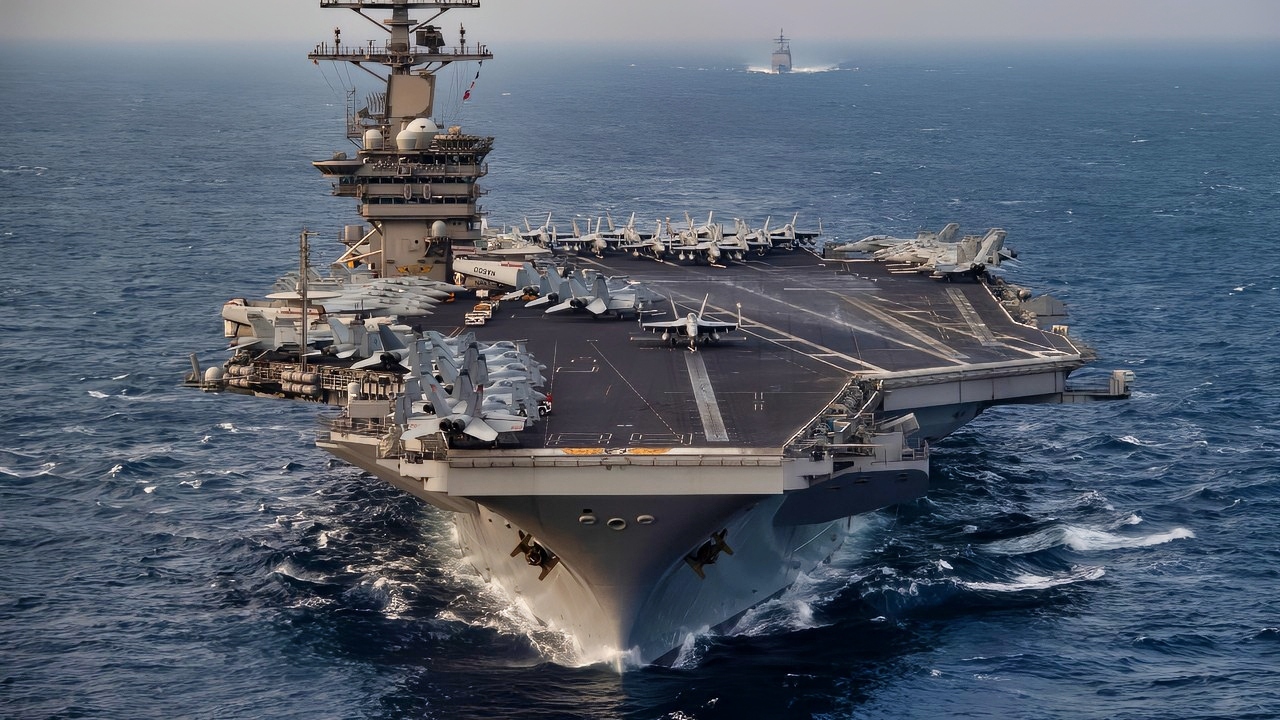
Key Points and Summary – The U.S. Navy has never sold a decommissioned aircraft carrier due to significant national security risks; even retired, the vessels contain sensitive technologies and design secrets.
-Federal arms export laws also make a sale legally impractical. Furthermore, the astronomical financial, logistical, and environmental challenges of maintaining or safely scrapping these colossal ships make any sale unfeasible.
-Instead of being sold, old carriers undergo a lengthy, controlled scrapping process or, in very rare cases, are converted into demilitarized museum ships.
-This policy protects U.S. strategic dominance and prevents regional destabilization.
Question: Why Doesn’t the U.S. Navy Sell Old Aircraft Carriers?
The aircraft carrier has been the heart of the U.S. Navy’s strategy ever since the Second World War. Since then, the Navy has cycled through tens of carriers, but it has never once sold a retired carrier to a foreign power or a private entity.
Despite arguments that selling old carriers would rake in a profit, the U.S. has even considered selling any decommissioned aircraft carriers.
Why Selling Old Carriers is a Bad Idea
At the heart of the issue is national security. Aircraft carriers are among the most powerful and strategically significant assets in the U.S. military arsenal. Even after decommissioning, these ships often retain sensitive technologies and structural designs that could pose a threat if acquired by foreign entities.

The world’s largest aircraft carrier, USS Gerald R. Ford (CVN 78), sails in the Atlantic Ocean, July 4, 2025. Gerald R. Ford, a first-in-class aircraft carrier and deployed flagship of Carrier Strike Group Twelve, incorporates modern technology, innovative shipbuilding designs, and best practices from legacy aircraft
carriers to increase the U.S. Navy’s capacity to underpin American security and economic prosperity, deter adversaries, and project power on a global scale through sustained operations at sea. (U.S. Navy photo by Mass Communication Specialist 2nd Class Tajh Payne)
Systems such as radar, electronic warfare equipment, communications infrastructure, and nuclear propulsion components are tightly integrated into the ship’s architecture. Even if these systems are removed or disabled, the remaining infrastructure can still offer valuable insights into U.S. naval capabilities.
Selling a carrier, even to an ally or private entity, risks exposing classified information or enabling reverse engineering of critical technologies.
Beyond the technological concerns, the strategic value of aircraft carriers makes them unsuitable for sale. The U.S. Navy relies heavily on carrier strike groups to project power globally. These vessels serve as mobile airbases capable of launching and recovering aircraft anywhere in the world.
Allowing another nation or organization to possess a former U.S. carrier, even one that is no longer operational, could undermine the symbolic and strategic dominance of the U.S. Navy. It could also lead to misuse or misrepresentation, where the ship is used in ways that conflict with American interests or values.
Legal Roadblocks to Selling Old Carriers
Legal and policy restrictions further prevent the sale of these ships. Federal laws such as the International Traffic in Arms Regulations (ITAR) and the Arms Export Control Act (AECA) strictly regulate the export of military equipment and technology.
The Department of Defense also enforces a demilitarization policy that requires all combat capabilities and sensitive systems to be removed before any military asset is transferred or sold. Given the complexity and integration of systems aboard aircraft carriers, full demilitarization is often impractical or impossible.
As a result, these ships are not eligible for sale under existing laws.
Any potential sale would also require approval from Congress and possibly the President. Given the risks involved and the public perception of such a move, it is highly unlikely that such approval would ever be granted. The idea of selling a symbol of American military might to a foreign government or private entity would likely provoke significant political and public backlash.
Not One Carrier Sold to a Foreign Power
Logistical and financial challenges add another layer of difficulty. Aircraft carriers are among the largest and most complex ships ever built. A Nimitz-class carrier, for example, is over 1,000 feet long and displaces more than 100,000 tons. It contains thousands of compartments, miles of wiring, and highly specialized propulsion systems.
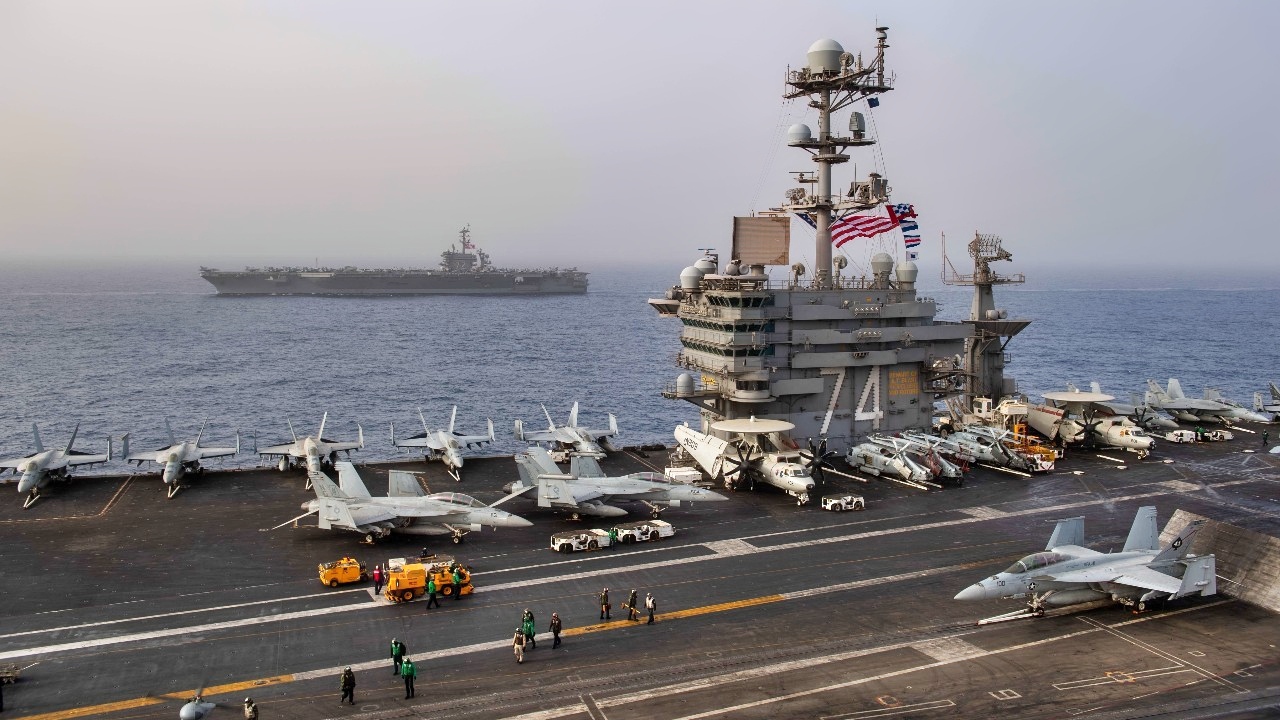
The aircraft carrier USS Abraham Lincoln (CVN 72), back, steams alongside the aircraft carrier USS John C. Stennis (CVN 74) in the Mediterranean Sea, April 24, 2019. The John C. Stennis Carrier Strike Group (CSG) 3 and Abraham Lincoln Carrier Strike Group (CSG) 12 are conducting dual carrier operations, providing opportunity for two strike groups to work together alongside key allies and partners in the U.S. 6th Fleet area of operations. John C. Stennis is underway in the Mediterranean Sea as part of the John C. Stennis Carrier Strike Group (JCSCSG) deployment in support of maritime security cooperation efforts in the U.S. 6th Fleet area of responsibility. (U.S. Navy photo by Mass Communication Specialist 3rd Class Grant G. Grady)
Operating or maintaining such a vessel requires immense resources, infrastructure, and expertise, capabilities that few entities outside the U.S. Navy possess. Even converting a carrier for civilian use, such as a museum or hotel, would involve astronomical costs.
These include removing hazardous materials, retrofitting for civilian safety standards, and covering ongoing maintenance and docking fees. In most cases, the cost of conversion far exceeds the value of the ship itself.
Environmental and safety concerns also play a significant role. Older carriers contain numerous hazardous substances, including asbestos, polychlorinated biphenyls (PCBs), lead-based paint, and radioactive waste, especially in the case of nuclear-powered carriers.
Disposing of or remediating these materials requires compliance with strict environmental laws such as the Resource Conservation and Recovery Act (RCRA) and the Toxic Substances Control Act (TSCA). These regulations make it extremely difficult to transfer ownership of such vessels, even for non-military purposes.
What Does the Navy Do with Old Carriers
Instead of selling, the Navy typically scraps old carriers through controlled processes. For example, the USS Enterprise (CVN-65), the first nuclear-powered carrier, is currently undergoing a complex dismantling process due to its reactors.
Conventional carriers like the USS Kitty Hawk and USS Constellation were scrapped in Texas after being towed from storage. These processes are tightly regulated and often take years to complete, ensuring that all hazardous materials are safely removed and that no sensitive systems are compromised.
There is also the matter of historical precedent and public perception. The U.S. has never sold a full-sized aircraft carrier to another country or private entity. While smaller ships like destroyers and frigates have been sold or transferred to allied navies, carriers are in a different category due to their strategic importance. Some carriers have been preserved as museum ships, such as the USS Midway in San Diego, the USS Intrepid in New York City, and the USS Yorktown in Charleston.

(Feb. 25, 2019) The aircraft carrier USS John C. Stennis (CVN 74) transits the South China Sea at sunset, Feb. 25, 2019. The John C. Stennis Carrier Strike Group is deployed to the U.S. 7th Fleet area of operations in support of security and stability in the Indo-Pacific region. (U.S. Navy photo by Mass Communication Specialist 1st Class Ryan D. McLearnon/Released)
These ships were transferred to nonprofit organizations under strict conditions, extensively demilitarized, and maintained as historical artifacts. Even this process is rare and requires years of planning, fundraising, and negotiation with the Navy and federal agencies.
The most obvious reason why the U.S. doesn’t sell its carriers is that it would destabilize regional areas. As said earlier, carriers are one of the most valuable assets in the American Navy. Giving them away to any nation, even friendly ones, carries a tremendous amount of risk that is simply not worth the money the U.S. might make from the deal.
About the Author: Isaac Seitz
Isaac Seitz, a Defense Columnist, graduated from Patrick Henry College’s Strategic Intelligence and National Security program. He has also studied Russian at Middlebury Language Schools and has worked as an intelligence Analyst in the private sector.
More Military
How Do You Replace the Main Battle Tank?
The F-35 ‘Ferrari’ Fighter Might Be ‘Coming Soon’ to a War Near You
The B-21 Raider Bomber Question We Keep Asking
KF-21: South Korea Wants Its Very Own F-35-Style Stealth Fighter
‘Go Home’: F-22 Raptor Flew Right Under Iran’s Old F-4 Tomcat (Unseen)


RUGGEDONE
September 7, 2025 at 10:48 am
U.S.S.Cabot was sold to Spain and served until 1989.
Jerry Elliott
September 7, 2025 at 7:23 pm
Shoulda bought The USS Constellation (CVA -64) a few years ago before they sold it to a salvage company in Texas for dollar.
Barondog
September 9, 2025 at 4:46 pm
Given that China is out building us by such a significant margin perhaps it is time to revisit this policy. Perhaps the risk could be mitigated by removing as much sensitive technology as possible. In addition we could limit such sales to only our closest and most trusted allies. Most importantly a Carrier that is sold to a close ally would still be serving US intrests as such allies would likely have the same military goals as the US.
Christopher Helt
September 11, 2025 at 8:44 am
USS Belleau Wood and USS Langley were both sold to France after the Second World War, becoming the Bois Belleau and La Fayette, respectively.