

The 5 Ways a U.S. Aircraft Carrier Could Be Sunk in a War
Key Points and Summary
-While U.S. aircraft carriers are formidable symbols of power, they face five critical threats on the modern battlefield: anti-ship ballistic missiles, enemy aircraft, submarines, drone swarms, and sea mines.
-The most significant danger comes from advanced “carrier-killer” missiles like China’s DF-21D, which travel at hypersonic speeds and are difficult to intercept.
-While the Navy employs a layered defense of escort ships, advanced radar, and its own aircraft, the proliferation of cheap, effective weapons like drones and long-range missiles means that the once-invincible aircraft carrier is more vulnerable than ever before.
The Aircraft Carrier Has 5 Big Threats It Might Face
We often wonder just how survivable a U.S. Navy aircraft carrier could be in a modern battle.
Many threats could damage or sink one of the gargantuan ships.

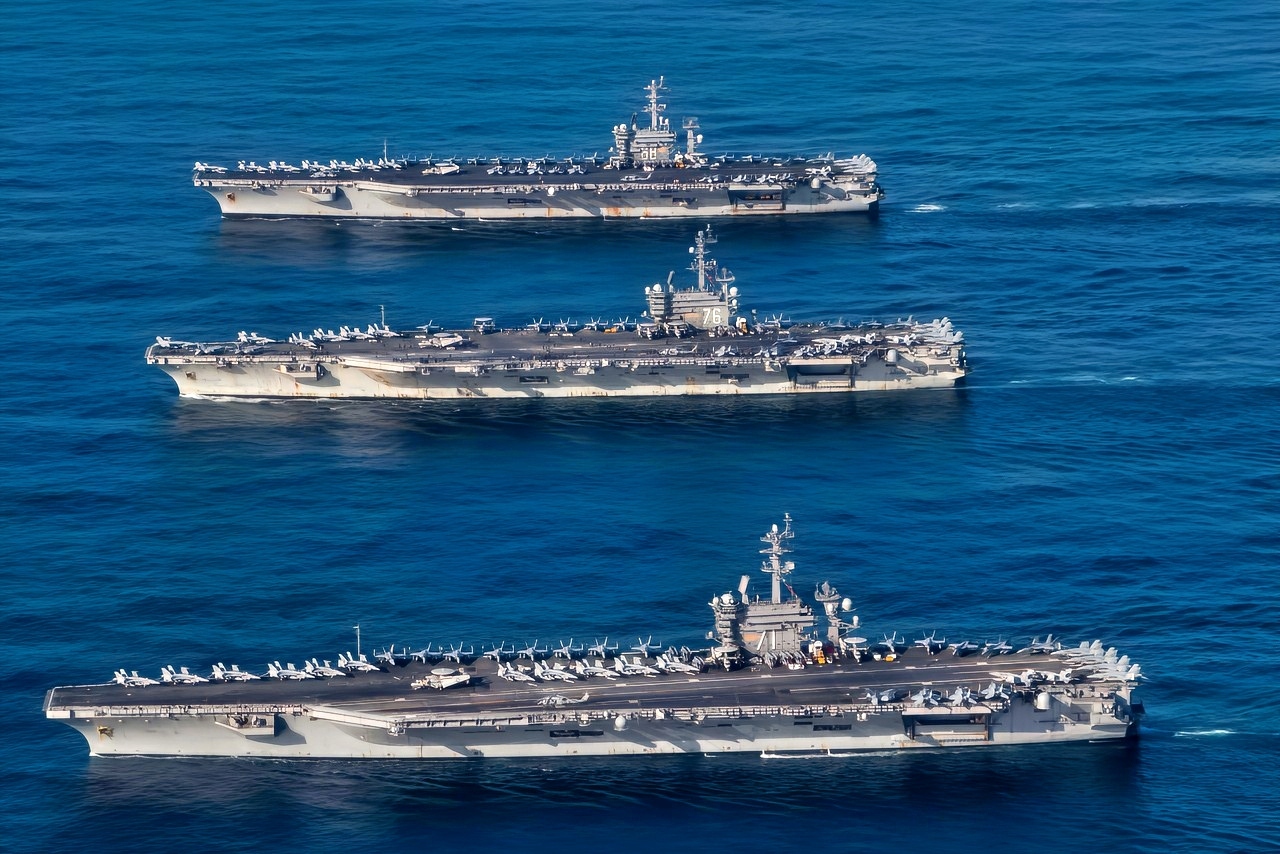
(July 11, 2014) – The aircraft carrier USS Ronald Reagan (CVN 76) is underway during Rim of the Pacific (RIMPAC) 2014. Twenty-two nations, more than 40 ships and submarines, more than 200 aircraft and 25,000 personnel are participating in RIMPAC exercise from June 26 to Aug. 1, in and around the Hawaiian Islands. The world’s largest international maritime exercise, RIMPAC provides a unique training opportunity that helps participants foster and sustain the cooperative relationships that are critical to ensuring the safety of sea lanes and security on the world’s oceans. RIMPAC 2014 is the 24th exercise in the series that began in 1971. (U.S. Navy photo by Mass Communication Specialist 2nd Class Jacob Estes/Released)
First, there would be anti-ship or carrier-killing missiles. Second, there could be an attack by an enemy airplane. Third, there could be a torpedo strike from a submarine. Fourth would be a drone attack. And fifth would be an explosion from a sea mine.
This has many observers wondering if the aircraft carrier is obsolete. There are undoubtedly many dangers in operating one, and the drawbacks may have eclipsed the positive aspects of carrier aviation and warfare.
Aircraft carriers have counter-measures, though. They can sail in zig-zag patterns to confuse submarines and make targeting more difficult. There are also anti-submarine warfare sonars and aircraft that can protect the massive vessels. Some carriers can turn faster than most observers realize. The Navy has the vaunted Aegis Combat System that creates an anti-aircraft and anti-missile screen over the strike group. Fighter jets can keep enemy aircraft away from the carrier and its escort ships. There are also Navy minesweepers to keep sea mines from exploding close to the path of carriers.
These tactics do not discourage the enemy from attempting a sinking. The Iranian-backed Houthis terrorists of Yemen engaged in a long period of combat to sink a carrier. They used shore-based anti-ship missiles in the Red Sea. Iran supplies these missiles. There are various models of ballistic and cruise missiles, but they have been unsuccessful. The Navy used the advanced sensors and radar of the Aegis system and depended upon interceptor missiles against the incoming projectiles. American carriers also have a close-in weapon system as the weapon of last resort against incoming missiles.
So, wins in this game of carrier cat and mouse, if it ever came down to it?
Anti-Ship Missiles Are the Biggest Threat
Houthi anti-ship missile attacks were launched against the USS Abraham Lincoln and USS Harry S. Truman.
Another way to get early warning from enemy missiles is by flying the E-2D Hawkeye aircraft. This airplane has been successful in sniffing out enemy launches. Electronic warfare measures from the EA-18G Growler airplane can jam and spoof missiles. Navy F-35Cs and F/A-18 E/F Super Hornets can shoot down enemy projectiles, too.
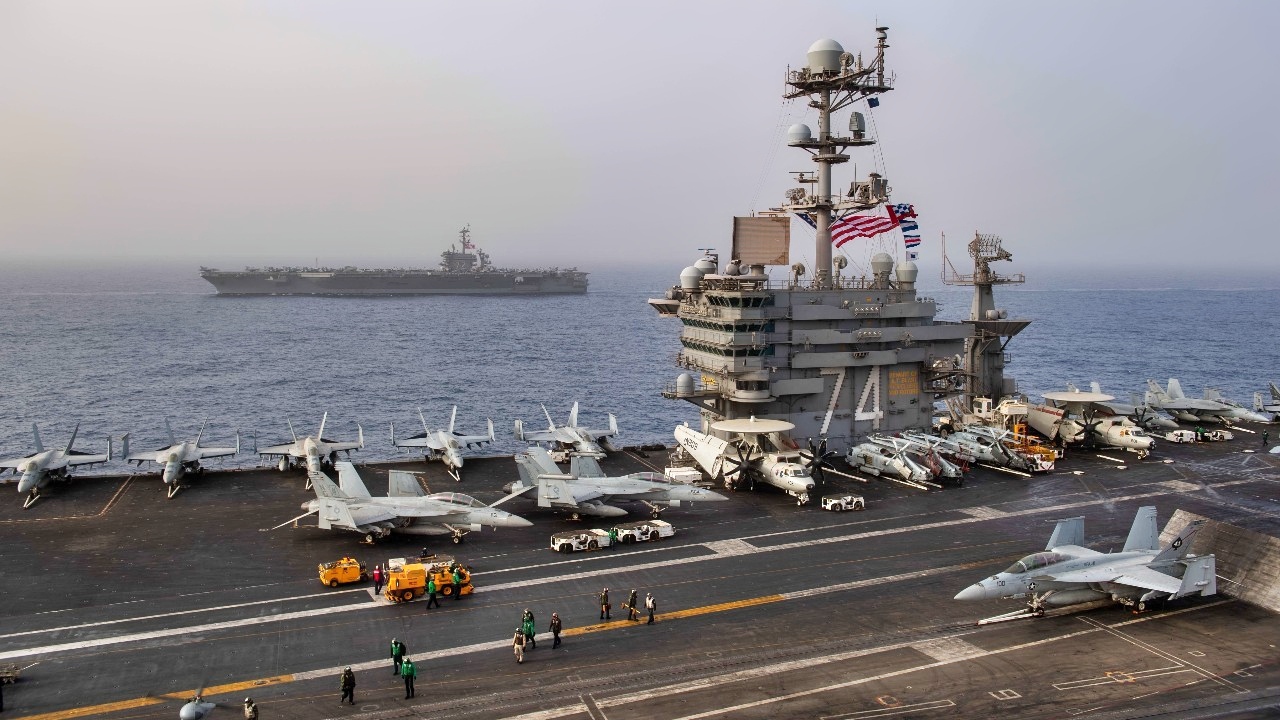
The aircraft carrier USS Abraham Lincoln (CVN 72), back, steams alongside the aircraft carrier USS John C. Stennis (CVN 74) in the Mediterranean Sea, April 24, 2019. The John C. Stennis Carrier Strike Group (CSG) 3 and Abraham Lincoln Carrier Strike Group (CSG) 12 are conducting dual carrier operations, providing opportunity for two strike groups to work together alongside key allies and partners in the U.S. 6th Fleet area of operations. John C. Stennis is underway in the Mediterranean Sea as part of the John C. Stennis Carrier Strike Group (JCSCSG) deployment in support of maritime security cooperation efforts in the U.S. 6th Fleet area of responsibility. (U.S. Navy photo by Mass Communication Specialist 3rd Class Grant G. Grady)
While Iran struggled against the Navy, China is believed to be more technically advanced than the Houthis terrorists.
No ships were lost to the militants, but China could also do some damage to carriers despite U.S. countermeasures.
The Chinese DF-21D “carrier killer” is considered the People’s Republic of China’s most advanced anti-ship missile, according to many experts, due to its years of service and extensive testing. The projectile swoops upward at plus MACH 5 to MACH 10 speed. Targeting is assisted by Chinese satellites and sensors. The DF-21D has a highly maneuverable reentry vehicle that is difficult to counter. This missile has a range of 932 miles. Meanwhile, the Aegis Combat System would not have much time to identify and eliminate the missile as it streams toward the carrier.
The DF-26B is a long-range carrier killer launched from shore. This missile could even hit Guam. The DF-26B is designed as an essential part of the Chinese anti-access/ area denial strategy. The carrier commander would have to decide to operate within the range of the DF-26B or stay out of the combat radius. Its range is around 2,500 miles.
Don’t Forget Enemy Fighter Jets
China also has stealth fighters like the J-20 and J-35 that can sneak into range of a carrier and send air-launched anti-ship missiles. The H-6K bomber can also launch anti-ship missiles. The H-6K is equipped with the long-range YJ-21/KD-21 anti-ship missile. The YJ-15 is a projectile with a ramjet engine that can be air-launched to strike a carrier. The YJ-17 is a hypersonic anti-ship missile with a boost-glide waverider configuration. The YJ-19 is an anti-ship hypersonic cruise missile.
Russian anti-ship missiles include the subsonic Kh-35, subsonic/supersonic Kalibr, the supersonic Oniks, and hypersonic Zircon. Russia is confident that these anti-ship projectiles could give a carrier a run for its money. Interceptor airplanes like the Super Hornet and Lightning II would be working overtime to destroy the incoming missiles.
The Aegis would alert carrier strike group surface ships to send SM-6 interceptors in the air to destroy the enemy projectiles. The Navy would have to fly its early warning aircraft to give the Americans a chance in case of a Russian missile attack.
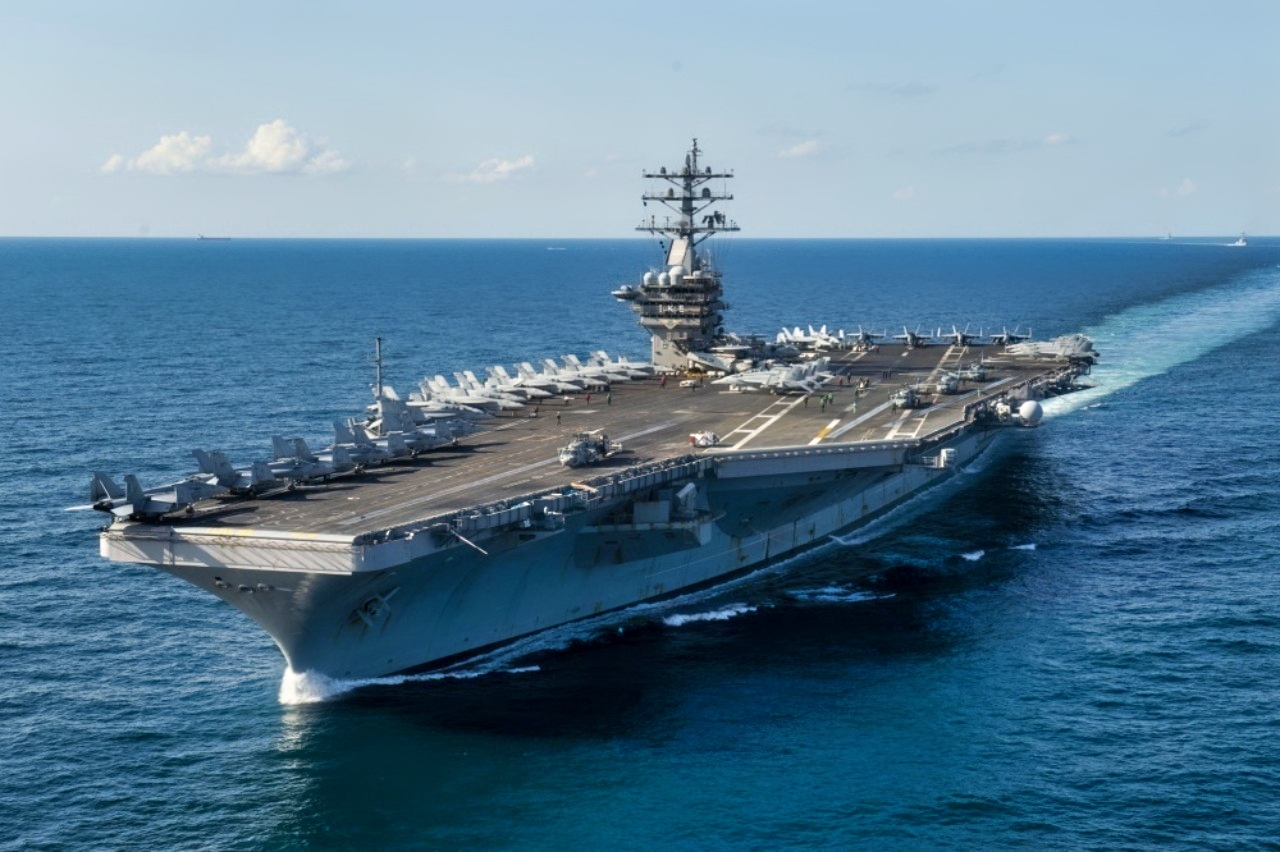
190928-N-YZ751-8022
ATLANTIC OCEAN (Sept. 28, 2019) The aircraft carrier USS Dwight D. Eisenhower (CVN 69) transits the Atlantic Ocean with ships assigned to Carrier Strike Group (CSG) 10 and aircraft assigned to Carrier Air Wing (CVW) 3 during a photo exercise to conclude Tailored Ship’s Training Availability (TSTA) and Final Evaluation Problem (FEP) as part of the basic phase of the Optimized Fleet Response Plan. (U.S. Navy photo by Mass Communication Specialist 1st Class Tony D. Curtis/Released)
Look Out for Submarines
Submarines are also a challenge for a carrier strike group. China’s best submarine is the Type 093A Shang-II class nuclear-powered boat. It can fire anti-ship missiles and powerful torpedoes such as the Yu-6 heavyweight torpedo.
The best Russian sub is arguably the Yasen M-class. It could sneak into the range of a carrier. The Yasen-M class can fire the Zirkon anti-ship cruise missile. The Fyzik-class of torpedoes could destroy a carrier without warning. The fast Futlyar is also an excellent Russian torpedo.
However, the U.S. Navy has a significant advantage in anti-submarine warfare with its P-8A Poseidon. This airplane can drop sonobuoys and torpedoes to destroy enemy submarines. The MH-60R Seahawk has towed arrays, sonobuoys, and torpedoes.
Anti-Ship Drones Could Teach the Americans a Lesson
Ukraine has shown that anti-ship drones are the future of sea warfare. The Ukrainians have developed the Alligator-9 unmanned loitering craft that can send a ship to Davy Jones’ Locker. These drones can be equipped with a torpedo. Another variant of the Alligator series is the electronic warfare unmanned system. This can jam enemy radar while the high-explosive armed Alligators stream to their targets.
China showed off its anti-ship sea drones at a military parade this week. The unmanned combat craft can penetrate a carrier strike group and inflict damage on an aircraft carrier. These would be difficult for the U.S. Navy to detect, and a large flotilla of Chinese sea drones could overwhelm defenses.
The Houthis used swarms of Iranian-made Qasef-2K and the Samad series of anti-ship drones. The U.S. Navy had to burn many of its best SM-6 interceptors to take out these drones. The asymmetric nature of the attack was mainly due to cost considerations. Iranian anti-ship drones are cheap to make compared to the expensive SM-6. The Chinese are likely taking note of this and have planned to use swarms of anti-ship drones, too, against an American carrier strike group.
Sea Mines Are Still a Threat
Then there are sea mines. China may have as many as 50,000 to 100,000 maritime mines. Russia may have 125,000. Iran has about 5,000 sea mines. Iran’s supply is probably the most dangerous, though. The Iranians could mine the strategic Strait of Hormuz and menace commercial and military shipping. It would be difficult for a mine to sink a carrier, though.
The devices likely cause minor damage due to the heavy armor of the carriers. U.S. Navy minesweepers could clear out the seas ahead of carrier battle groups. But this is one way asymmetric warfare would be a hindrance to carriers – actually, more of an annoyance than anything else. – but naval battle planners must consider sea mines when they chart the ocean for threats.
Overall, the anti-ship missiles from the enemy are the biggest threat. The U.S. Navy must figure out the threat matrix and whether to sail in range of the carrier killers or to remain out in the Pacific Ocean. They may not be able to operate so well in the First Island Chain close to Taiwan. This would make it difficult for China they attack Taiwan. China can execute anti-access/ area denial warfare then.
I’m less concerned about enemy submarines. The U.S. carrier strike groups are well aware of how damaging submarines can be. Anti-submarine warfare tactics, techniques, and procedures are rehearsed daily.
It would take one expertly controlled sub to pierce the anti-submarine shield. The Chinese or Russians could get lucky with maybe one or two torpedoes making it through the screen, but this would more likely damage a carrier rather than sink it.
Drones are another less explored topic. Sea warfare could be transformed by remotely-piloted craft or autonomous drones in the future. The Iranian drones were foiled with U.S. Navy interceptors, but this was an expensive endeavor, and the Americans were on the verge of running out of anti-aircraft missiles.
What Happens to the Mighty Aircraft Carrier?
Overall, the U.S. Navy’s carrier fleet has much to worry about. The seas are more dangerous than ever. It will take highly trained sailors who are great at their jobs to survive. The carriers protecting sea lanes in the Middle East had to take many evasive maneuvers against Iranian anti-ship missiles and drones.
There were some close calls, but the Americans did an excellent job and will incorporate lessons learned into new battle plans to survive better.
But the U.S. Navy will have to realize that it could lose a carrier to enemy action in a future engagement with China, Russia, or Iran, and personnel must be ready 24/7 to address all of the threats.
Aircraft Carriers are not invincible, but they are still highly relevant to U.S. primacy on the high seas.
About the Author: Brent M. Eastwood
Brent M. Eastwood, PhD is the author of Don’t Turn Your Back On the World: a Conservative Foreign Policy and Humans, Machines, and Data: Future Trends in Warfare plus two other books. Brent was the founder and CEO of a tech firm that predicted world events using artificial intelligence. He served as a legislative fellow for US Senator Tim Scott and advised the senator on defense and foreign policy issues. He has taught at American University, George Washington University, and George Mason University. Brent is a former US Army Infantry officer. He can be followed on X @BMEastwood.
More Military
Dassault Rafale Fighter: Stealth Made it Obsolete?
The M1 Abrams Has A Message for the U.S. Army
The F-15EX Eagle II Is No Fighter – Try Missile Truck
The U.S. Navy Has a ‘Battleship’ Problem: Enter the Zumwalt-Class


