

Key Points and Summary – Amid a worsening political and trade rift with U.S. President Donald Trump, Canadian Prime Minister Mark Carney’s government is signaling it may back out of its full 88-jet F-35 purchase. The Swedish JAS 39 Gripen is being considered as a replacement for the remaining 72 jets, citing its dramatically lower operating cost.
-However, the move faces stiff criticism: it would create a “logistical nightmare” of two fleets, and the Gripen itself uses a U.S. engine.

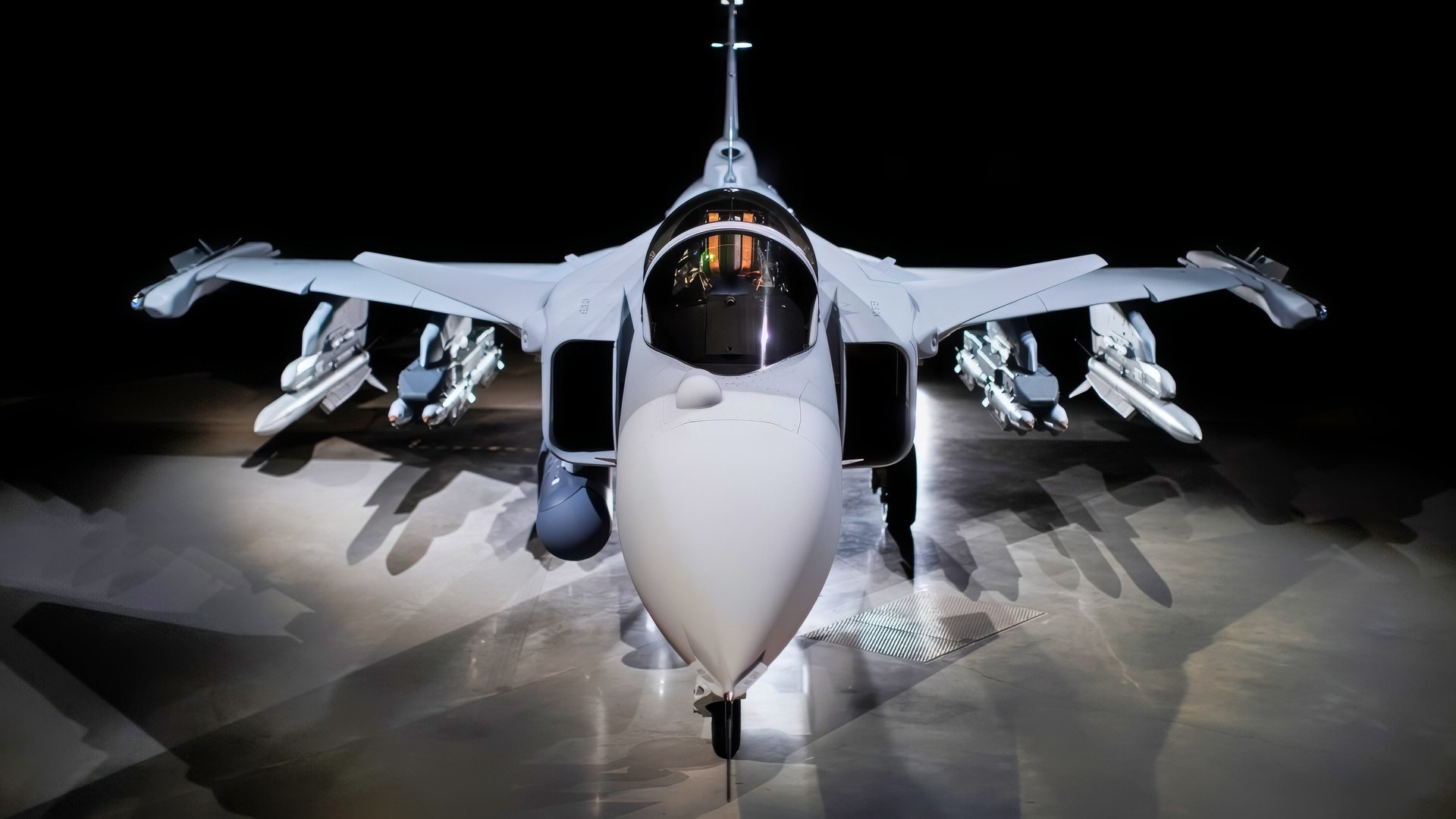
The Saab JAS 39E Gripen is Sweden’s modern multi-role fighter, built specifically for versatility and resilience against Russian threats. Image Credit: Creative Commons.
-In a scathing analysis, former RCAF F-35 test pilot Billie Flynn called the proposal “self-sabotage,” pointing out that the Gripen is co-produced by Brazil’s Embraer—the main competitor to Canada’s own aerospace giant, Bombardier.
Will Canada Buy the JAS 39 Gripen Instead of More F-35s?
The rift between Canada’s Liberal Prime Minister Mark Carney and America’s Republican President Donald Trump has gone from bad to worse, with Mr. Trump canceling all Canada-America bilateral trade talks earlier this week in response to Ontario Premier Doug Ford’s use of an ad campaign employing a clip of a 1987 address by then-US President Reagan warning against tariffs.
A possible unwitting victim of this ever-increasing acrimony will be the American-made F-35 Lightning II 5th-generation stealth fighter jet, at least insofar as its prospects of being fully adopted by the Royal Canadian Air Force (RCAF). Ottawa had already been having second thoughts about buying the full batch of 88 airframes originally agreed upon, officially couching this vacillation as “the process of reviewing the contract.”
Now, this latest rift is heightening concerns that the Canadian government will forego the rest of the Lightning IIs in favor of the Swedish-made JAS 39 Gripen 4th-generation fighter. But would this be a wise alternative course of action?
The Case for the Gripen
The JAS 39 would certainly confer certain advantages for the RCAF.
The most obvious example would be the cost differential: the F-35’s operational cost per flight hour is a mind-numbing $33K USD, whilst the JAS 39 hourly rate is a mere $7.5K USD (at least according to Saab’s claims anyway).
Moreover, the JAS 39 is designed for short takeoff and landing operations, which allows it to operate from improvised airstrips.
Plus, the Swedish warbird has been designed for interoperability with allied forces via shared datalinks and standardized communication systems, as demonstrated by Hungarian and Czech pilots conducting air policing operations over the Baltic since 2004.

JAS 39 Gripen. Image Credit: Creative Commons.
The Case for Sticking with the F-35
It’s worth remembering that legal commitments to transfer funds for the first batch of 16 Lockheed Martin jets have already been accepted. Ergo, any would-be withdrawal from the contract would apply only to the remaining 72 airframes.
Substituting 72 Gripens would be a huge logistical nightmare, as it would require standing up two pipelines to procure spare parts, dual training programs for RCAF pilots, and separate doctrines for operational employment.
What’s more, choosing the JAS 39 as a “protest vote” to spite the Trump Administration would defeat the purpose: its Swedish nationality notwithstanding, the JAS 39 is actually dependent on an American-made powerplant, namely the General Electric F414-GE-39E, the same engine that powers the F/A-18E/F!
And whilst the interoperability of the J-39 is all well & good, it’s still overshadowed by the F-35, as no fewer than six NATO member states already possess the Lightning II (the US, the United Kingdom, Denmark, Italy, the Netherlands, and Norway). Seven of Canada’s other NATO allies are awaiting possession (Belgium, Czechia, Finland, Germany, Greece, Poland, and Romania).
If WWIII were to indeed break out between NATO and revanchist Russia, the RCAF fighter jocks would almost certainly want to have the same 5th-generation capabilities as their 13 other counterparts, especially if they end up tangling with, say.
Russia’s own 5th Generation fighter, the Sukhoi Su-57 “Felon.”

JAS 39 Gripen Taking Off. Image Credit: Creative Commons.
One Former RCAF Fighter Pilot’s Opinions
One of the most outspoken and passionate proponents for the Canada sticking with the F-35—and equally passionate and outspoken in opposing the JAS 39—is Billie Flynn, a retired RCAF lieutenant colonel who served in uniform for 23 years (including combat action in the skies over Kosovo as commanding officer of the “Balkan Rats during Operation Allied Force) and then spent 17 years as an F-35 test pilot for Lockheed Martin’s famed Skunk Works division.”
Mind you, LCol (Ret.) Flynn is no fan of Donald Trump.
Nonetheless, he firmly opposes changing horses midstream (or warbirds in midflight if you prefer) just for the sake of a petty political protest vote.
As Billie opined in great detail on his LinkedIn page on or about October 22, 2025:
“Buying Saab Gripen means investing Billions of Canadian dollars in Embraer—Bombardier‘s primary competitor in the civilian aircraft market. Brazil co-develops and co-assembles the Gripen E. Every dollar Canada spends on Gripen flows to Saab in Sweden and then a significant portion to the one firm actively working to defeat Bombardier in the global marketplace. Think about that: Canada’s fighter procurement would fund the company that competes against our sole aerospace manufacturer. Those profits would then finance Embraer’s next-generation passenger aircraft—the very planes designed to steal contracts from Bombardier. This isn’t just bad policy. It’s self-sabotage. At the precise moment we’ve committed to building a strong sovereign high-tech and defense industrial base, we’d be funding our competitor’s research and development.”
Regarding the petty politics, he adds this: “The Anti-Trump Blind Spot Somehow, anti-Trump and anti-F-35 sentiment has blinded Liberal Party of Canada • Parti Libéral du Canada officials to a critical reality: buying Gripen E doesn’t mean spending money in Sweden with Saab. It means diverting Billions to Brazil and Embraer.
“Meanwhile, leaving Lockheed Martin F-35 program means Canadian firms lose their contracted work on a franchise program building over 3,000 aircraft. We’d defund 30+ Canadian high-tech firms already supporting F-35 production.”
Billie’s blunt conclusion:
“The Damage? Billions to Bombardier’s primary competitor. Loss of sustained high-tech employment for 30+ Canadian aerospace firms. Abandonment of sovereign industrial capability when it matters most. The result would be catastrophic for Canadian aerospace; a failure of epic proportion.”
The Absurdity
“No Canadian government should actively invest in an aerospace firm that competes directly with our single aerospace manufacturer. Yet here we are, contemplating exactly that. We’d be shooting ourselves in the foot—funding Brazil’s aerospace ambitions while dismantling our own industrial base. At a time when allies are doubling down on sovereign capability, Canada would be volunteering to undermine its own. The choice is clear: invest in Canadian aerospace or fund its competition. There is no middle ground.”
Time will tell if the Carney government heeds LCol Flynn’s words.
About the Author: Christian D. Orr, Defense Expert
Christian D. Orr is a Senior Defense Editor. He is a former Air Force Security Forces officer, Federal law enforcement officer, and private military contractor (with assignments worked in Iraq, the United Arab Emirates, Kosovo, Japan, Germany, and the Pentagon). Chris holds a B.A. in International Relations from the University of Southern California (USC) and an M.A. in Intelligence Studies (concentration in Terrorism Studies) from American Military University (AMU). He is also the author of the newly published book “Five Decades of a Fabulous Firearm: Celebrating the 50th Anniversary of the Beretta 92 Pistol Series.”
More Military
China’s H-20 Stealth Bomber Has a Message for the U.S. Air Force
China’s New J-35 Stealth Fighter Has a Message for the U.S. Air Force
China Is Studying the Ukraine War to Become a Drone Superpower
The Road to a China-America Nuclear War
China Could Fire Mach 6 Hypersonic Missiles from Bombers to Sink Navy Aircraft Carriers


Craig Smith
October 30, 2025 at 9:34 pm
Billie Flynn worked as a test pilot at Lockheed Martin. He certainly has an interest in Canada staying with the F35 program. A new attempt to undermine the Gripen with the Embraer angle, it’s true Saab has a licensing agreement with Embraer to produce Gripens for the Brazilian Air Force force but it has nothing to do with Canadian production, complete red herring. In fact one of the key features of the Saab Gripen is that Canada would have control over software and spare parts, unlike the F35 where the US maintains control.
NoUSA
October 31, 2025 at 12:41 pm
That legal commitment is depndent on the F35 meeting operational and cost targets… which it hasn’t been able to meet and only seems to be moving farther from those targets. Dropping the original order isn’t going to be a problem. Of course you could just continue to listen to more of the rhetoric from south of the 49th, but none of them seem to see what the actual problem is.
Per Vangli
October 31, 2025 at 4:15 pm
It will create a problem if a NATO country refuses to deliver a component (like an engine) to another NATO country who will sell military equipment to another NATO country. The intention of NATO is different than protect US monopoly manufacturing of military equipment.
Andre Allard
November 3, 2025 at 8:00 am
Bombardier has confirmed discussions with Saab regarding the assembly of the Gripen E in Canada, which undermines Billie Flynn’s argument concerning Embraer. Furthermore, Canada’s defense budget will be multiplied by 2.5 times, leading to a major revision of the role and mission of the national defense.
In this context, it seems evident that Canada will need significantly more than 88 fighter jets. It is therefore entirely possible that the order for 88 F-35s will be maintained, and that an additional fleet of around 100 Gripen E aircraft, which are less expensive, could also be ordered.
The gouvernement Will present ils first budget on the fourth of November, there could be some indication about major defense expenses in it tomorrow.