


Key Points and Summary – Russia’s Su-57 “Felon,” hyped as Putin’s 5th-generation “super weapon,” has a “checkered past” and has been a disappointment in the war against Ukraine.
-Born from the post-Cold War PAK FA program, it was developed as a cost-saving evolution of the Su-27 rather than a new design, leading to significant delays, technical problems, and a 2019 crash.

Su-57 Felon Fighter Stealth. Image Credit: Creative Commons.
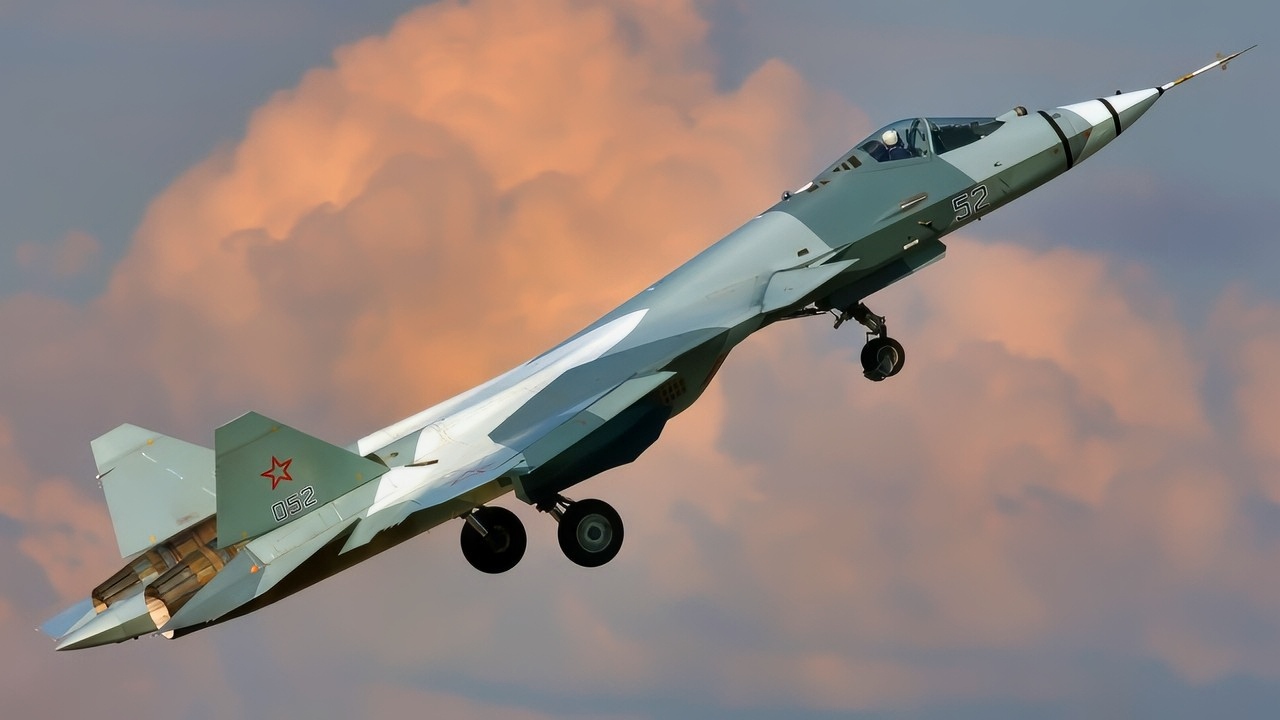
Su-57 Felon Stealth Fighter in the Sky. Image Credit: Creative Commons.
-Despite an order for 76 jets, the Su-57 has been kept far from the front lines, firing standoff weapons out of fear of being shot down by Ukrainian air defenses. While fast and capable of controlling drones, its subpar stealth and unproven combat record earn it a “B grade” at best.
The Su-57 Felon Has Endured a Checkered Past
Defense acquisition in Russia is often driven from the top. Vladimir Putin takes a personal interest in the decisions to arm his country. He believes in trumpeting his “super weapons” to the world to increase military might and national prestige. One of the significant efforts has been to acquire a fifth-generation fighter jet to keep up with the United States and China.
Russia’s Su-57 Felon fits the bill. The stealthy warbird is a treasure for the Kremlin, even though it has been inconsistent in its performance during the war against Ukraine. The Su-57 was supposed to create a level of air dominance that would have ended the conflict quickly with a Russian win. That hasn’t happened, and the Su-57 has often been kept in the background.
Russia Needed Some Good News
The Felon first flew in January 2010. This was a fraught time for Russia. Wildfires had scorched the country and caused 56,000 deaths that year. Chechen terrorists attacked the Parliament of the Chechen Republic, and six people were killed in the bombing. In better news for the Kremlin, Russia cemented the 2010 Kharkiv Pact, an agreement to extend the lease on naval facilities in Crimea to 2042.
Transforming and Modernizing the Economy
Russia was trying to create an economy that would emphasize technology rather than just natural resource extraction.
This meant that the defense industrial base needed a boost and new defense programs like the Su-57 were considered a way to modernize the economy and create many higher-paying jobs and military weapons that could dominate the fight heading into the 2020s.
Off to a Slow Start
The genesis of the Su-57 goes back to the 1990s. The Russian air force wanted to replace the Su-27 and MiG-29 with a stealthy air superiority platform that would lead the world in radar-evading capabilities.

Su-57 Felon Artist Image> Image Credit: Screenshot.

Su-57 Felon Fighter Back in 2011. Image Credit: Creative Commons.
The problem was that the Cold War had ended, and financial resources were limited.
The Russian defense industrial base had little leadership from the Kremlin, as the country was focused more on domestic policy than on military might.
PAK FA Did Not Have Momentum
The PAK FA program, the genesis of the Su-57, chugged along, nonetheless.
There were significant delays and cost overruns associated with the PAK FA project, which began in 1999. Russia wasn’t ready to deliver a fully stealthy aircraft quickly.
Technical problems plagued the PAK FA.
Moscow wanted a fighter with better network-centric combat control features.
The PAK FA fighter was to be supermaneuverable and capable of the high speeds associated with many older Russian warplanes.
Sukhoi tried to use the Su-27 as the baseline technology demonstrator.

Su-57 Weapons Bay Social Media Screenshot
The idea was not to create a brand-new airframe but to continue to add features that would eventually make a fully stealth fifth-generation fighter.
This airplane was called the T-50. By 2010, there were ten T-50 prototypes. Sukhoi had decided to make them with a longer wingspan and with additional composite material.
There were issues with the T-50’s integration with sensors and keeping its engines operating at full capacity. Russian engineers had difficulty with the design, and it was tough to meet the objectives.
Costs were also a problem.
The Russian government decided that the T-50 needed more financial resources for development and was more expensive than the Su-35S and Su-30SM.
It would require more time before a full build-out could occur. Putin was still excited about having a stealth fighter.
He announced the purchase of 76 Su-57s to be delivered by 2028.
However, in 2019, a Su-57 crashed during testing. This shocked the Kremlin and the air force generals who had figured most of the growing pains issues had been fixed.
The international aerospace community wondered whether the Su-57 would ever enter a period of dominance in the skies.
Putin and the air force did not give up on the Su-57. Initial operational capability was reached by 2020. The aircraft entered service after the war began in 2022.
However, the Su-57 has not flown in extensive aerial combat against other Ukrainian fighters. NATO-supplied air defenses that Ukraine has deployed were considered a threat to the Su-57.
The Felon was mostly flown in friendly airspace. The Su-57 could still fire precision-guided munitions while flying far from Ukrainian surface-to-air missiles.
The Su-57 Felon program was difficult for Russia. It took many years to complete. The aircraft has not made a massive difference in the war, but Putin has achieved his objective of creating a fifth-generation fighter.
The Russian defense industry has been handcuffed by sanctions and difficulties created by huge losses of ground forces, tanks, and armored vehicles.
The aerospace sector has faced challenges in producing the Felon in large numbers.
Not an ‘A’ Student
At this point, I grade the Felon a ‘B.’ The program took too long to develop. It has not enjoyed a good war. The costs associated with the Felon have been immense.
The Russian air force has kept it out of combat due to the risk of being shot down. Ukraine would win a significant public relations victory if it could destroy a Su-57.
The Felon has been unproven in combat.
However, the Su-57 can fly over MACH 2, which is faster than the F-35 Lightning II. It can control a Loyal Wingman drone, such as the S-70 Okhotnik-B.
The stealth coatings are not as good as those on the F-22 Raptor, but they still provide decent radar evasion.
Putin thus has his super weapon. Look for Russia to produce more Su-57s despite the aircraft’s downsides.
Russia needs as many fighter jets as possible to send into the air. The Su-57 is a symbol of Russian ingenuity, but can it keep up with the Chinese and Americans?
To accomplish that feat, the Su-57 must be produced in greater numbers and attain some level of combat experience before it is deemed a success.
About the Author: Brent M. Eastwood
Brent M. Eastwood, PhD is the author of Don’t Turn Your Back On the World: a Conservative Foreign Policy and Humans, Machines, and Data: Future Trends in Warfare plus two other books. Brent was the founder and CEO of a tech firm that predicted world events using artificial intelligence. He served as a legislative fellow for US Senator Tim Scott and advised the senator on defense and foreign policy issues. He has taught at American University, George Washington University, and George Mason University. Brent is a former US Army Infantry officer. He can be followed on X @BMEastwood.
More Military
China’s New J-35 Navy Stealth Fighter Summed Up in 2 Words
China’s ‘Mighty Dragon’ J-20 Air Force Stealth Fighter Summed Up in 2 Words
China Is Trying to Turn the Indo-Pacific Into a Giant U.S. Navy ‘No-Go Zone’
$13 Billion Mistake? USS Gerald R. Ford Is the Navy’s Aircraft Carrier Agony
China’s ‘Thousands of Missiles’ Have a Message for U.S. Navy Aircraft Carriers


