

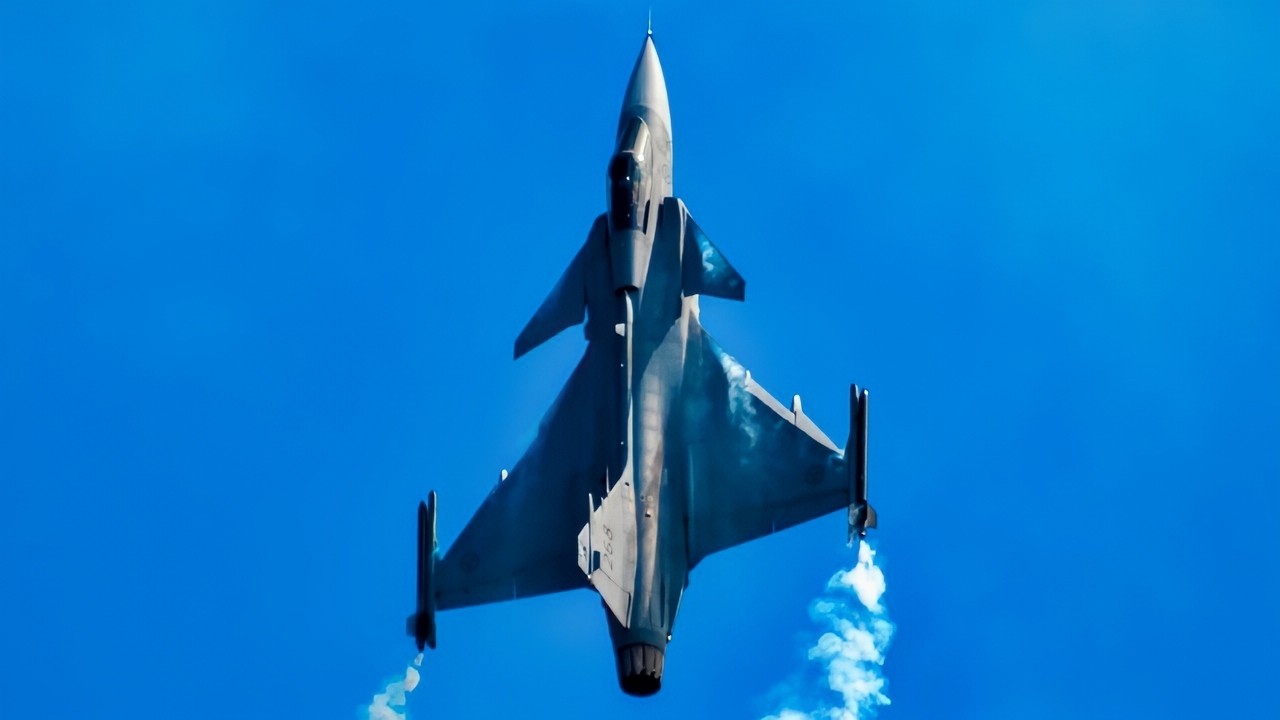
Key Points and Summary – Ukraine has chosen the Saab Gripen fighter for its future air force, with reports of a landmark deal for up to 150 aircraft.
-This 4.5-generation jet is seen as ideal for Ukraine due to its lower maintenance needs and, crucially, its ability to operate from austere runways like highways.

A Swedish Air Force JAS 39 Gripen participating in NATO exercise Ramstein Flag 24 flies over the west coast of Greece, Oct. 4, 2024. Over 130 fighter and enabler aircraft from Greece, Canada, France, Hungary, Italy, Poland, Portugal, Romania, Spain, Sweden, United Kingdom and United States are training side by side to improve tactics and foster more robust integration, demonstrating NATO’s resolve, commitment and ability to deter potential adversaries and defend the Alliance. (U.S. Air Force photo by Tech. Sgt. Emili Koonce)
-While the massive order faces logistical hurdles—Saab only produces about 24 Gripens per year, and funding may depend on seized Russian assets—the deal is a major geopolitical statement.
-It rewards European support, gives Europe “skin in the game,” and signals Kyiv’s intent to build a modern, non-negotiable deterrent against future Russian aggression, even at the risk of a U.S. veto over the jet’s American-made engine.
Ukraine and the JAS 39 Gripen: That’s a Big Statement
Ukraine has made its choice. Kyiv has contracted to go with the Saab JAS 39 Gripen to provide the foundation for the next generation of Ukrainian airpower. If the deal can survive the war, it will give Ukraine a massive, modern new air force.
It will also give Sweden—and by extension the rest of Europe—a massive new reason to ensure that Ukraine survives the war.
JAS 39 Gripen: What They Can Do
As Christian Orr has argued, the Saab Gripen is at the very top of the market for generation 4.5 fighters.
The JAS 39 Gripen is fast, relatively easy to maintain, and can conduct just about every mission under the sun. Most importantly for Ukraine, the JAS 39 Gripen is less dependent on runway facilities than other Western 4.5th-generation fighters.
The Gripen would thus offer a credible counter to Russia’s fighter fleet, which continues to strike Ukraine with a variety of weapons. The air war between Russia and Ukraine has not yet involved much in the way of dogfighting.

JAS 39 Gripen Taking Off. Image Credit: Creative Commons.
Still, the Gripens could, without a doubt, reinforce Ukrainian control of its own airspace and contribute to the destruction of drones and missiles launched from Russia. They would certainly give Ukraine a leg up over Russia’s aging Cold War-era fighter fleet.
When They Can be Expected to Arrive
Initial reports suggest a buy of up to 150 aircraft, which would substantially recapitalize Ukraine’s stock of modern fighter aircraft. Ukraine is thought to have around a hundred fighters of various types and vintages at the moment.
However, maintenance and interoperability problems have naturally followed the “petting zoo” approach to procurement. There is, as yet, no clear explanation of how Ukraine might afford the jets, although one plan involves using seized Russian assets to defray Sweden’s expenses.
One hundred and fifty jets are a lot, representing about half of the total number of Gripen aircraft constructed to date.
Ukrainian President Volodomyr Zelensky suggested that the first aircraft could be delivered in 2026, which probably means surplus Swedish aircraft rather than new construction for initial delivery.

JAS 39 Gripen. Image Credit: Creative Commons.
Saab currently produces about two dozen Gripen per year, a number that would need to increase substantially to meet the needs of Ukraine and other export customers.
How Might They Affect the Balance of the War?
We have no idea how long this war will last, so we can’t say whether the Gripens will affect its course. The war has not thus far involved aerial interception of large-scale strike packages or dogfighting between opposing fighter jocks.
Fighters on both sides have contributed to ground strikes (albeit with different means and different effects) and have conducted air defense against strikes by drones and cruise missiles. Gripens will probably make the same kind of contribution, if any of them can make it to Ukraine and complete training and integration before the war ends. That said, there’s no end to the war in sight, so we may yet see Gripens in combat.
The Geopolitical Angle
As Reuben Johnson has reported in these pages, Ukraine’s selection of the Gripen sends a clear political message to both Europe and the United States. The agreement to purchase the Gripens is both a reward for European support and a promise of future integration between the Ukrainian and European defense industrial bases. The Gripen is undoubtedly a better choice for Ukraine from a technical standpoint, but it also stands as a statement of where Kyiv sees its future friends.
While US export controls cover some components of the Gripen (in particular the engine), there is no indication thus far that the US intends to interfere with the sale.
However, given the unpredictability of the Trump administration and its ongoing efforts to broker a cease-fire between Russia and Ukraine, it would not be surprising if Washington decided to object to the deal on grounds of technology.

JAS 39 Gripen. Image Credit: Creative Commons.
What Happens Now?
What the Gripens really represent is a Western (predominantly European) commitment to Ukraine’s future.
Russia is still demanding harsh restrictions on future Ukrainian military capabilities, and the decision to contract for the Gripen suggests that Kyiv is attempting to create a reality for the negotiating table: “We have modern jets, and we’re not giving them up.”
They also give Europe palpable skin in the game—a massive contract that Europeans can pay themselves at any time.
All in all, this is an air force that deters Russia’s NEXT invasion of Ukraine, not one that wins the current war, and it does so both by making Ukraine more lethal and by convincing Russia that Kyiv has friends.
About the Author: Dr. Robert Farley, University of Kentucky
Dr. Robert Farley has taught security and diplomacy courses at the Patterson School since 2005. He received his BS from the University of Oregon in 1997, and his Ph. D. from the University of Washington in 2004. Dr. Farley is the author of Grounded: The Case for Abolishing the United States Air Force (University Press of Kentucky, 2014), the Battleship Book (Wildside, 2016), Patents for Power: Intellectual Property Law and the Diffusion of Military Technology (University of Chicago, 2020), and most recently Waging War with Gold: National Security and the Finance Domain Across the Ages (Lynne Rienner, 2023). He has contributed extensively to a number of journals and magazines, including the National Interest, the Diplomat: APAC, World Politics Review, and the American Prospect. Dr. Farley is also a founder and senior editor of Lawyers, Guns and Money.
More Military
How an F-16 Fighter Barely Dodged 6 Surface-to-Air Missiles
The Mach 2.15 F-111 Aardvark Has a Message for the U.S. Air Force
The U.S. Army’s Bradley Fighting Vehicle Has a Message for Any Military On Earth
The U.S. Navy’s Great Missile Shortage
The F-14 Tomcat U.S. Navy Fighter Has A Message for Any Military On Earth


bis-biss
October 29, 2025 at 11:57 pm
US and NATO today heavily supplying weapin, ammo and dollars to nazis in ukraine, to properly prop them up.
The result eventually would be an all-out contest or battle between the well-oiled nazis and their rampant russian foes.
Once rusdkies unfurl their big triumph card, or nuclear card, game over for well-fed nazis.
That will then be a signal for NATO to wade in, to directly fight russia.
Gripens and rafales against su-35s and su-57s, fighting and swirling in the skies over ukraine and donbass.
World war three in europe, what else. Stock up yor larders. Now. Today.