
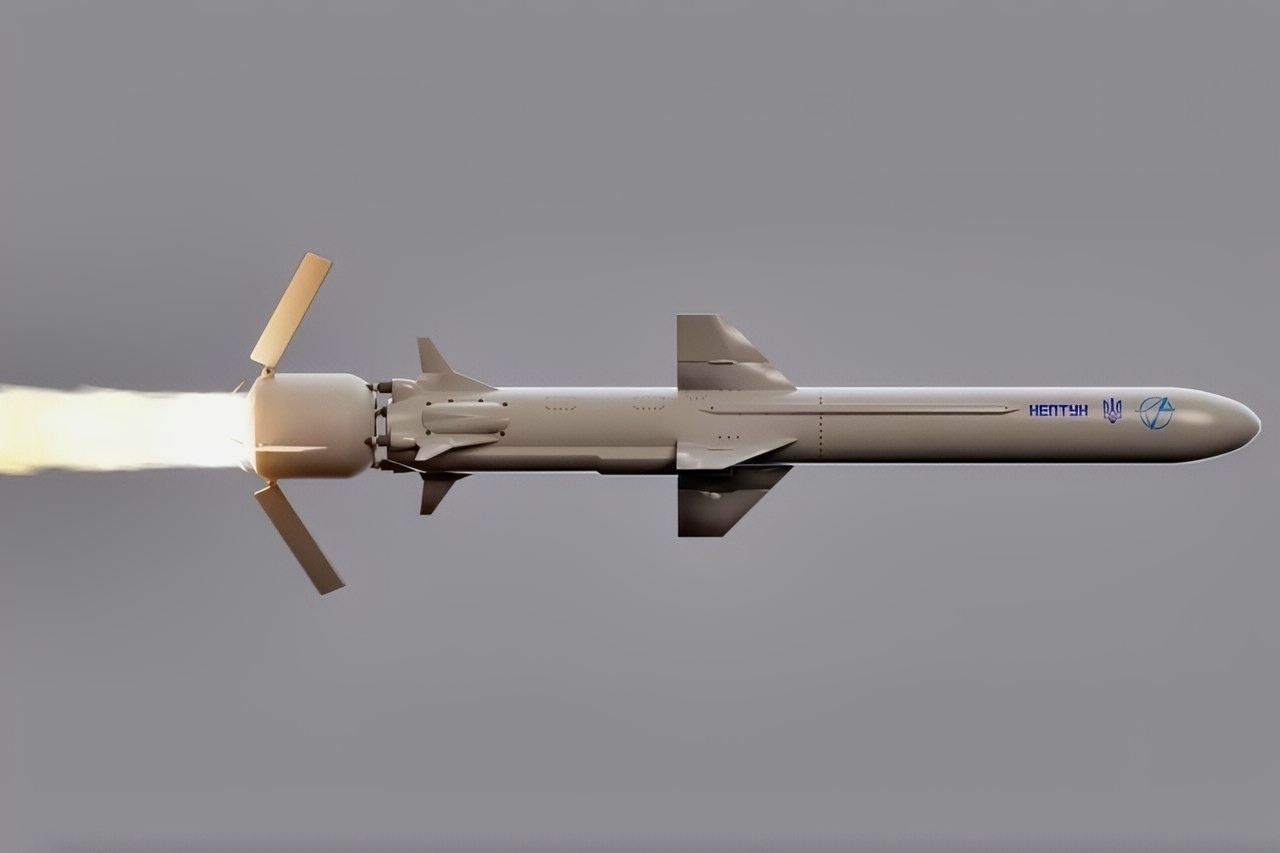
Key Points and Summary – Ukraine has massively upgraded its R-360 Neptune anti-ship missile, famous for sinking the Russian cruiser Moskva.
-The new variant, nicknamed “Long Neptune,” triples the missile’s range to an incredible 1,000km.
-It also features a completely new guidance system, likely using imaging infrared or electro-optical seekers, to effectively strike land targets deep inside Russian territory.
-The upgraded missile has already been successfully used in combat, hitting an oil refinery in Russia’s Krasnodar Oblast, and is expected to enter mass production soon, posing a significant new deep-strike threat to Moscow.
Ukraine’s Neptune Missile Upgrades Explained
Ukraine’s R-360 Neptune missile, responsible for sinking the Russian cruiser Moskva in April 2022, has received a massive upgrade focused on extending its range – and it can now travel three times further than the original model.
The Neptune, designed and developed by the Luch Design Bureau in Kyiv, was built around the Soviet Kh-35 missile and featured upgraded electronics, range, and targeting systems.
When it sank the Moskva during the early days of the Russian invasion, it represented Ukrainian strength amid growing Russian aggression – and it was just one of a series of high-profile Ukrainian strikes against Russian ships during the conflict.
And while the missile was already a significant upgrade over the Kh-35 system which inspired its design, the latest version – officially unveiled by the Ukrainian state – can now reach targets as far away as 1,000km.
According to a report by Defence Express, imagery of the so-called “Long Neptune” missile was released on the state-run “Weapons” Instagram account in a video. The clip, released in celebration of Ukraine’s Independence Day, reveals details about a missile program that became public knowledge in November, 2023. The report notes that the missile is not named in the video, and suggests that it is clearly identifiable by its “folding X-shaped wings.”
In March, 2025, Ukrainian President Volodymyr Zelenskyy confirmed that the missile had completed testing and had already been used in combat.
New Guidance System
On top of its dramatically extended range, analysts suggest that the missile has also been fitted with an entirely new guidance system.
Speaking to the Kyiv Independent, University of Oslo missile researcher Fiabian Hoffman said that the guidance system appears to have been upgraded – replacing its older radar guidance system with something far better suited for a land-based environment.
Hoffman noted that the original version was best suited for targeting large vessels, and that the upgraded model probably uses infrared seeking technology or electro-optical systems.
“You probably want to replace that with something like an imaging infrared seeker or an electro-optical seeker,” Hoffman said.
While official specifications have not been released, the missile is understood to have been used to strike an oil refinery in Russia’s Krasnodar Oblast earlier this year. According to reports by Ukrainska Pravda, the missile successfully struck the facility on March 14, indicating that more advanced guidance systems were installed as part of an effort to strike land targets deeper inside Russian territory.
The missile is expected to enter mass production in the near future.
About the Author:
Jack Buckby is a British author, counter-extremism researcher, and journalist based in New York. Reporting on the U.K., Europe, and the U.S., he works to analyze and understand left-wing and right-wing radicalization, and reports on Western governments’ approaches to the pressing issues of today. His books and research papers explore these themes and propose pragmatic solutions to our increasingly polarized society. His latest book is The Truth Teller: RFK Jr. and the Case for a Post-Partisan Presidency.
More Military
America Almost Had to Invade Japan


