

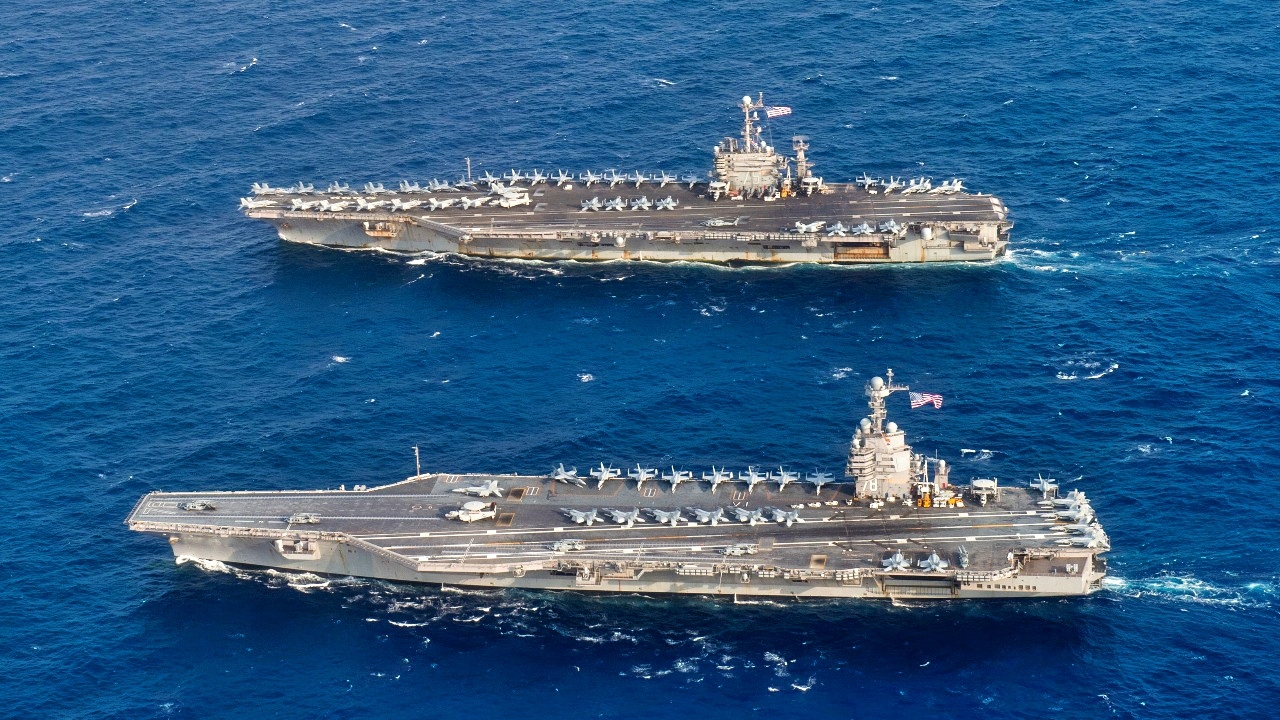
Key Points and Summary – The November 22, 1975, collision between the USS John F. Kennedy aircraft carrier and the guided-missile cruiser USS Belknap stands as one of the worst peacetime disasters in US Navy history.
-Caused by a miscommunicated maneuvering order aboard the Belknap, the collision sparked a catastrophic fire fed by ruptured jet fuel lines.
-The cruiser’s aluminum superstructure melted and collapsed in the intense heat, a vulnerability that led the Navy to favor all-steel construction in subsequent warships.
-The incident killed eight sailors and left the Belknap a gutted wreck, requiring a four-year, multi-million-dollar rebuild.
The Night a US Cruiser Melted: The USS Belknap Disaster
The U.S. Navy has had its fair share of collision incidents, many of which result in only minor damage.
However, on some occasions, naval collisions have resulted in immense structural damage and even worse, loss of life.
The collision between the USS John F. Kennedy (CV-67) and the USS Belknap (CG-26) on November 22, 1975 was one such occasion. As one of the worst peacetime naval incidents in U.S. Navy history, the incident not only resulted in the loss of lives and severe damage to both vessels but also prompted significant changes in naval shipbuilding and operational procedures.
A Naval Aircraft Carrier Collides with a Destroyer
The USS John F. Kennedy was a conventionally powered aircraft carrier, the last of its kind built by the U.S. Navy. Commissioned in 1968 and named after the 35th President of the United States, the Kennedy was a massive vessel designed for launching and recovering aircraft.
At the time of the incident, it was conducting nighttime flight operations, which required it to maintain high speeds (typically around 25 to 30 knots) to generate the necessary wind over the flight deck.
The USS Belknap, on the other hand, was a guided missile cruiser and served as the flagship of the U.S. Sixth Fleet and the first of the Belknap-class cruisers. Originally commissioned as a destroyer leader and later reclassified, the Belknap was equipped with advanced radar and missile systems.
However, it had a critical vulnerability: its superstructure was made of aluminum, a material that would prove disastrous in the fire that followed the collision.
The Incident
On the night of November 22, both ships were engaged in routine operations. The Kennedy was launching and recovering aircraft, while the Belknap was operating nearby, maintaining a parallel course at a distance of about 1,500 yards.
The collision occurred due to a miscommunication on the Belknap’s bridge. The captain intended to slow down and turn to port to pass behind the Kennedy. However, a junior officer misunderstood the order and initiated a hard left turn directly into the carrier’s path.
Despite last-minute evasive maneuvers, the Belknap crossed too close to the Kennedy. The aircraft carrier’s massive steel hull struck the Belknap just aft of its bridge. The Kennedy’s overhanging flight deck sheared into the Belknap’s superstructure, causing catastrophic damage.
The impact ruptured fuel lines aboard the Belknap, and within moments, the ship was engulfed in flames. The aluminum superstructure, unable to withstand the intense heat, melted and collapsed, making firefighting efforts nearly impossible.
Fire on Deck!
The situation quickly escalated. Ammunition aboard the Belknap began to explode due to the heat, sending shrapnel flying across the deck.
The crew fought valiantly to contain the blaze, but the fire raged for over two hours. Nearby ships, including the destroyers USS Claude V. Ricketts and USS Bordelon, rushed to assist.
They used their own fire hoses to douse the flames and helped evacuate the wounded. Ironically, the USS Bordelon would also collide with the USS John F. Kennady less than a year later in 1976.
The human cost was devastating. Seven sailors aboard the Belknap lost their lives, and one sailor aboard the Kennedy also perished. An additional 47 crew members on the Belknap were injured, many suffering from burns and smoke inhalation. The Belknap was left a gutted shell. Its superstructure was nearly destroyed, and the ship was rendered non-seaworthy. The Kennedy, though significantly larger and more robust, also sustained damage to its flight deck and hull but remained operational.
Aftermath and Investigation
The Navy launched a full investigation into the incident. It concluded that the primary cause was human error, specifically the misinterpretation of the captain’s maneuvering orders aboard the Belknap. The incident highlighted the need for clearer communication protocols and better training for bridge personnel.
One of the most significant outcomes of the collision was the reevaluation of shipbuilding materials. The fire demonstrated the vulnerability of aluminum in high-temperature environments.
As a result, the Navy began phasing out aluminum superstructures in favor of steel, which, while heavier, offered far greater resistance to fire and structural collapse.
Despite the extensive damage, the Belknap was not scrapped. Instead, it was towed to the Philadelphia Naval Shipyard, where it underwent a complete rebuild. The reconstruction took nearly four years and cost tens of millions of dollars. The ship was recommissioned in 1980 and continued to serve until its decommissioning in 1995.
The Kennedy, meanwhile, continued its service until 2007. It earned the nickname “The Can Opener” due to the way its flight deck sliced into the Belknap during the collision.
The 1975 collision between the USS John F. Kennedy and the USS Belknap left a lasting impact. The incident led to a number of reforms including improved bridge communication protocols, a reassessment of shipbuilding materials and enhancements in onboard firefighting equipment.
In addition, the Navy implemented training and operational reforms to ensure safer distances and coordination between vessels during nighttime operations.
Despite these reforms, the John F. Kennady collided with a civilian sailing craft in the Persian Gulf in 2004, making it the third and final collision in the carrier’s rich history.
About the Author:
Isaac Seitz, a Defense Columnist, graduated from Patrick Henry College’s Strategic Intelligence and National Security program. He has also studied Russian at Middlebury Language Schools and has worked as an intelligence Analyst in the private sector.
Iran War
30,000 Pound Bunker-Buster Bombs Might Not Be Able to Destroy Fordow


