

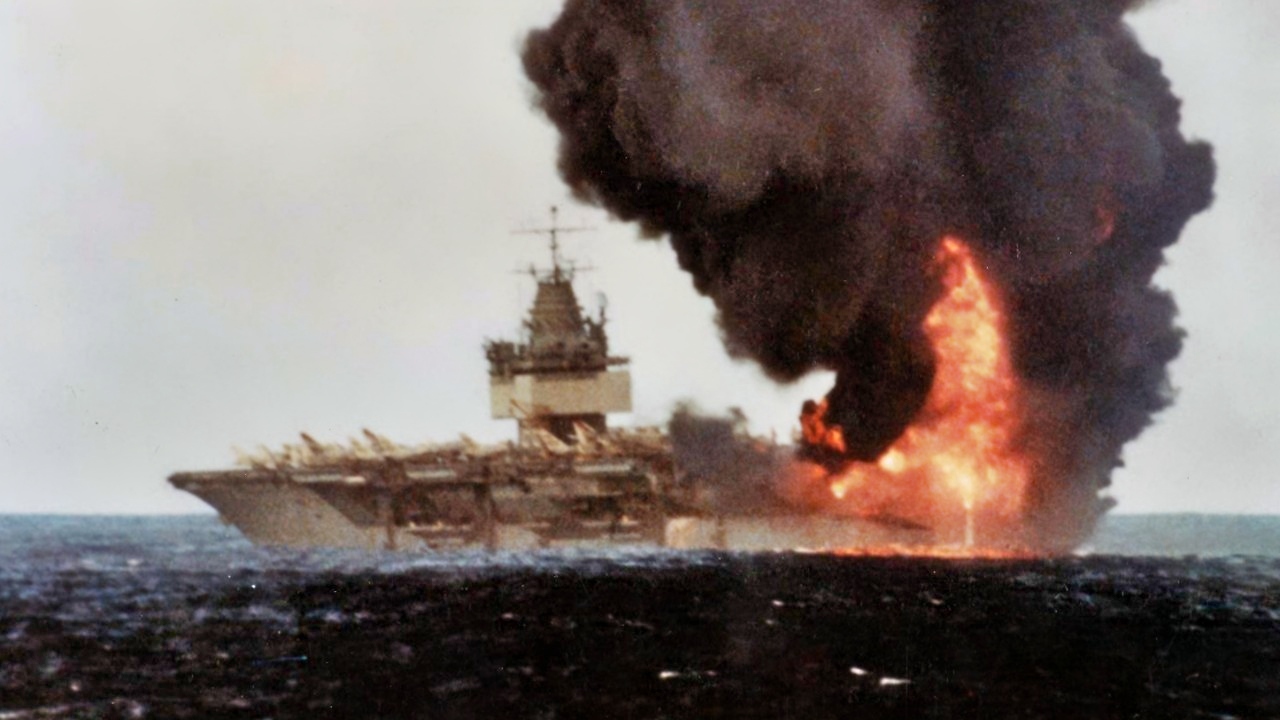
Key Points and Summary – On January 14, 1969, the nuclear-powered aircraft carrier USS Enterprise suffered a catastrophic fire while operating near Hawaii.
-The disaster began when the hot exhaust from a flight deck starter unit caused a Zuni rocket to overheat and explode.
-This triggered a devastating chain reaction of explosions and jet fuel fires that raged across the carrier, killing 28 sailors and injuring 314.
-The heroic efforts of the crew eventually saved the ship. The tragedy, along with other carrier fires of the era, led to a major overhaul of the Navy’s damage control and firefighting procedures.
When the Nuclear Aircraft Carrier USS Enterprise Caught on Fire
In January of 1969, the USS Enterprise—no, not the starship from Star Trek, but rather the aircraft carrier—caught on fire off the coast of Hawaii. As a result of the fire, 28 people died, 314 were injured, and the cost to the Navy was over $126 million.
According to the History Channel, the Enterprise was the first nuclear-powered aircraft carrier when it was launched in 1960.
What Happened That Day
According to the Navy’s Naval History and Heritage Command website, the Enterprise was operating 70 nautical miles southwest of Pearl Harbor. The ship was preparing for a final battle drill before heading to Vietnam for its fourth deployment of the day.
The Enterprise was “preparing for an 0830 launch of six F-4 Phantom II fighters, seven A-7 Corsair II light attack jets, one RA-5C Vigilante photo-reconnaissance aircraft, one EKA-3B tanker, and one E-2A Hawkeye airborne early warning aircraft of Air Wing NINE (CVW-9).”
But shortly before the launch, something went very wrong.
A Chain Reaction
“At 0818, as the Enterprise was commencing a turn to port into the wind, an explosion occurred on the port quarter of the flight deck outside the landing area. An MD-3A aircraft starter unit (“huffer”) had been positioned so that hot exhaust was blowing on the warhead of a MK-32 5-inch Zuni rocket,” the Naval History website said.
“The huffer’s exhaust temperature could reach 590 degrees (F) at a two-foot distance, while only 358 degrees was sufficient to cook off the warhead in about one minute and 18 seconds… When the Zuni warhead exploded, shrapnel perforated the external fuel tanks and ignited a JP-5 fuel fire. About one minute later, the other three Zuni rockets on F-4J No. 105 exploded, blowing holes in the flight deck down which burning JP-5 flowed into the O-3 level.”
As the History Channel story described it, “a MK-32 Zuni rocket that was loaded on an F-4 Phantom jet overheated due to the exhaust from another vehicle. The rocket exploded, triggering a chain reaction of explosions. Fires broke out across the deck of the ship, and when jet fuel flowed into the carrier’s interior, other fires were sparked. Many of the Enterprise’s fire-protection features failed to work properly, but the crew worked heroically and tirelessly to extinguish the fire.”
It was one of three big fires of U.S. aircraft carriers in the 1960s, following those of the USS Oriskany in 1966 and the USS Forrestal in 1967.
“The combined lessons learned from the fires on Forrestal and Enterprise were extensive, resulting in a major overhaul of carrier damage control and firefighting. Although there have been other fires on aircraft carriers, Enterprise was the last major conflagration,” the Naval History website said.
The End of the Enterprise
The ship was repaired within months and returned to service. The Enterprise continued in service for several more decades, serving in various wars, and it was decommissioned in 2012.
Back in June, the Navy awarded a $536 million contract to dismantle the USS Enterprise. NorthStar Maritime Dismantlement Services LLC was awarded the contract, described by The Aviationist as “a significant turning point in naval logistics, legacy management, and nuclear decommissioning strategy.”
“Under the new firm-fixed-price contract, CVN 65 will be completely dismantled in Mobile, Alabama, where NorthStar will carry out the work in partnership with Modern American Recycling and Radiological Services (MARRS). The project is expected to be completed by November 2029. Waste Control Specialists, based in Andrews, Texas, will handle the disposal of low-level radioactive and mixed hazardous waste. At the same time, all other materials will be recycled or safely discarded in compliance with relevant environmental regulations.”
Remembering the Heroes
In 2009, for the 40th anniversary of the tragedy, the Museum of Flight in Seattle honored the dead and hosted a panel of survivors.
About the Author: Stephen Silver
Stephen Silver is an award-winning journalist, essayist, and film critic, and contributor to the Philadelphia Inquirer, the Jewish Telegraphic Agency, Broad Street Review, and Splice Today. The co-founder of the Philadelphia Film Critics Circle, Stephen lives in suburban Philadelphia with his wife and two sons. For over a decade, Stephen has authored thousands of articles that focus on politics, national security, technology, and the economy. Follow him on X (formerly Twitter) at @StephenSilver, and subscribe to his Substack newsletter.
More Military
France Just Won a Dogfight Against the F-35 Fighter
Russia Has Titanium Submarines, the U.S. Navy Can’t Match Them


