

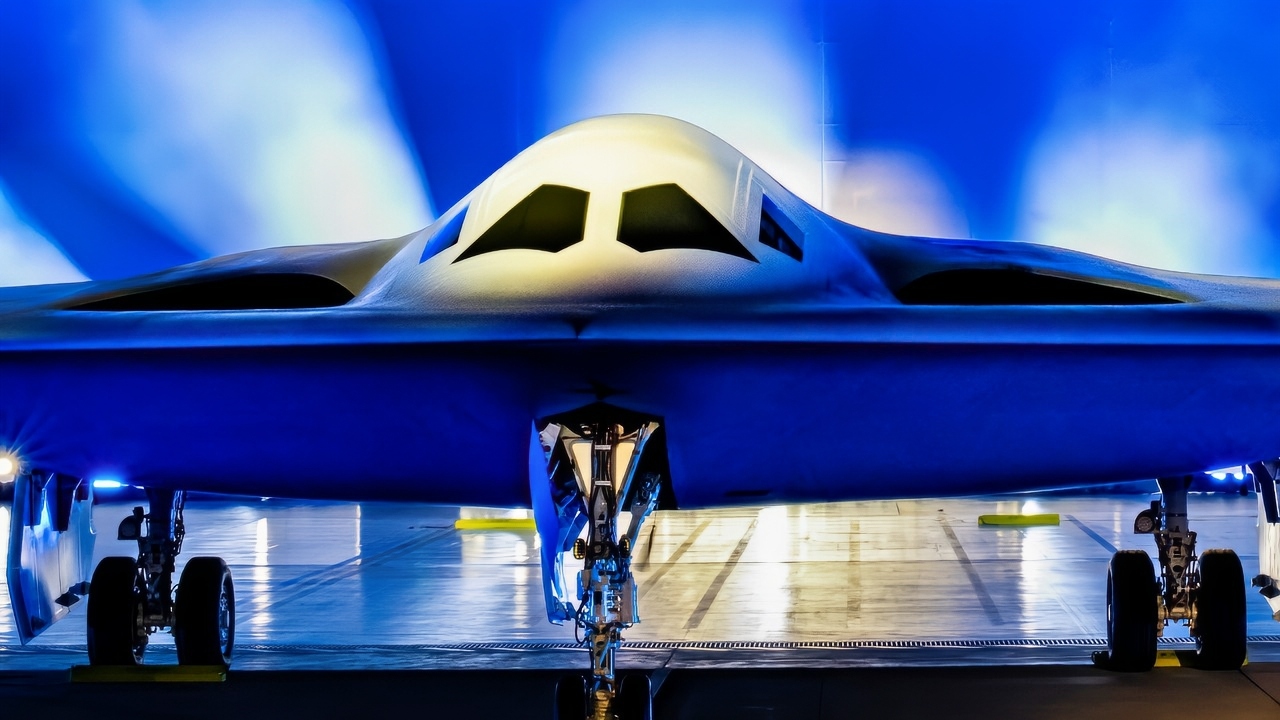
Key Points and Summary – Contrary to speculation that new technologies like drones and AI will render the B-21 Raider obsolete upon arrival, its core mission extends far beyond a traditional bomber.
-The B-21 is designed as a survivable, flying command-and-control “node,” leveraging its advanced stealth to gather and process critical battlefield data from deep inside enemy territory.
-Crucially, it retains the irreplaceable element of human cognition for high-stakes decision-making.
-Instead of being replaced by drones, the B-21 is being built to command them, ensuring its relevance as a central, thinking asset in modern multi-domain warfare.
B-21 Raider: Far More Than a Bomber?
The emerging “black” B-21 Raider next-generation bomber purportedly advances a series of next-generation technologies; however, there has been nothing short of a technological explosion since the new bomber was first designed.
Breakthroughs in AI and unmanned systems might lead some to speculate that new developments will render elements of the B-21 obsolete upon arrival. Overall, the program aims to determine whether newly arriving technology renders the platform obsolete.
The idea, suggested by some, that the arrival of new stealth drone technology, AI, and long-range sensing capabilities might render the B-21 obsolete raises interesting questions about the mysterious technological elements of the B-21.
New Stealth Paradigm
There are several key reasons why the B-21 is unlikely to be obsolete in any respect, given the limited information available about the platform.
Not only does the B-21 purportedly contain an entirely new generation of stealth technologies, according to credible senior leaders of the US Air Force, but its mission scope also far exceeds that of a traditional bomber.
Historically, stealth bombers have been regarded as platforms capable of delivering ordnance undetected above enemy territory, enabling them to pinpoint high-value targets such as air defenses. This capability is designed to create a safer “air corridor” through which 4th- and 5th-generation attack aircraft can travel to conduct attacks.
Of course, platforms like the B-2 do operate with some advanced sensing and command and control, particularly in more recent years, given the scope of upgrades to the platform. However, the emerging B-21 is known to incorporate a new generation of computing, sensing, and command and control technology.
This reality enables the platform to function as an unprecedented flying sensing “node” in the sky, capable of gathering, analyzing, and transmitting high volumes of time-sensitive information in combat. In essence, the platform is intended to operate as a flying “command and control” center as well as a bomb-attack aircraft.
B-21 Raider Bomer As “Sensor”
Senior Air Force and Pentagon leaders have been clear that the B-21 will not only be capable of unmanned missions, but perhaps of greater importance, it will also control groups of drones from the air.
This means that the Air Force will operate with a stealthy, flying command and control platform capable of gathering, organizing, and disseminating highly critical information across multiple domains and platforms in a major combat operation.
While there are command and control and sensing aircraft, such as an E2-D Hawkeye or P-8 Poseidon sub-hunting aircraft, there does not appear to be a comparable “manned,” “stealthy” airborne command and control capability apart from what F-35s, F-22s, or drones might offer.
Therefore, a stealthy B-21 equipped with advanced computing, data analysis, sensing, and networking technology would undoubtedly introduce a new generation of secure, more survivable multi-domain combat connectivity than currently exists in war.
While unmanned systems could potentially be engineered to operate with these kinds of technologies, there is no substitute for having a “manned” platform operate in a multi-domain command and control capacity.
Perhaps a high-altitude, undetected B-21 could receive ballistic missile threat information from a US Navy warship’s Aegis radar and be in position to quickly analyze the threat data and transmit critical details to ground or surface-based defenses and interceptors?
Perhaps forward-operating drones could detect threats to an armored convoy moving into contact with an enemy and quickly relay data to an airborne, manned command and control center, capable of making quick decisions to intervene.
Need For “Humans”
Mathematically determined computer algorithms would seem challenged to replicate the kinds of unique, yet more subjective, faculties fundamental to human cognition; therefore, a forward operating command and control stealthy “drone” would likely be ill-equipped to perform combat decision-making in a manner comparable to what human pilots can do. Essentially, human decision-making is believed to offer an irreplaceable space in combat decision-making.
This is why the most cutting-edge Pentagon thinking suggests that the optimal approach to utilizing autonomy and AI in combat requires a combination of humans and machines.
Human-Machine Interface, as it is called, remains center stage in the realm of Pentagon thinking about how best to leverage AI, autonomy, and unmanned technology as they surge into the future. Humans need to perform critical command and control functions, which even the most advanced AI-enabled drones might be ill-suited to perform.
This means a stealthy B-21 able to perform high-altitude command and control with “human” crews would seem to offer a unique and unparalleled advantage. It does not appear that anything similar to this exists, so the idea that a B-21 would be obsolete seems unlikely, if not entirely inaccurate.
About the Author: Kris Obsorn
Kris Osborn is the President of Warrior Maven – Center for Military Modernization. Osborn previously served at the Pentagon as a highly qualified expert in the Office of the Assistant Secretary of the Army—Acquisition, Logistics & Technology. Osborn has also worked as an anchor and on-air military specialist at national TV networks. He has appeared as a guest military expert on Fox News, MSNBC, The Military Channel, and The History Channel. He also has a Masters Degree in Comparative Literature from Columbia University.
More Military
F-20 Tigershark: The Best Fighter Jet You Never Heard Of


Vegeta
August 28, 2025 at 6:45 pm
I read your article about the future war with China and the need for the United States to obtain more F-47 aircraft to ensure the crushing of any force that stands in the way of the American tyranny, but I will tell you something, in the event of a major war, do you think that you will only confront China? No, my friend, you will confront every country that you have destroyed and are still continuing with your foolishness… Your fate is like any tyrannical country, it will be destroyed in the end, no matter how tyrannical and oppressive you are. You will be humiliated in the end, as happened in Vietnam, Afghanistan, Somalia, etc…. You have become hated by most peoples, except for the scum of humanity who follow you… They will never forgive you for what you did to their countries and people, and you will soon drink from the same cup. You will remember my words one day, but after it is too late.