

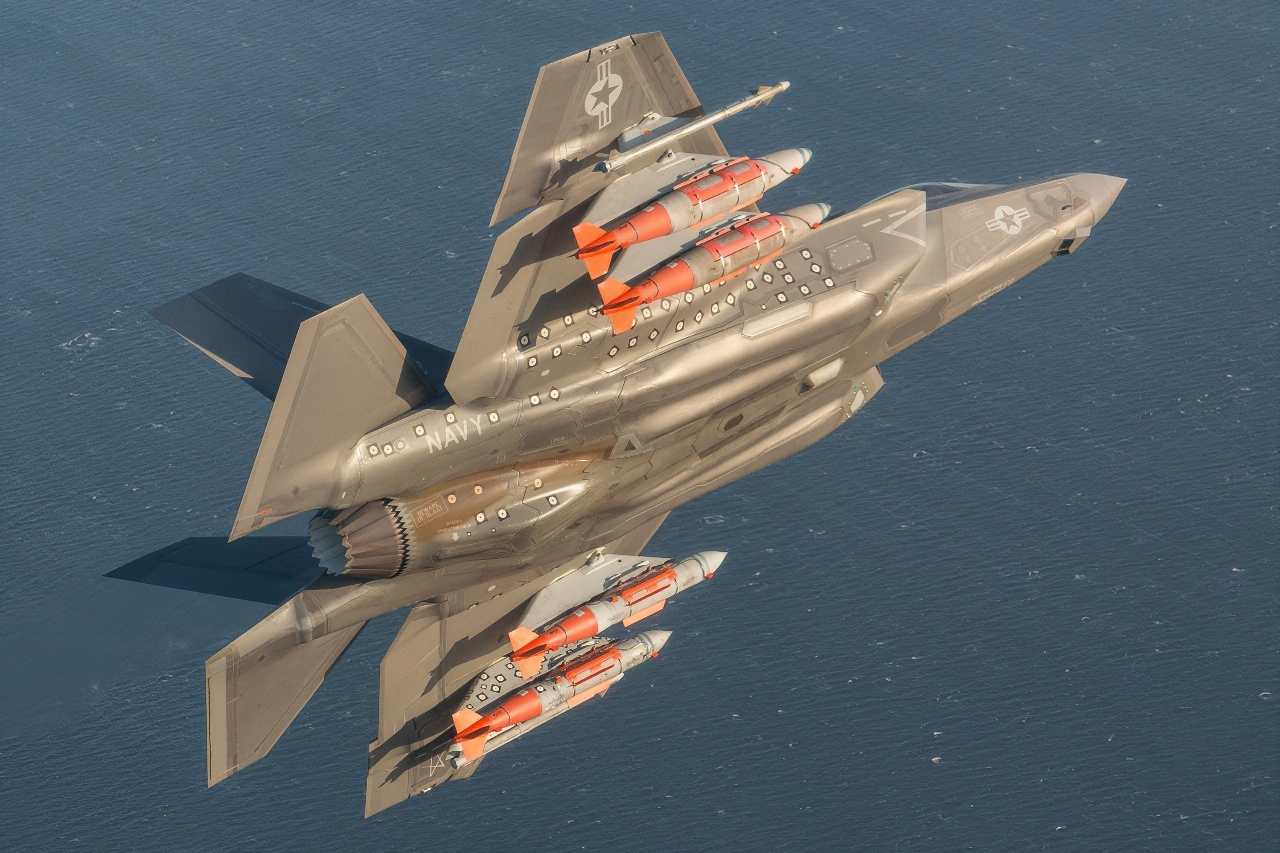
Key Points and Summary – A French Air Force video showing a Dassault Rafale achieving a simulated “kill” against a U.S. F-35A during a multinational exercise has sparked intense debate.
-The stunning footage from a close-range dogfight showed the 4th-generation Rafale gaining a missile lock on the 5th-generation stealth fighter.
-While impressive, experts caution against drawing broad conclusions from the engagement.
-The F-35 is designed primarily for beyond-visual-range combat, where its stealth and advanced sensors give it a decisive advantage not applicable in a close-in, visual-range fight, a scenario where the agile Rafale excels.
French Rafale Pilot “Kills” and American F-35 In Exercise
Should we be shocked or just chalk this up as a fluke? I’m referring to a recent military exercise in which a French Dassault Rafale “shot down” an American F-35A Lightning II. The surprising 44-second video clip clearly shows a Rafale getting missile lock on the Lightning II that granted it a virtual “kill.”
It happened during Exercise Trident Atlantic 25 over Finland. The French Air and Space Force released the video. The fourth-generation “+” Rafale overtook the fifth-generation F-35A in a stunning maneuver that undoubtedly surprised the American pilot. The exercise included forces from Finland, France, the United Kingdom, and the United States. The drills were held in June, but the French released the shoot-down footage on August 20.
F-35 Lost: What Happened During This Dogfight?
The India Times had a detailed description of the incident. “The video starts with a Rafale taking off and a few second later shows a F-35 jet passing it. The Rafale pilot is then seen trying to lock on to the F-35 and at exactly 15 seconds of the video, the French fighter’s radar paints the American stealth fighter. An audio ‘take the shot’ is then heard, indicating the Rafale firing its missile in the mock dogfight to take down the F-35,” the Indian news outlet wrote.
The French Were Flexing Aerial Muscles
That’s not all. The French aviator was having a splendid day. The same Rafale also took on a Finnish F/A-18 Hornet. The Rafale locked on to the Hornet twice, giving the French pilot another two notional kills.
This was Finland’s first big NATO exercise since the country became an alliance member in 2023. Finland held the war games at its Rovaniemi Air Base. The Finns wanted to work on “Agile Combat Employment” that focused on interoperability, maintenance crew activities, and competitions between friendly and aggressor warplanes.
Beyond F-35: A Diverse Range of Aircraft Took Part
There was an E-3F Sentry AWACS aircraft that allowed the airplanes to gain experience flying with an airborne command and control bird. A French tanker was there to refuel the fighter jets in the air. The British used Royal Air Force Eurofighter Typhoons. The Americans also flew F-15E Strike Eagles. The exercise involved more than 30 aircraft and approximately 1,000 military personnel.
What’s New With the Dassault Rafale Fighter?
The Rafale has undergone a transformation since 2009, when it also had an aerial “kill” against an American F-22. The Rafale now features a Safran M88 T-REX engine, which generates more thrust, speed, and acceleration. Thrust has been improved by 20 percent to nine metric tons.
The Rafale features conformal fuel tanks, which provide it with increased fuel capacity and range. This allows for the addition of munitions such as the MBDA Meteor missile. These changes make it one of the best fighters in Europe.
The Rafale is popular on the export market with sales to Serbia and Greece for a total of 24 French fighters. Colombia and Peru also have 24 Rafales. The Indian Air Force and Navy fly the French fighter, and there are over 100 in the Middle East countries.
The updated Rafale features an improved airflow intake with a high-pressure turbine and a redesigned nozzle section and cooling circuits. This has created an unparalleled level of performance.
The Rafale usually carries six air-to-air missiles, but the new modifications could allow it to deploy eight projectiles. The French can also choose to launch four beyond-visual-range MBDA Meteor missiles instead.
The Rafale Is the Pride and Joy of the French Air Force
The Rafale is the “flagship” of the French air force. It has demonstrated ample air superiority capabilities and can also conduct ground strike operations. The airplane has displayed its excellent dogfighting capability.
What I love about the Rafale is its “omni-role” capability. This means it can toggle between mission sets during a sortie. If it starts in air policing or dogfighting mode, it can switch to surface attacks within the same mission. That versatility will be crucial in the future for the French as they prepare for a potential NATO operation against Russia. The Rafale can be a “strike force” or a “show of force,” according to the airplane’s corporate website.
The Rafale is now flying with a considerable reputation boost, and that is good news for France and the other countries that fly the warbird. It is not stealth, but it has the fourth-generation designation, marked by a “+” or even “++”.
What about the stealthiness of the F-35? Something went wrong during the confrontation between the Rafale and the Lightning II. The Rafale’s sensors were working diligently, and perhaps the F-35’s radar-evading characteristics are not as impressive as they are made out to be. To be sure, this could be just an example of the F-35 pilot having a bad day.
To make a complete comparison with the F-35 and Rafale, the pilots would need to conduct several head-to-head flights. One “kill” does not make for a troubling trend. However, the French should be given credit for improving the Rafale and flying it to perfection.
So let’s not get carried away, but the Americans are likely conducting an extensive after-action report. Was this a pilot error or a deficiency in the airplane? Or a more troubling question – are there problems with the effectiveness of the radar absorbent coatings? Unfortunately for us, the US Air Force will not make the answers publicly available, but you can be certain that Americans are concerned. That’s fine with the Franch as there were probably some high fives going on when the winning Rafale landed, and that celebration probably culminated in some extensive wine or beer drinking the night after winning the war drill.
About the Author: Brent M. Eastwood
Brent M. Eastwood, PhD is the author of Don’t Turn Your Back On the World: a Conservative Foreign Policy and Humans, Machines, and Data: Future Trends in Warfare plus two other books. Brent was the founder and CEO of a tech firm that predicted world events using artificial intelligence. He served as a legislative fellow for US Senator Tim Scott and advised the senator on defense and foreign policy issues. He has taught at American University, George Washington University, and George Mason University. Brent is a former US Army Infantry officer. He can be followed on X @BMEastwood.
More Military
Russia Has Titanium Submarines, the U.S. Navy Can’t Match Them


Rodger
August 28, 2025 at 8:08 am
It’s my understanding that the F35’s least stealthy view is from the rear where it’s RCS is the greatest. It’s not designed to be involved in close encounters and is known not to be dominant in dogfighting situations. I guess there are too many compromises in the plane’s design for it to be the best at everything it does. It was a simulated kill. In reality, could the F35 have evaded the missile with appropriate counter measures. Could the missile have maintained the lock and actually taken down the plane. And should the F35 have found itself in this situation to begin with (possible pilot error).