

Key Points and Summary – Drawing on a legacy that began with the Saab 32 Lansen, Sweden now offers a sovereign, exportable strike and electronic warfare package just as demand surges.
-Europe is quietly shifting from relying on American airpower to building its own long-range strike punch—and Sweden is right at the center of that turn.

JAS 39 Gripen over the Ocean. Image Credit: Creative Commons.
-Stockholm has formally requested missiles with 2,000km reach while Saab upgrades its Gripen E to haul modern stand-off weapons and EW pods.
-In parallel, NATO states are pursuing the European Long-Range Strike Approach (ELSA) to field homegrown cruise missiles that can hit deep into hostile territory.
The Saab 32 Helped Sweden Become a Defense and Fighter Powerhouse
The F-35 is no longer Europe’s fighter darling, and nations on the continent are looking at other options. Sweden has big dreams of filling orders to replace the Lighting II. That might mean big JAS 39 Gripen fighter sales. Maybe.
And that’s not all.
Europe is pouring serious resources into its long-range strike capabilities, spanning operational planning and procurement – and much of the rest of the world is doing the same.
In November 2025, the armed forces of Sweden formally requested long-range weapon systems capable of striking deep inside foreign territory, with ranges of up to 2,000 km – far beyond traditional short-range munitions.

U.S. Air Force Maj. Melanie “Mach” Kluesner, pilot of the F-35A Demonstration Team, performs aerial maneuvers at the Sun ‘n Fun Airshow in Lakeland, Florida, April 1, 2025. The team travels across the country to demonstrate the unmatched capabilities of the F-35A Lightning II and highlight the skill of U.S. Air Force pilots. (U.S. Air Force photo by Senior Airman Nicholas Rupiper)
At the same time, several NATO countries (notably Denmark) have also begun integrating long-range precision weapons into their force structure, reflecting a continent-wide shift towards deterrence via strike power.
Sweden’s domestic defense industry giant Saab is also ramping up delivery of its Gripen E jets, and recently received a new order for a launch-system upgrade to ensure Gripen C/D and E can carry modern air-to-air missiles and countermeasure pods.
It should be abundantly clear by now that Europe is increasingly willing to invest in deep strike and stand-off capabilities as the geopolitical environment changes and the world’s largest superpowers increasingly flex their muscles – and once again, Sweden is at the forefront of modern aircraft development to support these efforts.
How Saab 32 Paved the Way
Understanding why Sweden and Saab are so well placed to lead this resurgence in strike power starts with its aviation history, specifically, the Saab 32 Lansen.
Introduced in the 1950s and 1960s, the Lansen was Sweden’s first purpose-built strike aircraft.
Rather than relying on foreign powers for long-range strike capability, Sweden built its own.
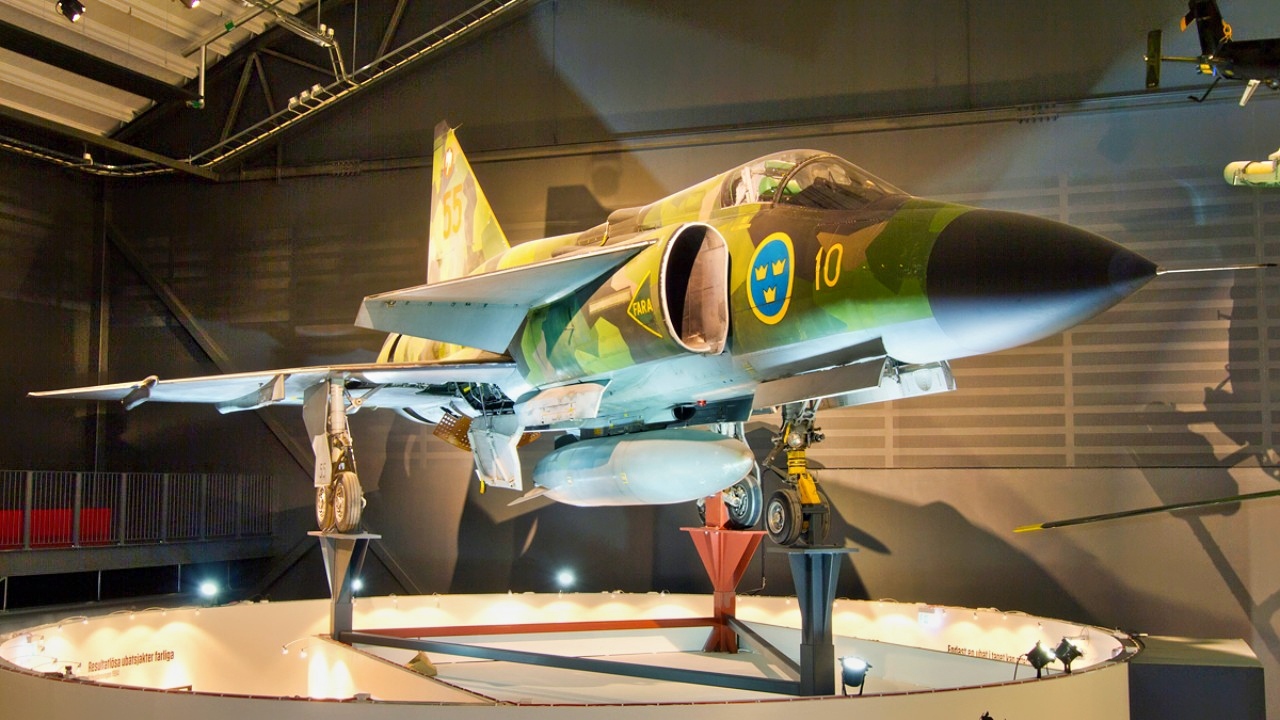
Saab 37 Viggen Fighter. Image Credit: Creative Commons.
Notably, the Saab 32 line included an electronic-warfare variant (J 32E) that was decades ahead of its time in terms of capability.
For Sweden, electronic warfare (EW) was not an afterthought, either – it was part of the aircraft’s strike philosophy from the very beginning.
Moreover, the Saab 32 fully reflected Sweden’s conception of what a “multirole” platform should be: an aircraft capable of reconnaissance, EW, and strike, tailored to individual mission requirements.
That DNA can be seen in designs from decades later, including the Gripen – a cheap and convenient fighter designed to stand up to top-tier threats without the industrial weight of heavy air forces.
It’s an accessible, modern fighter that is increasingly becoming an alternative for nations reluctant to spend big bucks on American systems like the F-35 and, as a result, get locked into foreign systems and logistics.
Why the Renewed Drive for Long-Range Strike?
Multiple factors are driving the renewed push for long-range strike across Europe, but it’s in large part a result of pressure from Russia’s war in Ukraine – and the lessons that have been learned in the process.
The invasion of Ukraine triggered what could be described as a wake-up call across Europe: ground-launched cruise missiles, long-range drones, and deep-strike tactics used by Russian forces have exposed major capability gaps across even some of the most powerful European militaries. Without American support, those capability gaps could prove fatal.
In response, a coalition of countries – including France, Germany, Italy, and Poland – all signed a letter of intent in mid-2024 to jointly develop ground-launched cruise missiles with ranges well beyond 500 km to fill the gap.
That effort has been formalized under the European Long-Range Strike Approach (ELSA) plan, which aims to coordinate deep-precision strike development across multiple NATO states.
All the while, Sweden continues building its own defense capabilities, requesting in 2025 missile systems capable of 2,000 km strike capability. In other words, Sweden wants the capability to strike Russia, and these developments should tell us this: the threshold of acceptable reach has dramatically shifted.

A Swedish Air Force JAS 39 Gripen participating in NATO exercise Ramstein Flag 24 flies over the west coast of Greece, Oct. 4, 2024. Over 130 fighter and enabler aircraft from Greece, Canada, France, Hungary, Italy, Poland, Portugal, Romania, Spain, Sweden, United Kingdom and United States are training side by side to improve tactics and foster more robust integration, demonstrating NATO’s resolve, commitment and ability to deter potential adversaries and defend the Alliance. (U.S. Air Force photo by Tech. Sgt. Emili Koonce)
And not only has acceptable reach shifted, so has Europe’s attitude to long-range strike. Specifically, Europe once saw this capability as the domain of superpowers, relying on the likes of the United States for it.
Today, that assumption is changing. ELSA aims to deliver European-made long-range strike options, reducing dependence on non-European suppliers – including the United States.
For Saab and Sweden, this environment presents an opportunity: they already have a solid legacy of designing multirole strike and EW aircraft, and the Gripen E’s recent upgrades – including new launch systems – are being fielded just as demand spikes.
Sweden Is Ready
Sweden is ready to deliver. Its commitment to autonomous strike and EW capability never really disappeared, either – it just changed.
Where Saab 32 represented the post-war vision of Swedish strategic independence, the Gripen E is the 21st-century embodiment of that same idea.
It’s a multirole, exportable system designed to thrive in a new European security environment that is increasingly focused on deep-strike, deterrence, and electronic warfare.
That’s why Saab isn’t just maintaining old capabilities, but introducing new ones with the Gripen’s brand new launch system. Saab is future-proofing and investing in flexibility.
As Europe moves to adopt new ground-launched cruise missiles and long-range strike capabilities, the Gripen E, with its multirole architecture and modern EW suite, offers a ready-made aerial component to that strategy.
And the orders are already coming in.
About the Author:
Jack Buckby is a British author, counter-extremism researcher, and journalist based in New York who writes frequently for National Security Journal. Reporting on the U.K., Europe, and the U.S., he works to analyze and understand left-wing and right-wing radicalization, and reports on Western governments’ approaches to the pressing issues of today. His books and research papers explore these themes and propose pragmatic solutions to our increasingly polarized society. His latest book is The Truth Teller: RFK Jr. and the Case for a Post-Partisan Presidency.
More Military
The Army’s AH-64E Apache Helicopter Can Destroy Drones with Missiles
U.S. Navy Iowa-Class Battleship USS New Jersey’s ‘Comeback’ Is Now Complete
Blaze of Glory: The SR-71 Blackbird Retired Hitting Mach 3.21


Mats Croon
December 2, 2025 at 9:44 am
Interesting read! Thank you.
/A swedish dude
Oli
December 4, 2025 at 3:26 am
Super