


Article Summary – Canada’s decision to revisit its original plan to buy 88 F-35s has thrust Sweden’s Saab JAS 39 Gripen back into the spotlight.
-On paper, Gripen E/F offers agility, modular avionics, and sovereignty-friendly open architecture—an appealing contrast to the tightly controlled, U.S.-centric F-35 ecosystem.

JAS 39 Gripen. Image Credit: Creative Commons.

JAS 39 Gripen over the Ocean. Image Credit: Creative Commons.
-But once export prices, support, and economies of scale are factored in, Gripen is not dramatically cheaper, and it cannot match the F-35’s deep sensor fusion, stealth, and integrated electronic warfare.
-The result: while Gripen offers flexibility and political independence, the F-35 remains the clearly superior combat system—and the “cheap alternative” narrative is mostly myth.
Why the Saab JAS 39 Gripen Isn’t Really a “Cheap F-35” for Canada
In the 2010s, Canada originally made a deal with the U.S. to acquire 88 aircraft to replace its aging fleet of CF-18s.
Since President Trump’s second term, however, Canada has been strongly reconsidering this deal and is looking to buy other foreign jets.
One such fighter under consideration is the Saab JAS 39 Gripen.
The JAS 39 has garnered a lot of attention recently due to heavy marketing by Saab and notable successes in international markets. But is it good enough to replace the F-35?
The Gripen vs the F-35
The Gripen E/F belongs to the 4.5-generation category, emphasizing affordability, agility, and rapid upgrade cycles. Saab designed it with modularity and open architecture in mind, allowing operators to integrate new sensors and weapons without being locked into proprietary systems.
This approach prioritizes cost-effectiveness and sovereignty, making Gripen attractive to smaller air forces that need advanced capabilities without the logistical burden of fifth-generation jets.
The F-35, on the other hand, is a fifth-generation stealth fighter built around low observability, deep sensor fusion, and network-centric warfare.
Its avionics are often described as some of the most advanced in the world, and for good reason.
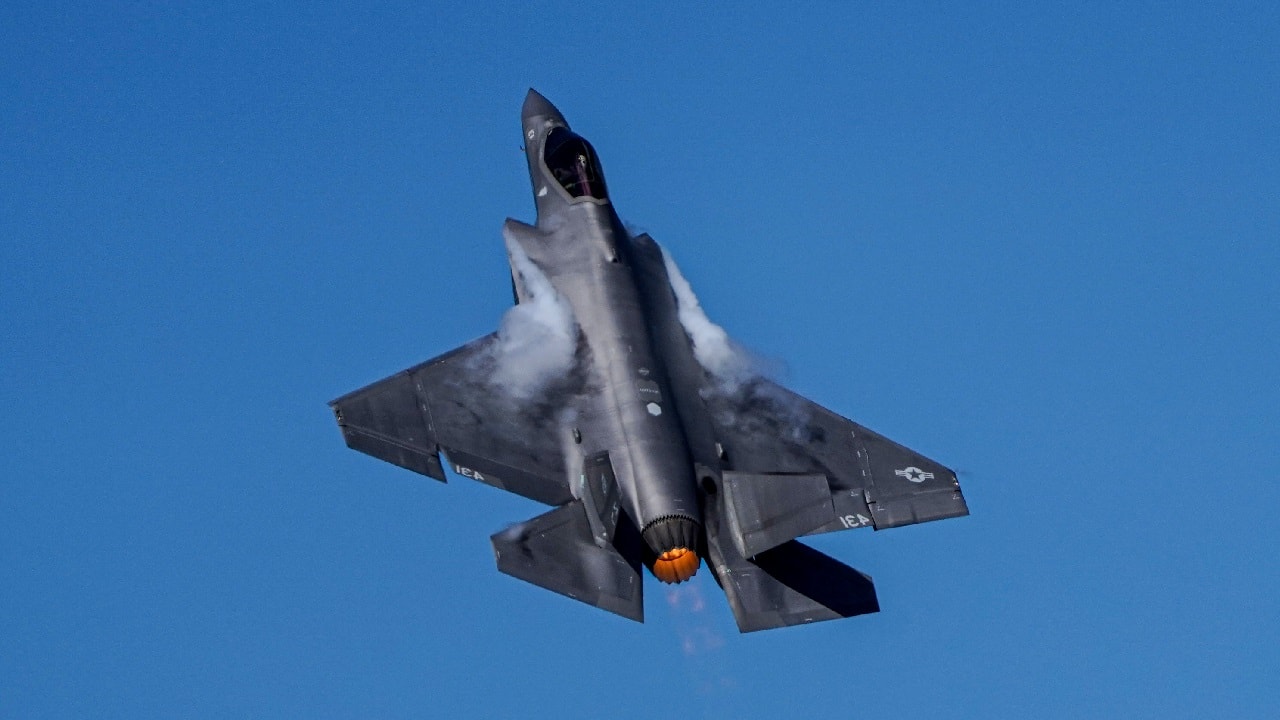
F-35 Fighter Heading Into the Sky. Image Credit: Creative Commons.

A U.S. Air Force F-35 Lightning II assigned to the 56th Fighter Wing, Luke Air Force Base, Arizona, performs a strafing run during Haboob Havoc 2024, April 24, 2024, at Barry M. Goldwater Range, Arizona. Haboob Havoc is an annual total force exercise that brings together multiple fighter squadrons from numerous bases to practice skills and test abilities in various mission sets. (U.S. Air Force photo by Staff Sgt. Noah D. Coger)
The F-35 was designed from the ground up to integrate sensors, electronic warfare, and communications into a single, coherent system that supports stealth penetration of highly defended airspace. This makes its avionics architecture far more monolithic and deeply integrated than Gripen’s modular approach.
Avionics: Where the F-35 Shines
When comparing radar and sensor suites, the Gripen E/F uses the ES-05 Raven AESA radar mounted on a swashplate, which provides a wide field of regard of up to ±100 degrees.
This design allows the aircraft to track multiple targets without maneuvering aggressively. Saab is also introducing Gallium Nitride technology for improved power efficiency and jamming resistance.
In addition to radar, Gripen features the Skyward-G infrared search-and-track system for passive detection of stealthy or non-emitting targets.
Its electronic warfare suite includes digital RF memory-based jamming, missile approach warning, and expendable decoys, while the Arexis EW system leverages GaN transmit/receive modules for high-power jamming.
Networking capabilities include Tactical Data Links and Link 16, enabling cooperative engagement and silent networking across dispersed units.
The system integrates radar, IRST, EW, and datalink inputs into a fused tactical picture, but this fusion occurs at the mission level rather than being deeply embedded within the aircraft’s core systems.
The F-35’s sensor suite is far more advanced and much better integrated. Its AN/APG-81 AESA radar offers long-range detection, synthetic aperture mapping, and electronic attack modes, with future upgrades moving to the AN/APG-85.
The Electro-Optical Targeting System provides stealth-compatible precision strike capability.
At the same time, the Distributed Aperture System uses six infrared sensors to deliver accurate 360-degree coverage, missile warning, and night vision projected onto the pilot’s helmet.
The AN/ASQ-239 electronic warfare system delivers 360-degree threat warning, geolocation, and electronic attack, fully integrated with radar and DAS for real-time response.
Communications include the Multifunction Advanced Data Link for stealthy intra-flight communication and Link 16 for broader interoperability.
Unlike Gripen, the F-35 combines radar, EW, DAS, and EOTS into a single, coherent picture displayed on a panoramic cockpit display and the Gen III helmet.
This fusion is platform-level, meaning that every sensor feeds into a single integrated system rather than separate stovepipes.
EW and Sensor Fusion
The Jas 39 is equipped with a GaN-based jamming, DRFM techniques, and expendable decoys. It is designed for electromagnetic spectrum dominance in contested environments, leveraging AI-assisted threat analysis.
Saab has even demonstrated AI-controlled Gripen E flights, showing adaptive engagement strategies and hinting at future autonomy in EW.
The F-35’s AN/ASQ-239 EW suite is fully integrated with the aircraft’s stealth and sensor fusion systems, providing precise emitter geolocation, electronic attack, and self-protection while maintaining low observability.
For the F-35, EW is treated as a primary sensor, feeding into the fused picture for both defensive and offensive operations.
Both aircraft incorporate some form of sensor fusion. The JAS 39 uses a Wide Area Display and advanced Human-Machine Collaboration to simplify the pilot workload. Its sensor fusion is robust but mission-level, integrating onboard and networked inputs without the same depth of internal coupling as the F-35.
Open architecture allows rapid software updates and third-party integration, giving operators sovereignty and flexibility. The F-35’s fusion is platform-level and real-time, combining radar, EW, DAS, and EOTS into a single picture.
The helmet-mounted display projects 360-degree imagery from DAS, eliminating blind spots and enabling passive tracking. Tech Refresh 3 and Block 4 upgrades will add more processing power, new weapons, and advanced radar modes, ensuring future-proofing.
Is the Gripen Really a Cheaper Alternative
Saab has often marketed the Gripen as a low-cost alternative to the F-35, but there are a couple of nuances worth noting. First off, recent export orders of the JAS 39 show that it is not, in fact, much cheaper than the F-35.
According to the contract signed with Columbia, the aircraft cost around $297 million per aircraft as opposed to the $203 million that the Czech Republic paid for its jets (these costs include offset support). Second, the F-35 benefits from economies of scale.
Because the F-35 has had so much international success, its broad production has helped offset its massive costs and lowered its price. The JAS 39, on the other hand, does not enjoy such an advantage.
So, which aircraft has better avionics and electronics overall?
The F-35 Lightning II is the clear winner in terms of absolute capability. Its deep sensor fusion and stealth synergy, DAS and panoramic cockpit display for unmatched situational awareness, integrated EW as a primary sensor, and advanced networking for joint operations set it apart.
The Gripen E/F offers a more modular option with more control, but let’s face it: everything the Gripen does, the F-35 can do, but much better.
Even the myth about it being a more cost-effective alternative is largely untrue.
About the Author: Isaac Seitz
Isaac Seitz, a Defense Columnist, graduated from Patrick Henry College’s Strategic Intelligence and National Security program. He has also studied Russian at Middlebury Language Schools and has worked as an intelligence Analyst in the private sector.
More Military
The F-35 Fighter Is In More Trouble Than You Think
Was USS Wasp Really the Worst U.S. Navy Aircraft Carrier?
The Navy Had a Nuclear Submarine That Could Tap Russia’s Undersea Cables and Self Destruct
The U.S. Navy’s Flying Aircraft Carrier Mistake Still Stings


Pierre
November 26, 2025 at 4:29 pm
Well, perhaps but at the end of the day, the Gripen frees the client from being under the thumb of the U.S. government.
Keith Rosenfeld
November 26, 2025 at 4:37 pm
Thanks for your article. I follow this subject quite a bit and have a few quick questions:
1) Your fellow NSJ columnist, Brent M. Eastwood has some alternate data/views:
https://nationalsecurityjournal.org/top-5-the-f-35-stealth-fighter-has-a-long-list-of-problems-you-cant-ignore/
2) What are your thoughts on the F-35 vs Gripen E fly-off that resulted in, basically, 2 Gripen victories:
https://www.youtube.com/watch?v=p8GvqzgKHEQ
3) Data I have read show a readiness percentage of:
54% for the F-35A and F-35B models and 58% for the F-35C. The Gripen actually shows a 100% readiness history.
And I have read that the stealth coating and related airport parts are major worries for use in Artic and other Canadian area usage? Any info on that?
4) Especially in the Artic, the ability of the Gripen to take off and land from short roads and unimproved runways is crucial. But, I understand the F35 takes much longer lengths and the stealth coating can be compromised (“beaten up”) by such launch/landing areas.
5) Finally, the Gripen can be rearmed, gassed up, and take off in about 10-20 minutes, performed by a crew of 4 conscripts. No way the F35 could perform like that in a war.
6) A Gripen engine can be replaced in under an hour by 4 people. In contrast, the fact is that F35 engines can take 18 months to receive and 24 hours of work to install.
My observation is that the F35 is great for some situations, but:
1) it is only available about half the time of the Gripen,
2) the costs are much higher,
3) repair/spare parts continue to be unavailable quickly, and
4) the Arctic environment makes reliability and use of the F35 difficult, if not impossible in many situations.
And recently, the new Rolls Royce engine has enabled even greater power and capability of the Gripen:
https://www.youtube.com/watch?v=pHNyIuoxBOc&t=8s
I know there have been a TON of articles published in the past few weeks trying to make the point that Canada should buy the F35 – which seems like a propaganda campaign.
But, to me (I am not a pilot, just an armchair analyst) the Gripen seems much more practical than the F35 in almost every respect. And Sweden not only does NOT shit on Canada publicly, but has offered a joint venture to produce and support the planes IN CANADA with the opportunity for Canada to export jets globally.
Your thoughts?
Bill
November 26, 2025 at 9:50 pm
Silly article clearly meant to sell Lockheed Martin’s product. Facts don’t support the claims. The F35’s biggest selling point of stealth is easily defeated by the Gripen E/F’s active EW systems. The Gripen is more easily and comprehensively integrated with multiple platforms for overall theatre dominance. It’s fast and has longer range, plus a higher weapons payload than the F35. In recent NATO exercises, the Gripen E out fought the F35 and had a 3 fold better availability rate, and cost significantly less per hour to operate. The F35 is an expensive hanger queen that cannot handle adverse weather (including cold), needs high tech support, is dependent on American good will, etc. etc. etc. In short, the F35 is a leash not a benefit. Why would any nation buy a weapons platform that can be made useless by sending a bit of code to renders it useless?