

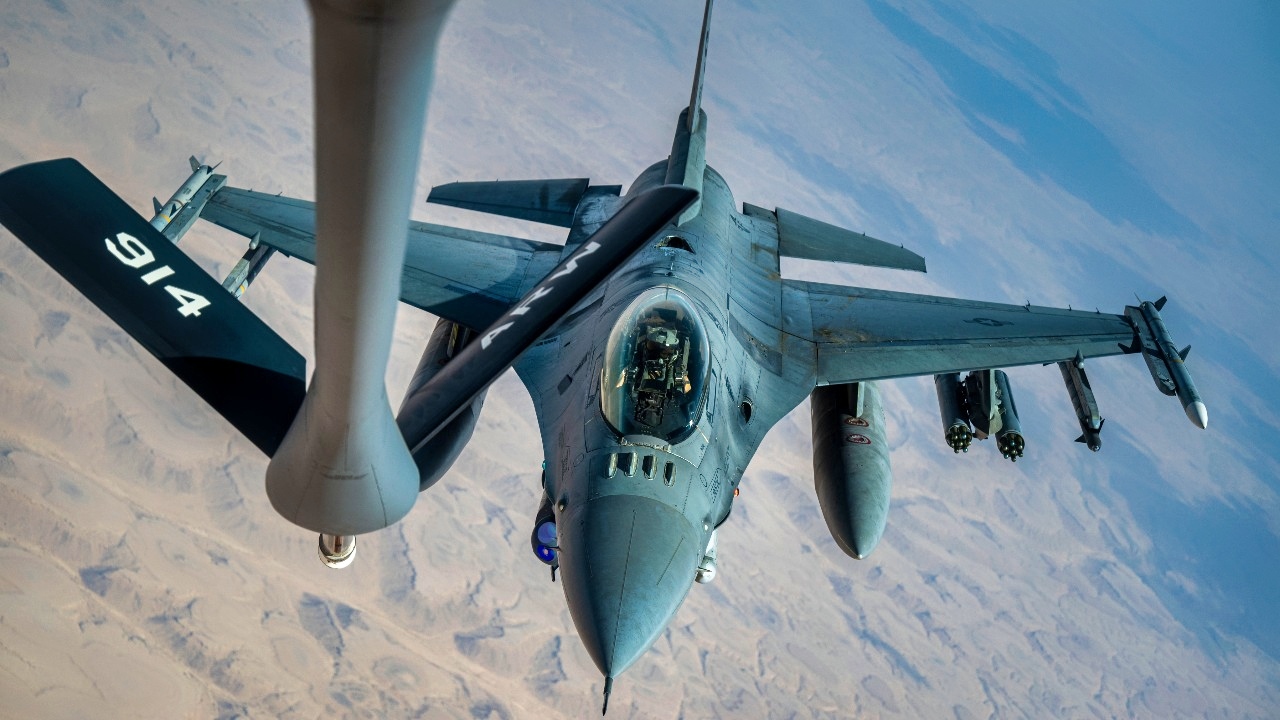
Key Points and Summary – To break the current battlefield stalemate, Ukraine desperately needs modern Western air power, a critical element it has lacked since the war’s beginning.
-According to military experts like former NATO Supreme Allied Commander Gen. Philip Breedlove, a robust fleet of F-16s could have decimated Russian forces in the initial invasion.
-Now, the most urgent requirements are for more Patriot air defense systems to protect cities from relentless Russian missile and drone barrages, and for long-range strike weapons, like Germany’s Taurus cruise missile, to hit high-value targets deep in the Russian rear, a capability Kyiv has yet to receive.
What Weapons Would Make A Difference For Ukraine Against Russia?
LONDON, UK – The battlelines are frozen due to the predominance of drones in the Ukraine-Russia conflict.
Both sides are looking for a “breakout” set of weapons or strategy to end the deadlock.
This makes the one question that everyone wants to know the answer to: What kind of weapons does Ukraine need now to have some decisive advantage in this war.
One of the answers that comes up over and over when speaking with experienced senior US and other field commanders is the comprehensive ability to employ and effectively use modern air power.
Three years ago, in an address at the 2022 Warsaw Security Forum, former NATO Allied Supreme Commander and former Vice Chief of the US Air Force (USAF) Gen. Philip Breedlove clearly stated the need. “If the PSU [Ukraine Air Force] had received modern US aircraft and the requisite training before the Russian invasion, or if NATO had been engaged in the conflict, either scenario would have wreaked havoc on the Russian ground forces,” he said at the time.
Specifically, this occurred during the opening period of the war, when Russian President Vladimir Putin’s legions were marching on Kyiv, a target of opportunity that Breedlove referred to as a dramatic “lost opportunity.”
In this period after the invasion, “when the Russian army was essentially stuck in the mud on the road to Kyiv,” this could have been a decision moment if the Ukrainians had been able to use themselves or had had the support of western air power, he stated.
“If a western air force could have come in and attacked those columns it would have eliminated 40 percent of the army that Ukraine is still fighting now,” he explained in 2022. “Think of the destruction of an enemy force on the level of the ‘highway of death’ in the [1991 Desert Storm] war with Iraq” and you have an idea of how much different the situation might be today.
That deficit of air power—not enough F-16s, not enough air-launched weapons—this continues to this day.
The Air Defense Deficit for Ukraine
The US-made Patriot PAC-3 air and missile defense (AMD) systems were slow getting to Ukraine in the first place, and there are still not nearly enough of them in-country to be effective enough against Russia’s constant bombardments of Ukraine’s cities.
Although Ukraine has eight batteries of the system, reportedly only six are operational at the moment. Given the airspace they must cover and the density and tempo of Moscow’s regular attacks on Kyiv and other cities, even doubling this number of batteries is probably not enough.
In early May, Col. Yurii Ihnat, a spokesman for the PSU, stated it was no secret that Ukraine needed more air defense systems and that they were needed sooner rather than later. “We are really waiting for supplies [of air defense assets],” he said at the time.
Ukrainian President Volodymyr Zelenskiy has been so desperate to acquire more Patriots that when US President Donald Trump refused his requests, the Ukrainian leader volunteered to pay for the units rather than asking them to be donated. Trump even later admitted that the Ukrainian leader was “always looking to purchase missiles.”
Another significant effort that has required more assistance and prosecution at a greater speed was the program to modernize Ukraine’s fleet of Russian-made Buk air defense systems by integrating US-made RIM-7 Sea Sparrow missiles onto the platform. The design had been developed and was primarily defined by the Ukrainian industry when the Russian invasion occurred in February 2022.
However, the effort to complete this program was then handed over to a USAF special projects organization, which, according to Ukrainian officials who spoke to National Security Journal, was not the optimal solution. According to them, this turned the effort into a program that took several times longer than it should have required to complete. It also ended up transferring tens of millions of dollars to US defense contractors to complete work in the US that could have been performed either in Ukraine or in its next-door neighbor, Poland.
“We are hoping,” they said, “that the assets and freedom of movement for the Ukrainian side are on the list of items that are the outcome of Trump’s meeting” with NATO Secretary General Mark Rutte on Monday of this week.
Hitting Back
However, the Ukrainian military acknowledges that defensive weapons alone are only half the battle. The situation is that someone needs to “take the fight to the Russians,” said a Ukrainian defense contractor who splits his time between the front lines and the design office where his company is working on new concepts for long-range strike drones.
No one can move an inch “on some parts of the front lines for now,” he said. “There are drones everywhere. Infantrymen trying to move from the front lines to the rear area sometimes need days to more just 3-4 kilometers. They can only move slowly and/or at night – it is a situation that cannot continue indefinitely. That deadlock has to be broken.”
One weapon that has been promised—sort of—and then excuses made for not delivering, followed by new promises, is the German-made air-launched Taurus missile. German Chancellor Friedrich Merz had said as recently as July 1 that supplying these missiles to Ukraine was still under consideration. Kyiv has been trying literally for years to receive the weapons as Russia continues to attack civilian targets in Ukraine.
However, in his most recent meetings with US Defense Secretary Pete Hegseth, German Defense Minister Boris Pistorius stated that Berlin will still not provide Taurus cruise missiles to Ukraine.
The Taurus missile can hit targets at a distance of 300 miles, which is a longer reach than any of the other long-range strike assets that Ukraine has received thus far from allied donor nations. The weapon has been considered to have both symbolic significance and tactical impact on the battlefield, yet it remains elusive. One of those items on Kyiv’s wish list that its war-weary population hopes will come true someday.
About the Author: Reuben F. Johnson
Reuben F. Johnson has thirty-six years of experience analyzing and reporting on foreign weapons systems, defense technologies, and international arms export policy. Johnson is the Director of Research at the Casimir Pulaski Foundation. He is also a survivor of the Russian invasion of Ukraine in February 2022. He worked for years in the American defense industry as a foreign technology analyst and later as a consultant for the U.S. Department of Defense, the Departments of the Navy and Air Force, and the governments of the United Kingdom and Australia. In 2022-2023, he won two awards in a row for his defense reporting. He holds a bachelor’s degree from DePauw University and a master’s degree from Miami University in Ohio, specializing in Soviet and Russian studies. He lives in Warsaw.
More Military
The U.S. Navy’s Submarine Crisis Is Real


Jim
July 18, 2025 at 10:07 pm
Battle lines frozen…
You haven’t checked the map recently.
Anyway, I’ll give you credit for having an idea about actually reversing the trend at the front before it’s too late.
That’s better than more empty sanctions talk.
But those weapons named as game changers have already been talked about before… even introduced in the field.
Didn’t work… won’t work, now.
The cracks are spreading and you can’t stop it.
I suspect kiev’s leaders are in denial as much as the writer.
Swamplaw Yankee
July 19, 2025 at 1:03 am
This op-ed is a boring repeat. Zip all that it teaches us.
The POTUS Obama unilaterally greenlighted this free, no-cost give-away of the WEST’s control of Ukrainian Crimea and its Black/Azov sea zones to the prime vile cold war enemy of the WEST.
This marxist betrayer of the WEST seems of the same cloth as the FDR sell out artist of the WEST in the second world war. The parallels are too vivid.
And, the MSM is now pushing for our contemporary betrayer of the WEST to entertain the Yankee Doodle Dandies with a comedy show. Obviously no 7 day visit to Ukraine’s Kherson “Human Safari” zone for this Epstein era greenlighter of the re-start of the worlds largest contemporary sex trade business. Yeah, the comedy of Obama as Obama avoids any responsibility for the hundreds of thousands of tortured and sex abuses mass abducted Ukrainian children. Obama wants to see this tragic human toll of his marxist dreaming turned into TV comedy. Hide under a rock as your moral turpitude is too blinding! -30-
Brandon
July 20, 2025 at 6:30 am
With all due respect to the former SACEUR, no, a robust fleet of F-16s would’ve done nothing to stop this conflict early. The F-16s gifted to and currently being utilized by Ukraine do not possess the electronic warfare capability or the sophisticated radar and missile technology required to be survivable in eastern Ukraine.
The air domain in eastern Ukraine requires far more than the F-16 can offer. Even if the Ukrainians can roll back the Russian air defense network to something resembling a semi-permissive environment, the F-16 doesn’t possess the on-station time or payload capacity to sufficiently affect the ground fight.
Air power may be an answer. The F-16 isn’t it.