

Key Points and Summary – The U.S. Navy’s traditional “waterfall” procurement process is a slow, bureaucratic nightmare that is causing America to lose the shipbuilding race against China, putting national security at risk.
-To build the 355-ship navy needed to deter adversaries, the service must abandon this outdated model and embrace the “agile,” iterative approach used by innovative tech companies.

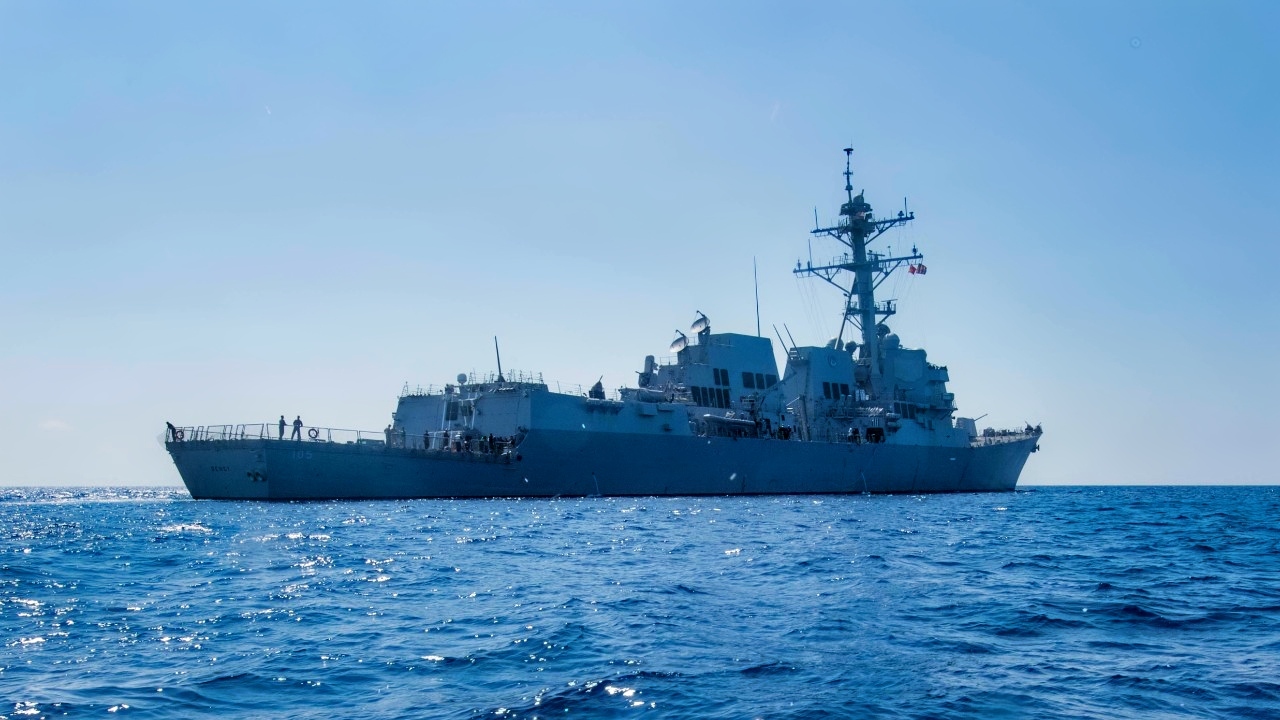
(July 28, 2022) U.S. Navy Zumwalt-class guided-missile destroyer USS Michael Monsoor (DDG 1001) sails in formation during Rim of the Pacific (RIMPAC) 2022, July 28. Twenty-six nations, 38 ships, three submarines, more than 30 unmanned systems, approximately 170 aircraft and 25,000 personnel are participating in RIMPAC from June 29 to Aug. 4 in and around the Hawaiian Islands and Southern California. The world’s largest international maritime exercise, RIMPAC provides a unique training opportunity while fostering and sustaining cooperative relationships among participants critical to ensuring the safety of sea lanes and security on the world’s oceans. RIMPAC 2022 is the 28th exercise in the series that began in 1971. (U.S. Navy photo by Mass Communication Specialist 3rd Class Aleksandr Freutel)
-Successful, smaller-scale programs like the Lionfish drone prove this method works within the Navy. Scaling this “agile” process, particularly for major shipbuilding projects, is essential for the U.S. to maintain its naval dominance and prevent a catastrophic failure in a potential conflict.
Why America’s Shipyards Are a ‘National Security Risk’ in the Race Against China
In most people’s imagination, great products are the brainchild of a small cadre of people. This cadre fleshes out an idea, then they tell everyone else what to do and when to do it. They imagine Henry Ford coming out of his office with the complete plan for the Model T, a product design in his right hand and a production plan stretching a decade out in his left. This is called the “waterfall” method. It doesn’t allow room for discovery and implementation of better ideas as the process moves forward, and it ignores the fact that lots of great brains are better than one. The process isn’t effective, so no one uses it anymore.
Well, almost no one. People accuse the federal government – and the U.S. Navy in particular – of using it and argue it is one of the main culprits for why the ships we purchase are consistently over budget and behind schedule. As anyone who has read a long and prescriptive Navy RFP can attest, the critics have a point.
Yet there are pockets of the Navy that have moved onto a process that more closely resembles the “agile” or iterative project management approach used by the most innovative companies like Google, Apple, and Amazon. We must scale the approach across the Navy right away, as it is already producing strong results. Indeed, it has proven that “government efficiency” and “government innovation” are not oxymorons. Given the terrifying pace at which China is expanding its navy, we have no choice but to become more efficient and innovative.
The alternative is failing to deter or, if necessary, defeat China in a war over Taiwan. That would spell the end of American primacy; it is not an option.
Our Navy can do this, and the proof has been delivered on time and on budget. Take the Lionfish program, which just saw the delivery of the first two small uncrewed undersea vehicles (SUUV)’s, which are critical for undersea ISR, mine hunting, and even undersea warfare. The project was a small iteration off of an existing product. It leveraged modular, open architecture design. The process allows us to see how it operates in the real world and then make iterations to future vehicles.
This is the process that works so well for the tech industry. The Defense Innovation Unit (DIU), which managed the project, consciously modeled it on the processes that work in the private sector. Seeing this agile process applied to building seagoing vessels, then, is not the stretch critics imagine it to be.
The same is true of the Navy’s “innovation adoption kit” (IAK). The IAK consolidates all of the requirements into a simple top-level document 90% shorter than its predecessor. That simplicity encourages rapid iteration and quick delivery of services so that smaller companies don’t collapse in the “valley of death,” or the period between designing a prototype and delivering a product that the Navy pays for. By leveraging this more agile system, the Navy has been able to call upon smaller, innovative companies that would go bankrupt waiting to get paid through the “waterfall” method. The system has allowed for mission-critical improvements in months that would have taken the traditional system years (if they happened at all). For instance, the Navy’s was able to begin its partnership with Via, a small company that helped the Navy store its sensitive data and digital identities across many locations, in a matter of months. This is an important upgrade; it means no one hack can entirely compromise naval operations. Given the pace of Chinese hacking attempts against our military, such defenses are a necessity.

Virginia-Class Submarine. Image Credit: Creative Commons.
There are dozens of such examples of agile processes enabling faster adoption of solutions that provide major operational improvements to our lethality, from the network improvements saving sailors aboard a carrier 5000 hours a month to the robotic processes that tore through a two-year invoice backlog in days. Every minute not spent on a rote or frustrating task is a minute that can be spent better understanding our enemies’ tactics or investigating newer, more lethal technologies.
This flexibility has another benefit: it enables the Navy to make new investment decisions in the middle of an execution year, while the normal process would demand waiting until the next one. For instance, the Navy was able rapidly scale a commercial telemetry tool to better facilitate its investment strategy by prioritizing technologies with demonstrated, objective, and measureable benefits to mission outcomes. The tool has saved 120 years worth many hours in just two years.
There are practical steps the Navy can take right away to recreate these sorts of results at scale. The first is to expand and fully leverage DIU. DIU should be designing the process – from concept and contractor partnership to iteration, delivery, and bulk buys – for as many projects as possible. If that means funnelling more of the best people into DIU, or even hiring them from outside of government, so be it. Good people can have an enormous impact there. Even failing a rapid expansion of DIU, we can still distribute its best practices through the defense acquisition community through rotations of traditional program executive officers (PEO) through DIU and DIU officers through PEO offices.
Second, we need to apply the IAK process across the whole of the Navy’s technology purchases, including everything from basic IT to advanced AI. Given the enormous list of new technologies the Navy needs to incoporate, like software to rapidly leverage massive data sets aboard ships andcoordinate unmanned systems, additive manufacturing, digital twinning, and even AI to automate boring back-office functions, there will be no shortage of opportunities to use the IAK.
MORE: The Navy’s Attack Submarine Crisis Is Real
Finally, we need to apply agile processes to shipbuilding.The “waterfall” model is too slow and costly. It set back the Constellation Class frigates by years; despite Fincantieri Marinette Marine (FMM) coming to the competition to build the future frigate with a battle-tested FREMM, the Navy all but redesigned the ship based on speculation of how the Navy would deploy it. An agile, iterative model would have allowed FMM to make the first ship in the Constellation-Class similar to the FREMM, let the Navy use it in the real world, then tell FMM what improvements it needed on the next ship. Then FMM could innovate and iterate. It could solve problems, rather than take orders. Such a system would save years and hundreds of millions of dollars.
The U.S. Navy, with nearly one million Sailors, Marines, reservists, and civilians, an annual budget of $265.5 billion, and an immensely complex ecosystem of suppliers and contractors, is too large for any one person to fully control, no matter how smart or competent they are. An organization that big can only be effective when the leader sets a mission and all of the smart people below him are empowered to leverage their expertise to find the best solution. Any system that ignores that fact is going to run into mountains of inefficiency and, ultimately, poor outcomes.
As navalists and as Americans, it is our duty to demand the Navy use the flexible systems that the private sector has proven to work best. Doing so could well prevent a war.
About the Author: Neal Urwitz
Neal Urwitz served as a speechwriter for and advisor to the Secretary of the Navy from 2021-2023. He is currently a PR executive in Washington.
Fighter Jet Fails
Russia’s Su-57 Felon Stealth Fighter Is a Waste of Rubles


Yeah
July 9, 2025 at 6:05 pm
U.S. Navy today is like the westerns movies hollywood gunslinger riding into the sunset.
There no money anymore for making clunt eastwoid ciwboy movies. Same for U.S.
Navy. No more money.
The future of warfare is or will be dictated by space weapons, suborbital weapons, missiles, drones and stealth jets. No more big behemoth ships and slow moving vessels.
Latest reports (last month) say the chines have succeeded in achieving the holy grail of aerospace hypersonic technology.
What the heck’s the holy grail.
The seamless transition from mach 5 rocket propulsion to mach 12 scramjet propulsion.
Clearly, the Navy is riding into the sunset.
Jacksonian Libertarian
July 9, 2025 at 9:18 pm
70% of the Earth is water, and the Navy has no seaplanes.
Insanely expensive and vulnerable surface warships are obsolete.
It is good that China is pissing away resources on warships, but the US should avoid the “Sunk costs fallacy” and stop sending good money after bad.
The Navy should cover its responsibilities with drone swarms that can operate from the water, and mothball or sell most of its obsolete warships, including the carriers.
Lemuel Crump
July 12, 2025 at 10:57 am
I have an idea that I was trying to sell to General Dynamics 10 years ago. They ignored me. Last year I saw a dude in YouTube where Russia built a submarine that can dive deeper than any other submarines today. Their design is the design I came up with. I didn’t have my design online where it could have been stolen. These submarines would have paid for themselves.