

Could an Iranian tanker convoy surpass the US blockade in the Strait? While the ongoing war in the Middle East has not yet depleted Iran’s ability to launch strikes targeting US assets and allies in the region, Tehran is certainly beginning to feel the economic effects of its near-zero crude oil exports.
American forces have maintained a naval blockade of all Iranian and Iranian-connected vessels from traversing the Gulf of Oman since April, with the exception of a brief pause during this summer’s ceasefire.

U.S. Air Force Tech. Sgt. Reggie Fernandez, 199th Air Expeditionary Squadron F-22 Raptor crew chief, conducts a basic post-flight inspection at Royal Australian Air Force Base Tindal, Northern Territory, Australia, July 29, 2023. Maintaining and building trust with like-minded allies & partners is crucial to a free and open Indo-Pacific. (U.S. Air National Guard photo by Master Sgt. Mysti Bicoy)
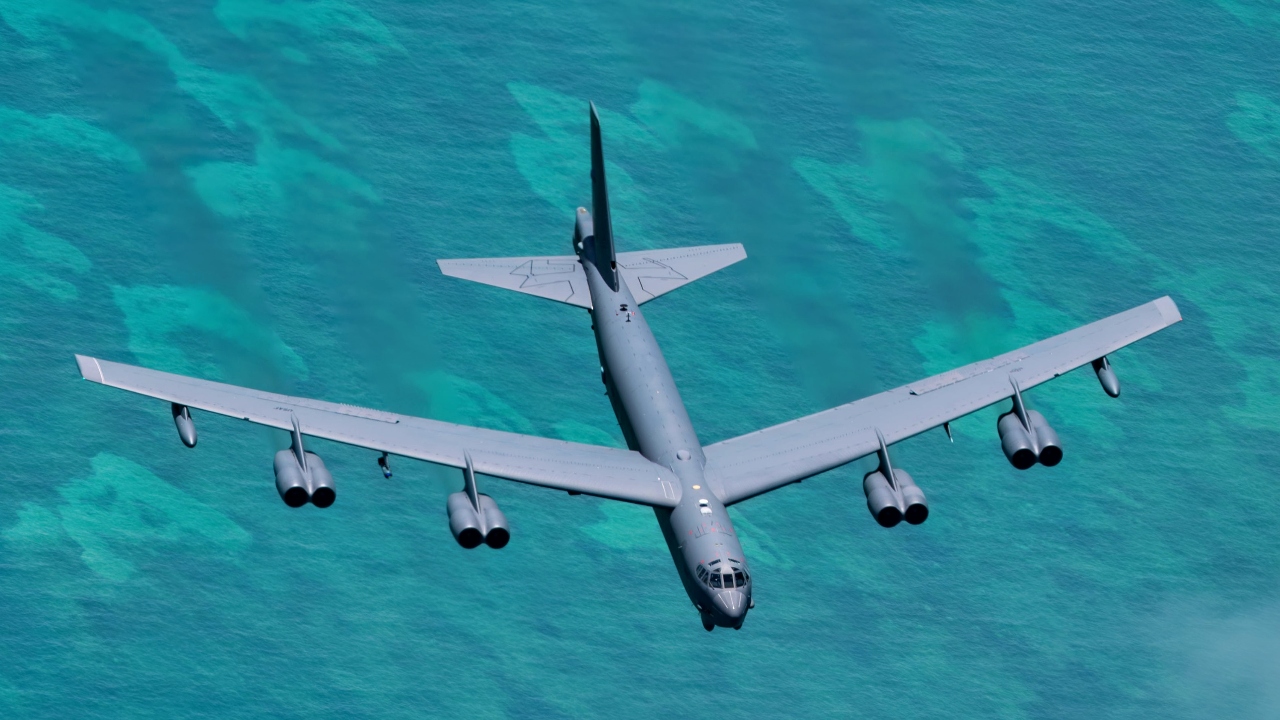
A U.S. Air Force B-52H Stratofortress aircraft flies in a seven-ship formation during the Hyundai Air and Sea Show at Miami Beach, Florida, May 24, 2025. The flyover represented the Air Force’s total force, integrating active duty, guard, and reserve pilots flying the B-1B Lancer, B-2 Spirit, F-22 Raptor, A-10 Thunderbolt II, B-52H Stratofortress, F-16C Fighting Falcon, and F-15C Eagle aircraft. (U.S. Air Force photo by Staff Sgt. Bailee A. Darbasie)
Since the memorandum of understanding between Iran and the US failed in July, the US Navy has redirected at least 150 ships and has disabled five.
How the US Naval blockade is evolving
In this month alone, the US military has ramped up this approach on more than one occasion.
In a November 7 press release, US Central Command (CENTCOM) established a task force aimed at better enforcing its blockade of “weapons systems, sanctioned materials and illegal revenue streams” across Iran and the Caspian Sea.
Just this week, an advisory issued by CENTCOM said the US would now be treating ships that receive cargo at sea from vessels loaded in Iran as targets of its blockade. “Any ship that receives cargo via a ship-to-ship transfer with a vessel subject to the blockade and carrying cargo loaded at an Iranian port or coastline may be considered to be evading the blockade, even if it has not entered Iranian ports or the Iranian coastline,” CENTCOM said in the update.
“Such ships may be stopped, boarded, diverted, captured, or directed to proceed to the Iranian port where the cargo originated.”
Will Iran deploy a tanker convoy?
Iran’s economy has struggled immensely in recent months amidst the backdrop of sanctions and the blockade.
Since July, production has been reduced to roughly half of its pre-war levels, according to energy-intelligence firm Kpler.
To make matters worse for the regime, the country’s seaborne oil exports are estimated to be near zero.
Kpler’s data indicates that 43 million barrels of Iranian oil remain inside the blockade area.
In response to this dire economic situation, Iranian media outlets affiliated with the Islamic Revolutionary Guards Corps (IRGC) are reporting that the regime is preparing a convoy as a direct challenge to the blockade.
According to these reports, at least 14 tankers are assembling near Kharg Island and are planned to sail toward the Gulf of Oman in the upcoming days. Reports vary on whether this sailing is certain to occur; however, there is extensive discussion across various media outlets about what happens next.
As part of this proposal, Tehran would launch missile and drone barrages targeting regional energy infrastructure (most notably in the UAE) if any US military intervention is detected.
According to the Jerusalem Post, Iranian parliament member Mohammad Bayat said on November 20 that Tehran needed to abort its passive approach to the ongoing situation of “neither war nor peace,” adding that “We must take clear and decisive positions and issue an ultimatum to the countries of the region and the American side in order to create the conditions for breaking the blockade,” he said.
Earlier yesterday, Bloomberg first reported that a cargo of roughly 200,000 barrels of Iranian oil was transferred between two tankers near Kharg Island on November 17. This ship-to-ship transfer circumvented restrictions because the cargo was transferred to a vessel not under sanctions. CENTCOM’s press release detailing its pursuit of any vessels that engage in ship-to-ship transfers loaded at an Iranian port or coastline clearly piggybacked off this apparent incident.
Uptick in violence in the Gulf of Oman
If this Iranian tanker convoy plan does not come to fruition, the regime will likely continue to carry out attacks on ships in an effort to disrupt Washington’s blockade.
The United Kingdom Maritime Trade Operations Center (UKMTO) reported 31 such attacks in and around the Strait of Hormuz in October and November alone. This number is significant, as a total of 53 similar incidents were reported between March and September.
The uptick in attacks carried out by Iranian forces suggests the regime is grasping at straws to try and disrupt US-facilitated routes in the region. “We consider the economic blockade (imposed by the American terrorist army) to be an act of war, and we will take any action necessary to break the economic blockade,” Iranian Deputy Foreign Minister Kazem Gharibabadi told reporters.
Although the ongoing blockade is inflicting economic pain on Iran, it is not being carried out without strain on the US. Bloomberg estimated that the operation ties up more than 30% of the US Navy’s warships, a figure that, even if slightly off, cannot be completely dismissed when considering how much longer the blockade will continue.
About the Author: Maya Carlin
Maya Carlin is an analyst with the Center for Security Policy and a former Anna Sobol Levy Fellow at IDC Herzliya in Israel. She has over 1,000 articles published over the last several years on various defense issues. Carlin has bylines in many publications, including The National Interest, Jerusalem Post, and Times of Israel. You can follow her on Twitter: @MayaCarlin.