

Washington’s Difficulty in Enforcing its Economic Sanctions on Iran – The United States is expanding its crackdown on Iran’s shadow fleet, targeting not only the tankers that move sanctioned oil but also the maritime companies that fuel, repair, and guide them through some of Asia’s busiest shipping lanes.
Under heavy sanctions that severely limit its ability to export oil, Iran is using ship-to-ship cargo transfers to sell millions of barrels of sanctioned oil to trading partners.

F-35. Image Credit: Lockheed Martin.
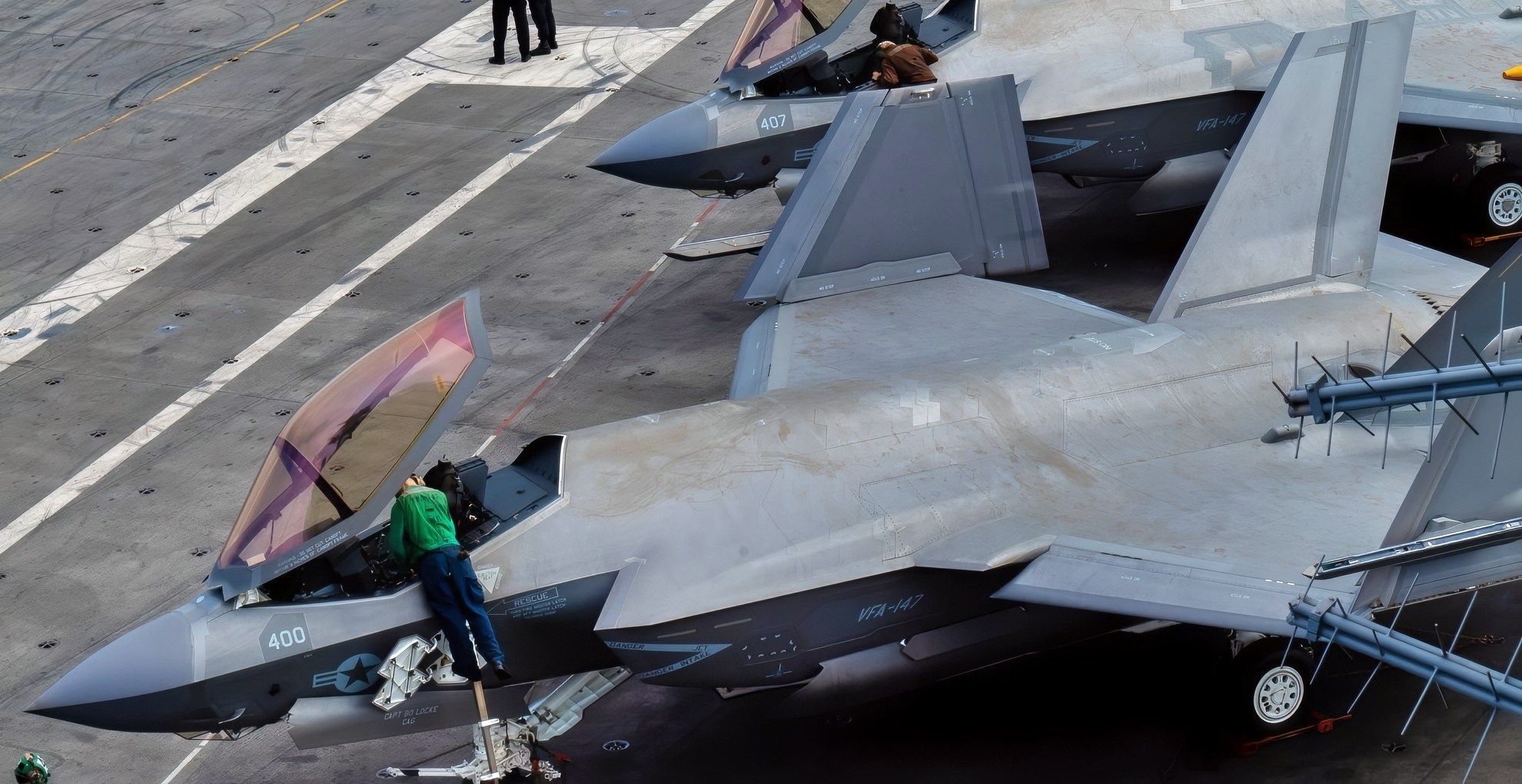
SOUTH CHINA SEA (Jan. 15, 2022) Sailors preform pre-flight checks on several F-35C Lightning II’s, assigned to the “Argonauts” of Strike Fighter Squadron (VFA) 147, on the flight deck of Nimitz-class aircraft carrier USS Carl Vinson (CVN 70), Jan. 14, 2022. Carl Vinson Carrier Strike Group is on a scheduled deployment in the U.S. 7th Fleet area of operations to enhance interoperability through alliances and partnerships while serving as a ready-response force in support of a free and open Indo-Pacific region. (U.S. Navy photo by Mass Communication Specialist Seaman Apprentice Derek Kelley)
A U.S. Naval blockade has crippled the Iranian economy, with exports unable to leave Iran’s ports for several months. However, the full effects of the sanctions are proving difficult to enforce.
Malay Methods
The New York Times reported from waters off Malaysia’s coast, where giant tankers are sometimes used as floating storage facilities. It discussed ship-to-ship cargo transfers, common in maritime operations and used by both legitimate oil exporters and those trying to evade sanctions.
Iran, sanctioned in various forms since the late 1970s, has increasingly used ship-to-ship transfers to evade economic sanctions. Gulf states also use these operations to shuttle oil through the otherwise closed Strait of Hormuz for exporters without a pipeline or alternative route to bypass it.
Under the latest wave of economic measures, Iranian tankers are gathering around the Malaysian Eastern Outer Port Limits (EOPL), about 45 miles off Johor’s eastern coast. It’s just outside of Malaysia’s territorial waters in the Strait of Malacca, one of the world’s most important shipping routes. From there, cargo is transferred to other vessels that carry it onward to buyers, most often Chinese refiners.
Washington Responds
For years, the U.S. has sanctioned Iranian tankers, their operators, and their financiers. However, up until the end of August, companies that enabled Iranian shadow fleets to continue exporting sanctioned oil were able to split the net. That changed when Treasury Secretary Scott Bessent announced new measures to enforce a “zero-leakage approach.”
The wider ecosystem includes not just vessels supporting Iran, but also service boats and local firms that provide fuel, repairs, provisions, and other essential services to enable ship-to-ship transfers. Local knowledge is also important, particularly when transfers take place while vessels are still moving.
“Malaysian, Singaporean, and Indonesian master mariners are highly sought for these operations,” Eddie Effendi, a mooring master, told the Times. While his company refuses requests from Iranian ships, others do not. “The EOPL has become a parallel economy. They’re being offered good money for pilotage services,” Effendi added.
Malaysian Persuasion
One of Washington’s biggest hurdles is that Malaysian law doesn’t make working with Iranian vessels illegal, as Kuala Lumpur does not consider U.S. sanctions legally binding. For local businesses, it’s a commercial risk: they could be cut off from the dollar system, banks, and international suppliers, not face criminal charges.
Malaysian officials have noted how the transfers take place outside its waters. However, the country also enjoys important relationships with China – its largest trading partner – and Iran, from whom it purchases more crude than any other nation. Malaysia is hardly a supporter of the Iran war, either, regularly calling for regional stability and even condemning U.S.-Israeli military action.
Tracking Tankers
The U.S. has limitations beyond its lack of support for its economic war. While larger tankers are visible from space, their much smaller supplier vessels hardly appear in satellite imagery.
Enforcement is also made harder when sanctioned companies can hide behind shell companies or shut down and restart under a new name. For many local operators, it’s a small logistical headache for an otherwise profitable venture.
Then there’s the obvious point that vessels can simply move out of targeted areas. As enforcement increases, tankers can move to another anchorage; one interviewee told the Times that operations were already shifting toward the waters of Penang, Malacca, and Indonesia.
Washington’s campaign, therefore, has mixed results. In the Persian Gulf, oil exports have all but ceased from Iranian ports, with vessels simply unable to leave and breach the U.S. blockade.
Iran’s waters, however, stretch beyond the Strait of Hormuz, and ships that sneak through can rely on an ecosystem the U.S. is finding increasingly difficult to enforce.
About the Author: Shay Bottomley
Shay Bottomley is a British journalist. He has written for the Western Standard, Business Insider, Maidenhead Advertiser, Slough Express, Windsor Express, Berkshire Live and Southend Echo.