

The U.S. and Iran continue to negotiate over the status of the Strait of Hormuz. Meanwhile, reports describe an incident in the Strait this week.
According to Reuters, citing the shipping intelligence service Marisks, three Liberian-flagged oil tankers were “struck by unknown projectiles” while transiting the Strait of Hormuz on Tuesday.

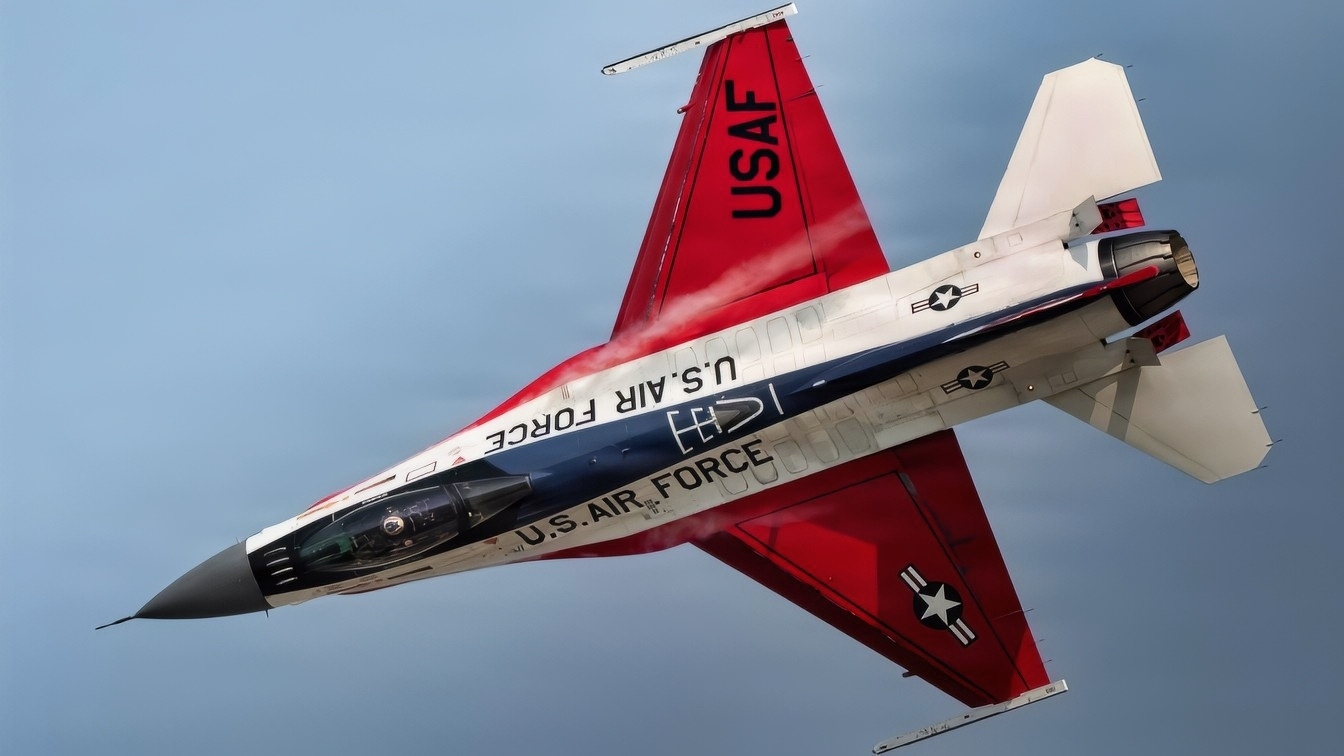
U.S. Air Force Maj. Taylor “FEMA” Hiester, F-16 Viper Demonstration Team commander and pilot, performs aerial maneuvers in a U.S. Air Force F-16C Fighting Falcon during an air show at Latrobe, Pennsylvania, June 21, 2025. The F-16, a multi-role fighter aircraft capable of both air-to-air and air-to-ground combat, demonstrates its versatility through dynamic aerial demonstrations at air shows across the globe. (U.S. Air Force photo by Senior Airman Steven Cardo)

F-16I Sufa. Image Credit: Creative Commons.
The report says the ships were moving with their Automatic Identification System transponders turned off, a common practice in recent months as ships avoid detection while transiting the Strait of Hormuz.
The ships were named as the oil products tanker Al Ruwais, the “Very large crude carrier” Mersin Prosperity, and the Aframax-sized tanker Sinbad. ADNOC Logistics & Services manages the first two, while Anglo-Eastern Tanker Management manages Sinbad.
Seatrade Maritime News, meanwhile, reported that a fourth vessel, the VLCC Al Funtas, was also struck in recent days. The report added that, of those ships, only Sinbad is on Iran’s list of “non-compliant vessels” subject to “fines, detention, or confiscation” for transiting the Strait.
The latter report cited Vanguard Tech, which said: “the extent of damage to the three vessels remains unclear at current.”
“Lashing Out”
According to a report by Maritime Executive about the recent wave of strikes, they show that Iran is “lashing out to demonstrate that it is still threatening vessels,” amid reports that Iran’s grip on the Strait of Hormuz has been loosening.
That report also cited Iran’s Fars News Agency, which claimed that warning shots had been fired at vessels trying to get through the Strait on Tuesday.
These reports follow last weekend’s reporting from NBC News, which stated Iranian forces on September 14 had struck a ship that U.S. forces were on in the Strait of Hormuz, which led to injuries – including smoke inhalation and possibly traumatic brain injuries — for those service members, who were not on a Navy ship at the time.
Seven of the injured were enlisted, while one was an officer, and all have since returned to duty, NBC said.
It took two weeks for the first news reports to break. The War Zone reported that while it’s unclear which ship the service members were on, there’s a “strong possibility” it was the former British Royal Mail vessel RMS St Helena, converted into a “floating armory.”
TWZ had not confirmed that this was the ship, and CENTCOM did not comment.
However, Trade Winds News reported more definitively, shortly after the attack, that Iran had “attacked a historic former British Royal Mail passenger ship in the Strait of Hormuz,” although that report did not state that U.S. service members were on board.
How, exactly, did Iran’s grip on the Strait loosen? A series of media reports in recent days has examined how that happened.
Broken “Chokehold” and “Zero Hormuz”
According to the Wall Street Journal, Iran’s ability to “choke off oil” flowing through the crucial waterway has weakened, along with its leverage in talks with the U.S. That’s because both the U.S. Navy and Gulf oil producers have improved their ability when it comes to “fending off or evading Iranian attacks, allowing more tankers to cross the strait.”
As a result, Middle Eastern crude oil exports have rebounded to nearly 80 percent of their prewar levels, the Journal said, citing Kpler data.
Factors include Saudi Arabia getting its East-West Pipeline back online and other workarounds.
Separately, Bloomberg News reported this week that Sheik Khaled bin Mohamed Al Nahyan, Abu Dhabi’s crown prince, is spending billions of dollars on a project called “Zero Hormuz.” The Sheik, who earlier this year took control of L’imad Holding, a $300 billion sovereign wealth fund, is working to build new port infrastructure needed to achieve the goal of “overriding Iran’s stranglehold over the Strait of Hormuz.” The fund announced it is taking Abu Dhabi Ports Co. private at a valuation of over $9 billion, aiming to reduce dependence on the Strait of Hormuz.
Meanwhile, The Economist reported that President Donald Trump’s public rejection, earlier this week, of Iran’s latest ceasefire proposal came because Trump feels it’s a better idea to wait.
About the Author: Stephen Silver
Stephen Silver is an award-winning journalist, essayist, and film critic, and contributor to the Philadelphia Inquirer, the Jewish Telegraphic Agency, Broad Street Review, and Splice Today. The co-founder of the Philadelphia Film Critics Circle, Stephen lives in suburban Philadelphia with his wife and two sons. For over a decade, Stephen has authored thousands of articles that focus on politics, national security, technology, and the economy. Follow him on X (formerly Twitter) at @StephenSilver, and subscribe to his Substack newsletter.


